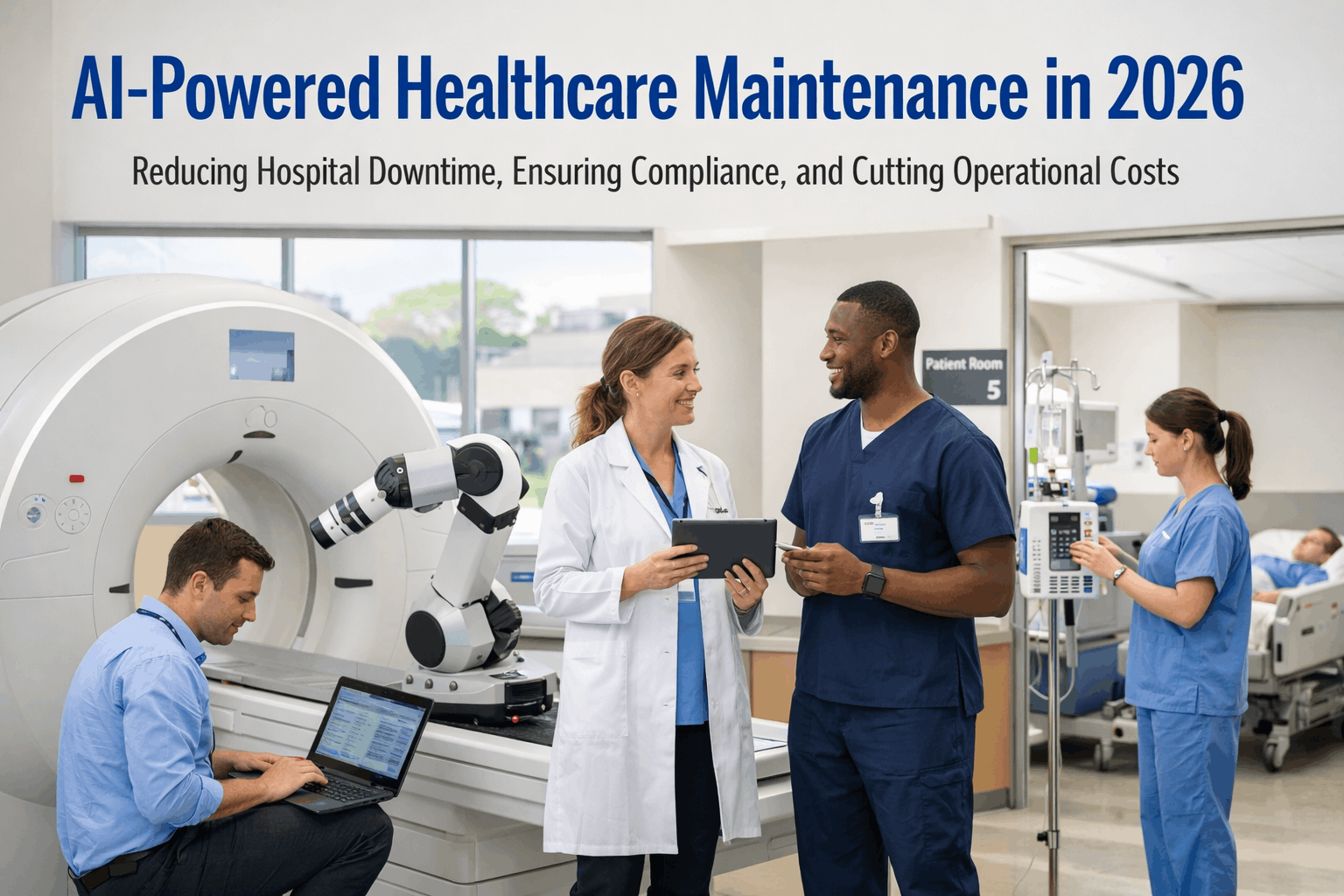
Healthcare facilities in 2026 face an unprecedented challenge: maintaining complex biomedical equipment while controlling costs and ensuring strict regulatory compliance. Unplanned equipment downtime costs hospitals an average of $7,900 per hour, with critical failures potentially reaching $15,000 per hour in lost revenue and patient care disruption. AI-powered maintenance solutions are transforming how hospitals manage their assets, shifting from reactive repairs to predictive intelligence that prevents failures before they impact patient care. This shift isn't just about technology—it's about creating resilient healthcare operations that never compromise on patient safety. Organizations ready to embrace this transformation can sign up today to experience the future of healthcare maintenance management.
The Hidden Crisis in Healthcare Maintenance
Behind the scenes of every successful surgery and accurate diagnosis lies a complex ecosystem of medical equipment requiring constant attention. MRI machines, CT scanners, ventilators, and dialysis units represent millions in capital investment, yet traditional maintenance approaches often fail to maximize their potential. The statistics reveal a troubling reality: hospitals experience equipment failures 50% more frequently than necessary, with 30% of maintenance budgets wasted on unnecessary preventive tasks. Regulatory compliance adds another layer of complexity, with Joint Commission standards, FDA requirements, and CMS guidelines demanding meticulous documentation that manual processes struggle to provide. The consequences extend beyond financial losses—delayed diagnoses, postponed surgeries, and compromised patient safety create ripple effects throughout healthcare delivery. Forward-thinking facilities are discovering that booking a demo of AI-powered solutions reveals immediate opportunities for operational improvement.
The True Cost of Equipment Downtime
How AI Transforms Healthcare Maintenance in 2026
Artificial intelligence has evolved from experimental technology to essential infrastructure in modern healthcare facilities. Machine learning algorithms now analyze thousands of data points from connected medical devices, identifying subtle patterns that human technicians might miss. These systems process vibration data, temperature fluctuations, usage patterns, and performance metrics to predict failures 72 hours in advance with 94% accuracy. The technology doesn't replace human expertise—it amplifies it, allowing biomedical engineers to focus on complex repairs rather than routine inspections. Computer vision capabilities enable automated visual inspections of equipment, detecting wear and tear that could lead to future failures. Natural language processing streamlines compliance documentation, automatically generating reports that meet Joint Commission standards without manual data entry. For facilities ready to modernize their operations, signing up for an AI-powered platform represents the first step toward maintenance excellence.
Key AI Capabilities Driving Results
- 01 Predictive Analytics: Forecasting equipment failures 3-5 days before occurrence
- 02 Automated Scheduling: Optimizing maintenance windows based on patient census and urgency
- 03 Compliance Automation: Real-time documentation meeting FDA and Joint Commission standards
- 04 Inventory Intelligence: Predicting spare parts needs before failures occur
- 05 Resource Optimization: Matching technician skills to specific equipment needs
Reducing Hospital Downtime Through Predictive Intelligence
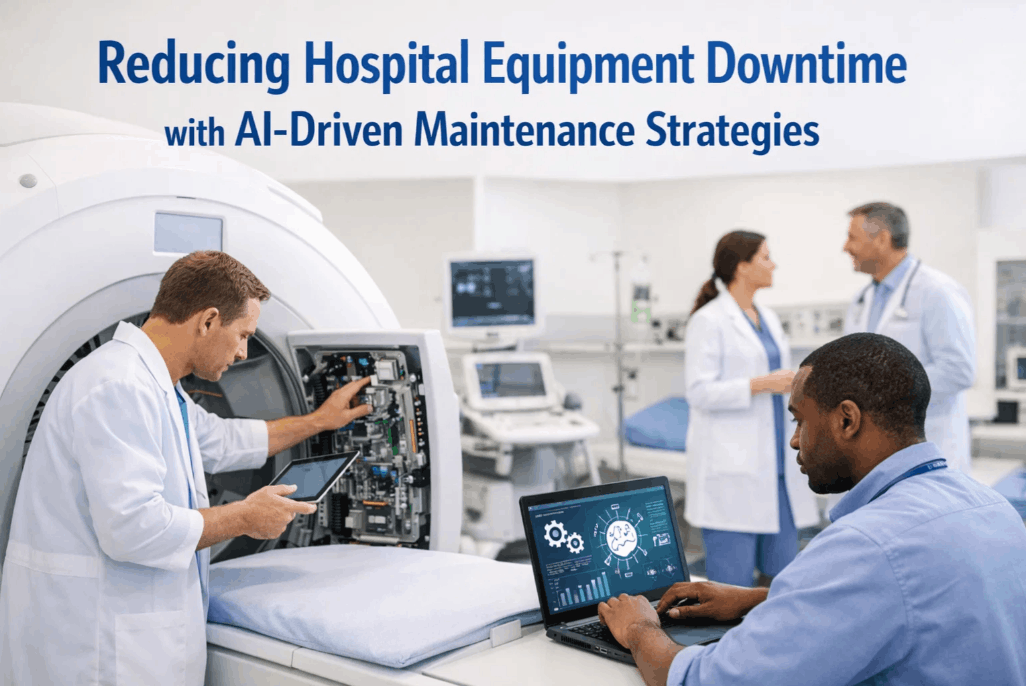
Unplanned downtime represents the most significant threat to hospital operations and patient care continuity. When a CT scanner fails during emergency hours, the impact extends far beyond repair costs—patients face delayed diagnoses, emergency departments become congested, and clinical staff experience increased stress. AI-powered maintenance platforms eliminate this uncertainty by continuously monitoring equipment health through IoT sensors and historical performance data. The system learns each device's unique operational signature, detecting deviations that indicate impending failure. Maintenance teams receive alerts with specific recommendations, including required parts and estimated repair time, enabling proactive intervention during scheduled downtime windows. This approach reduces unplanned downtime by up to 45%, ensuring critical equipment remains available when patients need it most. The financial impact is substantial, with mid-sized hospitals saving $2-4 million annually through improved uptime alone. Healthcare leaders interested in quantifying these benefits for their facilities should book a demo to see personalized ROI projections.
The Downtime Reduction Framework
Ensuring Compliance Without the Administrative Burden
Regulatory compliance in healthcare maintenance has traditionally required extensive manual documentation, creating administrative overhead that detracts from core maintenance activities. Joint Commission surveys, FDA Quality System Regulations, and CMS Conditions of Participation demand detailed records of every maintenance activity, calibration, and safety inspection. AI-powered platforms automate this compliance landscape, capturing maintenance data in real-time and generating audit-ready reports instantly. The system maintains complete equipment histories, tracks calibration schedules automatically, and ensures all work meets regulatory standards before completion. When surveyors arrive, facilities can demonstrate compliance with comprehensive digital records accessible in seconds rather than days. This automation reduces compliance-related administrative work by 60%, allowing clinical engineering teams to focus on equipment performance rather than paperwork. The risk of compliance violations decreases significantly, protecting hospitals from potential citations and associated remediation costs. For maintenance managers seeking to streamline their compliance processes, signing up provides immediate access to automated compliance tools.
Compliance Automation Benefits
Cutting Operational Costs Through Intelligent Resource Management
Healthcare facilities operate on razor-thin margins, making operational efficiency essential for financial sustainability. Traditional maintenance approaches often involve either excessive preventive maintenance that wastes resources or reactive repairs that cost significantly more than proactive intervention. AI optimization finds the perfect balance, analyzing equipment criticality, failure patterns, and utilization rates to create dynamic maintenance schedules. The system prioritizes high-risk equipment while extending intervals for reliable devices, optimizing labor allocation and parts inventory. Predictive analytics identify which components will need replacement, enabling just-in-time inventory management that reduces carrying costs by 25%. Energy optimization features analyze equipment power consumption patterns, identifying opportunities to reduce utility costs without compromising performance. These combined efficiencies typically deliver ROI within 8-12 months, with ongoing annual savings representing 15-20% of total maintenance budgets. Facilities looking to implement these cost-saving strategies can book a demo to explore customized cost reduction opportunities.
Ready to Transform Your Healthcare Maintenance?
Join hundreds of healthcare facilities already using AI-powered maintenance to reduce downtime, ensure compliance, and cut costs. Start your journey today.
Real-World Impact: Case Studies from 2026
Leading healthcare systems have already documented remarkable results from AI-powered maintenance implementation. A 600-bed tertiary care hospital in the Midwest reduced unplanned downtime by 52% within six months of deployment, translating to $3.2 million in annual savings. Their biomedical engineering team reported 40% more time available for strategic improvements rather than emergency repairs. A multi-hospital health system in the Southeast achieved 99.2% compliance scores during their Joint Commission survey, with surveyors specifically noting the comprehensive digital documentation as a best practice. The system's automated calibration tracking prevented 23 potential citation-worthy deficiencies. A community hospital network in the Southwest optimized their parts inventory using predictive analytics, reducing on-hand inventory value by $1.8 million while actually improving parts availability. These results demonstrate that AI maintenance isn't futuristic speculation—it's present reality delivering measurable value. Healthcare leaders interested in similar outcomes for their organizations should sign up to begin their transformation journey.
Measurable Results Across Healthcare Systems
Implementation Strategy: From Legacy to Intelligence
Transitioning to AI-powered maintenance requires thoughtful planning but doesn't necessitate disrupting current operations. Successful implementations typically follow a phased approach, beginning with high-value equipment that significantly impacts patient care. The first phase involves connecting existing equipment to the platform through IoT sensors or integration with existing building management systems, requiring minimal infrastructure changes. Initial data collection establishes baseline performance metrics, allowing the AI to learn normal operational patterns before making predictions. The second phase expands coverage to secondary equipment while refining prediction algorithms based on actual facility data. By the third phase, the system operates autonomously for routine scheduling and compliance documentation, with human experts focusing on complex decision-making and continuous improvement. Most facilities achieve full deployment within 90-120 days, with initial predictive capabilities available within the first month. The key success factor isn't technical complexity—it's organizational commitment to data-driven maintenance culture. Facilities ready to begin this transformation can book a demo to discuss their specific implementation roadmap.
Frequently Asked Questions
How does AI-powered maintenance differ from traditional preventive maintenance schedules?
Traditional preventive maintenance follows fixed time-based intervals regardless of actual equipment condition, often resulting in unnecessary maintenance or missed emerging issues. AI-powered maintenance continuously analyzes real-time equipment data, usage patterns, and environmental factors to predict actual failure probabilities. This approach maintains equipment only when needed, extends intervals for reliable devices, and catches developing problems that time-based schedules miss. The result is typically 30-40% reduction in maintenance costs while improving equipment reliability.
What types of medical equipment can be monitored with AI maintenance platforms?
Modern AI platforms monitor virtually all categories of medical equipment including imaging systems (MRI, CT, X-ray, ultrasound), life support devices (ventilators, infusion pumps, dialysis machines), laboratory equipment, surgical instruments, and facility infrastructure (HVAC, emergency power, medical gas systems). IoT sensors can be added to older equipment without native connectivity, while newer smart devices integrate directly through APIs. The platform creates a unified maintenance view across all asset types regardless of manufacturer or age.
How does the system ensure compliance with Joint Commission and FDA requirements?
The platform incorporates regulatory requirements directly into workflow design, ensuring every maintenance activity automatically generates compliant documentation. It tracks calibration intervals, preventive maintenance schedules, and safety inspections according to Joint Commission Environment of Care standards and FDA Quality System Regulations. Digital signatures, audit trails, and automated reporting eliminate manual documentation errors. During surveys, facilities can instantly generate comprehensive equipment histories, maintenance logs, and compliance reports that demonstrate adherence to all standards.
What is the typical return on investment for AI-powered maintenance systems?
Most healthcare facilities achieve positive ROI within 8-12 months of full implementation. Primary savings sources include 45% reduction in unplanned downtime costs, 25% decrease in parts inventory carrying costs, 30% reduction in emergency repair expenses, and 60% decrease in compliance administrative costs. A 400-bed hospital typically saves $2-4 million annually, while larger health systems realize proportionally greater benefits. The platform also generates revenue protection by ensuring high-utilization equipment remains available for patient care.
How long does implementation take and what training is required?
Standard implementation spans 90-120 days from contract to full deployment, with initial predictive capabilities available within 30 days. The process begins with equipment assessment and sensor installation, followed by data integration and AI training. Clinical engineering teams require approximately 8-12 hours of training on the platform interface, mobile applications, and reporting tools. The system is designed for intuitive use, with most technicians becoming proficient within their first week of active use. Ongoing support includes regular optimization reviews and system updates.
Is patient data secure when using AI maintenance platforms?
AI maintenance platforms operate entirely on equipment performance data—vibration, temperature, operational hours, error codes—not patient health information. The systems comply with HIPAA requirements by design, with no access to clinical data or patient records. All data transmission uses encryption, and cloud-based platforms maintain SOC 2 Type II certification with regular security audits. On-premise deployment options are available for facilities with specific security requirements. The focus remains strictly on equipment health and maintenance optimization.
Start Your AI Maintenance Journey Today
Don't let equipment downtime compromise patient care or drain your budget. Join the healthcare facilities already leveraging AI to transform their maintenance operations.

.png)
.jpg)


