
Healthcare facility management has entered a new era of complexity. As hospitals expand their clinical footprints, adopt increasingly sophisticated medical technologies, and operate under tightening regulatory scrutiny, the traditional approach to managing physical infrastructure has become fundamentally inadequate. Today, effective facility management is not simply about keeping the lights on and the equipment running — it is a direct determinant of patient safety outcomes and institutional compliance standing. A Computerized Maintenance Management System (CMMS) has emerged as the critical technology layer that connects these responsibilities into a single, auditable, data-driven operational framework. This guide examines how a healthcare CMMS transforms facility management from a reactive cost center into a proactive patient safety and compliance engine. Ready to experience the difference? Start free with OxMaint or book a personalized demo to see it in action.
Transform Your Hospital's Facility Management Today
OxMaint's AI-powered CMMS is built for healthcare — streamlining compliance, maintenance, and patient safety in one platform.
The Intersection of Facility Management and Patient Safety
In a clinical environment, the state of the physical facility is inseparable from the safety of the patients it serves. Every HVAC system that fails to maintain proper air pressure differentials in an isolation room, every sterilization unit with a missed calibration cycle, and every patient lift with a deferred inspection represents a direct pathway to adverse patient outcomes. Facility management in healthcare is not a back-office function — it is a frontline patient safety responsibility.
The evidence for this connection is well-established. Healthcare-associated infections, equipment-related adverse events, and environmental safety incidents each carry documented links to lapses in facility maintenance and infrastructure management. The Joint Commission's environment of care standards and CMS Conditions of Participation both reflect this reality, mandating systematic, documented maintenance protocols precisely because the consequences of neglect extend beyond operational disruption to patient harm.
A healthcare CMMS provides the operational infrastructure to manage this complexity at scale. By automating preventive maintenance scheduling, creating unbroken compliance documentation chains, and delivering real-time visibility into asset health across the facility, a purpose-built CMMS converts patient safety from an aspiration into a measurable, manageable operational outcome.
How CMMS Strengthens Compliance Across Regulatory Frameworks
Healthcare facilities operate under a layered and demanding regulatory environment. The Joint Commission, CMS, OSHA, NFPA, and state health departments each impose distinct requirements on facility management practices — and satisfying all of them simultaneously, with documented evidence, represents one of the most significant administrative burdens facing hospital leadership today.
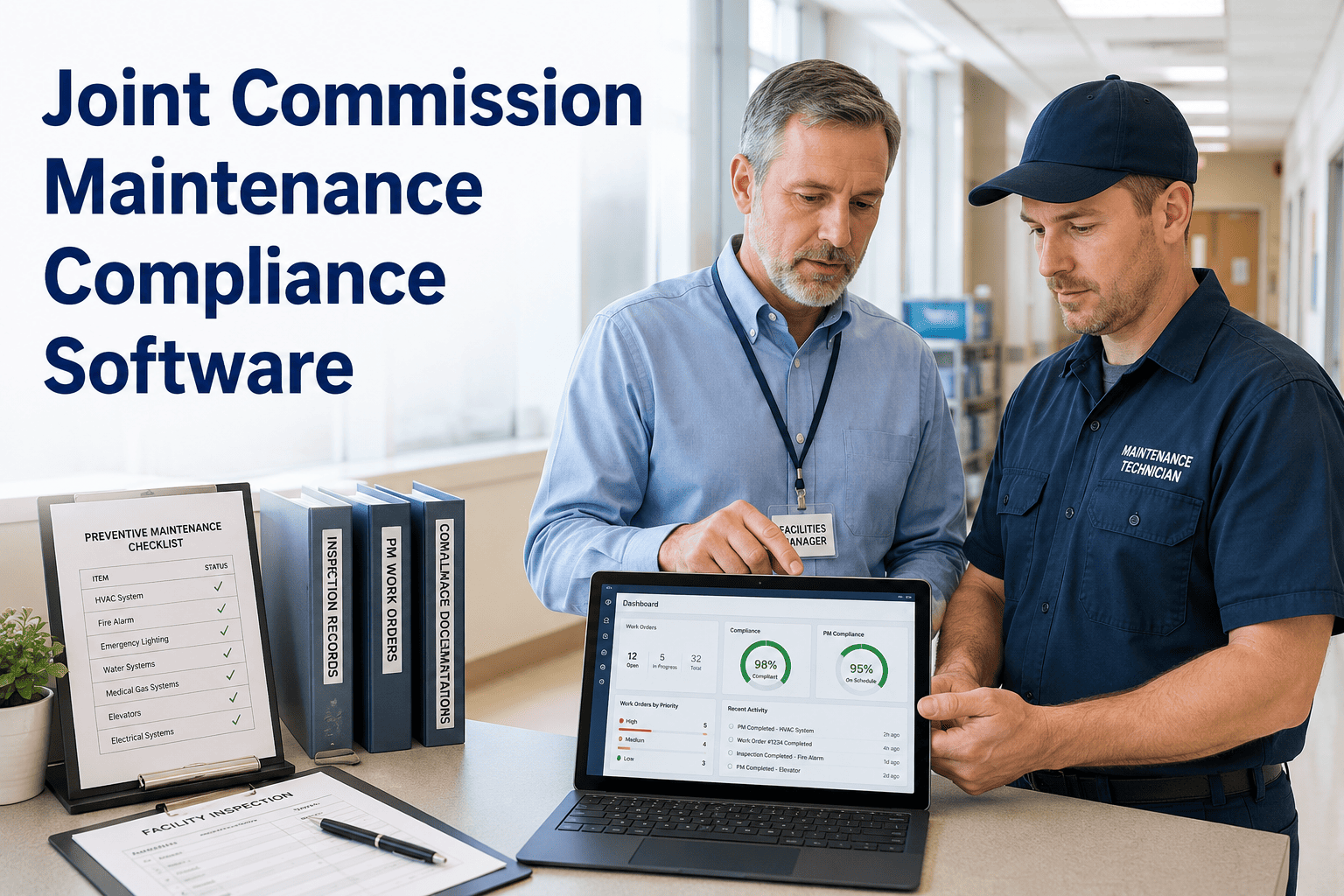
A healthcare CMMS addresses this challenge by transforming compliance from a manual documentation exercise into an automated operational byproduct. Every work order completed in the system becomes a timestamped compliance record. Every preventive maintenance task generates audit-ready evidence. Every inspection and calibration is archived in a searchable database that can produce regulatory-grade reports in minutes rather than days.
CMMS automatically documents EC.02 equipment management activities, generates PM completion rates, and maintains the continuous maintenance records surveyors require during triennial reviews and for-cause inspections.
Maintenance records produced by a CMMS satisfy the physical environment requirements under the Hospital CoPs, providing evidence that the facility maintains equipment in a manner that protects patient health and safety.
Documented inspection histories for patient lifts, electrical systems, and hazardous materials storage areas provide the evidence base needed to demonstrate compliance with applicable OSHA standards during inspections.
Fire suppression systems, emergency lighting, egress equipment, and smoke compartmentalization components all require documented inspection cycles that a CMMS schedules, tracks, and archives automatically.
Core CMMS Capabilities That Drive Patient Safety Outcomes
Understanding how a CMMS connects to patient safety requires examining the specific platform capabilities that translate facility management data into clinical risk reduction. The following capabilities are the most directly linked to measurable patient safety improvements in healthcare environments. Sign up free to explore these capabilities inside OxMaint today.
Automated Preventive Maintenance for Clinical Equipment
The CMMS generates and assigns preventive maintenance work orders based on manufacturer protocols, regulatory intervals, and usage thresholds — ensuring that ventilators, infusion pumps, patient monitors, and sterilization equipment receive scheduled service before deterioration creates clinical risk. No critical PM task falls through the cracks of a manual calendar system.
Real-Time Equipment Status Visibility
Facility managers and biomedical teams gain immediate visibility into the operational status of every maintained asset — identifying equipment currently out of service, overdue for inspection, or flagged by an IoT sensor alert. This situational awareness allows clinical leadership to make informed decisions about equipment deployment and patient assignment.
Rapid Work Order Response for Safety-Critical Failures
When a piece of equipment fails or a facility system malfunctions, the CMMS enables immediate work order creation, automatic technician dispatch, and priority escalation workflows. Response time to safety-critical failures is dramatically reduced compared to manual communication chains — minimizing the window during which compromised equipment could reach a patient.
Infection Control Infrastructure Management
HVAC pressure differentials, air exchange rates, and filtration maintenance in isolation rooms, operating theaters, and sterile processing departments are tracked and scheduled through the CMMS. Lapses in this infrastructure maintenance are among the most significant contributors to healthcare-associated infection risk — and automated scheduling eliminates the human error that allows these lapses to occur.
Emergency Power System Reliability
Generator testing, UPS maintenance, and automatic transfer switch inspections are mission-critical safety tasks that a CMMS schedules and documents with the same rigor applied to clinical equipment. The documented reliability of emergency power systems directly protects patients on life support and in active surgical procedures during utility failures.
Recall and Safety Alert Management
When the FDA or a manufacturer issues a device safety alert or recall, the CMMS asset registry allows immediate identification of all affected units in the facility, automatic work order generation for required corrective actions, and documentation of response completion — closing the loop on patient safety obligations that paper-based systems routinely leave open.
CMMS Impact on Key Healthcare Facility Management Metrics
The operational and safety benefits of healthcare CMMS adoption are measurable across a range of facility management performance indicators. Hospitals that have implemented purpose-built CMMS platforms consistently report improvements across the metrics that matter most to clinical leadership, compliance teams, and hospital finance.
| Performance Metric | Without CMMS | With Healthcare CMMS | Impact on Patient Safety |
|---|---|---|---|
| PM Completion Rate | 60–75% (manual tracking) | 90–98% (automated scheduling) | Reduces equipment failure incidents in clinical areas |
| Mean Time to Repair | 4–8 hours average | 1–3 hours average | Minimizes duration of compromised equipment exposure |
| Compliance Documentation | Days to compile manually | Minutes via automated reports | Accelerates regulatory response and reduces citation risk |
| Unplanned Equipment Downtime | Baseline frequency | 40–50% reduction | Fewer clinical disruptions from unexpected equipment failures |
| Safety Alert Response Time | Days to identify affected assets | Hours via registry search | Faster removal of recalled or flagged equipment from use |
| Regulatory Audit Outcomes | Higher citation frequency | Documented reduction in findings | Sustained compliance culture reduces systemic safety risks |
Building a Compliance-Ready Facility Management Program with CMMS
Transitioning to a CMMS-supported facility management model requires thoughtful program design, not just software implementation. The hospitals that achieve the strongest compliance and safety outcomes treat their CMMS as an operational strategy rather than a technology purchase — embedding the platform into every maintenance workflow, governance process, and performance review cycle. Book a demo to see how OxMaint fits your facility's existing workflows.
Compliance documentation is only as strong as the asset inventory beneath it. A complete, accurate registry of every maintained asset — including clinical equipment, building systems, and life safety infrastructure — is the foundation on which the entire CMMS compliance framework is built.
Preventive maintenance intervals in the CMMS should be explicitly mapped to the regulatory sources that govern them — whether manufacturer recommendations, Joint Commission standards, or NFPA inspection cycles. This mapping makes the compliance rationale for each task transparent and defensible during inspection.
Compliance documentation derives its value from its integrity. CMMS role-based access controls ensure that work orders are completed and signed off by credentialed personnel, that supervisory approval is embedded in the workflow, and that the audit trail reflects actual accountability rather than administrative convenience.
Effective healthcare facility management bridges the organizational boundary between biomedical engineering and facilities management. A shared CMMS platform with coordinated workflows eliminates the documentation gaps that form at this boundary and ensures unified compliance posture across all asset categories.
Not every work order carries equal urgency. CMMS escalation configurations should reflect the clinical risk hierarchy of your asset inventory — ensuring that failures in life-critical systems trigger immediate notification chains while routine tasks follow standard scheduling workflows.
The compliance value of a CMMS is realized through active management, not passive documentation. Regular leadership review of PM completion rates, overdue work orders, and compliance report metrics sustains the organizational attention needed to maintain inspection readiness year-round.
The Patient Safety Business Case for Healthcare Facility Investment
Hospital leadership teams sometimes frame facility management investment as a cost center rather than a value driver — a framing that the data does not support. The financial consequences of facility-related patient safety events dwarf the operational cost of the CMMS platforms and maintenance programs that prevent them.
A single healthcare-associated infection linked to HVAC maintenance failure carries direct treatment costs that routinely exceed tens of thousands of dollars per case, compounded by regulatory investigation exposure, potential CMS reimbursement penalties, and the litigation liability that follows serious adverse events. Equipment failure events in clinical settings carry similar financial profiles — with the added dimension of reputational damage that affects patient volume long after the incident itself.
By contrast, healthcare CMMS implementations consistently demonstrate maintenance cost reductions of 25 to 35 percent in the first year of operation — a return that is measurable, reportable to boards, and compounding over time as predictive capabilities mature and the asset registry grows more complete. When this operational savings is set against the avoided cost of compliance failures and patient safety events, the investment case becomes not merely justifiable but compelling.
Facilities directors and CFOs who have modeled this comparison reach the same conclusion: the cost of not investing in modern facility management infrastructure is substantially higher than the cost of investing. A healthcare CMMS is not an operational expense — it is a patient safety infrastructure investment with a quantifiable return. Book a demo with OxMaint to model these numbers against your facility's actual maintenance data.
Ready to Strengthen Patient Safety Through Smarter Facility Management?
OxMaint is the AI-powered healthcare CMMS trusted by 1,000+ organizations — built to make compliance automatic and patient safety measurable.
Frequently Asked Questions: CMMS and Healthcare Facility Management
How does a CMMS directly improve patient safety in hospitals?
A CMMS improves patient safety by ensuring that clinical equipment receives scheduled preventive maintenance before failure, that safety-critical facility systems are continuously monitored and serviced, and that device recalls and safety alerts are acted upon quickly through asset registry searches and automated work order generation. The reduction in unplanned equipment failures and maintenance lapses directly reduces the patient exposure events that lead to adverse outcomes.
What regulatory standards does a healthcare CMMS help satisfy?
A purpose-built healthcare CMMS supports compliance with Joint Commission Environment of Care and Life Safety standards, CMS Conditions of Participation for hospital physical environments, OSHA workplace safety requirements for clinical facilities, and NFPA 101 Life Safety Code inspection and maintenance mandates. The automated documentation generated by the CMMS creates the audit trail required to demonstrate compliance during inspections and surveys.
Can a CMMS help prevent healthcare-associated infections?
Yes. A significant portion of healthcare-associated infections are linked to environmental and infrastructure factors — including HVAC air quality failures, sterilization equipment maintenance lapses, and water system contamination events. A CMMS schedules and documents the maintenance activities that address these infection vectors, creating a preventive maintenance program that directly supports infection control objectives.
How does CMMS documentation support Joint Commission surveys?
During a Joint Commission survey, surveyors request evidence of ongoing equipment maintenance and facility management activities. A CMMS can generate comprehensive maintenance history reports — including PM completion records, corrective work orders, inspection documentation, and calibration logs — within minutes, providing surveyors with the organized, time-stamped evidence they require and eliminating the compliance risk created by disorganized or incomplete paper records.
What is the difference between facility management CMMS and biomedical CMMS?
Facility management CMMS focuses on building infrastructure assets — HVAC, electrical systems, plumbing, fire suppression, life safety equipment, and general facilities maintenance. Biomedical CMMS manages clinical and biomedical equipment — medical devices, diagnostic imaging systems, patient care equipment, and laboratory instruments. A healthcare CMMS platform should support both categories within a unified system, as the compliance and safety requirements of a hospital span both domains.
How quickly can a hospital expect compliance improvements after CMMS implementation?
Most hospitals report measurable compliance improvements within the first operating quarter after go-live, as automated PM scheduling immediately eliminates the scheduling gaps that drive compliance deficiencies. Full compliance posture improvements — including complete historical documentation, optimized inspection schedules, and inspection-ready reporting — are typically achieved within six to twelve months as the asset registry matures and workflows are fully optimized.

.png)
.jpg)
