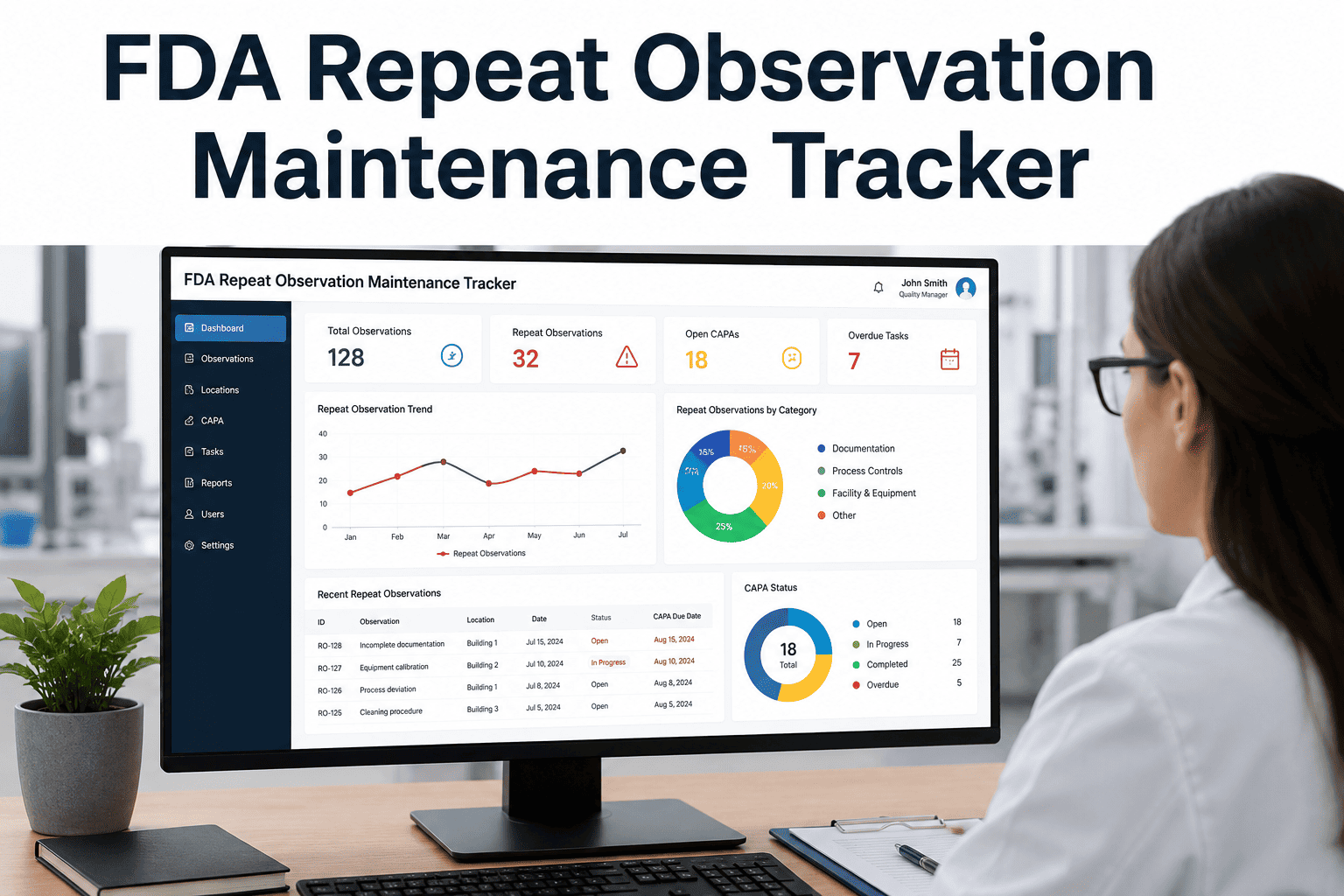
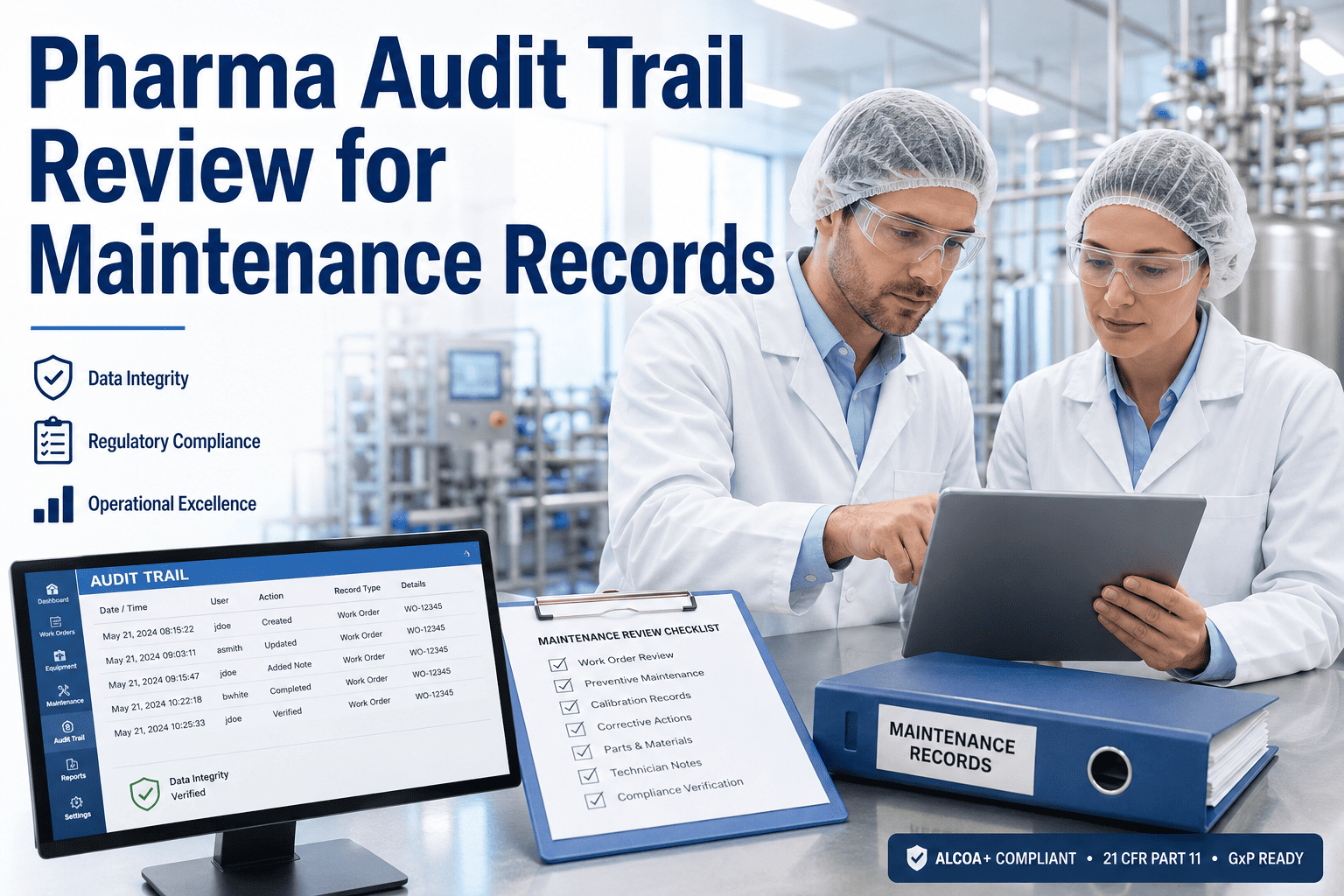
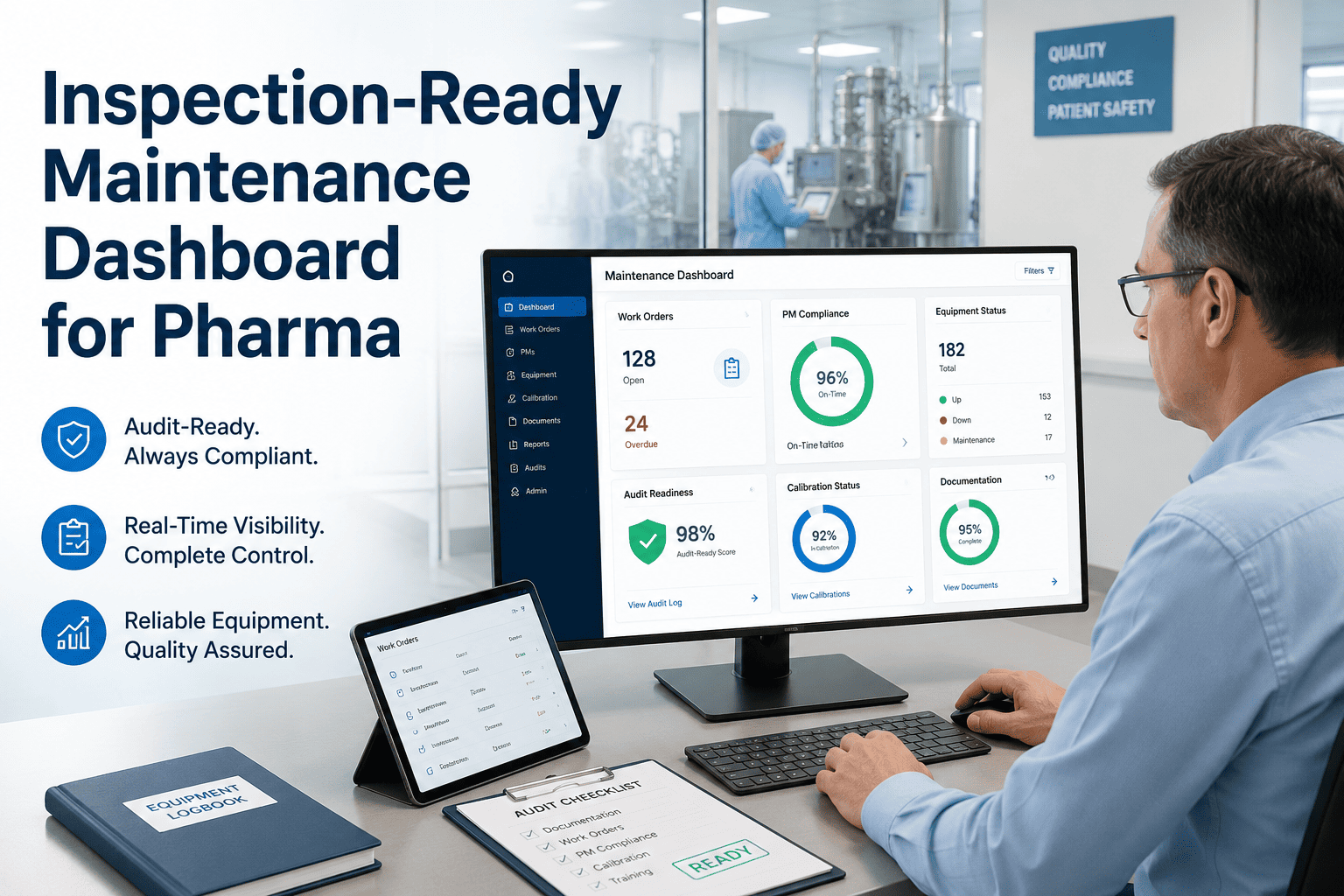
FDA repeat maintenance observations don't happen in isolation — they are symptoms of broken documentation loops, untracked corrective work, and missed closure evidence that auditors find in subsequent inspections. When the same finding appears twice, the regulatory consequences escalate from a warning to a potential consent decree. Book a demo with OxMaint to see how a structured maintenance tracker eliminates repeat 483 observations, or start a free trial and configure your first repeat-observation workflow today.
FDA Inspection Ops · Pharma CAPA · Audit Closure
FDA Repeat Observation Maintenance Tracker
How to stop the same FDA maintenance finding from appearing twice — with tracked corrective work, owner accountability, due dates, and audit-ready closure evidence built into your CMMS.
2×
Higher likelihood of Warning Letter if same 483 observation repeats within 2 inspection cycles
67%
of pharma sites with repeat observations had no owner-assigned corrective work order in their CMMS
30 days
FDA's informal expectation for initial corrective action response to a maintenance-related 483 observation
Why Repeat Observations Happen
01
No Owner, No Deadline
Corrective actions from 483 responses are written in documents but never converted into tracked work orders with an assigned owner and a real due date. At the next inspection, the paper says it was fixed. The system shows no evidence it was.
02
CAPA Lives in a Silo
Quality writes the CAPA. Maintenance executes the fix. The two records never link. The inspector asks for maintenance evidence of the corrective action and finds a CAPA that says "completed" with no work order, no technician signature, no parts used.
03
Closure Without Verification
Someone marks the corrective action closed in a spreadsheet. No QA verification. No secondary sign-off. No follow-up PM created to confirm the fix held. The underlying failure mode was never eliminated — it was just acknowledged.
04
No Trend Visibility
Without a system that aggregates observation data, no one can see that the same equipment category or the same production line has produced three consecutive inspection findings. Trend analysis requires structured data — not binders.
The 6-Field Tracker Every 483 Response Needs
Each FDA maintenance observation must generate a structured corrective work order in your CMMS with these six fields populated and time-stamped before the response letter is submitted.
| Field |
Required Content |
Who Owns It |
Audit Function |
| Observation Reference |
FDA 483 item number and verbatim observation text |
QA Manager |
Links maintenance work to exact regulatory finding |
| Corrective Work Description |
Specific maintenance action required — not paraphrased |
Maintenance Supervisor |
Confirms action scope matches finding |
| Responsible Technician |
Named individual — not a team or department |
Maintenance Manager |
Provides accountable signature trail |
| Committed Due Date |
Date matching the 483 response commitment |
Maintenance Manager |
Verifiable deadline — not floating |
| Completion Evidence |
Photo, parts record, or calibration certificate |
Technician |
Proof the work was done, not just scheduled |
| QA Closure Sign-off |
Digital signature with timestamp per 21 CFR Part 11 |
QA Director |
Confirms independent verification of closure |
OxMaint creates this 6-field tracker automatically for every corrective action linked to a regulatory observation — with owner routing, escalation alerts, and QA sign-off built in.
Observation Response: Spreadsheet vs OxMaint CMMS
Spreadsheet / Manual Tracking
Observation logged in a shared Excel tab — no system link to corrective work
Owner is listed by role, not by name — accountability is ambiguous
Due date is a cell — no escalation if it passes without closure
Closure is a checkbox — no evidence attachment, no QA review
Repeat trend invisible — requires manual cross-referencing of multiple files
Inspector asks for evidence package — retrieval takes hours or days
OxMaint CMMS Tracker
Observation creates a linked corrective work order with traceability ID
Named technician assigned — notifications sent and escalations triggered automatically
Due date fires escalation alerts at 75% elapsed time — manager notified
Closure requires evidence upload and QA digital sign-off before status change
Repeat-observation dashboard flags recurring findings across inspection cycles
Inspector package exported as PDF in under 10 minutes — complete chain of custody
Observation Lifecycle Status Flow
1
FDA Observation Received
483 item logged in CMMS — QA notified
2
Corrective Work Order Created
Owner assigned — due date set
3
Work Executed & Evidenced
Parts, photos, signatures recorded
4
QA Closure Verified
Digital sign-off — record locked
5
Audit-Ready Package
Full chain of custody exportable
RK
Rajiv Kulkarni
FDA Compliance Specialist · 19 Years in Pharma Inspection Readiness
The single most damaging thing I see during reinspection preparation is a corrective action that was closed on paper without any maintenance system record to support it. FDA investigators are specifically trained to ask for the work order behind the CAPA commitment. When there is no work order — or the work order has no completion evidence attached — the 483 repeats and the response credibility collapses. The facilities that eliminate repeat observations are the ones that treat every regulatory finding as a maintenance work order event from day one, not as a document management task.
Frequently Asked Questions
What makes a 483 observation "repeat" in FDA's eyes?
FDA classifies an observation as repeat when the same systemic deficiency — typically identified by system area, regulation citation, and failure mode — appears in a subsequent inspection of the same facility. It does not require identical wording; substantively similar findings on the same equipment category or process are treated as repeat. A CMMS that tracks observation categories and links them to corrective work orders allows you to demonstrate systemic correction before the next inspection, reducing the likelihood of a repeat classification.
Book a demo to see OxMaint's observation categorization workflow.
Does OxMaint integrate with quality management systems for CAPA linking?
OxMaint supports bidirectional CAPA linking, allowing maintenance corrective work orders to reference and be referenced by quality system CAPA records. This means the maintenance work order and the CAPA record share a common traceability ID, so an inspector can pull either record and navigate to the other within seconds. The linked record structure is the most critical factor in demonstrating that CAPA commitments were actually executed in the field, not just documented.
Start a free trial to explore the CAPA linking configuration.
How should sites prioritize corrective actions when multiple 483 observations are received at once?
Prioritization should follow a criticality matrix that considers three factors: the GMP system area affected (equipment maintenance carries higher risk than documentation), the frequency of the finding (first-time vs. repeat), and the production impact potential (critical instruments or cleanroom equipment take precedence). OxMaint's observation tracker allows you to assign a risk tier to each observation at intake, which then drives escalation timelines and notification routing automatically. This ensures high-risk findings receive owner assignment and QA review within 24 hours.
Book a demo to see the risk-tiered routing in action.
What evidence does FDA expect to see when reviewing corrective maintenance actions?
FDA investigators typically look for four types of evidence when reviewing corrective maintenance actions: a dated work order with a named technician, completion documentation including parts records or calibration certificates, a QA review signature confirming the work meets the corrective intent, and a follow-up PM or monitoring record demonstrating the correction was sustained over time. Missing any one of these elements — especially the QA sign-off or the follow-up PM — creates a gap that can result in a repeat observation at reinspection. OxMaint structures every corrective work order to capture all four evidence types automatically.
Never Face the Same FDA Finding Twice
OxMaint turns every 483 observation into a tracked corrective work order — with owner assignment, evidence collection, QA sign-off, and repeat-trend monitoring — so your next inspection starts from a clean slate.