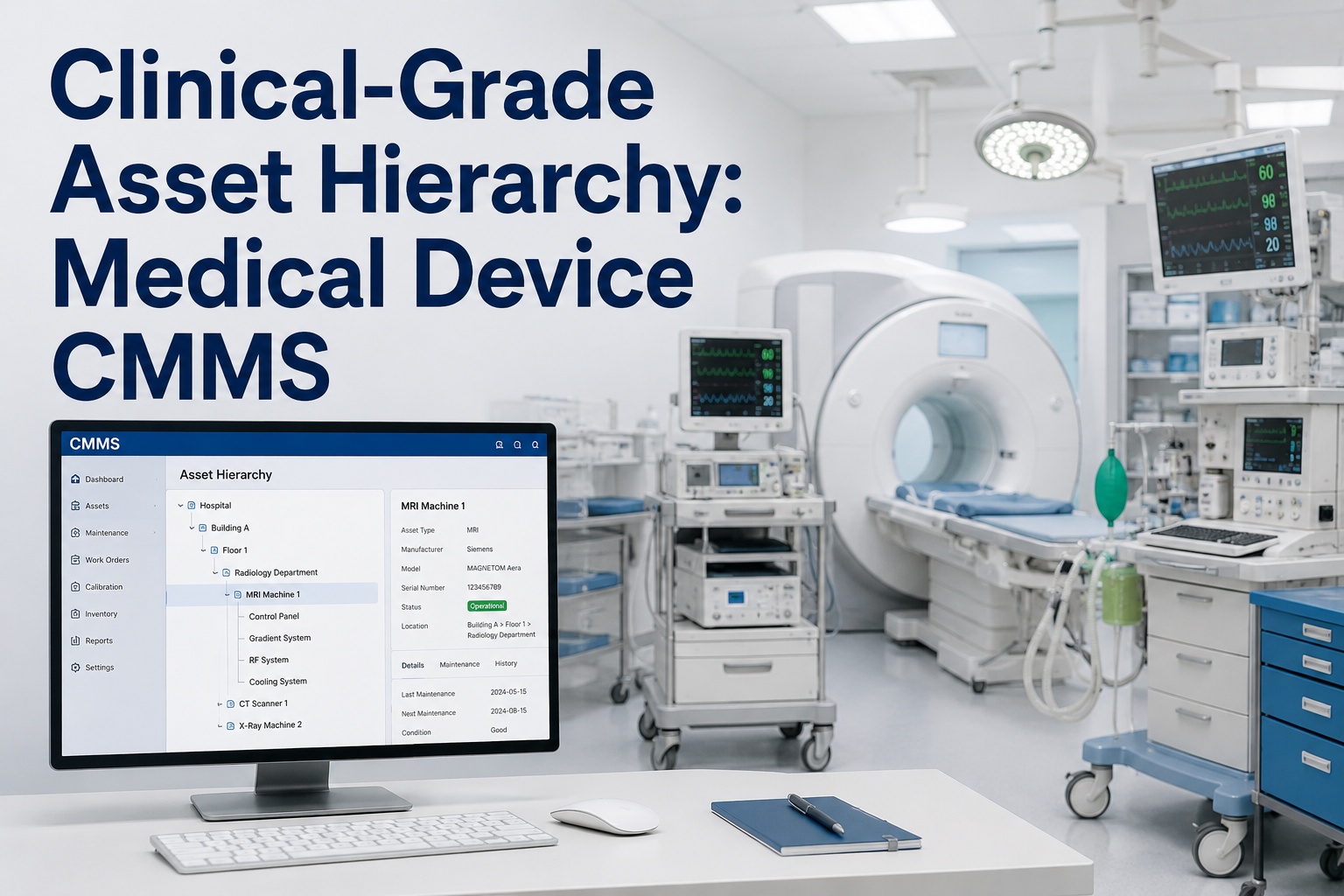
A pharmaceutical facility's CMMS is only as trustworthy as the data inside it. When asset names vary between departments, PM codes don't match the validation master plan, criticality ratings were assigned informally years ago and never reviewed, and spare parts are listed under three different names in the same system, maintenance teams operate on a foundation that cannot support audit scrutiny. Master data governance in pharma maintenance isn't an IT project—it's a GMP requirement with direct implications for equipment qualification, risk assessment, and regulatory submission. Book a demo to see how OxMaint structures governed master data workflows for pharma operations.
GMP Systems | CMMS Data Governance
Maintenance Master Data Governance for Pharma
Control asset names, PM codes, criticality ratings, spare parts, and ownership assignments with structured CMMS governance workflows—designed for pharmaceutical GMP environments where data quality is a compliance requirement.
The Five Master Data Domains That Pharma Maintenance Teams Must Control
Each master data domain in a pharmaceutical CMMS carries its own compliance risk. Inconsistent asset naming creates mismatches between the CMMS and the Equipment Qualification Master Plan. Poorly structured PM codes make it impossible to demonstrate regulatory compliance against a validated maintenance schedule. Unreviewed criticality ratings result in the wrong maintenance strategy being applied to GMP-critical assets. The guide below addresses each domain in sequence.
1. Asset Naming
2. PM Codes
3. Criticality
4. Spare Parts
5. Ownership
01
Asset Naming and Hierarchy Standards
Asset names in a pharma CMMS must be consistent, controlled, and traceable to the equipment IDs used in qualification documents, SOPs, and batch records. A reactor called "R-101" in the CMMS but "Reactor A" in the Equipment Qualification Plan and "Mix Tank 1" in a batch record is three different assets in the eyes of an auditor—and none of them can be confirmed as qualified. Governed naming requires a defined naming convention, a change control process for modifications, and version tracking for any asset renaming.
Single naming convention applied across all sites and systems
Asset IDs match Equipment Qualification Master Plan entries
Renaming requires change control record with approvals
Asset hierarchy reflects physical installation (Site > Building > System > Asset)
02
PM Code Structure and Validation Alignment
Preventive maintenance codes are the bridge between a CMMS schedule and a validated maintenance program. When PM codes are created ad hoc by individual technicians or managers without a controlled structure, the validated maintenance procedure referenced in an equipment qualification document cannot be reliably linked to the work order that executed it. Governed PM codes require a defined code taxonomy, ownership assignment, and a process to verify that CMMS PM schedules match the current validated master plan.
PM codes follow a defined structure (e.g., PM-[Asset Class]-[Frequency]-[Task Type])
Each PM code links to the governing SOP or validation document
New PM code creation requires approval from maintenance and QA
Annual review confirms CMMS PM schedule matches validated master plan
03
Asset Criticality Classification and Review
Criticality ratings determine the maintenance strategy applied to each asset—frequency of PM, response time for corrective work orders, and whether failure consequences trigger a regulatory notification. Criticality ratings that were assigned informally during system setup and never reviewed represent a governance gap: the maintenance strategy may not reflect current process risk, and any audit that traces a maintenance failure to an under-maintained critical asset will expose the gap. Governed criticality requires a defined rating scale, periodic review, and documented rationale for each assignment.
Criticality scale defined and documented (GMP-Critical, Major, Minor)
Criticality assignment linked to risk assessment or FMEA record
Periodic criticality review scheduled (at minimum annually)
PM frequency and response time targets derived from criticality rating
04
Spare Parts Master Data and Approved Suppliers
Spare parts used on GMP-critical equipment must be traceable to approved supplier qualification records. When a CMMS spare parts catalog contains duplicate entries for the same component under different names, or when parts are added without an approved supplier link, the traceability chain breaks. A work order that records "replaced impeller" without linking to a qualified, approved part creates a documentation gap that qualifies as a cGMP violation if the equipment processes drug product. Governed spare parts master data requires deduplication, supplier qualification links, and controlled new-item creation.
Spare parts catalog deduplicated; single canonical entry per component
GMP-critical parts linked to approved supplier qualification record
New part creation requires QA review for GMP-critical assets
Part substitutions require change control documentation
05
Ownership Assignment and Accountability Structure
Every asset and PM record in a GMP CMMS requires a defined owner responsible for its accuracy and currency. Ownership gaps—assets with no assigned owner, PM schedules maintained by technicians who have since left the company, or QA countersignature routing to a generic "QA" account rather than named individuals—create accountability voids that regulators identify during inspection. Governed ownership requires named individuals, succession planning, and periodic ownership review as part of the CMMS change control process.
Every asset has a named owner with documented responsibility
PM schedule ownership assigned to named individuals, not generic roles
Ownership transfer process defined and documented in change control
Periodic ownership review confirms assignments remain current
Master Data Governance Maturity: Where Is Your Facility?
| Domain |
Level 1: Ad Hoc |
Level 2: Documented |
Level 3: Controlled |
Level 4: Governed |
| Asset Naming |
No standard; individual variation |
Convention exists but not enforced |
Enforced in new entries; legacy gaps remain |
System-enforced; change controlled |
| PM Codes |
Created on demand, no taxonomy |
Defined structure, manual adherence |
Approval required for new codes |
Linked to validated master plan |
| Criticality |
Informal assignment, no documentation |
Defined scale, initial rating done |
Linked to risk assessment |
Periodic review, drives PM strategy |
| Spare Parts |
Duplicates, no supplier links |
Catalog cleaned, some supplier data |
GMP parts link to qualified suppliers |
Substitution change control enforced |
| Ownership |
No defined owner for assets or PMs |
Owners assigned but not reviewed |
Defined transfer process exists |
Periodic review; succession documented |
"
The most common master data problem I see in pharma CMMS audits isn't missing records—it's records that exist but can't be trusted. An asset with three different names across three systems. A PM that runs on schedule but the code doesn't link to the current validated procedure. A criticality of 'GMP-Critical' assigned five years ago that nobody has reviewed since the process changed. These aren't data quality problems in the abstract—they're audit findings waiting to happen. The facilities that handle this well have one thing in common: they treat CMMS master data the same way they treat any other controlled GMP document. It has an owner, a review cycle, and a change control process. Nothing in it changes without a record of who changed it, why, and who approved it.
Patricia Okonkwo
Principal GMP Systems Consultant | Former Roche QA Systems Lead
25 years pharmaceutical quality systems | CMMS implementation lead at 12 regulated facilities | Expert reviewer, EMA technical guidance on computerized systems
5
Master data domains that require governance in a pharma CMMS
Change Controlled
Every master data modification in OxMaint generates a traceable change record
Frequently Asked Questions
What is CMMS master data governance and why is it a GMP requirement?
CMMS master data governance refers to the controlled management of the foundational reference data that drives maintenance operations—asset names, PM codes, criticality ratings, spare parts, and ownership assignments. In a GMP environment, this data directly supports regulatory compliance: asset names must match qualification records, PM codes must align with validated maintenance schedules, and criticality must drive appropriate maintenance strategy. EU Annex 11 and FDA 21 CFR Part 11 both require that changes to computerized system records be controlled, documented, and traceable. Uncontrolled master data changes effectively mean uncontrolled changes to your GMP maintenance program.
OxMaint enforces change-controlled master data workflows for all five domains.
How should pharma maintenance teams structure asset criticality classification?
A practical criticality framework for pharmaceutical maintenance typically uses three to four tiers: GMP-Critical (direct product contact equipment where failure impacts patient safety or product quality), Major (indirect GMP impact—HVAC, utilities, supporting systems where failure could affect a GMP-Critical asset), Minor (no GMP impact, facilities and non-process equipment), and optionally Safety-Critical (assets where failure presents an immediate personnel safety risk regardless of GMP classification). Each asset's criticality should be documented with a rationale, linked to an FMEA or risk assessment record, and reviewed annually or after any significant process change.
Book a demo to see how OxMaint structures criticality assignment and review workflows.
How does OxMaint enforce master data governance rather than just documenting it?
OxMaint enforces master data governance through three mechanisms: access controls that restrict who can create or modify master data records, approval workflows that route proposed changes to designated reviewers before changes take effect, and audit trail logging that captures every modification with a timestamp, user ID, reason code, and before/after values. New asset creation, PM code additions, criticality changes, and spare parts modifications all require defined approvals before they are activated in the system. This means the CMMS cannot be changed informally—every modification leaves a traceable, audit-ready record.
What is the right approach to cleaning up existing CMMS master data in a pharma facility?
Master data remediation in a regulated environment requires a structured approach rather than direct bulk editing. Start with an audit of each domain to quantify the scope: count duplicate asset names, PM codes with no SOP link, assets with no criticality rating, and spare parts with no supplier qualification record. Prioritize remediation by GMP risk—address GMP-Critical assets first. Each change to an existing record must go through a formal change control process that documents the original data, the corrected data, the rationale, and the approvals. Avoid migrating data informally; bulk imports that bypass the change control workflow create a gap in the audit trail for every record modified. OxMaint's implementation team supports governed data migration as part of the initial deployment.
Governed CMMS Master Data for Pharma Operations
OxMaint gives pharmaceutical maintenance teams the governance infrastructure to control asset naming, PM codes, criticality ratings, spare parts, and ownership with change-controlled workflows, audit trails, and approval routing built for GMP environments.