In regulated pharmaceutical manufacturing, a maintenance record without a proper electronic signature isn't just incomplete—it's a compliance liability. FDA 21 CFR Part 11 requires that every approval, review, and sign-off on a maintenance record be traceable to an individual, timestamped, and protected against alteration. Missing reviewer routing, skipped approval steps, and unsigned exception records are among the most cited documentation deficiencies in FDA Form 483 observations. Book a demo to see how OxMaint closes electronic signature gaps before they become audit findings.
Pharma Data Integrity | 21 CFR Part 11
Electronic Signature Gaps in Maintenance Records
A working checklist for pharma maintenance teams to identify, close, and prevent missing approvals, unsigned exceptions, and broken reviewer routing chains that trigger FDA audit observations.
High Risk
Missing reviewer routing
High Risk
Unsigned exception records
Medium Risk
Shared login credentials
Medium Risk
Incomplete audit trail
Why Signature Gaps Are a Part 11 Problem, Not Just a Process Problem
21 CFR Part 11 doesn't allow for "we usually get it signed within a few days." It requires that electronic signatures on records be applied at the point of action, attributable to a specific individual, and impossible to modify without generating an audit trail entry. When maintenance teams rely on paper sign-offs that are later scanned, shared credentials where multiple technicians log into one account, or approval routing that bypasses certain work order types, they create documentable gaps that inspectors identify during walkthroughs. The following checklist addresses the full signature chain from work order creation through exception closure.
A
Work Order Signature Requirements
Technician execution sign-off applied at completion, not retrospectively
Part 11 §11.10(e): signature must be applied contemporaneously with the action performed. Post-dated entries are a critical finding.
Critical
Supervisor review signature captured before record is closed
GMP SOPs typically require a second reviewer sign-off for corrective maintenance on critical equipment. Verify your SOP defines which WO types require dual signature.
Critical
Each signatory logs in with unique, individual credentials
Shared logins make signatures non-attributable and invalidate the Part 11 requirement for individual accountability. A single shared account for a shift team is a repeat observation in FDA 483s.
Critical
Signature meaning (reviewed / approved / executed) is displayed at point of signing
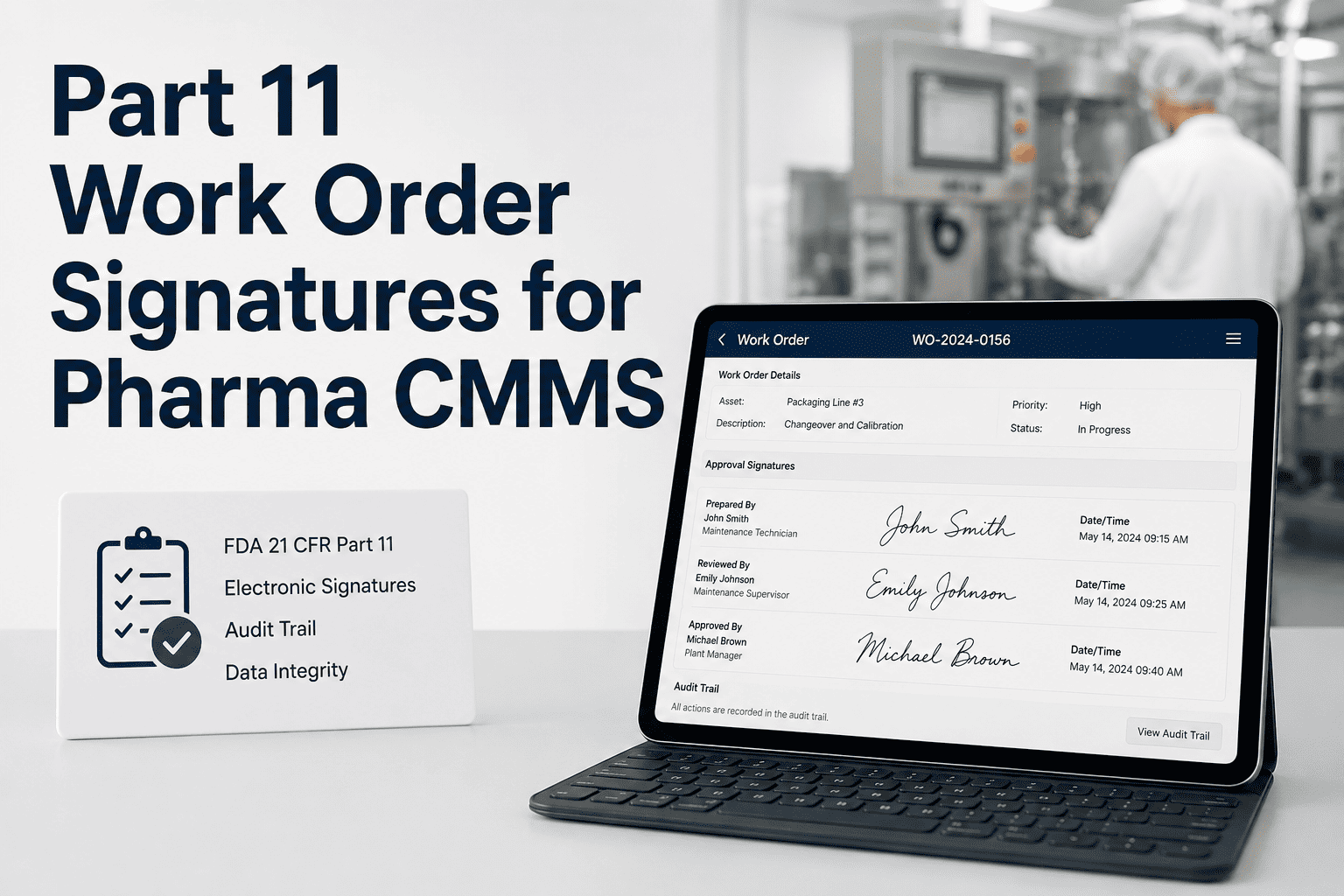
Part 11 §11.50 requires that the meaning of each signature be printed on any displayed or printed form of a record. OxMaint captures this metadata with every signature event.
High
B
Reviewer Routing Configuration
Reviewer routing is system-enforced, not manual email or verbal request
Routing via system automation prevents records from being closed without required approvals. Manual routing via email is unenforceable and untraceable in an audit context.
Critical
Work order types requiring QA countersignature are configured in CMMS routing rules
Not all WO types require QA sign-off, but GMP-relevant maintenance on qualified equipment typically does. Confirm your CMMS routing rules match your validated SOP requirements.
High
Escalation routing triggers if reviewer does not sign within defined period
Unsigned records that age beyond 24–48 hours are a common gap. Automated escalation ensures records don't sit in a reviewer queue and expire without closure.
High
Alternate reviewer is designated when primary reviewer is unavailable
Operations don't stop when a supervisor is on leave. Your CMMS routing configuration should include a designated backup approver to prevent signature bottlenecks during absences.
Medium
C
Exception Tracking and Sign-Off
Deviations from PM procedure are documented and signed as exceptions, not left as notes
A technician comment of "skipped lubrication—no grease available" is not a compliant exception record. Exceptions require a formal deviation entry, a reason code, and a sign-off from a responsible individual.
Critical
Out-of-tolerance findings on calibration or maintenance checks trigger immediate exception workflow
OOT findings that are recorded but not formally signed as exceptions are a data integrity gap. The exception record must be initiated, routed, and signed before the asset is returned to service.
Critical
CAPA records linked to exceptions carry their own complete signature chain
An exception linked to a CAPA that has an incomplete signature trail creates a chain-of-custody break. Both records must individually satisfy Part 11 signature requirements.
High
D
Audit Trail Integrity
Every signature event is logged with timestamp, user ID, and record state at time of signature
Part 11 §11.10(e) requires the audit trail to capture before-and-after values when records are modified. The signature event itself should be logged as an independent, tamper-evident entry.
Critical
Audit trail cannot be disabled or bypassed by any user, including system administrators
System administrator access that allows disabling the audit trail is a common finding. Verify your CMMS configuration prevents admin-level bypass of signature and audit trail functions.
Critical
Unsigned records report is reviewed and actioned at least weekly
The signature gap you don't see is the one that appears in the audit. OxMaint's unsigned records dashboard provides an always-current view of records pending approval so gaps are closed before they age into a compliance finding.
High
In place
Gap — action required
Critical FDA 483 observation risk
High Warning letter risk at pattern
Medium Internal audit finding
Common Audit Observations by Signature Gap Type
| Gap Type |
Regulatory Citation |
Observation Frequency |
OxMaint Prevention |
| Unsigned exception records |
21 CFR Part 11.50 |
Very High |
Exception workflow with mandatory sign-off before closure |
| Shared user credentials |
21 CFR Part 11.10(i) |
High |
Individual login enforcement; SSO integration available |
| Missing QA countersignature |
cGMP 211.68 / SOP requirement |
High |
Asset-class-based routing rules with automatic QA routing |
| Retrospective signature application |
21 CFR Part 11.10(e) |
Medium |
Timestamp lock at point of signing; no backdating allowed |
| Admin audit trail bypass |
21 CFR Part 11.10(a) |
Medium |
Immutable audit trail; admin permissions do not include bypass |
| Aged unsigned records (>48 hrs) |
Inspection history / SOP violation |
Lower |
Escalation routing + unsigned records dashboard with aging view |
"
Every signature gap I've seen cited in a 483 started the same way—someone designed the process correctly, but the system they were using couldn't enforce it. The routing was manual, or the work order type wasn't mapped to the right approval level, or there was no mechanism to flag unsigned records before the batch closed. The process was right on paper. What failed was the enforcement layer. A validated CMMS that automates signature routing and escalation is not a luxury in pharma maintenance—it's the difference between your documentation protecting you in an audit and your documentation creating the audit finding.
Dr. Lakshmi Anand
GMP Compliance Consultant | Former FDA CDER Reviewer
20+ years pharmaceutical quality | Author of 3 industry guidance papers on Part 11 implementation | Validated 40+ CMMS systems for FDA compliance
483
Observations are prevented when signature enforcement is automated, not manual
21 CFR
Part 11 requires contemporaneous, attributable, and tamper-evident signatures
Close Signature Gaps Before Your Next FDA Inspection
OxMaint's pharma-grade CMMS enforces electronic signature routing, escalation, and exception tracking with a complete, immutable audit trail. Built for 21 CFR Part 11 compliance.
Frequently Asked Questions
What does 21 CFR Part 11 actually require for electronic signatures on maintenance records?
Part 11 requires that electronic signatures be unique to one individual, non-reusable by anyone else, applied contemporaneously with the action taken, and linked to the record in a way that makes the signature inseparable from it. The system must produce a complete audit trail capturing who signed, when, and what the record contained at the time of signing. For pharma maintenance records, this means every work order, exception, and calibration record must meet these requirements.
OxMaint is built to satisfy these requirements with validated signature workflows and immutable audit trail generation.
How does reviewer routing automation prevent signature gaps in practice?
System-enforced routing means a maintenance record cannot progress to the next stage—or be closed—until the required signature is applied. Manual routing via email or verbal request creates a gap where records can be closed or archived before all approvals are obtained. In OxMaint, routing rules are configured per work order type, asset criticality, and process step. When a WO reaches a stage requiring QA countersignature, the system automatically routes it to the designated reviewer, sends a notification, and prevents closure until that signature is captured.
Book a demo to walk through the routing configuration for your facility.
What is an exception record in the context of maintenance documentation, and when is a signature required?
An exception record documents any deviation from the standard procedure described in the work order or preventive maintenance SOP—whether that is a skipped step, a substituted part, an out-of-tolerance finding, or an equipment condition requiring further review. A technician note in a comments field is not an exception record. A formal exception requires a structured entry with a deviation type, a reason code, corrective notes, and a sign-off from a qualified reviewer before the asset can be returned to service. OxMaint's exception workflow triggers automatically when a technician marks a step as incomplete or out of tolerance.
How can I quickly identify which maintenance records have signature gaps in my current system?
OxMaint's unsigned records dashboard provides a real-time view of all work orders, exceptions, and PM records that are pending a required signature, organized by aging—24 hours, 48 hours, and beyond. Managers can filter by asset class, site, reviewer, or work order type to prioritize closure. Records approaching a compliance deadline are automatically escalated. For teams migrating from paper or legacy systems, OxMaint's implementation team can help configure an initial gap assessment using your existing maintenance record backlog as part of the
onboarding process.
Pharma-Grade Electronic Signature Enforcement in Your CMMS
OxMaint gives pharmaceutical maintenance teams automated signature routing, escalation workflows, exception tracking with mandatory sign-off, and a complete audit trail that satisfies 21 CFR Part 11 requirements—without the manual overhead that creates gaps.