A single HEPA filter loaded 22% above its clean baseline can drop your Grade A air supply velocity below 0.45 m/s — and you will not know until the particle counter alarms during the next batch. A pressure cascade that drifts by 5 Pa across two doors can reverse cross-contamination protection for an entire suite. These are not theoretical failures. They are the routine, slow-drift events that cause 34% of cleanroom HVAC systems to fail at least one ISO 14644 or GMP parameter every year — with HEPA integrity, pressure differential, and humidity stability accounting for the majority of citations. OxMaint's cleanroom HVAC module tracks every filter, every pressure tap, every temperature mapping point, and every PM against the validated baseline — generating the documented evidence FDA, EMA, and notified-body inspectors actually ask for. This page shows what a GMP-defensible cleanroom HVAC maintenance programme looks like, the failure modes it must catch, and the metrics that prove your facility is in control.
Cleanroom & HVAC · Pharma GMP · Contamination Control
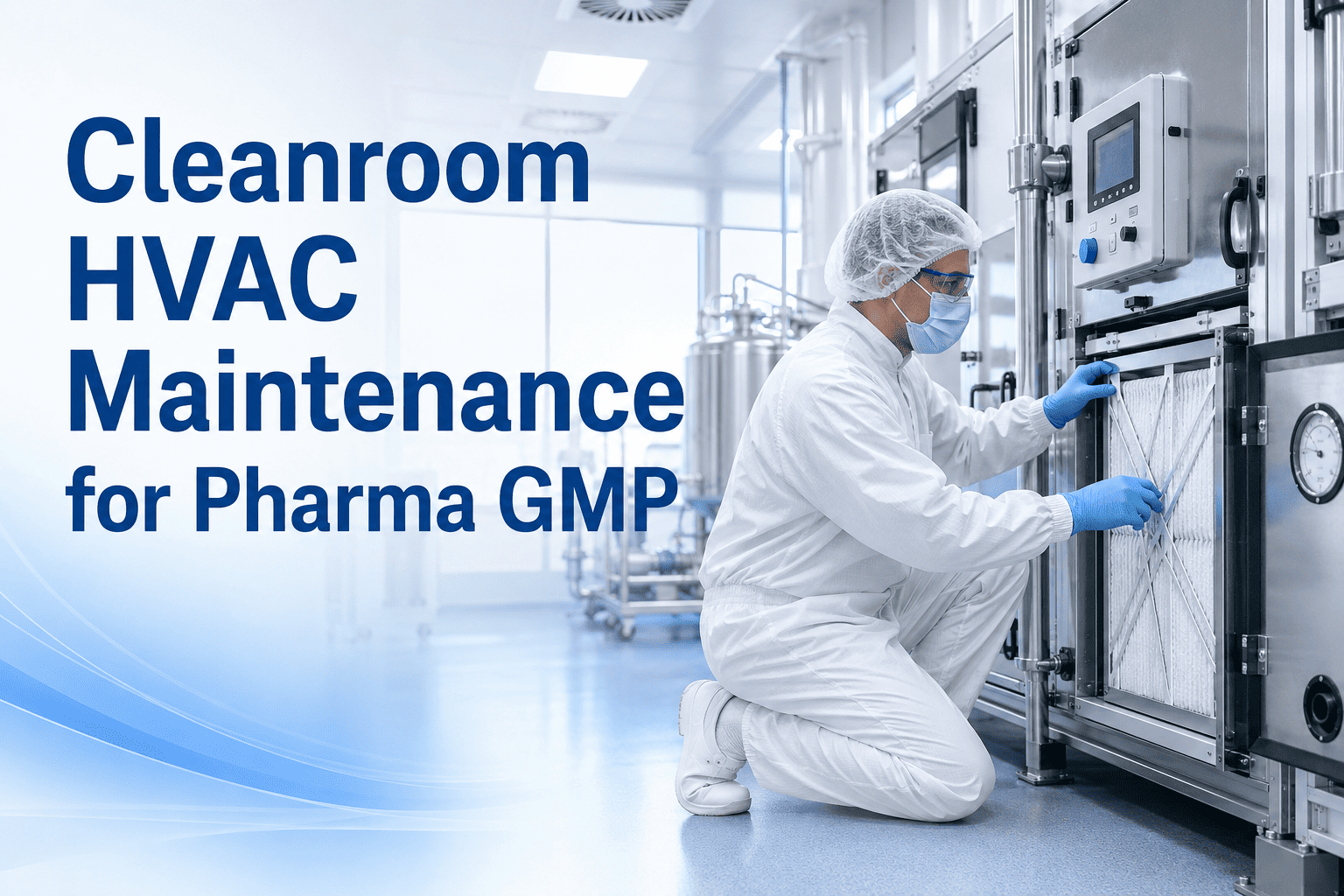
Cleanroom HVAC Maintenance for Pharma GMP Compliance
PM scheduling, HEPA integrity tracking, pressure cascade monitoring, temperature mapping, and GMP evidence — managed in one validated platform that satisfies 21 CFR Part 211, EU GMP Annex 1, and ISO 14644.
Annual HVAC Failure Citations
Other ISO 14644 parameters
The Grade Cascade — How Cleanroom HVAC Actually Holds the Line
Every pharma cleanroom suite is built around a pressure cascade that flows from the cleanest grade to the dirtiest. HVAC is what physically creates and maintains that cascade. Maintenance is what keeps it within validated tolerance year after year. The four grades below are the EU GMP Annex 1 reference framework — used in parallel with ISO 14644 classifications by every globally regulated pharma site.
Grade A
ISO 5 (at rest & in operation)
ApplicationSterile fill-finish, open product zones, aseptic critical areas
Air ChangesUnidirectional laminar flow · 0.36–0.54 m/s air velocity
HEPA CoverageFull ceiling HEPA, 99.997% efficiency at 0.3 µm
PM FrequencyHEPA integrity test every 6 months · DOP/PAO challenge
Grade B
ISO 5 at rest · ISO 7 in operation
ApplicationBackground environment for Grade A aseptic operations
Air Changes40–60 ACH typical · turbulent mixed flow
HEPA CoverageTerminal HEPA, 99.97% at 0.3 µm
PM FrequencyHEPA integrity annually · pressure check daily
Grade C
ISO 7 at rest · ISO 8 in operation
ApplicationSolution preparation, equipment wash, less-critical operations
Air Changes20–40 ACH typical
HEPA CoverageTerminal HEPA, 99.97% at 0.3 µm
PM FrequencyHEPA integrity every 12 months · pressure check weekly
Grade D
ISO 8 at rest · uncontrolled in operation
ApplicationMaterial/personnel airlocks, gowning rooms, support corridors
Air Changes15–25 ACH typical
HEPA CoveragePre-filter + HEPA at supply
PM FrequencyHEPA integrity every 24 months · pressure check weekly
Five Maintenance Functions That Keep a Cleanroom GMP-Compliant
The cleanroom HVAC maintenance programme has five interlocking workstreams. Each generates the documented evidence inspectors will request. A gap in any one of them undermines the GMP defensibility of the entire suite.
01
HEPA & Filter Programme
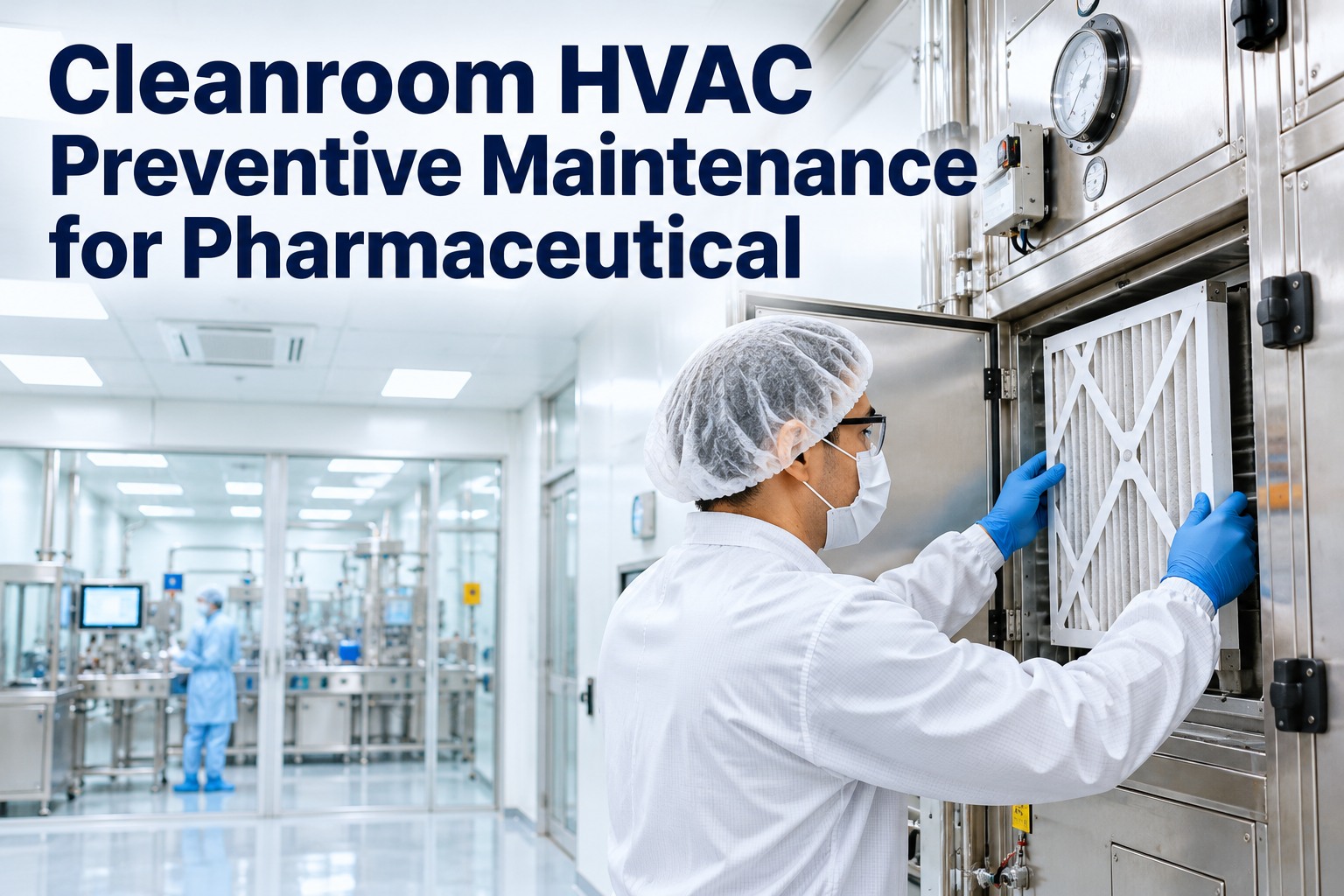
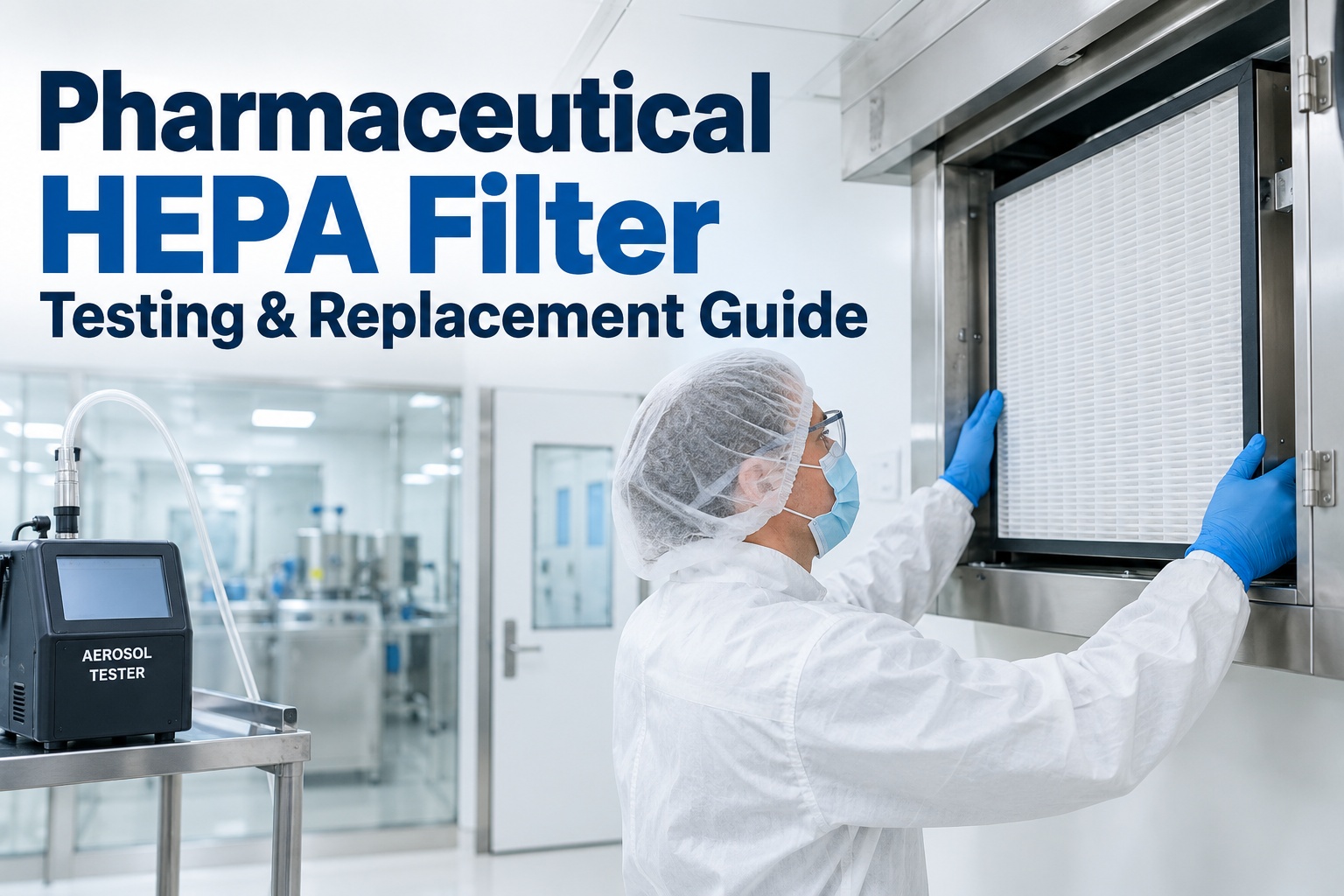
Pre-filter inspection monthly, HEPA pressure drop monitored continuously, integrity testing on schedule per grade, replacement triggered at 20% pressure-drop rise from clean baseline. Replacement evidence linked to filter serial number and OEM certificate.
Trigger Pressure-drop sensor + calendar PM
02
Pressure Cascade
Differential pressure between adjacent grades verified daily (Grade A–B), weekly (B–C, C–D), and continuously where DDC/BMS instrumented. Target 10–15 Pa cascade per grade transition. Drift greater than 30% from baseline triggers HVAC balancing or door seal inspection.
Trigger BMS continuous monitoring + manual logsheet
03
Temperature Mapping
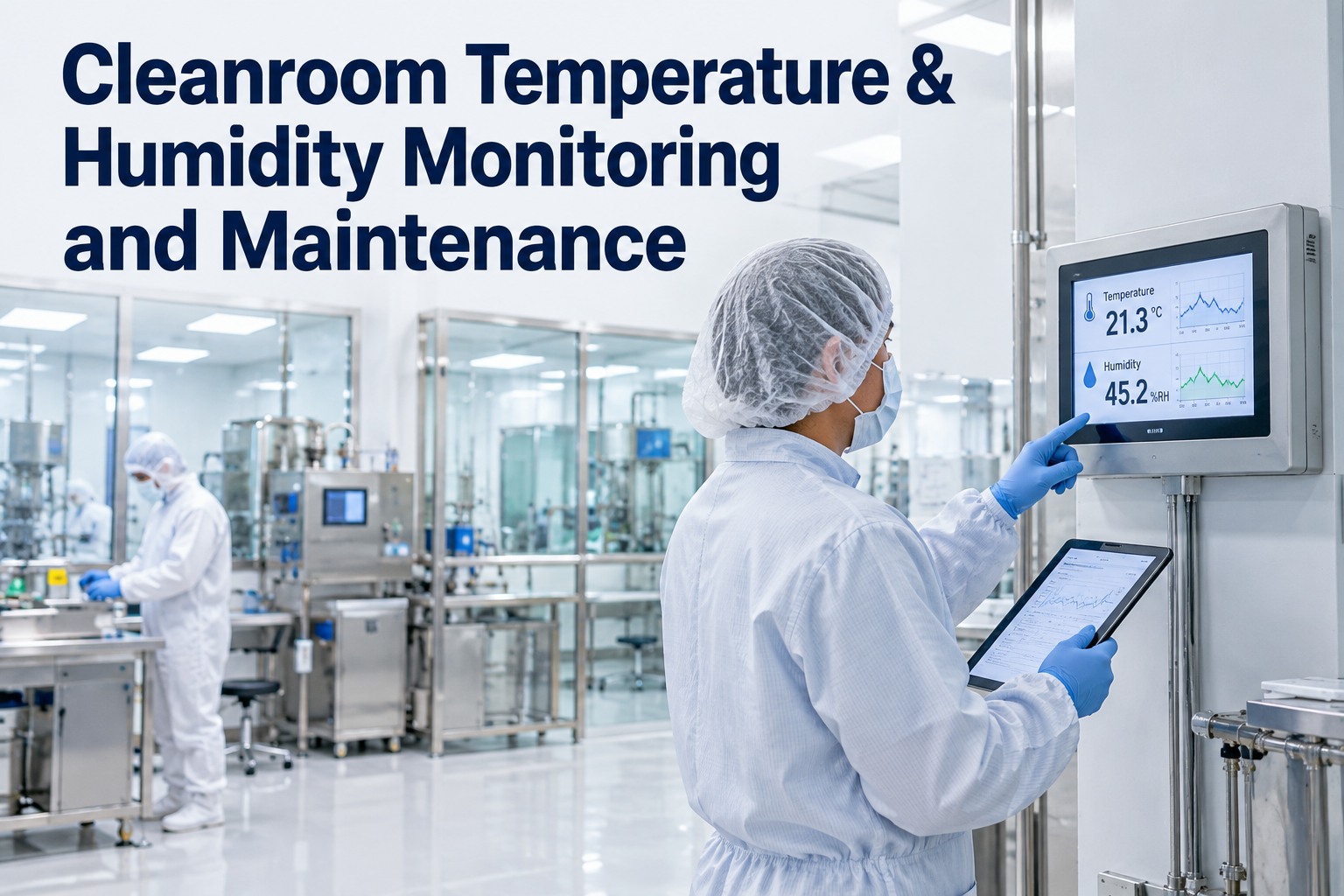
Annual temperature and humidity mapping per room with calibrated data loggers at validated positions. Mapping report compared to OQ baseline. Deviations greater than 1°C or 5% RH trigger investigation. Stability chambers and storage rooms mapped at higher density.
Trigger Annual calendar PM + change events
04
AHU & Equipment PM
Air handler coil cleaning, fan belt inspection, damper actuator function, condensate drain integrity, BMS sensor calibration. Tasks scheduled per OEM and risk-based criticality, with electronic signature on completion. PMs cannot lapse without change control.
Trigger Runtime hours + calendar
05
GMP Evidence Capture
Every task completion, every reading, every deviation captured in CMMS with timestamp, technician ID, electronic signature, and asset linkage. Inspection-ready exports per asset, per room, per regulatory framework. Audit trail immutable per 21 CFR Part 11.
Trigger Every work order completion
06
Requalification Cycle
Annual requalification for Grade A and B, every 24 months for Grade C and D. Triggered earlier by major changes, sustained deviations, or accumulated minor change controls. Requalification tasks pre-loaded as recurring work orders in CMMS.
Trigger Annual calendar + change accumulation
Stop Treating Cleanroom HVAC PMs Like Building Maintenance
OxMaint connects every HEPA, every pressure tap, every BMS sensor, and every PM into one GMP-validated trail. Inspectors get evidence in one click. Your maintenance team stops chasing paper.
PM Frequency Matrix by Asset and Grade
This matrix shows the minimum-defensible PM frequency for the critical cleanroom HVAC assets across each grade. Many pharma sites apply tighter intervals based on internal risk assessment — but going below these frequencies invites observations under FDA 21 CFR 211.42 and EU GMP Annex 1.
| HVAC Maintenance Task |
Grade A |
Grade B |
Grade C |
Grade D |
Evidence Captured |
| HEPA filter integrity test (DOP/PAO) |
6 months |
12 months |
12 months |
24 months |
Test certificate, technician ID, photo |
| HEPA pressure drop verification |
Continuous |
Continuous |
Weekly |
Weekly |
BMS log or manual reading |
| Pre-filter inspection & replacement |
Monthly |
Monthly |
Quarterly |
Quarterly |
Replacement record, filter serial |
| Pressure differential reading |
Continuous |
Continuous |
Weekly |
Weekly |
BMS trend or logsheet entry |
| Airflow velocity verification |
6 months |
12 months |
12 months |
24 months |
Anemometer reading per location |
| Air changes per hour calculation |
12 months |
12 months |
12 months |
24 months |
Volumetric airflow + room volume |
| Temperature & humidity mapping |
12 months |
12 months |
24 months |
24 months |
Calibrated logger data per position |
| AHU coil cleaning |
6 months |
12 months |
12 months |
12 months |
Pre/post photo + completion record |
| BMS sensor calibration |
6 months |
12 months |
12 months |
12 months |
Calibration certificate, NIST trace |
| Full HVAC requalification (PQ refresh) |
Annual |
Annual |
24 months |
24 months |
Requalification summary report |
The Live Cleanroom Dashboard — What OxMaint Surfaces in Real Time
Cleanroom HVAC is one of the few maintenance domains where slow drift is the dominant failure mode. A daily logsheet check cannot catch a HEPA pressure drop climbing 0.3 inches w.c. per month, or a pressure cascade losing 2 Pa per week. Continuous monitoring integrated with the maintenance system surfaces drift 3–8 weeks before classification breach.
Live Cleanroom HVAC Status — Suite 04 · Sterile Fill-Finish
Real-time · BMS & CMMS integrated
HEPA-A-04-12 — Pressure drop 22% above baseline
BAS Point HEPA_A04_12_DP · Reading 1.42 in.w.c. (Limit 1.30) · Auto WO-2026-3387 Created · Assigned HVAC Lead
Critical
Suite 04 — Grade B to C pressure cascade drifting
BAS Point PDIF_B_C_04 · Reading 8.6 Pa (Target 12–15 Pa) · Auto WO-2026-3388 Created
Warning
AHU-04 — Humidity trending up across last 72 hours
BAS Point AHU04_RH · Reading 56.8% RH (Limit 55%) · Pre-emptive WO under review
Moderate
BMS sensor SENS-04-T-08 — Calibration due in 12 days
Calibration PM-2026-1182 auto-scheduled · Technician notified · Certificate template attached
Low Priority
What Inspectors Actually Ask For — And What OxMaint Hands Them
FDA, EMA, MHRA, and notified-body inspectors converge on the same evidence requests during a cleanroom HVAC audit. The difference between a routine inspection and a 483 observation is whether your maintenance system can produce the evidence in the time the inspector waits.
"Show me HEPA filter integrity test results for the last three years on this Grade A suite."
OxMaint returns all DOP/PAO test certificates filtered by suite, sorted by date. Each certificate is linked to the filter serial number, technician ID, test equipment calibration certificate, and resulting work order. One click to download as audit package.
"What action was taken when the pressure cascade dropped below specification on March 14?"
OxMaint shows the BMS alarm timestamp, the auto-created deviation, the investigation work order, root cause assignment, CAPA reference, Quality approval signature, and the effectiveness verification follow-up — all linked to the original event.
"Are all BMS sensors in this suite within current calibration?"
OxMaint returns the calibration dashboard for the suite. Every sensor shown with last calibration date, due date, certificate link, NIST traceability reference, and current status. Overdue items flagged red with documented reason for any deferral.
"Show me the temperature mapping report and how you verified continued conformance since."
OxMaint links the annual mapping report to the continuous BMS trend data covering the period since. Any single-point deviation greater than 1°C or 5% RH is highlighted with the corresponding investigation reference.
Expert Review
"
In twenty-two years auditing cleanroom HVAC systems for pharma manufacturers across Europe and North America, the failure mode I see most consistently is not equipment failure. It is documentation failure. The HEPA filter is performing fine, the cascade is in tolerance, the AHU is running clean — but the maintenance team cannot produce the integrity test certificate from eighteen months ago when the inspector asks for it. That is the moment a routine inspection becomes a Form 483 observation. The single most valuable capability a maintenance system can provide a pharma site is not predictive analytics or fancy dashboards. It is the ability to retrieve any task completion record, any sensor calibration certificate, any deviation history, in the time an inspector is willing to wait — which is often less than ten minutes. That is what defensible cleanroom HVAC maintenance looks like in practice, and it is overwhelmingly a CMMS capability question, not an engineering question.
Dr. Helena Brückner, PharmD, RAC
EU GMP Annex 1 Specialist · Former MHRA Senior GMP Inspector · 22 years pharma cleanroom auditing · Lead consultant for sterile injectable, biologics, and ATMP facility qualification programmes · Co-author of three industry guidance documents on aseptic processing
Cleanroom HVAC Maintenance KPIs
Target 100%
PM Completion on Schedule
Percentage of cleanroom HVAC PMs completed within their scheduled window. Below 95% indicates a planning gap that will surface as a deviation pattern at audit. Grade A and B work cannot be deferred without change control.
Target Zero
Pressure Cascade Excursions
Number of cascade excursions outside the 10–15 Pa specification per month. Each excursion requires investigation, root cause, and CAPA. Recurring excursions in the same location point to door seal degradation or AHU balancing drift.
Less than 20%
HEPA Pressure-Drop Rise
HEPA filter pressure drop measured against clean baseline. Replacement is triggered at 20% rise. Operating above this threshold reduces airflow velocity and risks classification breach during peak room activity.
Target 100%
Calibration Currency
Percentage of BMS sensors, particle counters, and test instruments within their calibration window. Any overdue instrument used during a measurement event creates retrospective data integrity exposure across all readings taken in the overdue period.
Less than 5 days
Deviation Closure Cycle
Average days from cleanroom HVAC deviation creation to Quality-approved closure. Long closure cycles compound across multiple events and become a systemic finding under FDA quality system inspection.
Target 100%
Evidence Retrieval Time
Percentage of inspector evidence requests fulfilled from the CMMS within 10 minutes during audit. The single strongest indicator of audit readiness. Sites achieving 100% see substantially fewer 483 observations under maintenance and HVAC sections.
Frequently Asked Questions
Q1
How does OxMaint integrate with our existing BMS for pressure and HEPA monitoring?
OxMaint integrates with major BMS platforms — Siemens, Honeywell, Johnson Controls, Schneider — via OPC UA, BACnet, or REST API. Real-time pressure differential, HEPA pressure drop, temperature, and humidity readings stream into the CMMS where they trigger automated work orders when validated limits are breached. Historical trend data is retained alongside maintenance records for audit retrieval.
Sign in to OxMaint to review integration options for your facility.
Q2
What is the difference between continuous monitoring and periodic cleanroom certification?
ISO 14644-1 defines periodic classification testing — typically annual — that proves the cleanroom meets its classification at a point in time. ISO 14644-2 addresses ongoing monitoring between certification events. Continuous monitoring provides the evidence that classification is maintained day-to-day; periodic certification provides the evidence that it can be achieved under validated test conditions. Both are required under GMP, and inspectors will ask for both.
Q3
What happens if a HEPA filter integrity test is missed past its due date?
An overdue HEPA integrity test is one of the most commonly cited 21 CFR Part 211 observations on FDA Form 483 reports. The response depends on duration and scope — a short overdue period may require a documented investigation and impact assessment, while a sustained pattern can support a Warning Letter citing systemic quality system failure. Batches manufactured during the overdue window may be subject to retrospective impact review.
Book a demo to see how OxMaint prevents overdue events with 30/14/7 day automated alerts.
Q4
How often does pharma cleanroom HVAC need formal requalification?
Grade A and B cleanrooms typically require full requalification annually under EU GMP Annex 1. Grade C and D rooms are requalified every 24 months. Requalification is also triggered by major changes — HVAC modifications, room reconfiguration, accumulated minor change controls, sustained deviations, or relocation of critical equipment. OxMaint loads requalification cycles as recurring work orders and triggers ad-hoc requalification when change control events accumulate against an asset.
Q5
Does OxMaint satisfy 21 CFR Part 11 for cleanroom HVAC maintenance records?
Yes. OxMaint provides immutable audit trail, dual-component electronic signatures, role-based access controls, computer-generated timestamps, and a documented validation package for pharma deployment. The pharmaceutical manufacturer remains responsible for validating the CMMS in their specific environment — OxMaint provides the validation kit including VAQ, IQ/OQ protocol framework, and infrastructure qualification summary.
Sign in to activate Part 11 features or
book a demo to review the validation package.
Cleanroom HVAC Maintenance That Holds Up at Audit — Without the Paper Trail
OxMaint connects HEPA tracking, pressure cascade monitoring, temperature mapping, AHU PMs, and GMP evidence into one validated platform. Every task linked to an asset. Every reading linked to a sensor. Every signature compliant with Part 11. Inspector evidence retrieved in seconds, not days.