FDA investigators do not arrive on a schedule. When they do arrive, they request equipment maintenance logs, calibration records, deviation investigations, and CAPA documentation — and they expect those records to be produced within two hours. Under 21 CFR 211.67 (equipment cleaning and maintenance), 211.192 (production record review and deviation investigation), and 211.68 (calibration), pharmaceutical manufacturers are required to maintain complete, accurate, and immediately retrievable records. In 2024 FDA inspections of sterile facilities, these three CFR sections collectively appeared in nearly 70% of all Form 483 observations issued. The failure in the majority of citations was not that maintenance was skipped — it was that the records could not be produced, cross-referenced to deviations, or linked to corrective actions in a way that satisfied inspector scrutiny. Book a demo to see how OxMaint transforms pharma maintenance documentation into an audit-ready evidence system — or start free and run your first mock audit readiness check today.
FDA Audit Readiness · cGMP Maintenance · 21 CFR 211
FDA 483 Maintenance Response for Pharma Plants
Equipment logs, calibration records, deviation evidence, and CAPA trails — produced within 2 hours, linked to the right batch, and structured exactly the way FDA investigators expect to see them.
70%
Of 2024 sterile facility 483s cited equipment, maintenance, or deviation records
2 hrs
Maximum time to produce requested maintenance records during an FDA inspection
211.67
Top 3 CFR citation in 2024 — equipment cleaning and maintenance records
ALCOA+
Data integrity standard — Attributable, Legible, Contemporaneous, Original, Accurate
The 2024 FDA 483 Maintenance Observation Map — What Inspectors Actually Cited
| CFR Section |
What It Requires |
Most Common 483 Observation Language |
What OxMaint Provides |
| 21 CFR 211.67 |
Written procedures for equipment cleaning and maintenance; records of each cleaning, maintenance, and sanitisation |
"Firm's preventive maintenance records were incomplete / could not demonstrate equipment was maintained per written programme" |
Digital PM work orders with completion timestamps, technician attribution, and equipment-specific checklists — retrievable per asset in under 60 seconds |
| 21 CFR 211.192 |
All unexplained discrepancies investigated; production record reviewed before batch release; CAPA documented |
"Deviations were not investigated with adequate root cause analysis; corrective actions were not documented or verified" |
Structured deviation workflow with mandatory RCA fields, CAPA assignment, effectiveness verification, and linked batch record — all timestamped and audit-trailed |
| 21 CFR 211.68 |
Equipment calibrated at suitable intervals per written programme; calibration records retained |
"Calibration records were not maintained / instruments were used outside calibration validity period" |
Automated calibration schedules with overdue alerts; calibration certificates stored per instrument asset; blocked from use if overdue |
| 21 CFR 211.100 |
Written procedures for production; deviations from written procedures documented and justified |
"Firm deviated from approved procedure without documentation or investigation" |
Work order completion requires step-by-step confirmation; deviations from procedure trigger automatic deviation record creation |
| 21 CFR 211.160(b) |
Laboratory controls must include calibration of instruments and validation of test methods |
"Laboratory instruments were not calibrated / calibration records did not demonstrate traceability to NIST standards" |
Calibration records carry standard reference, certificate number, and NIST traceability — formatted for immediate inspector review |
Paper Records vs OxMaint — What the Inspector Sees at 9:00 AM
Without OxMaint
✕
Maintenance logs in binders across multiple departments — retrieval takes hours
✕
Equipment ID on the log does not match batch record reference — traceability gap
✕
Deviation raised but CAPA assigned verbally — no documented owner, no timeline, no closure record
✕
Calibration certificate in a separate file from the equipment log — inspector must request both separately
✕
Overdue calibration discovered only after inspector flags the instrument — reactive, not proactive
With OxMaint
✓
Inspector types equipment ID — full maintenance history with timestamps on screen in under 60 seconds
✓
Equipment record linked directly to batch record, calibration certificate, and all deviations for that asset
✓
Every deviation has a named owner, target date, root cause field, and electronic CAPA closure with effectiveness verification
✓
Calibration certificate, acceptance criteria, and next-due date all on the same asset record — one screen, no hunting
✓
Overdue calibrations flagged 30 days before expiry — equipment tagged as restricted if not renewed on time
See the Inspection-Ready Dashboard FDA Investigators Expect
OxMaint structures your pharma maintenance programme around the five CFR sections that generate the most Form 483 observations — so every document an inspector requests is ready before they ask.
The 5 Audit Readiness Disciplines OxMaint Automates
01
Equipment Maintenance Records
Every PM work order timestamped, attributed, and linked to the asset
OxMaint generates PM work orders on schedule per equipment ID, requires step-by-step completion confirmation, captures the technician's name and timestamp at each step, and stores the completed record against the asset — so any inspector query "show me the maintenance records for autoclave AC-04" produces the full history in under a minute without file cabinet searches.
21 CFR 211.67 — Equipment cleaning and maintenance records
02
Deviation and CAPA Workflow
Structured investigation from observation to verified closure
Every deviation raised in OxMaint must have a root cause category, a named CAPA owner, a target closure date, and an effectiveness verification step before it can be closed. Inspectors reviewing deviation records find a complete trail from the original observation through investigation to corrective action — not a deviation log entry with "closed" and no follow-up evidence.
21 CFR 211.192 — Production record review and deviation investigation
03
Calibration Traceability
Certificate, due date, and NIST reference — one asset record
OxMaint stores the calibration certificate, acceptance criteria, calibration standard reference, NIST traceability chain, and next-due date against each instrument asset. Overdue instruments are flagged 30 days in advance and restricted from GMP use if the calibration deadline passes. The full calibration history per instrument is exportable as a formatted report for the inspector's file.
21 CFR 211.68 and 211.160(b) — Calibration records and laboratory instrument controls
04
Batch-Equipment Linkage
Every batch traceable to every piece of equipment it touched
When an inspector asks "which equipment was used for batch 2024-0441 and what was its maintenance status at the time of manufacture," OxMaint returns the answer directly — equipment IDs, last PM dates, calibration validity at time of manufacture, and any open deviations. This linkage is the document that prevents a maintenance finding from escalating to a batch disposition question.
21 CFR 211.68 and 211.192 — Equipment history and batch record traceability
05
Data Integrity and ALCOA+
Electronic records that paper records structurally cannot produce
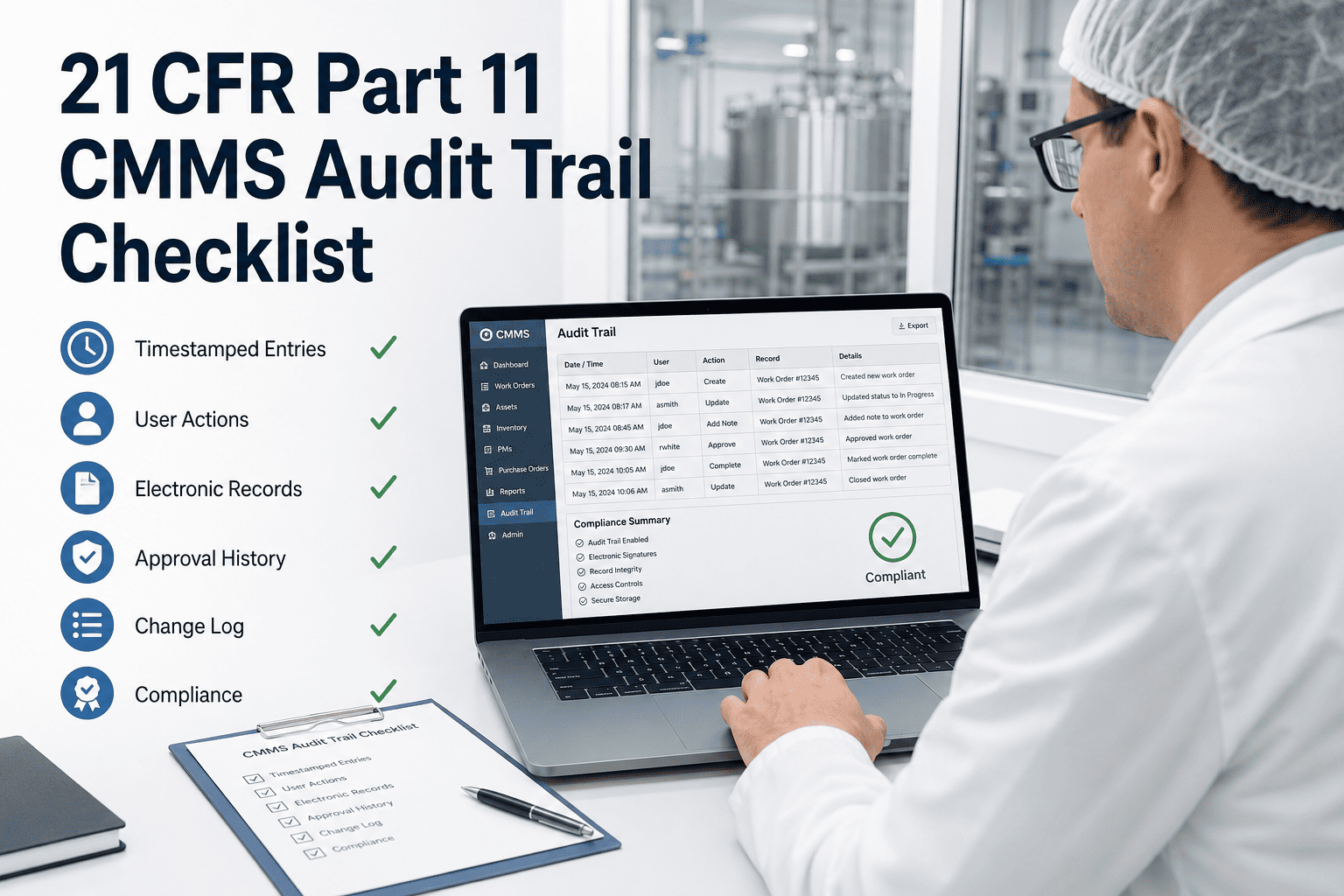
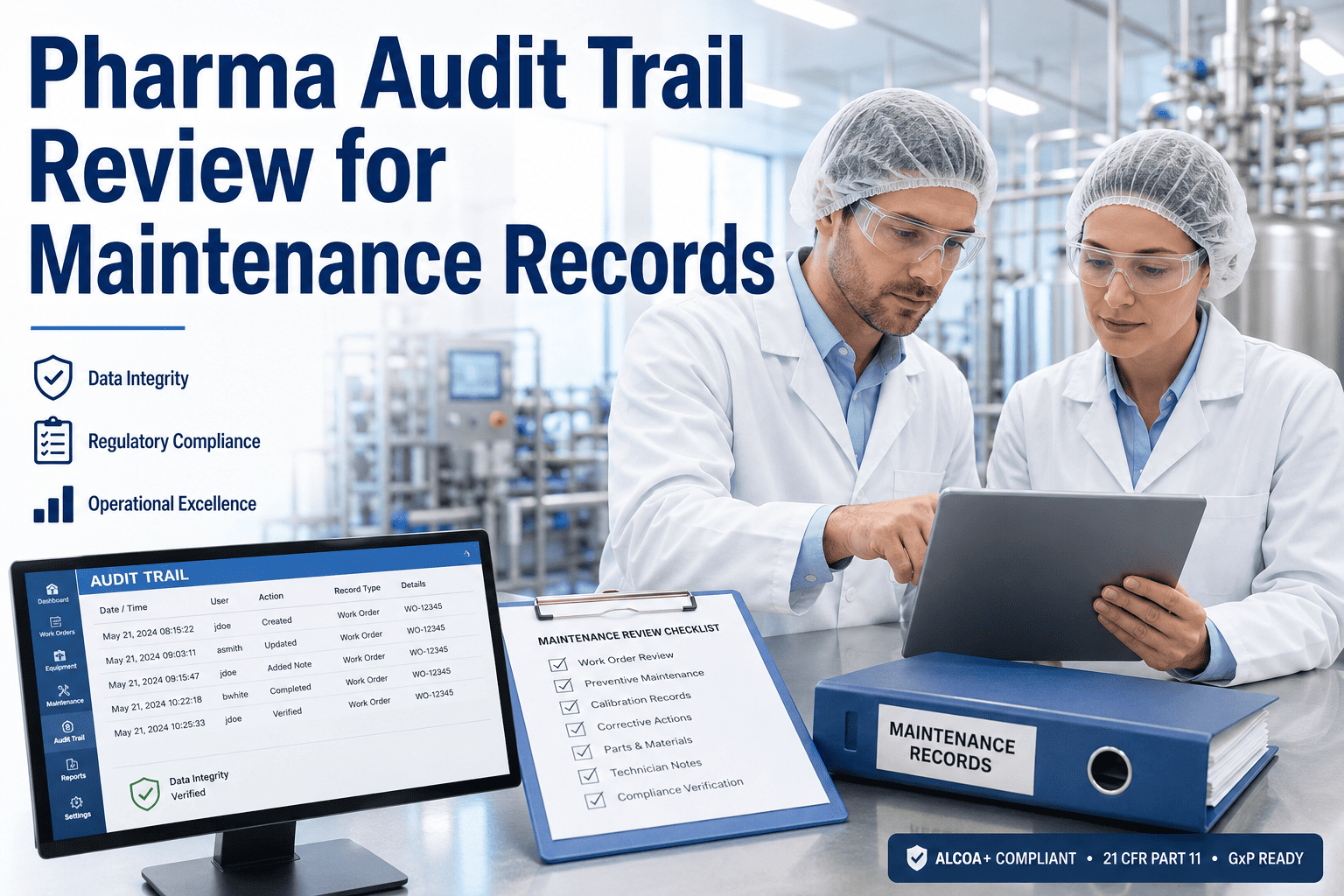
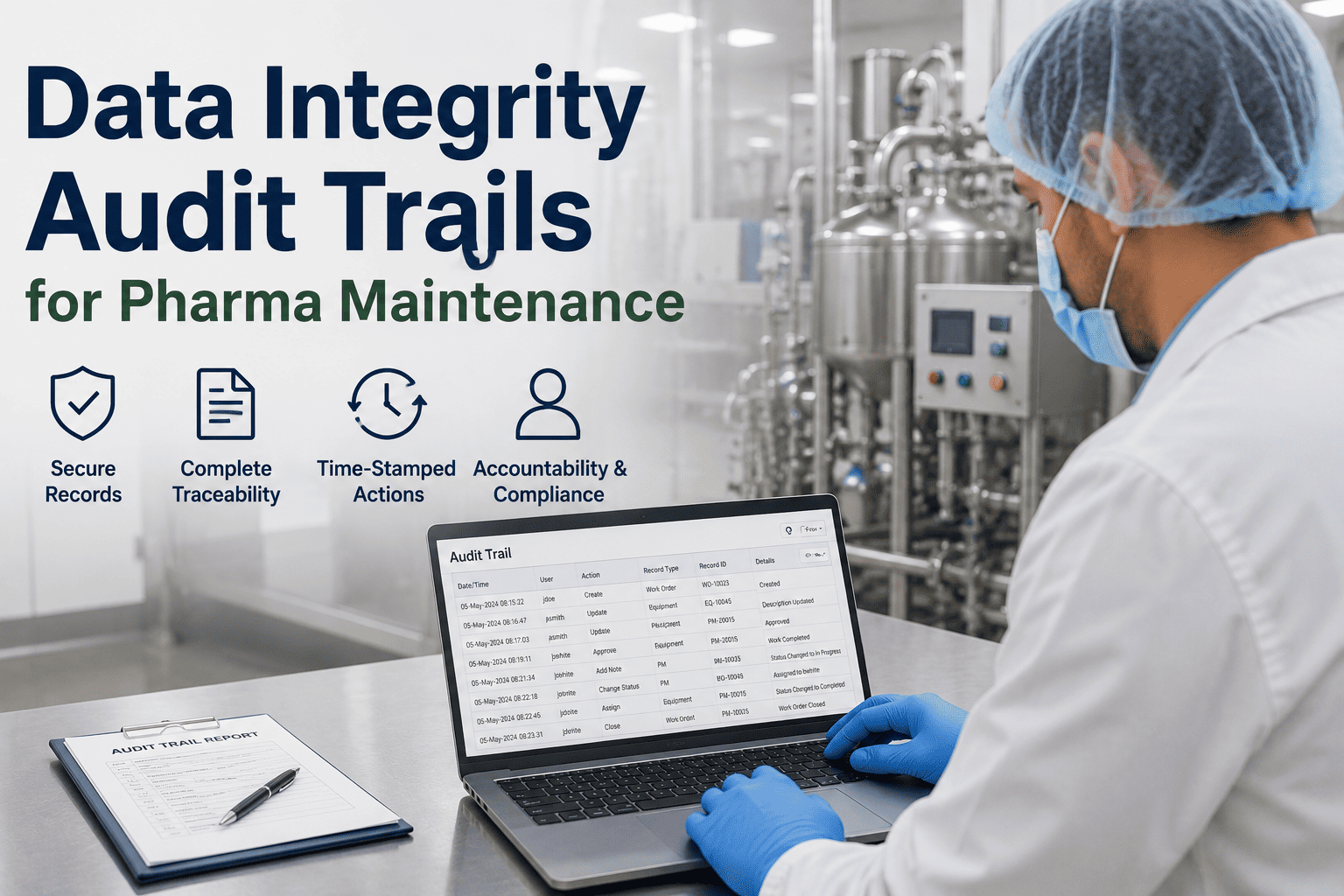
Every OxMaint record satisfies ALCOA+: Attributable (named user with role), Legible (digital, not handwritten), Contemporaneous (server-generated timestamp at event), Original (audit trail shows every change with who changed it and when), Accurate (calculated fields auto-populated, not manually transcribed). 21 CFR Part 11 electronic records and signatures compliance is built into the platform — the data integrity standard FDA increasingly demands at every inspection.
21 CFR Part 11 — Electronic records and electronic signatures; ALCOA+ data integrity
Expert Review
"In every FDA inspection I have participated in as a quality director, the first 30 minutes determines the tone of the entire inspection. If you can produce the maintenance log for a specific piece of equipment, the deviation record for a specific batch event, and the calibration certificate for a specific instrument — all within the time it takes the investigator to pour their first coffee — the inspection moves forward in your favour. The facilities that struggle are the ones where retrieving those three documents requires three different people, two different filing systems, and a phone call to the maintenance department. What FDA is testing in those first 30 minutes is not whether your records exist. They know your records exist — you told them in your Quality Management System documentation. They are testing whether your records are immediately retrievable, whether they are cross-referenced to the right batch and the right deviation, and whether the CAPA that was supposed to be closed six months ago is actually closed with effectiveness evidence. OxMaint is the system that makes yes the answer to all three of those tests — not by creating new compliance, but by making the compliance you are already achieving immediately visible."
Jonathan Reyes, RAC, CQA
Regulatory Affairs Certified · Certified Quality Auditor (ASQ) · 17 years FDA inspection readiness and pharmaceutical quality systems · Former FDA Office of Pharmaceutical Quality consultant · Specialist in cGMP maintenance documentation and Form 483 response strategy for North American manufacturing sites
Frequently Asked Questions
What maintenance records does the FDA most commonly request during a pharma inspection?
The most frequently requested maintenance records during FDA inspections are:
preventive maintenance logs for critical processing equipment (autoclaves, tablet presses, filling lines) covering the period under review;
calibration records for instruments used in batch testing or process control, including calibration certificates and NIST traceability;
deviation records for any maintenance-related event that occurred during the batch period; and
CAPA closure records for any maintenance-related observations from the previous inspection. All must be produced within approximately two hours and must satisfy ALCOA+ data integrity requirements.
Book a demo to see how OxMaint structures all five record types for immediate retrieval.
What does 21 CFR 211.67 require for pharmaceutical equipment maintenance records?
21 CFR 211.67 requires that drug manufacturers establish and follow written procedures for equipment cleaning and maintenance, including schedules, methods, and materials used. Records must document each cleaning, sanitising, and maintenance operation and must identify the equipment, the date and time of the operation, and the personnel who performed it. Records must be readily available for FDA inspection and retained for at least one year beyond the expiry date of the last batch produced on that equipment. Inspectors check that the written procedure matches what the records show was actually done — discrepancies between the SOP and the maintenance log are a common 483 observation pathway.
How quickly must a pharma plant produce maintenance records during an FDA inspection?
Industry guidance and FDA expectation is that
requested records should be produced within approximately two hours of the inspector's request. Failure to produce records within a reasonable timeframe can itself become an observation — it signals that the record management system is inadequate for immediate retrieval, which is a data integrity concern. Plants that rely on paper binders across multiple departments routinely fail the two-hour standard.
Start free to configure OxMaint's audit retrieval dashboard for your maintenance records.
What is the difference between a Form 483 and an FDA Warning Letter in the context of maintenance?
A Form 483 is an Inspectional Observations form issued at the end of an FDA inspection listing conditions observed that may violate cGMP. It is not a regulatory action — it is a formal list of concerns that the firm must respond to in writing within 15 business days with a CAPA plan. A Warning Letter is issued when FDA determines that the inspectional observations represent significant violations and that the firm's response to the 483 was inadequate or the violations are recurring. Warning letters are public, can trigger Import Alert 66-40 blocking shipments, and require a comprehensive response. Maintenance-related 483 observations under 211.67 that are not adequately corrected frequently escalate to Warning Letter status.
FDA Investigators Are Not Checking If Your Maintenance Was Done. They Are Checking If Your Records Prove It.
OxMaint gives North American pharma manufacturing sites the audit-ready maintenance records, deviation trails, calibration evidence, and CAPA documentation that turn a two-hour FDA document request into a two-minute export.