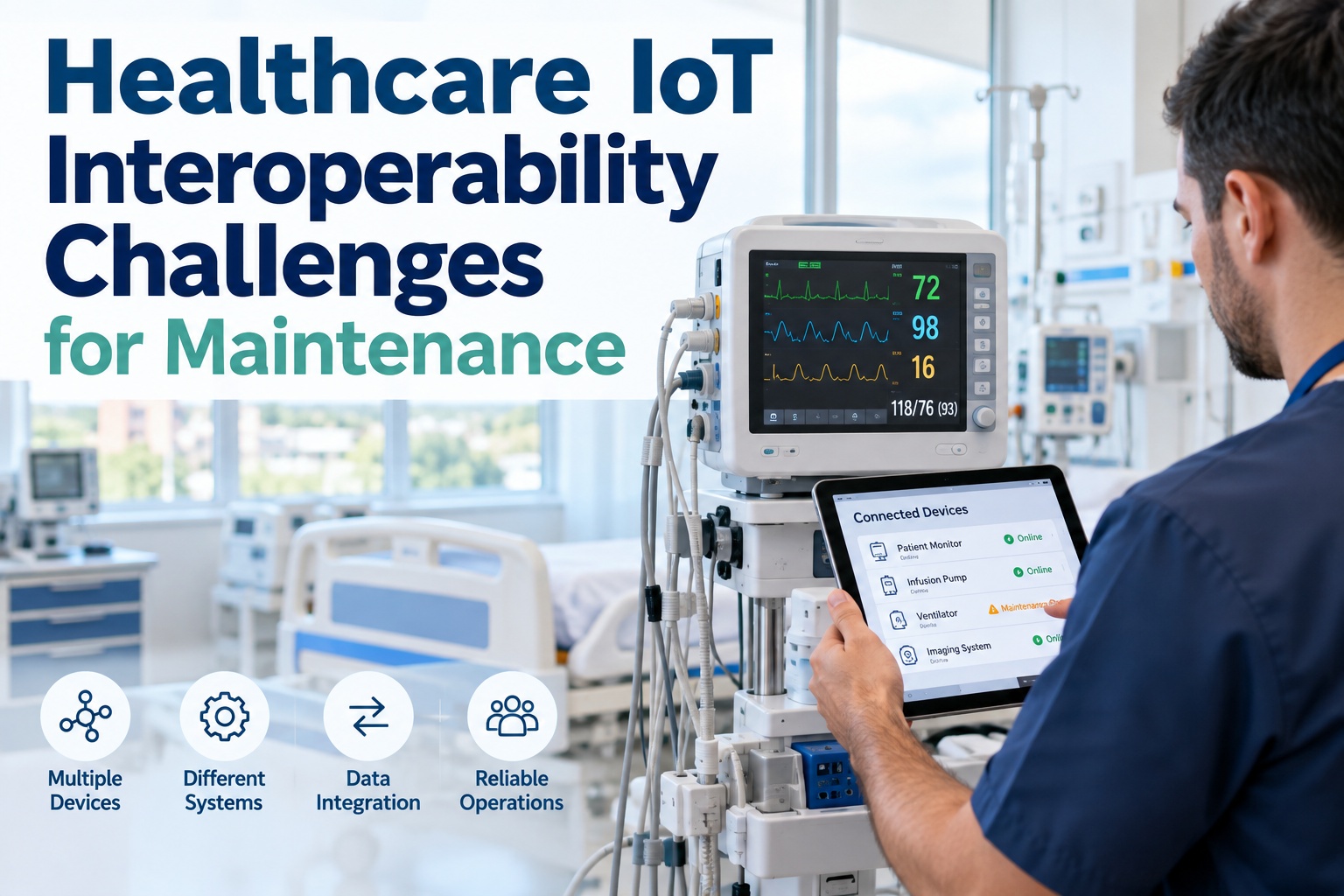
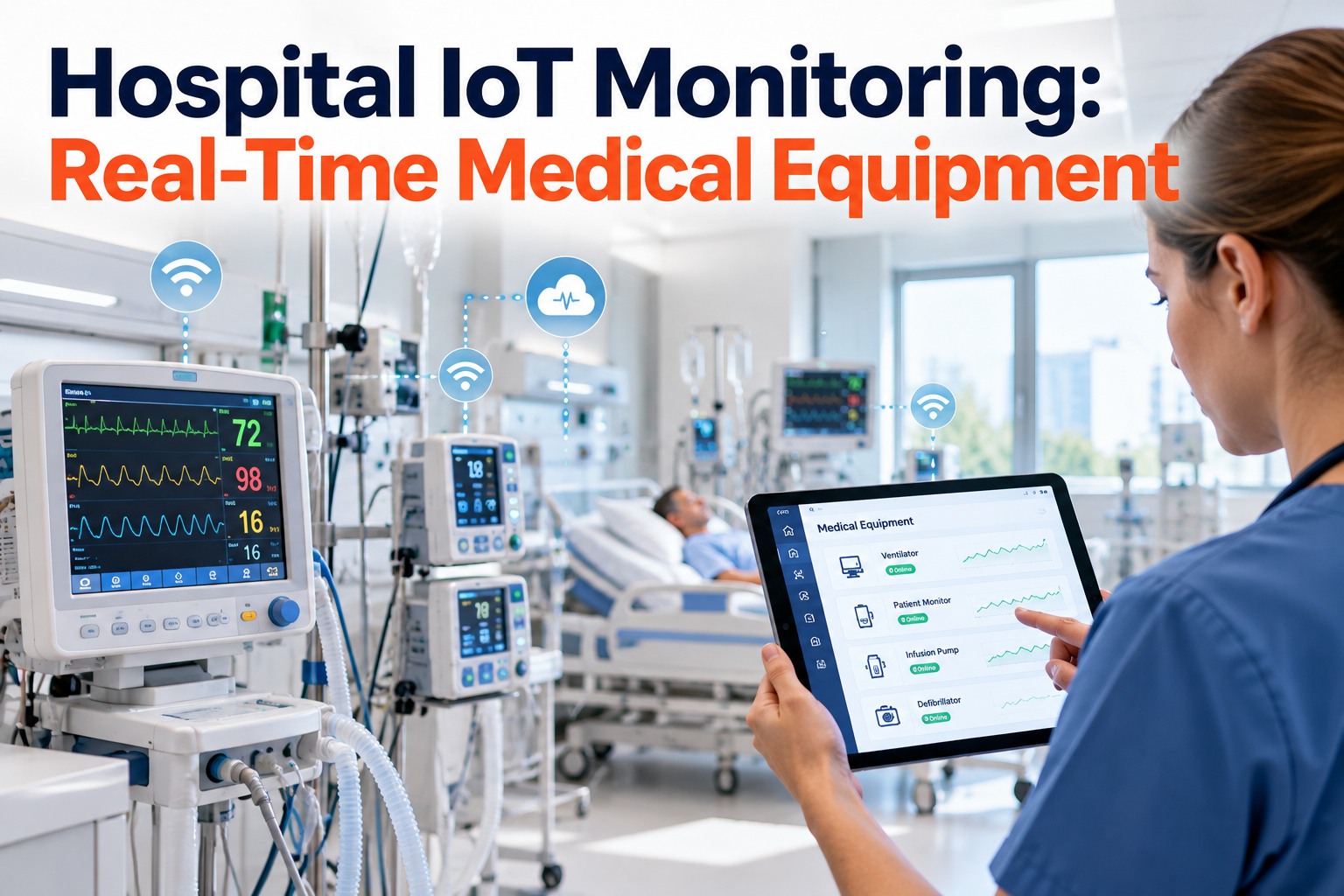
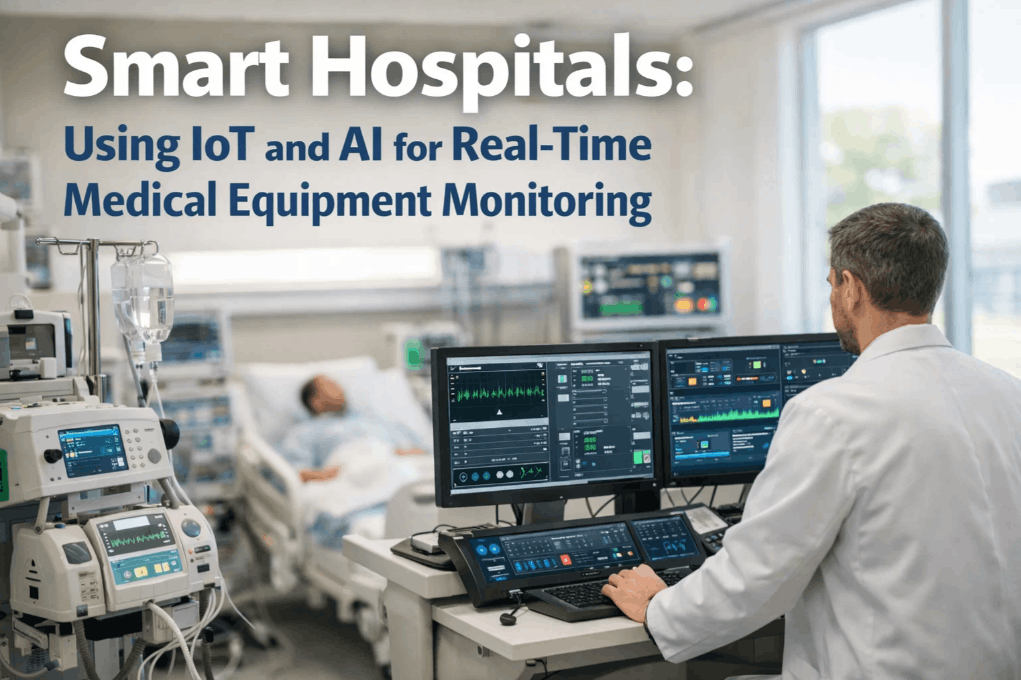
A hospital ICU can have 10 to 15 connected devices per patient, including monitors, infusion pumps, and ventilators. These devices often use different protocols, from legacy serial connections to Bluetooth and proprietary gateways. This fragmentation makes it difficult for maintenance teams to monitor device health and detect failures early. This guide explains key healthcare IoT interoperability challenges and how maintenance teams can address them.
Healthcare IoT · IoMT Interoperability · Maintenance Visibility · 2026
Your Devices Speak Five Different Languages. Your Maintenance Team Needs One.
OXMAINT AI connects medical devices across different protocols, captures condition data, and turns flagged readings into inspections or work orders on one unified asset record.
10–15 devices
commonly connected to a single ICU patient at once, each a potential protocol island
6+ standards
HL7 v2, HL7 FHIR, IEEE 11073, DICOM, IHE PCD and BLE/HDP all in active hospital use
4 layers
physical, transport, device-communication and clinical-data layers each device stack must cross
IEC 80001
the risk-management standard specifically covering IT networks incorporating medical devices
The Interoperability Stack, Layer by Layer
A device's data doesn't reach a maintenance dashboard in one hop — it crosses several distinct layers, and a break at any one of them is enough to lose the signal. Start free and see where your devices actually break down.
1
Physical Layer
USB, RS-232, Bluetooth, Wi-Fi, Ethernet — the raw connection a device uses to communicate at all.
2
Transport Layer
How data actually moves across the network — often where legacy devices bottleneck.
3
Device Communication
IEEE 11073 (point-of-care) or IEEE 11073 SDC (service-oriented, OR/ICU) structures the device's own data model.
4
Clinical Data Exchange
HL7 v2 or FHIR carries that data into the EHR, analytics platform, or maintenance system.
Why Hospital IoT Is Harder Than Standard Building IoT
A vibration sensor on a chiller and a vitals monitor on a patient are both "IoT," but the constraints around them aren't remotely similar. Book a demo to see how this shapes a healthcare-specific maintenance setup.
Standard Facility IoT
Devices typically support common protocols (Modbus, BACnet, MQTT)
Network segmentation is a convenience, not a patient-safety requirement
Device lifespan often 5–10 years before replacement
Downtime is a cost problem
Healthcare IoMT
Protocols vary by manufacturer, often proprietary or licensed separately
Network segmentation is a cybersecurity and patient-safety requirement (IEC 80001)
Legacy medical devices routinely stay in service well beyond typical IT hardware life
Downtime can be a direct patient-safety problem
Where Interoperability Actually Breaks Down
Sign up free and start mapping which of these apply to your device fleet.
Protocol Fragmentation
Different device generations and vendors export data in incompatible formats — some proprietary, some standards-based but different standards.
Legacy Device Longevity
Medical equipment often stays in clinical service for 10+ years, well past when its original connectivity approach was current.
Vendor Lock-In
Some manufacturers gate data export behind a proprietary gateway or licensing fee, limiting what a third-party system can access.
Network Segmentation
Medical device networks are often deliberately isolated for cybersecurity reasons — which also complicates centralizing condition data.
One Condition View, Regardless of the Protocol Underneath
OXMAINT AI ingests device and equipment data across the standards your fleet actually uses — HL7, IEEE 11073, direct sensor feeds, or manual entry where a device predates all of them — and turns a flagged condition into an inspection or work order on one unified asset record.
From Device Signal to Maintenance Action
01
Signal Captured
Device data ingested via its native protocol — HL7, IEEE 11073, direct feed, or manual log where needed.
02
Normalized to Asset Record
Reading mapped to the specific device's asset record, regardless of source format.
03
Threshold Checked
Condition compared against that device's own baseline — calibration drift, connectivity loss, or fault code.
04
Inspection or Work Order Opens
Biomedical technician assigned, with device history and protocol details attached.
Interoperability Audit Checklist
Book a demo and run this checklist against your device inventory.
✓
Inventory each device's actual protocol — don't assume; legacy units often differ from their listed spec sheet.
✓
Identify vendor-gated data — flag any device whose condition data requires a paid or proprietary gateway.
✓
Confirm network segmentation compatibility with IT/cybersecurity before assuming a device can be centrally monitored.
✓
Plan for manual entry fallback on devices too old to export data at all — don't leave them invisible to the maintenance system.
✓
Map data to one asset record per device, not a separate dashboard per protocol or vendor.
✓
Review with biomedical and IT/security together — interoperability decisions touch both domains.
Frequently Asked Questions
What's the difference between IEEE 11073 and HL7 FHIR?
IEEE 11073 focuses on cross-vendor, device-to-device communication — getting a monitor, pump or ventilator to describe itself and its readings in a standard way. HL7 FHIR focuses on exchanging health data between software systems, like getting device readings into an EHR or analytics platform. Both are often needed together in a fully connected clinical environment.
Why do so many hospital devices still use proprietary protocols instead of open standards?
Device lifespans in healthcare are long, and many devices in active use were designed before current interoperability standards matured or became widely adopted. Vendor-specific gateways also sometimes persist because they're a revenue line for the manufacturer, not just a technical necessity.
Does connecting medical devices for maintenance monitoring create a cybersecurity risk?
It can, if not planned with IT/security involved — which is why standards like IEC 80001 exist specifically to manage risk on IT networks incorporating medical devices. Network segmentation and careful scoping of what data flows where are standard parts of doing this safely, not an afterthought.
What happens with devices too old to support any of these standards?
They generally need a manual data-entry fallback — inspection readings, calibration checks and condition notes logged by a technician rather than pulled automatically. The goal is that the device still has a maintained record, even without automated connectivity.
Can OXMAINT AI connect to devices using multiple different protocols at once?
Yes — OXMAINT AI is designed to ingest condition and connectivity data from whatever mix of protocols a hospital's device fleet actually uses, mapping each device's readings back to a single asset record regardless of the underlying communication standard.
Give Every Device One Record — However It Actually Talks.
Unify condition data across HL7, IEEE 11073, proprietary gateways and legacy devices that predate all of them — so a failing connection or drifting reading becomes a work order, not a blind spot.