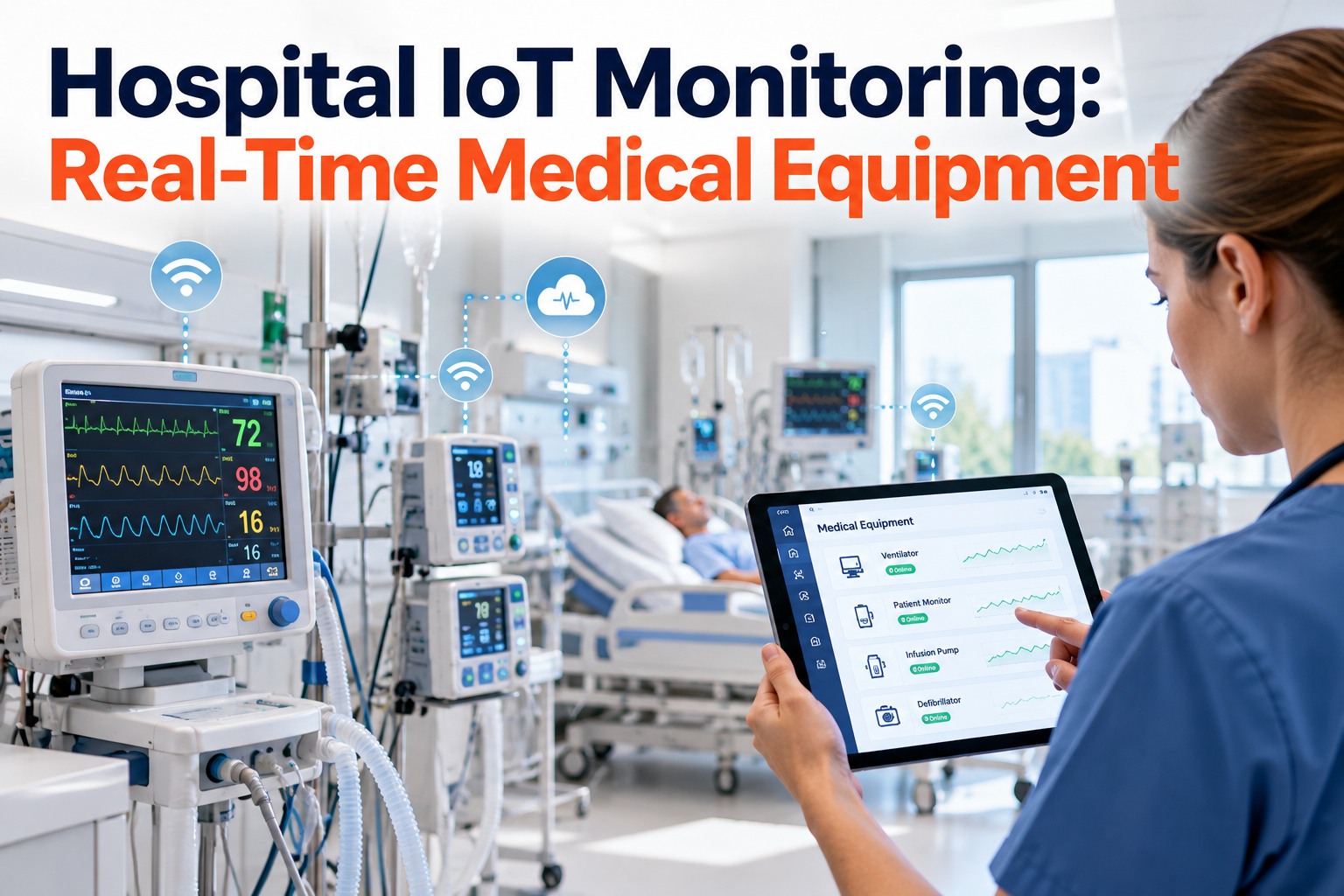
Hospital IoT Monitoring: Real-Time Medical Equipment

By William Jerry on September 29, 2026

hospital-iot-monitoring-real-time-medical-equipment

An infusion pump fails mid-shift. A nurse walks three floors to find a spare that isn't there. A ventilator's PM comes due and no one notices until it's overdue. None of these are equipment problems — they're visibility problems, and the fix is software, not more hardware. OXMAINT AI is the AI-powered maintenance management software that turns your hospital's IoT signals into action — every connected device's location, status and condition flows into one platform, and every alert that crosses a threshold becomes a tracked, prioritized work order automatically.

Hospital IoT · IoMT · Real-Time Equipment Monitoring · 2026

Hospital IoT Monitoring: See Every Medical Device in Real Time

Nurses hunting for a pump. A fridge drifting out of range overnight. A ventilator PM that slips past due. OXMAINT AI, the AI-powered CMMS and maintenance management software, closes those gaps on one platform: device signals and inspections become logged issues, issues become ranked work orders, and every asset stays on an automated preventive and predictive schedule — so a problem turns into a fix in minutes, not shifts.

1Signal / Inspect → 2Issue → 3Work Order → 4PM / PdM
LIVE DEVICE BOARD
Infusion Pump · 4W-12Running
Vital Monitor · ICU-07Running
Ventilator · ICU-03Battery 22%
Fridge · Lab-B24.1°C OK
Fridge · Pharm-18.6°C ALERT
Infusion Pump · 3E-09PM Overdue
2 signals raised → 2 work orders drafted automatically
~42%
average utilization of mobile medical equipment without live tracking
~11%
of movable assets unlocatable on any given shift
$1.1M
annual clinical labor lost to equipment search at a 400-bed hospital
100%
documented PM required on medical equipment (TJC EC.02.04.01)

What "Real-Time Monitoring" Actually Means in a Hospital

Hospital IoT monitoring isn't one gadget — it's a stream. Every device reports where it is, whether it's in use, and what condition it's in. On their own those signals are just dashboard noise. The OXMAINT AI software reads every one and turns the ones that matter into scheduled work — so no one has to watch a screen. Start free and put your device fleet on a live board in OXMAINT AI.

Location
RTLS, BLE beacons and RFID put every mobile asset on a live floor map — no more walking the wards to find a pump.
Utilization
Usage sensors separate in-use from idle from lost — so you buy against real demand, not availability complaints.
Condition
Battery health, temperature, runtime hours and fault codes flag a developing failure days before it strands a device.
Compliance
Every reading is timestamped and retained — PM records, recalls and inspections become a query, not a scramble.

From Silent Sensor to Closed Work Order

A "smart" device is only as useful as what happens after it speaks. In most hospitals the signal dead-ends in a dashboard nobody watches. OXMAINT AI runs the full chain on one event stream — a low battery or an out-of-range fridge becomes a prioritized, assigned, verified work order on its own. Book a demo to watch a live signal become a work order in OXMAINT AI.

01
Device Streams a Signal
A pharmacy fridge reads 8.6°C. The IoT sensor pushes the reading to OXMAINT AI the moment it crosses the safe range.
↓
02
Threshold Breach Becomes a Defect
OXMAINT AI recognizes the excursion, opens a defect record, and tags the asset by its criticality class automatically.
↓
03
Work Order Auto-Drafts
A work order is created with the device ID, the exact reading, service history and location already attached — no manual entry.
↓
04
Routed & Escalated by Priority
Life-critical and compliance-weighted assets jump the queue; overdue or missed tasks escalate to a supervisor, never go silent.
↓
05
Verified & Recorded
The tech closes the order with evidence; the reading returns to range; the full chain is retained for the next survey.

What the Sensors Watch — Device by Device

Not every device streams the same signal, and not all matter equally. OXMAINT AI lets you map the right condition metric to each device class. Here's what it watches across the four families that hurt most when they go dark. Sign up free and map your own device classes in OXMAINT AI.

Device familyLive signal watchedWhat a breach meansAuto-action
Infusion & syringe pumps Location, battery, runtime hours, fault codes Lost, dying battery, or PM due Locate + draft PM work order
Ventilators & life-support Battery health, self-test status, run hours Failed self-test or overdue check Priority WO + supervisor escalation
Cold-chain (fridges/freezers) Temperature, door state, power Excursion risking meds/samples Immediate alert + corrective WO
Imaging & diagnostics Error logs, uptime, calibration due Downtime or calibration lapse Scheduled WO + calibration record

A Dashboard Full of Alerts Has Never Fixed a Single Device.

The point of hospital IoT isn't more signals — it's fewer surprises. The OXMAINT AI maintenance management software turns each condition alert into a ranked, assigned, verified work order, so your biomed team spends its hours fixing what matters, not decoding a wall of notifications.

Priority Is a Patient-Safety Decision, Not a Timestamp

When two devices signal at once, which gets fixed first? A fixed queue answers by clock; OXMAINT AI answers by consequence — classifying every asset by patient impact, so a ventilator's overdue check never waits behind a lobby TV. It's the same logic that runs a compliant Alternative Equipment Maintenance (AEM) program. Book a demo to see criticality routing on your device list in OXMAINT AI.

LIFE-CRITICAL
Ventilators · defibrillators · infusion pumps · anesthesia
Any signal → immediate work order + supervisor escalation. Highest priority; manufacturer PM intervals enforced.
HIGH-RISK
Imaging · cold-chain storage · lab analyzers · monitors
Condition breach → same-shift corrective work order. Excursions and calibration lapses raised at once.
GENERAL
Beds · pumps (non-critical) · wheelchairs · general HVAC
Routine cadence with AEM-eligible, risk-based PM intervals set from the device's own performance data.
SUPPORT
Non-clinical fixtures · furniture · cosmetic items
Scheduled or on-condition only — never allowed to crowd out a clinical signal.

The Payoff: Three Numbers That Move

Real-time monitoring changes the math in three places: the hours staff lose searching, the capital spent on "missing" equipment, and the evidence you can produce on survey day. All three trace back to the one live stream OXMAINT AI collects, ranks and acts on. Start free and see your device fleet on one board in OXMAINT AI.

Staff Hours Back
Nurses lose up to an hour a shift searching for equipment. A live floor map replaces the search with a glance — hours returned to patient care.
Capital Freed
Fleets that seem short are usually just misplaced — utilization near 42% means you own more than you use. Real usage data replaces reflex re-ordering.
Survey-Ready
100% documented PM is a Joint Commission requirement. A monitored fleet keeps every record timestamped — audits become a query, not a fire drill.

Built to Connect — Securely — to What You Already Run

IoT monitoring only works if the data lands where it can act — and stays protected on the way. OXMAINT AI ingests signals from RTLS, BLE, RFID and device sensors, and keeps electronic records with the audit trails and access controls hospital IT expects. Book a demo to review the integration and security model in OXMAINT AI.

SIGNALS IN
RTLS, BLE beacons, RFID checkpoints and device condition sensors feed one live asset registry.
RECORDS
Electronic records with timestamped audit trails and role-based access — built for 21 CFR Part 11 expectations.
AEM EVIDENCE
PM completion and failure rates per device class generate the evidence an AEM program needs on inspection.
DEVICE SECURITY
Full device visibility supports the lifecycle and cyber-hygiene posture modern connected-device rules now demand.
“

We had eleven "missing" infusion pumps on order before we turned on live tracking. It turned out nine of them were sitting idle in three supply rooms two floors apart. The real win wasn't finding them — it was that the low-battery and overdue-PM signals now open a work order on their own. Our biomed team stopped chasing the board and started clearing it.

Director of Clinical Engineering · Regional Medical Center

Frequently Asked Questions

What is hospital IoT monitoring, in plain terms?
It's connecting medical equipment so each device continuously reports its location, usage and condition to one live view. The real payoff comes when a condition signal automatically becomes a maintenance action — which is exactly what the OXMAINT AI maintenance management software does with those signals. Start free and connect your first devices.
Do we need to rip out our RTLS or existing tags?
No. The OXMAINT AI software is built to ingest signals from the RTLS, BLE, RFID and device sensors you already run, and turn them into ranked work orders. You add the action layer, not a second tracking system. Book a demo to map your current setup.
How does this help with Joint Commission and AEM compliance?
The software timestamps and retains every reading, PM and repair, so 100% documented PM under EC.02.04.01 becomes a query instead of a scramble. For AEM programs, OXMAINT AI produces the per-device performance evidence the program requires. Start free and see the evidence trail build itself.
Which devices should we monitor first?
Start where a failure hurts most and equipment moves most — infusion pumps, ventilators and cold-chain storage. Connect those to the OXMAINT AI software first for the fastest payoff in both patient safety and recovered staff time. Book a demo to prioritize your device classes.
How fast do we see impact after connecting devices?
Location and utilization signals show value in week one — most teams find idle equipment they thought was missing almost immediately once the software maps it. Condition-triggered work orders start flowing as soon as thresholds are set in OXMAINT AI. Start free and see week-one signals in OXMAINT AI.

Turn Every Device Signal Into an Action.

Put your whole medical-equipment fleet on one live board with the OXMAINT AI maintenance management software — real-time location and condition monitoring, criticality-ranked work orders routed to the right biomed, and a timestamped record ready for every survey. See the failures before your patients do.


Share This Story, Choose Your Platform!