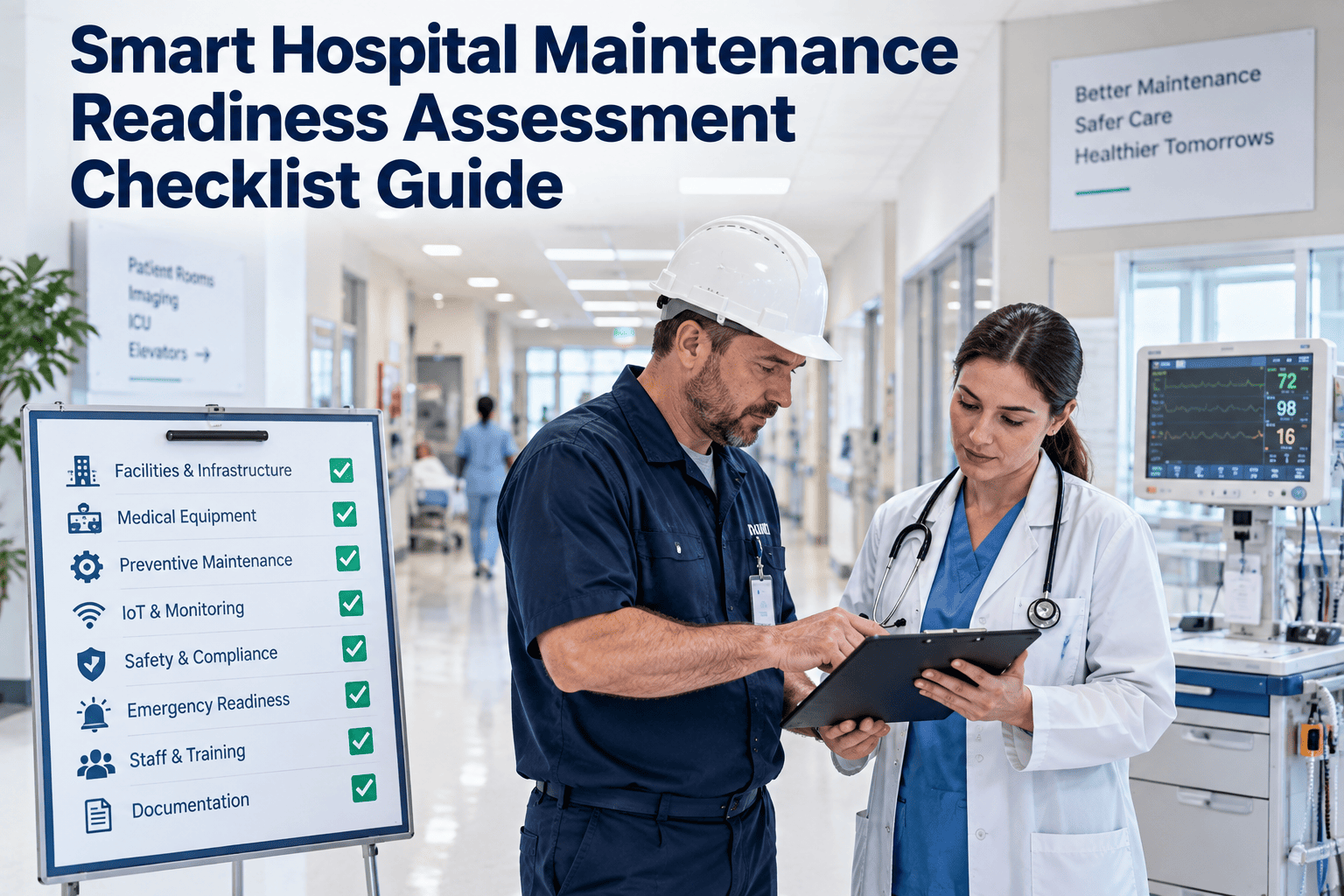
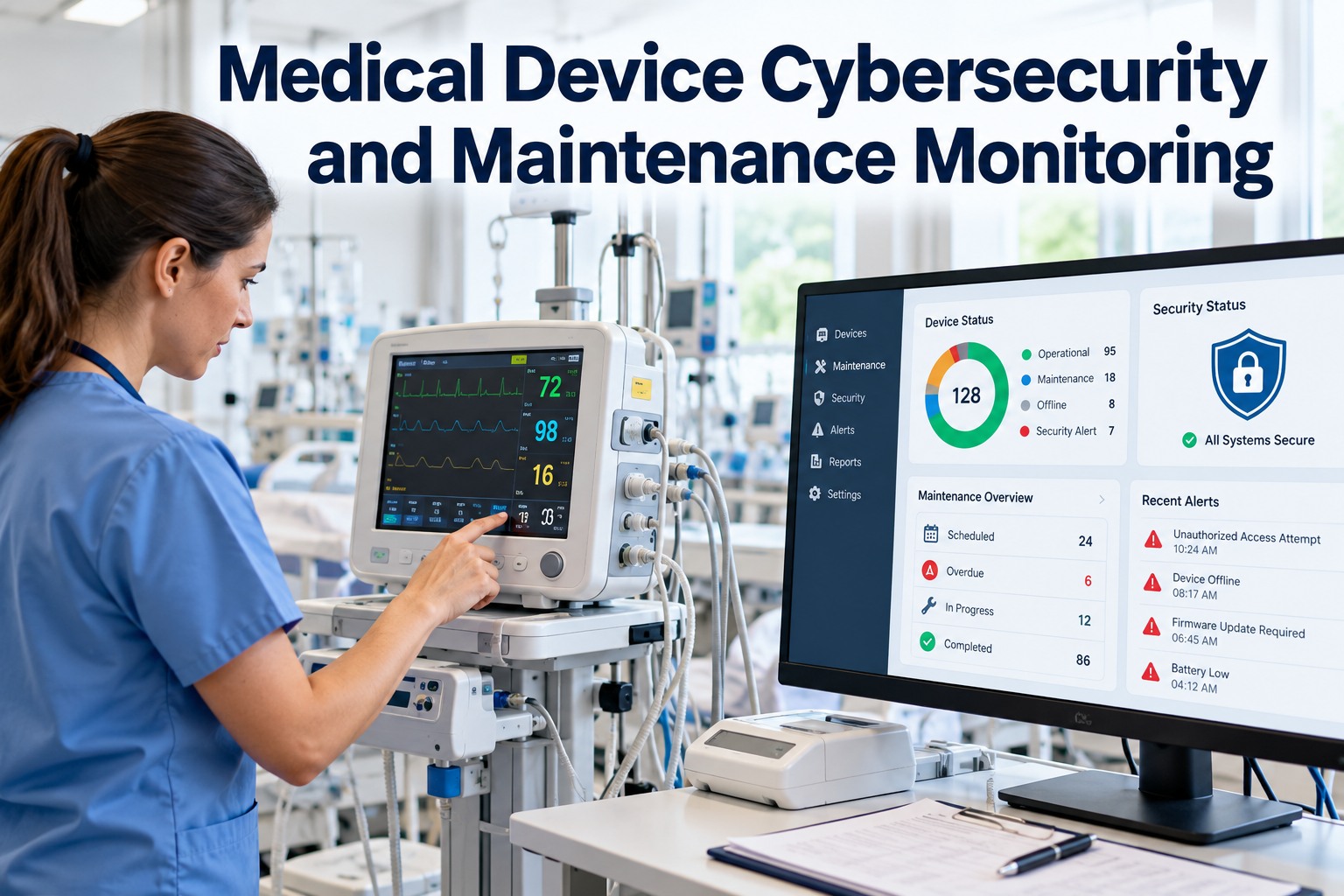
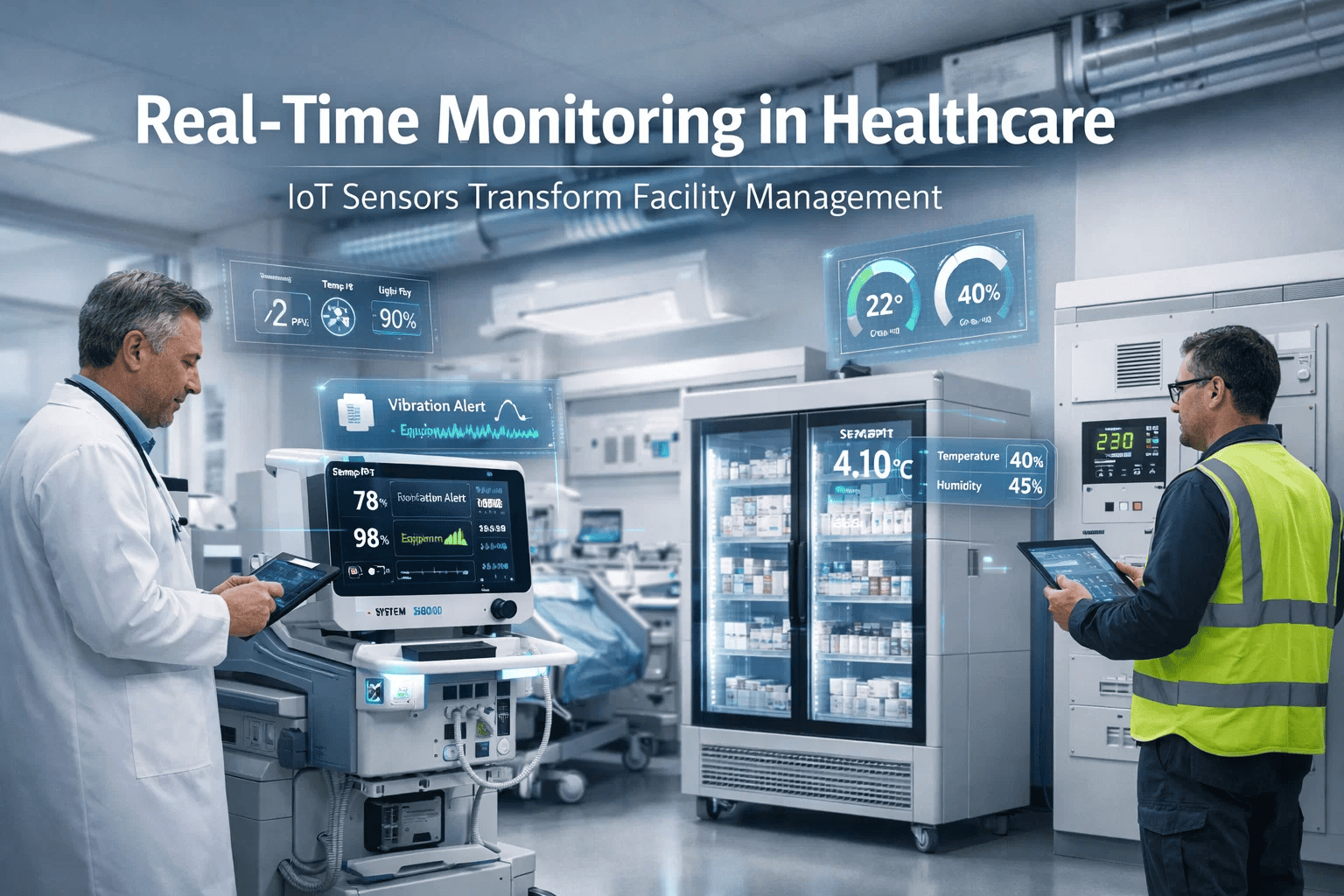
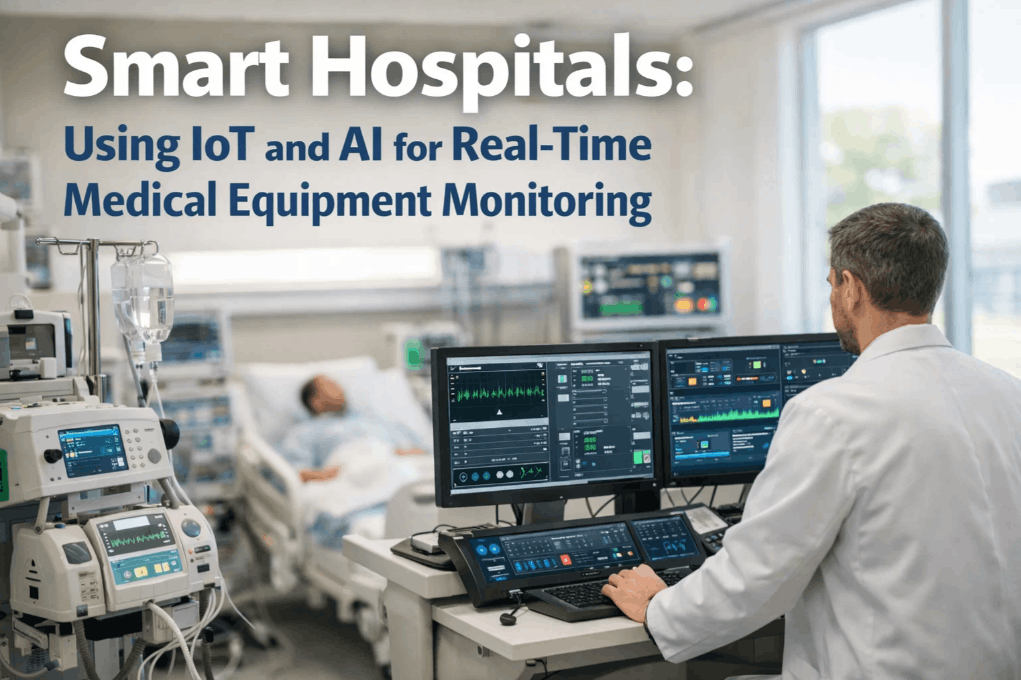
Every hospital plans to be "smart" — connected beds, IoMT-enabled infusion pumps, live utility telemetry, real-time location tracking. But most estates aren't ready for what smart means to a maintenance department: ten times the data, ten times the alerts, and a device fleet that phones home whether the biomed team can answer or not. This assessment walks the readiness dimensions using OXMAINT AI, the AI-powered CMMS built to absorb the IoMT signal before it becomes noise.
Smart Hospitals · IoMT · Maintenance Readiness Assessment
The Devices Are Talking. Is Your CMMS Listening?
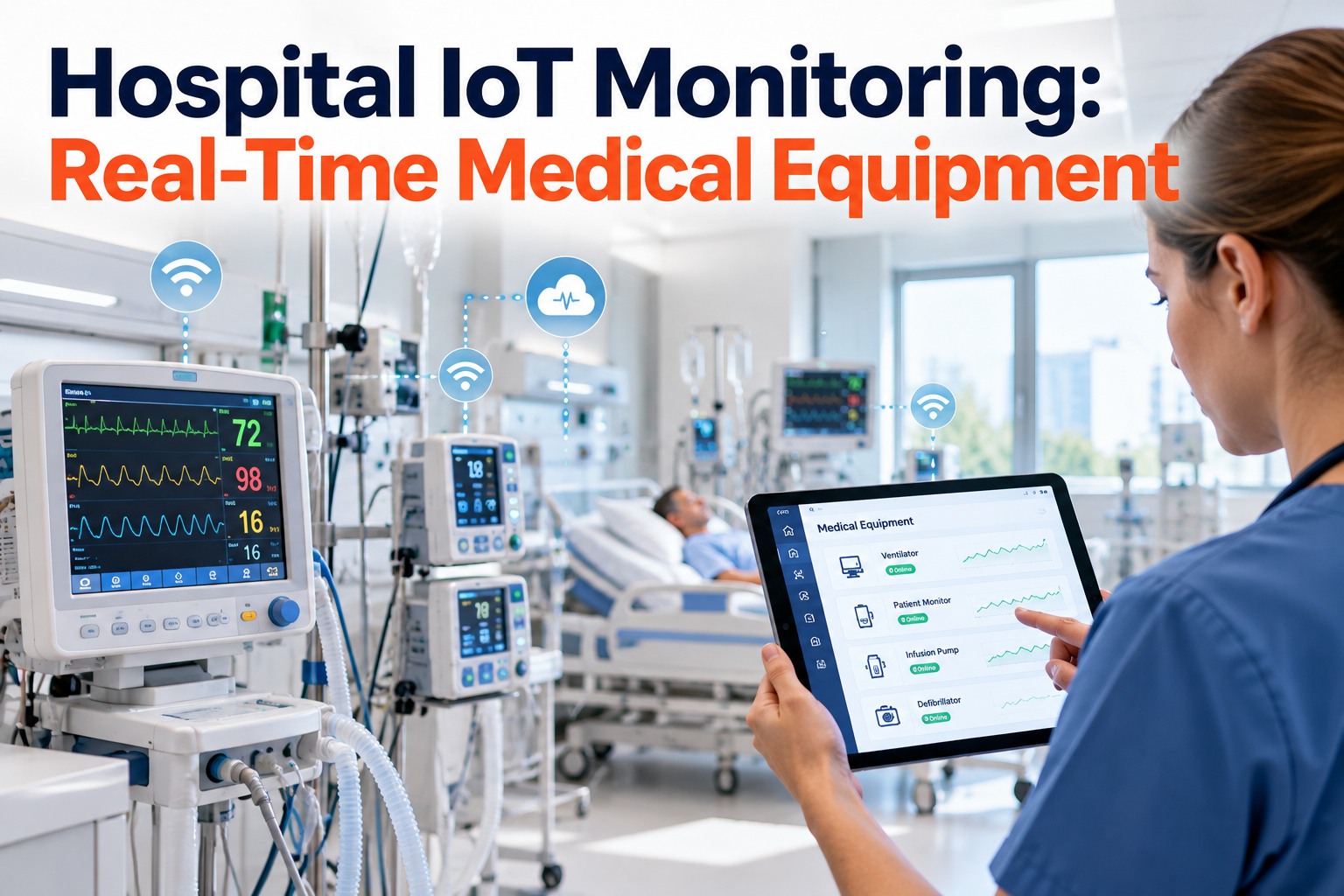
OXMAINT AI, the AI-powered CMMS/maintenance management software, connects the full smart-hospital workflow on one platform — IoMT telemetry and clinical requests in, condition alerts triaged to defects, work orders assigned to biomed and facilities techs, and predictive PM cadence tuned per connected device class.
Telemetry → Alerts → Work Orders
Condition-Based PM Scheduling
Per-Device Signal History
7 Pillars
of smart-hospital readiness the assessment scores
35 Items
checklist points — 5 per pillar, scored 0/1/2
4 Levels
readiness maturity — Reactive to Predictive-Native
1 Score
out of 70 that tells the biomed team where to start
The Smart Hospital Signal Shift
A traditional hospital estate calls biomed when a device fails. A smart hospital estate emits signals continuously — some meaningful, most noise. Readiness is the capacity to sort the signal, act on it, and close the loop with a work order. OXMAINT AI is the loop closer. Sign up free and connect your first IoMT stream in OXMAINT AI.
TRADITIONAL
Reactive Signal
- Device fails → clinical staff notice → phone call to biomed
- Symptom describes the failure — root cause guessed
- PM cadence fixed, calendar-driven, one-size
- Recall response depends on manual fleet query
SMART / IoMT
Continuous Signal
- Device streams status — drift caught before failure
- Root cause tagged in signal metadata
- PM cadence tuned by condition, not by calendar
- Recall closes device-by-device with live progress
The 7 Pillars of Smart-Hospital Maintenance Readiness
Readiness isn't binary. It's a spread across seven dimensions — some hospitals lead on connectivity but lag on data governance, others have great biomed skills but a CMMS that can't hold telemetry. Score each pillar out of 10, roll up to 70. Book a demo to see the readiness dashboard live.
01
Device Connectivity
What % of the biomed fleet is network-connected? Which subnets, which VLANs, which protocols (HL7, FHIR, MQTT, DICOM)?
02
Data Ingestion & Storage
Where does telemetry land — vendor cloud, on-prem, or fragmented? Is retention consistent across families?
03
Signal-to-Work-Order Pipeline
Does a condition alert automatically raise a defect and route to biomed — or does it sit in a vendor portal?
04
Cybersecurity Posture
Are IoMT devices inventoried, patched, segmented and monitored? Is the biomed team looped into IT's SIEM?
05
Biomed Skills & Coverage
Does the team have network-literate technicians? Is coverage tuned for after-hours device chatter?
06
Facilities Integration
Are building systems (BMS, medgas, chilled water, backup power) exposing telemetry to the same CMMS?
07
Governance & KPIs
Is there a smart-maintenance KPI set the exec team looks at? Who owns the number when it moves?
The 35-Item Assessment — 5 Questions Per Pillar
Score each item 0 (not started) · 1 (in progress) · 2 (in place). Total the pillar, then the whole estate. OXMAINT AI holds the score, retests quarterly and shows the trajectory. Start free and log your first assessment in OXMAINT AI.
01 · Device Connectivity
Complete inventory of network-capable biomed devices exists
Each device has a documented protocol (HL7/FHIR/MQTT/DICOM)
VLAN and subnet mapping known per device class
Connection uptime monitored per device
Vendor connectivity contract terms tracked per device
02 · Data Ingestion & Storage
Telemetry destinations documented per device family
Retention windows defined and enforced
Historical signal accessible for trend analysis
Data quality (missing, late, malformed) monitored
Vendor lock-in risk assessed per stream
03 · Signal-to-Work-Order Pipeline
Condition alerts route to CMMS, not just vendor portal
Alert-to-defect thresholds tuned per device class
False-positive rate tracked and reviewed monthly
Auto-generated WOs carry full signal context
Closed WOs feed back into the model for tuning
04 · Cybersecurity Posture
IoMT device inventory shared with IT security
Patching cadence agreed per device family
Network segmentation applied to critical devices
Anomalous behaviour flagged in SIEM with biomed loop
End-of-support devices identified with mitigation plan
05 · Biomed Skills & Coverage
Team includes network-literate biomed technicians
Vendor training current per major device family
On-call coverage covers after-hours device chatter
Escalation path to IT and vendor documented
Cross-training with facilities engineering exists
06 · Facilities Integration
BMS telemetry feeds the same CMMS as biomed
Medgas, chilled water, backup power monitored live
Utility failure auto-triages downstream device risk
Facilities and biomed share a single WO queue view
Environmental drift (temperature, humidity) tracked per zone
07 · Governance & KPIs
Smart-maintenance KPI set defined at exec level
Owner named for each KPI
Monthly review cadence held with clinical stakeholders
Vendor performance reviewed against SLA per quarter
Investment plan tied to readiness score trajectory
Score the Estate. Close the Gaps. Prove the Trajectory.
OXMAINT AI holds the readiness scorecard, retests quarterly and shows the trend line the exec team actually reviews — not another PDF that ages in a shared drive.
Interpret the Score — 4 Maturity Levels
The number out of 70 lands the estate somewhere on a maturity curve. Each level has a different next move — not more spending, but the right spending. OXMAINT AI recommends the priority pillar per level. Book a demo to see level-based recommendations.
Reactive
Devices connected but signal isn't reaching biomed. Focus: pillar 03 (Signal-to-WO pipeline) — get one device class routed end-to-end.
Emerging
Some telemetry landing, thresholds untuned. Focus: pillar 02 (data quality) + pillar 04 (cybersecurity) — stabilise before scaling.
Connected
Signal drives WOs across families. Focus: pillar 06 (facilities integration) — one queue across biomed and facilities.
Predictive-Native
Condition-based PM the norm; governance mature. Focus: pillar 07 (governance) — sustain the model and refresh the KPI set.
Sample Readiness Scorecard
A worked example — a 350-bed community hospital at first assessment. Notice the spread: strong on cybersecurity, weak on facilities integration. The gap is the roadmap. Sign up free and generate your own scorecard in OXMAINT AI.
Estate Score: 38 / 70 — Level 2 (Emerging)
06 · Facilities Integration
2/10
07 · Governance & KPIs
8/10
Illustrative example — actual scores vary by estate. Weakest pillars (03, 06) point at the first quarter's investment.
The 90-Day Readiness Roadmap
Once the assessment lands, a 90-day plan moves the score. OXMAINT AI tracks the roadmap actions as WOs against the readiness project. Book a demo to walk the 90-day template.
Days 0–30
Baseline
Run assessment · connect first device family end-to-end · define KPI set
➜
Days 31–60
Route
Alerts routed to CMMS · thresholds tuned · false-positive rate under target
➜
Days 61–90
Sustain
Reassess score · publish trajectory · scope quarter 2 investment
What OXMAINT AI Gives a Smart-Hospital Team
Purpose-built for the connected estate — one platform holding telemetry, alerts, work orders and the readiness scorecard the exec team reviews. Start free and configure your smart-hospital workflow.
Telemetry Ingestion
Signal from IoMT devices, BMS and utility meters landed on the same CMMS asset record.
Alert-to-WO Routing
Condition thresholds per device class raise defects and route to biomed or facilities queues.
Readiness Scorecard
7-pillar, 35-item assessment stored, retested quarterly, trajectory chart for the exec team.
False-Positive Learning
Closed WOs feed back into the model — thresholds tighten as evidence accrues.
One Queue, Biomed + Facilities
Both teams see the same board — utility failure auto-triages downstream device risk.
Vendor SLA Ledger
Connectivity, patching and service SLAs tracked per vendor with quarterly rollups.
"
We had smart devices for three years before we had a smart response to them. Alerts piled up in a vendor portal no biomed tech opened. Once the pipeline landed alerts as WOs in the same queue as clinical requests, we found we'd been carrying dozens of drift-warnings for months. The score isn't the point — the trajectory is.
Director of Biomedical Engineering · 350-Bed Community Hospital
Frequently Asked Questions
Can we run the readiness assessment before connecting anything?
Does OXMAINT AI replace the vendor's device management portal?
How do we handle IoMT cybersecurity concerns?
What if we're only ready for one pillar right now?
That's the point of the score — most estates start with one pillar strong and six weak. Focus one quarter per pillar, retest, and let the trajectory drive investment.
Book a demo to see one-pillar setup.
How often should we reassess?
Quarterly is the typical cadence. It's short enough to see movement, long enough for changes to bed in. The scorecard's trajectory chart is what the exec team actually looks at.
Sign up free and set the quarterly reminder.
Score the Signal. Close the Gaps. Move the Trajectory.
Move your smart-hospital maintenance operation onto OXMAINT AI — 7-pillar assessment, alert-to-WO pipeline, and one queue across biomed and facilities.