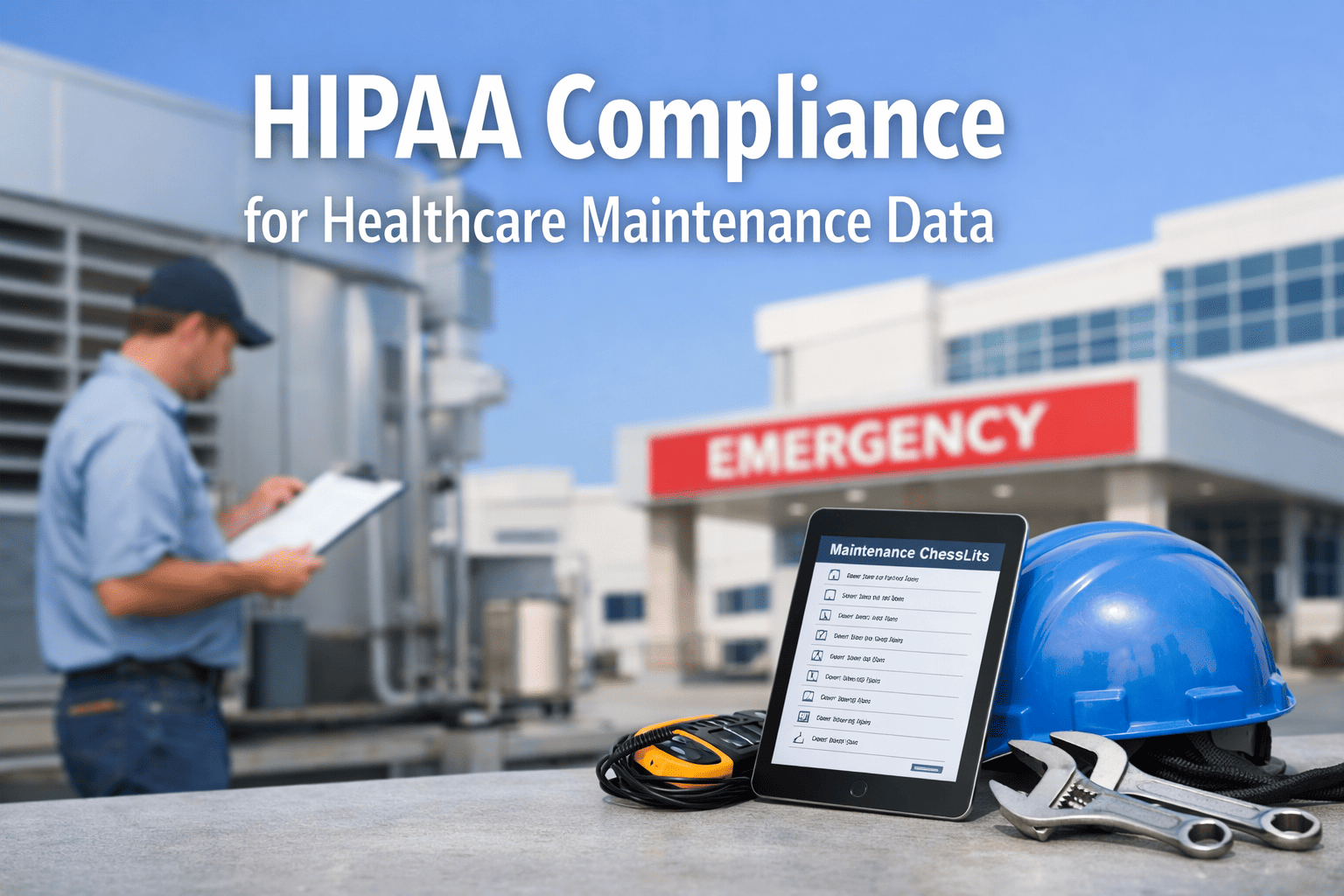
When a maintenance technician enters Room 312 to repair a therapy lift, they're not just fixing equipment—they're stepping into a space governed by one of healthcare's most stringent privacy frameworks. For rehabilitation facilities, where extended patient stays create deeper data footprints and specialized equipment connects to clinical systems, the intersection of maintenance operations and HIPAA compliance creates risks that traditional paper-based systems simply cannot address. The question isn't whether your maintenance data contains protected health information—it's whether you've built the governance framework to handle it properly.
Healthcare data breaches affected over 133 million individuals in 2024 alone, with HIPAA penalties reaching up to $1.5 million per violation category annually. Rehab facilities face unique exposure: patient room assignments in work orders, equipment usage tied to therapy schedules, IoT sensors monitoring environmental conditions in care areas. This playbook transforms compliance complexity into actionable steps, helping your facility build maintenance data governance that protects patient privacy while enabling the operational efficiency modern healthcare demands.
133M+
Individuals affected by healthcare breaches in 2024
$1.5M
Maximum annual penalty per violation category
720+
Healthcare data breaches reported to HHS
72 hrs
Data restoration requirement under new rules
Strengthen healthcare energy performance using AI + IoT data
Modern rehab facilities deploy IoT sensors throughout their operations—monitoring HVAC efficiency, tracking equipment performance, managing energy consumption. These systems generate the data intelligence that drives predictive maintenance and cost optimization. But when sensors operate in patient care areas, the data they collect can inadvertently cross into PHI territory, creating compliance exposure that many facilities don't recognize until an audit surfaces the gap.
IoT Data Flow & HIPAA Touchpoints
IoT Sensors
Temperature, humidity, equipment runtime, energy meters
PHI Checkpoint
Room location? Patient linkage? Identifiable patterns?
Compliant Storage
Encrypted, access-controlled, audit-logged
The solution isn't avoiding IoT—it's implementing data governance that classifies information at the point of collection and routes it through appropriate controls. Facilities ready to modernize their approach can connect with compliance specialists to design architectures that capture operational intelligence without creating PHI exposure in maintenance systems.
Work orders include patient room numbers with dates
Equipment logs linked to individual patient schedules
IoT data captured at patient-specific locations
Maintenance notes reference patient conditions
Vendor access to systems without BAA in place
Location data aggregated or de-identified
Equipment tracked by asset ID, not patient
Environmental data stored without room mapping
Maintenance notes focus on equipment only
All vendors covered by Business Associate Agreements
See Compliant Maintenance Management
Discover how role-based access, encrypted storage, and automated audit trails protect your facility while streamlining operations.
Closing the loop on maintenance — a healthcare lifecycle with IoT
HIPAA compliance requires three categories of safeguards working together: administrative policies that govern how data is handled, physical controls that secure facilities and equipment, and technical measures that protect electronic information. For maintenance operations, this translates into specific actions across each category—actions that digital CMMS platforms can automate and document.
Security Officer
Designate responsibility for maintenance data governance
Workforce Training
Annual HIPAA training for all maintenance personnel
Access Management
Role-based permissions limiting PHI exposure
Risk Assessment
Annual evaluation of maintenance system vulnerabilities
Facility Controls
Secure maintenance areas with PHI access
Workstation Security
Screen locks, positioned away from public view
Device Tracking
Inventory all devices accessing maintenance systems
Media Disposal
Documented destruction of PHI-containing records
Encryption
Protect ePHI at rest and in transit
Audit Controls
Log all access to maintenance records
Access Authentication
Unique user IDs with automatic session timeout
Integrity Controls
Verify data hasn't been altered improperly
Organizations implementing these safeguards benefit from requesting a compliance-focused demonstration to see how automated systems reduce manual documentation burden while strengthening audit readiness.
Day 1-7
Assessment Phase
Audit existing systems for PHI exposure • Inventory maintenance data touchpoints • Identify compliance gaps
Day 8-14
Policy Development
Draft data classification procedures • Create access control matrix • Establish incident response protocols
Day 15-21
System Configuration
Configure role-based permissions • Enable audit logging • Set up encryption protocols
Day 22-30
Training & Go-Live
Train maintenance staff on new procedures • Document training completion • Begin compliant operations
Expert Review: Building Lasting Compliance
"
The facilities that succeed with HIPAA compliance in maintenance aren't necessarily the ones with the largest IT departments—they're the ones that make compliance automatic. When your CMMS enforces role-based access without manual intervention, when audit trails generate themselves, when encryption happens in the background, staff can focus on their actual work while compliance happens as a natural byproduct of using the system correctly.
Sustainable compliance requires ongoing attention beyond initial implementation. Facilities should conduct annual risk assessments, refresh training as regulations evolve, and regularly review access logs for anomalies. Those seeking ongoing compliance support benefit from CMMS platforms that automate monitoring while generating audit-ready documentation on demand.
The intersection of maintenance operations and patient privacy will only grow more complex as IoT adoption increases. Rehab facilities establishing clear governance frameworks now position themselves to adopt emerging technologies confidently. For organizations ready to modernize, booking a demo provides a practical starting point for understanding how digital tools simplify the compliance journey.
Ready to Transform Your Compliance?
See Oxmaint in Action for Healthcare
Join rehabilitation facilities using automated compliance tools to protect patient data while streamlining maintenance operations.
Conclusion
HIPAA compliance in rehab facility maintenance requires coordinated safeguards across administrative, physical, and technical domains. This playbook provides the framework for classifying maintenance data, implementing appropriate protections, and building audit-ready documentation systems. By establishing clear PHI boundaries, training staff properly, and leveraging CMMS platforms with built-in compliance features, facilities can protect patient privacy while maintaining operational efficiency. Those seeking expert implementation guidance can begin with a compliance assessment to identify priorities and build a sustainable path forward.
Frequently Asked Questions
When does maintenance data become PHI under HIPAA?
Maintenance data becomes PHI when it contains information that can identify a specific patient. This includes work orders with patient room assignments and dates, equipment logs linked to individual therapy schedules, or any documentation connecting maintenance activities to specific patients receiving care. General equipment records without patient identifiers typically don't qualify as PHI, but the determination requires careful analysis of what information could potentially be combined to identify individuals.
Do we need Business Associate Agreements with maintenance vendors?
Yes, if vendors may access PHI during their work. This includes CMMS software providers storing data that contains patient information, equipment technicians who may encounter patient-related device data, and any contractor whose work involves areas where PHI is accessible. The BAA establishes the vendor's commitment to HIPAA-compliant handling and creates liability for any breaches that occur through their access.
What training do maintenance staff need for HIPAA?
All maintenance personnel should receive training on recognizing PHI, understanding minimum necessary standards, proper handling and disposal of documents containing PHI, and incident reporting procedures. Training should be completed at hiring and refreshed annually. Documentation of completed training must be retained for audit purposes—digital CMMS platforms can automate this tracking and generate compliance reports.
How long must we retain maintenance records containing PHI?
HIPAA requires covered entities to retain documentation of compliance activities for six years from creation or last effective date. State laws may require longer periods. Digital systems simplify retention by automatically archiving records with appropriate access controls and tamper-proof audit trails, eliminating the risk of lost or damaged paper documentation.
What happens if our maintenance system experiences a data breach?
Under the Breach Notification Rule, you must notify affected individuals within 60 days of discovering a breach involving unsecured PHI. Breaches affecting more than 500 individuals require notification to HHS and prominent media outlets. Smaller breaches must be logged and reported to HHS annually. Having documented incident response procedures and maintaining comprehensive audit logs helps demonstrate good-faith compliance and may reduce penalty severity.