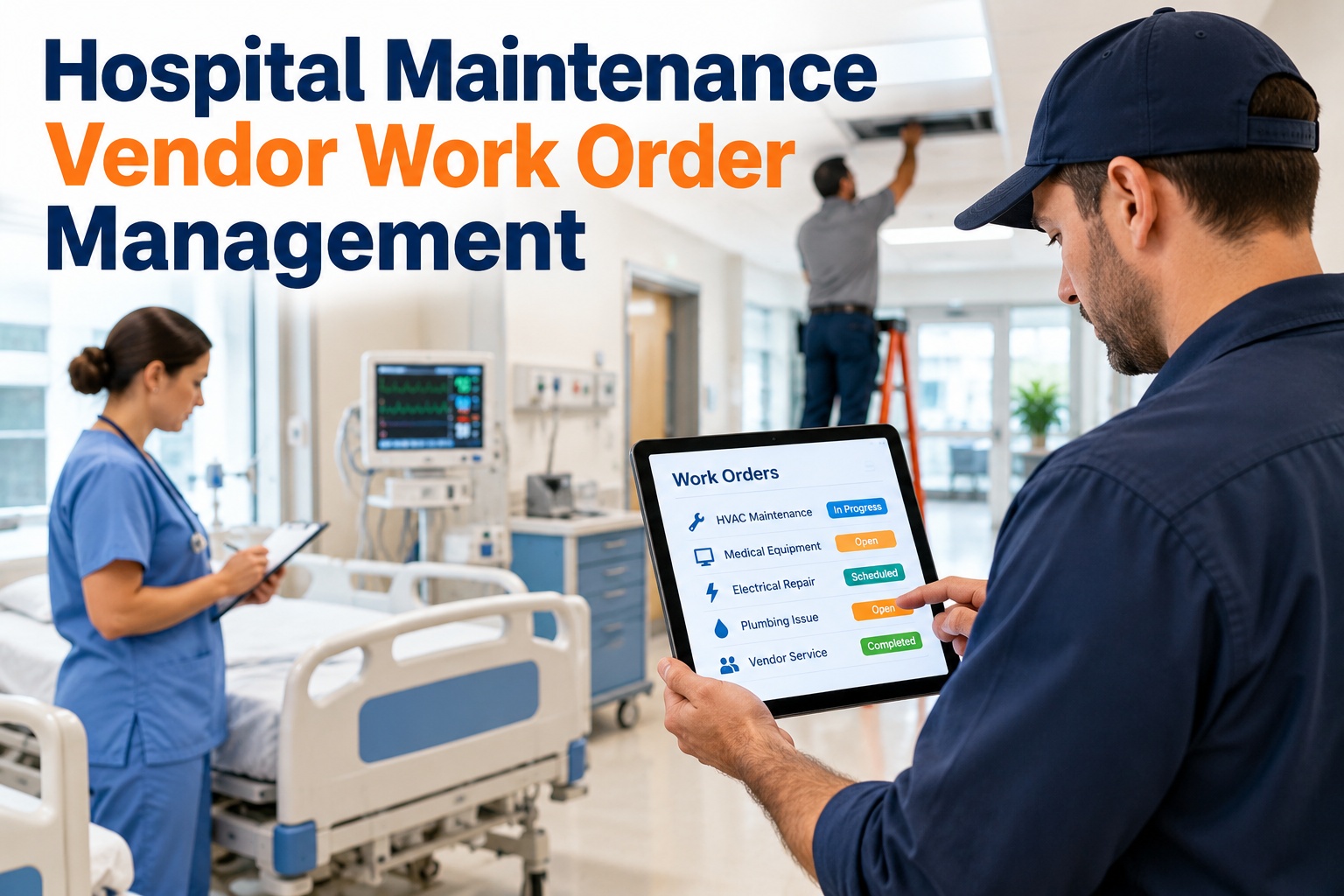
In a hospital, the people fixing your fire pumps, medical gas systems, elevators, and imaging equipment often don't work for you — they work for the forty-plus outside vendors your facilities team coordinates. That's where the exposure lives. A contractor walks into a clinical space with an expired certificate of insurance; a life-safety service window closes without anyone noticing; a critical contract lapses and takes its warranty with it. None of it shows up until a surveyor asks — and by then it's a finding. Managing vendor work orders in a healthcare CMMS is how a facilities leader turns that scramble into a controlled process: no vendor works uncredentialed, no SLA breach goes unseen, and the audit package is ready in hours, not days. OxMaint AI gives hospital facilities teams that control across every contracted vendor.
Hospital Maintenance Vendor Work Order Management
Most hospital maintenance work is performed by outside vendors — and that's exactly where credential gaps, missed SLAs, and lapsed contracts create Joint Commission and CMS exposure. A healthcare CMMS puts vendor work orders under control: it blocks assignment to any vendor without current credentials, tracks every service-level clock in real time, scores vendor performance, and keeps the compliance record survey-ready. OxMaint AI gives facilities leaders one system for in-house and contracted work alike.
Where Vendor Maintenance Puts a Hospital at Risk
Vendor work isn't harder because the trades are complex — it's harder because the accountability sits outside your walls. Four failure modes recur across hospital facilities departments, and each maps to a regulatory exposure. Start free and close these gaps in OxMaint AI.
The Controlled Vendor Work Order: Gate, Clock, Scorecard
A vendor work order should pass through three controls before, during, and after the job. Together they turn vendor coordination from a trust exercise into an enforced process.
Because the controls are enforced by the system, compliance stops depending on someone remembering to check. Book a demo to see the credential gate and SLA clock in OxMaint.
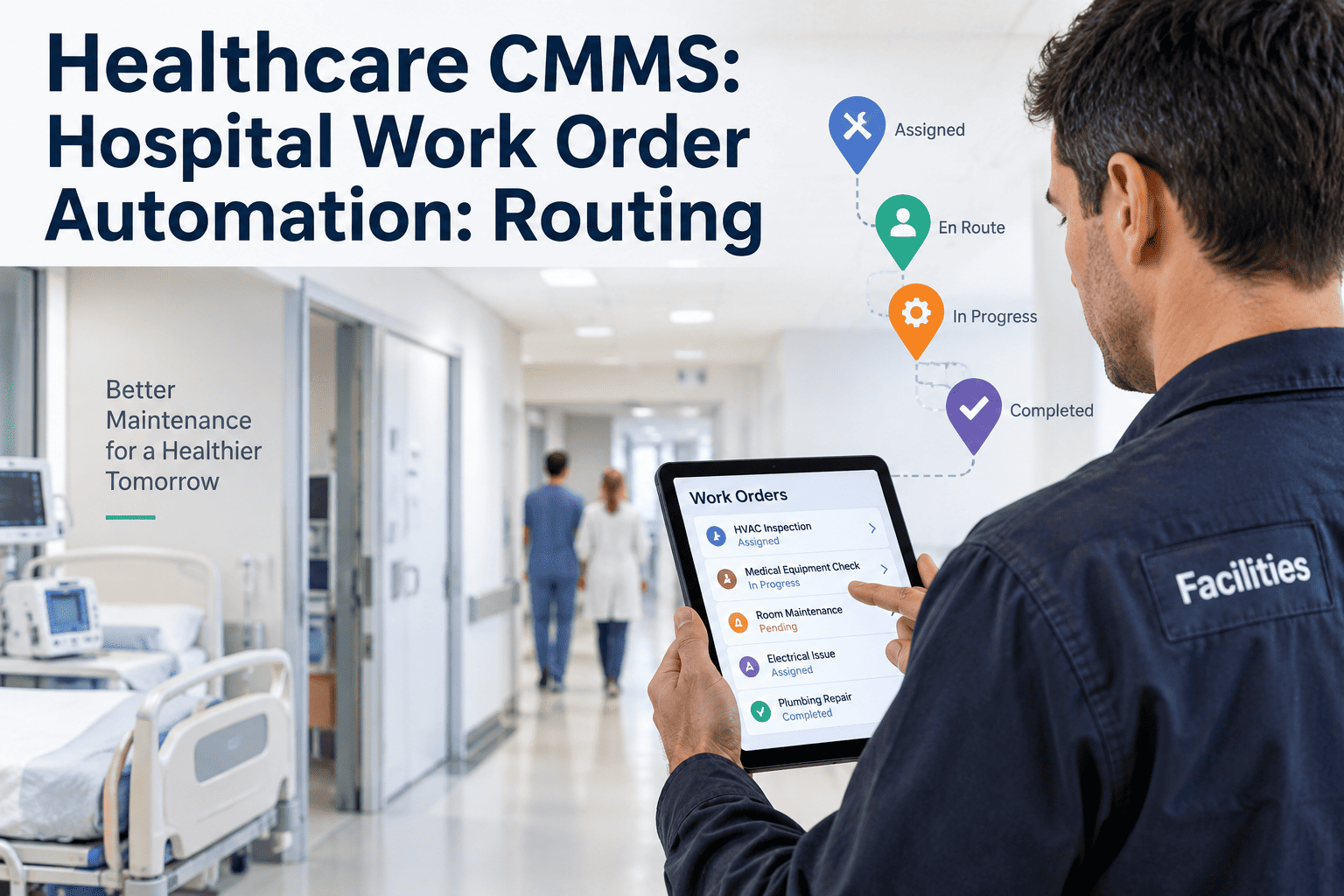
Routing Work to the Right Vendor, Automatically
With dozens of vendors covering different equipment and locations, manual dispatch is a bottleneck and a source of error. A healthcare CMMS routes each request to the correctly contracted vendor by equipment category, location, and contract scope — so the medical-gas request goes to the medical-gas vendor, not into someone's inbox. Start free and route vendor work orders automatically in OxMaint AI.
The Surveyor Doesn't Ask Whether the Work Got Done. They Ask You to Prove It.
A Joint Commission or CMS survey turns on documentation: current credentials, service-contract records, SLA compliance logs, and corrective-action evidence — for every vendor touching life-safety and clinical systems. When that lives across inboxes and filing cabinets, assembling it is days of retrieval. When it lives in one CMMS, the vendor compliance package is produced in hours.
The Regulatory Map for Vendor Work
Vendor maintenance in a hospital sits under several overlapping standards. A CMMS built for healthcare keeps the record each one expects. Book a demo to see each standard evidenced in OxMaint.
| Standard | What it covers | What the CMMS holds |
|---|---|---|
| Joint Commission EC.02.06.01 | Contractor site-access controls | Credential-gate records for every vendor entry |
| Joint Commission EC.02.05.07 | Life-safety service-contract compliance | SLA logs for fire, medical gas, and elevator contracts |
| CMS CoP 482.41 | Physical environment and facility safety | Vendor work history tied to each affected asset |
| CMS CoP 482.12(e) | Contracted-service accountability | Vendor performance and corrective-action evidence |
| NFPA 99 | Life-safety equipment maintenance | Response and resolution windows tracked per contract |
| DNV GL ME.3 | Vendor management program | Scorecards and credential currency across vendors |
The point isn't the citation numbers — it's that one system produces the evidence each expects, on demand. Start free and keep the vendor record survey-ready in OxMaint AI.
What Good Vendor Governance Looks Like
A mature vendor program runs to clear targets. These are the benchmarks facilities leaders hold their vendor management to. Book a demo to track these targets in OxMaint AI.
How OxMaint AI Manages Hospital Vendor Work Orders
Vendor governance, in-house maintenance, and asset history live in one healthcare CMMS — so the facilities team runs contracted and internal work from a single record. Start free and bring every vendor into one system.
Frequently Asked Questions
Put Every Vendor Under One System of Control.
The vendors maintaining your life-safety and clinical systems carry your compliance risk with them. A healthcare CMMS makes that risk manageable — no uncredentialed access, no unseen SLA breach, no lapsed contract, and a survey package ready when the inspector arrives. OxMaint AI gives hospital facilities leaders that control across every contracted vendor.

.jpg)