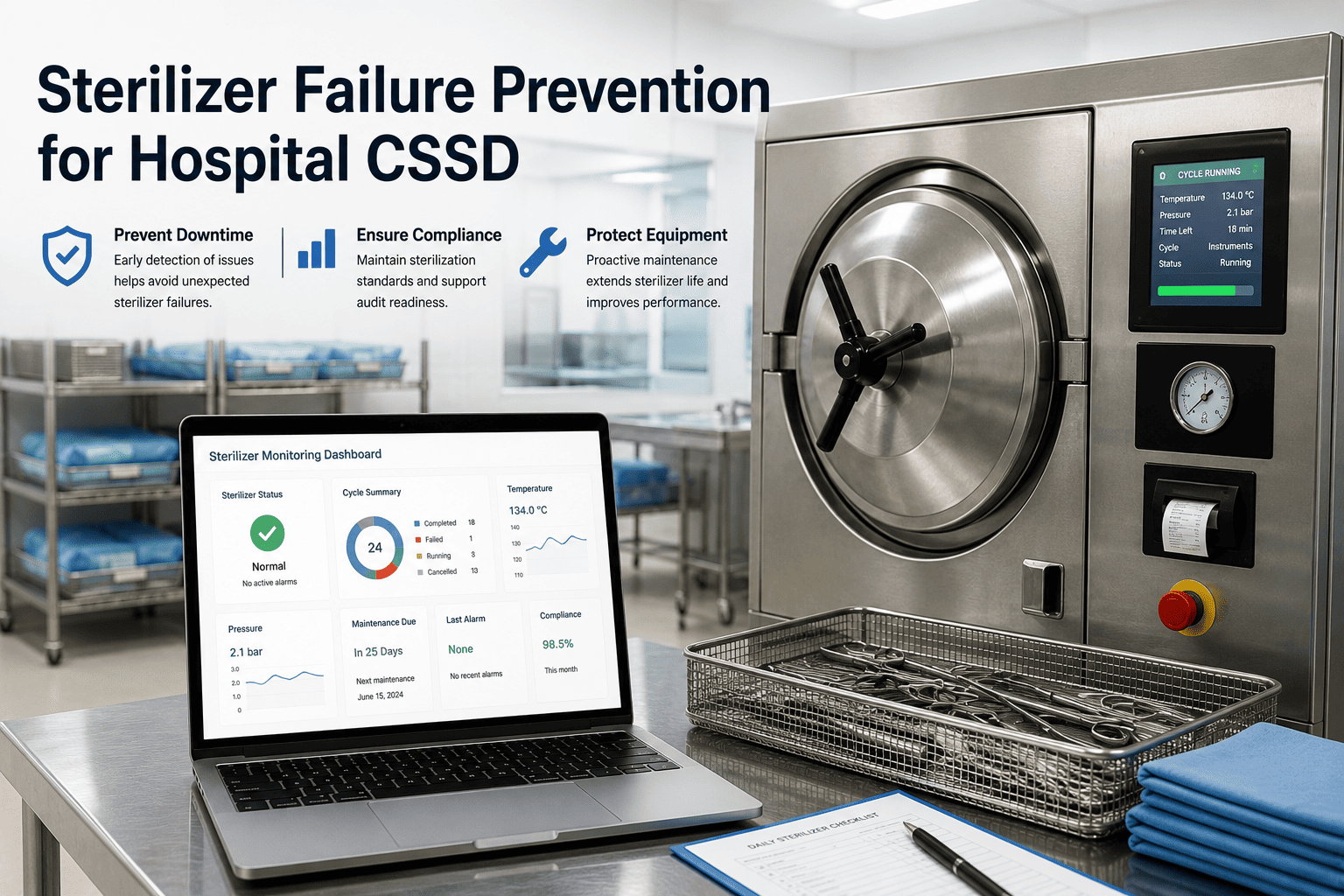
A surgical tray that is not sterile at 6:55 AM for a 7:00 AM joint replacement is not a CSSD problem. It is a hospital problem — one that delays the OR, cascades across the day's surgical schedule, and at industry-benchmark $65 per minute of lost OR revenue (Bioseal data) consumes $1,300 in 20 minutes. The 2024 BMC Surgery study at a single academic medical center documented 236 instrument errors across just 147 cases, with broken or malfunctioning sterilization-side issues accounting for 44 of those events. The compliance dimension is equally unforgiving: under ANSI/AAMI ST79, a single positive biological indicator requires immediate recall of every load processed since the last negative BI. Oxmaint's CSSD sterilizer maintenance and cycle-tracking platform consolidates cycle records, preventive maintenance, biological-indicator history, and repair logs into one audit-grade system — turning the next sterilizer alarm from a surgery-cancellation event into a routine work order.
Sterilizer Failure Prevention for Hospital CSSD
When the OR is scheduled to start at 7:00 AM and the sterilizer alarm sounded at 5:42 AM, your CSSD team has 78 minutes to decide whether the load is safe to release, whether the sterilizer can be returned to service, and whether the next case can start on time. The decisions that follow are governed by AAMI ST79, AORN guidance, and Joint Commission expectations — and a single wrong call cascades across the surgical day.
Compliance Standards Governing CSSD Sterilizer Operations
Sterile processing in North America is regulated by overlapping standards from four bodies: AAMI (technical), AORN (clinical practice), HSPA (workforce competency), and Joint Commission (accreditation). The relevant standards for sterilizer maintenance and cycle documentation:
CSSD Sterilizer Fleet Snapshot — What a Healthy Status Board Looks Like
Most hospital CSSDs operate 3–8 sterilizers spanning multiple modalities. Preventive maintenance for hospital sterilizers requires real-time visibility across the fleet — cycle status, PM due dates, BI test currency, and historical failure trends — surfaced in one view rather than buried in paper logs.
Sterilization Cycle Types — Parameters Every CSSD Team Must Know
Different load types require different sterilization modalities, each with distinct cycle parameters, monitoring requirements, and OEM-specified maintenance intervals. The CMMS must capture all of them — generic templates fail in a CSSD audit.
| Cycle Type | Temperature | Exposure Time | Typical Application | BI Requirement | Standard |
|---|---|---|---|---|---|
| Steam Pre-Vacuum | 132–135°C | 4 min | Wrapped instruments, textiles, most rigid trays | PCD + BI daily, every implant load | AAMI ST79 |
| Steam Gravity | 121–123°C | 30 min | Liquids, certain wrapped items, slower throughput | PCD + BI weekly minimum | AAMI ST79 |
| Immediate Use (IUSS) | 132°C | 3–10 min | Emergency single instrument · use immediately · no storage | BI per cycle for implants | AAMI ST79 |
| Ethylene Oxide (EtO) | 37–55°C | 2–6 hr + aeration | Heat-sensitive devices, plastics, electronics | BI every load | AAMI ST58 |
| H₂O₂ Plasma (STERRAD) | 45–55°C | 28–75 min | Heat-sensitive, moisture-sensitive surgical devices | BI every load | AAMI ST58 |
The Six Sterilizer Failure Modes a CSSD Director Cannot Miss
Sterilizer failures rarely arrive as a clean error code. Most begin as subtle deviations that experienced CSSD technicians recognize before the alarm sounds. These are the six failure modes most consistently associated with surgical-tray delays — and the early indicators a CMMS surfaces before they escalate.
The Biological Indicator Workflow — Where Compliance Risk Concentrates
The BI workflow is the single highest-leverage compliance touchpoint in any CSSD. Every sterilization cycle that includes a BI generates a strict sequence of actions, timing windows, and decision points. A break in this chain is the most common Joint Commission survey finding in sterile processing. Biological indicator tracking software for CSSD structures every step into a digital record.
The Next Positive BI Will Test How Fast Your Records Move — Not How Good Your Sterilizers Are.
OxMaint sequences every cycle record, BI result, and quarantine status into one searchable history — so the recall trace runs in minutes instead of the hours it takes from paper logs spread across binders and shift handovers.
The Pull-From-Service Decision Tree — What CSSD Technicians Must Run on Every Cycle
Every completed sterilization cycle goes through the same four-gate decision sequence before any load is released to the OR. Skipping a gate — or making the wrong call at any node — triggers either a patient safety risk or a load recall.
Documentation Trail — What a Joint Commission Surveyor Asks to See
A CSSD compliance review on a Joint Commission accreditation cycle drills into the maintenance and cycle record trail — not the sterilization technology itself. Joint Commission CSSD compliance CMMS structures these records into an evidence stack ready for surveyor request. The seven records below are the most consistently requested in survey context.
The Cost Math — Surgery Delays vs CMMS Investment
Sterilizer failure prevention is one of the rare CMMS investments that pays back in surgical revenue, not just maintenance savings. The math below uses industry benchmarks against a mid-size hospital CSSD operating 4 sterilizers and supporting ~30 OR procedures daily.
The CSSD KPIs That Surface Before a Sterilizer Fails
Sterile processing KPIs differ from operational maintenance KPIs because they have a direct patient-safety dimension. These six metrics are what a strong CSSD director reviews weekly — and the early warning signs that prevent the next surgery-delaying failure.
Positive BI Events
Number of positive biological indicator results in the period. The highest-consequence CSSD metric. Even a single positive triggers a recall under AAMI ST79 — and trends across multiple positives suggest systemic failure.
Cycle Pass Rate
Percentage of sterilization cycles completed without abort, parameter deviation, or wet-pack finding. Below 96% indicates either equipment problems, load packaging issues, or steam quality variability.
PM On-Time Rate
Percentage of sterilizer preventive maintenance completed within OEM-specified interval. Any overdue PM on a production sterilizer is a top-cited finding in Joint Commission surveys.
Tray Readiness for OR
Average time between OR request and sterile tray availability. Above 15 minutes indicates either CSSD throughput problem or sterilizer reliability problem — both surfaceable in the maintenance record.
Wet Pack Rate
Percentage of pre-vacuum loads with wet packs at unload. Above 2% indicates drying-phase optimization needed or steam quality issue. Wet packs trigger immediate reprocessing under ANSI/AAMI ST79.
Bowie-Dick Compliance
Daily Bowie-Dick test completion on every pre-vacuum sterilizer before patient loads are processed. Missing Bowie-Dick records on a survey day is among the most predictable findings in CSSD audits.
Expert Review — A Sterile Processing Director's Perspective
In every CSSD I have managed, the question is never whether a sterilizer will fail — it is whether the failure will surface as a Bowie-Dick test on Monday morning at 5:30 AM, or as a positive BI two hours into a 14-case surgical day. The first costs the hospital nothing. The second costs the hospital a recall of every load since the last negative BI, every implant under that load, and a surveyor visit that nobody asked for. The discipline that separates the two outcomes is not equipment quality — it is record discipline. The CSSDs that ride out a sterilizer failure without OR impact have three traits: their PM is genuinely on schedule, their daily Bowie-Dick is documented in real time, and they can produce the full cycle history of any tray with a single search. The CSSDs that turn a sterilizer alarm into a hospital-wide event have records scattered across paper logs, spreadsheets, and shift handovers — and discover at the moment of crisis that nobody can prove when the last gasket was changed. The CMMS is what closes that gap. Without it, sterilizer failure prevention is an aspiration. With it, it is an operational discipline.
Frequently Asked Questions
How does OxMaint integrate with our existing sterilizer printers and cycle data outputs?
Modern sterilizers (Steris, Getinge, Belimed, STERRAD, 3M, Tuttnauer) all export cycle data through digital outputs — typically CSV, RS-232 serial, or proprietary network protocols. OxMaint ingests these feeds directly and structures each cycle record against the sterilizer asset, load number, BI result, and technician on shift. For sterilizers with paper-only output, the CSSD team scans the printout and attaches it to the digital cycle record using the mobile app — preserving the paper evidence while building the searchable history. Book a demo to walk through the integration pattern for your sterilizer fleet.
What happens to an in-progress sterilizer cycle if there is a positive BI on a previous load?
Under ANSI/AAMI ST79, a positive BI requires immediate pull-from-service of the affected sterilizer and recall of every load processed since the last documented negative BI on that machine. In-progress cycles complete (so the load is not lost) but are then quarantined alongside all other recall-affected loads. OxMaint's recall trace runs the lookup automatically: filter by sterilizer ID, date range "last neg. BI to now," and the system surfaces every load number, every tray contents list, and every OR case those trays supplied. AAMI ST79 cycle records in CMMS turn a recall from hours of binder digging into a single filtered export.
How does the system handle IUSS (immediate-use steam sterilization) records, which have different requirements than routine loads?
IUSS records are distinct in OxMaint because IUSS loads cannot be stored and are typically used for single emergency instruments. The system tracks: justification for IUSS use (per AORN and AAMI ST79, this should be documented per cycle), the specific instrument and OR receiving the load, the technician who ran the cycle, and the BI result if the load contained an implant. Some Joint Commission surveyors specifically probe IUSS records because high IUSS rates often indicate inadequate instrument inventory or workflow problems. Sign in to OxMaint to see the IUSS justification report.
Does OxMaint support the rapid-readout BI workflow as well as traditional 24–48 hour spore strip incubation?
Yes. The OxMaint BI record carries the indicator type — rapid readout (1–3 hour result) or traditional spore strip (24–48 hour incubation) — and the quarantine logic adjusts accordingly. For rapid BI, the load can typically be released within the same shift once the auto-reader confirms negative growth. For traditional BI on implant loads, the load remains quarantined until the full incubation period completes. The system surfaces pending BI results on the supervisor dashboard so no load is released prematurely. Most modern CSSDs operate a mix of both, depending on the volume of implant cases. OR tray readiness tracking integrates both workflows on the same dashboard. Book a demo to see the dual-mode BI workflow.
How quickly can a CSSD deploy OxMaint without disrupting daily sterilization operations?
A typical hospital CSSD with 3–6 sterilizers reaches full deployment in 4–8 weeks with no interruption to daily sterilization. Weeks 1–2: sterilizer asset registry, OEM PM schedule import, BI lot tracking setup. Weeks 3–4: parallel running — paper records continued alongside digital entry to build technician familiarity. Weeks 5–6: digital becomes the system of record; sterilizer printer feeds connected; mobile QR tagging on every sterilizer. Weeks 7–8: shift supervisors trained on the recall trace, dashboard, and audit export workflows. The migration runs alongside production — no sterilizer is taken offline for the deployment. Start free in OxMaint to begin the sterilizer registry phase today.
The Next Sterilizer Alarm Will Decide Whether Tomorrow's 7 AM Case Starts On Time.
OxMaint structures every sterilizer cycle, BI result, PM event, repair record, and Bowie-Dick test into one searchable, audit-grade system — so the moment the alarm sounds, the answers your CSSD team needs are one filter away, not three binders deep.