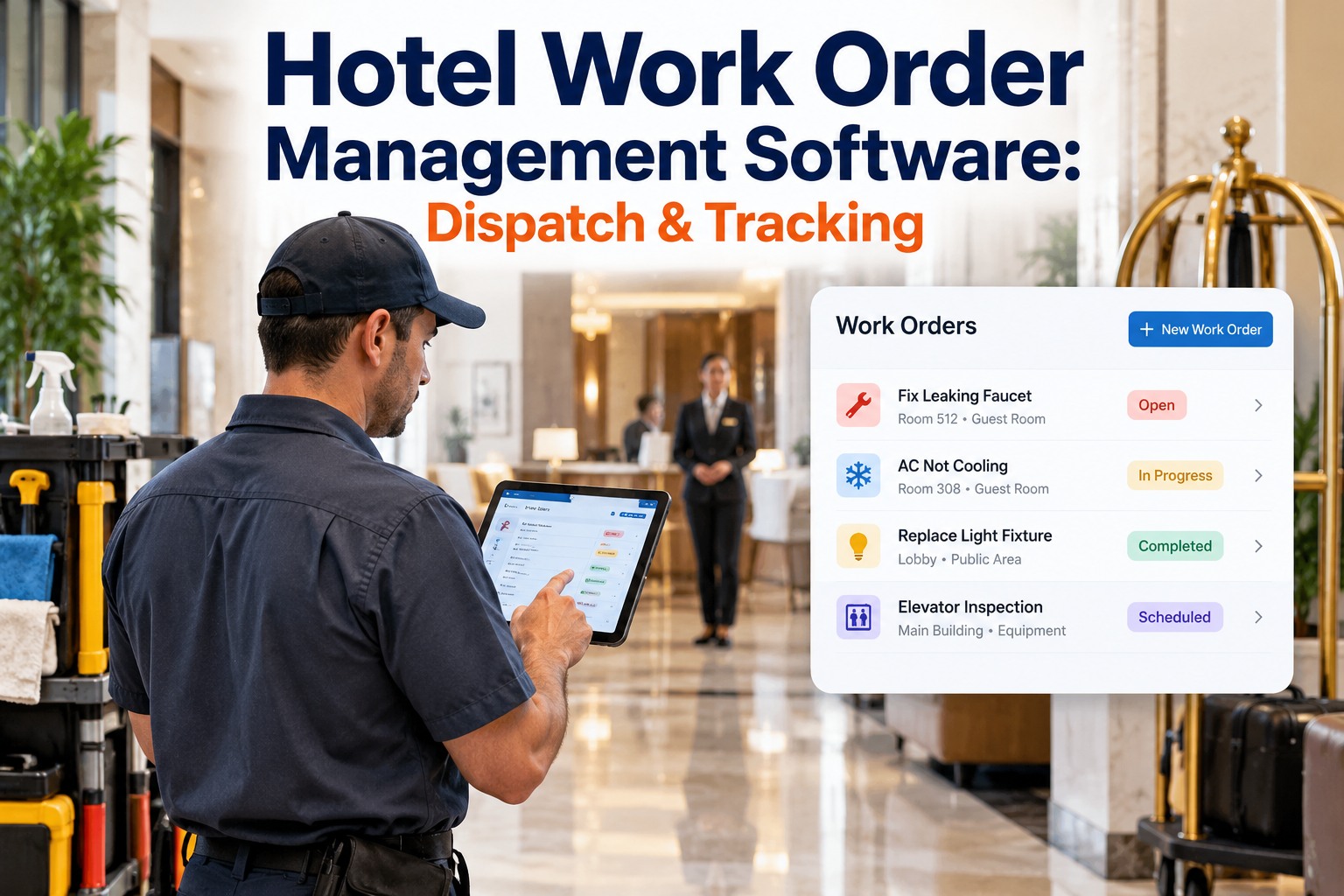
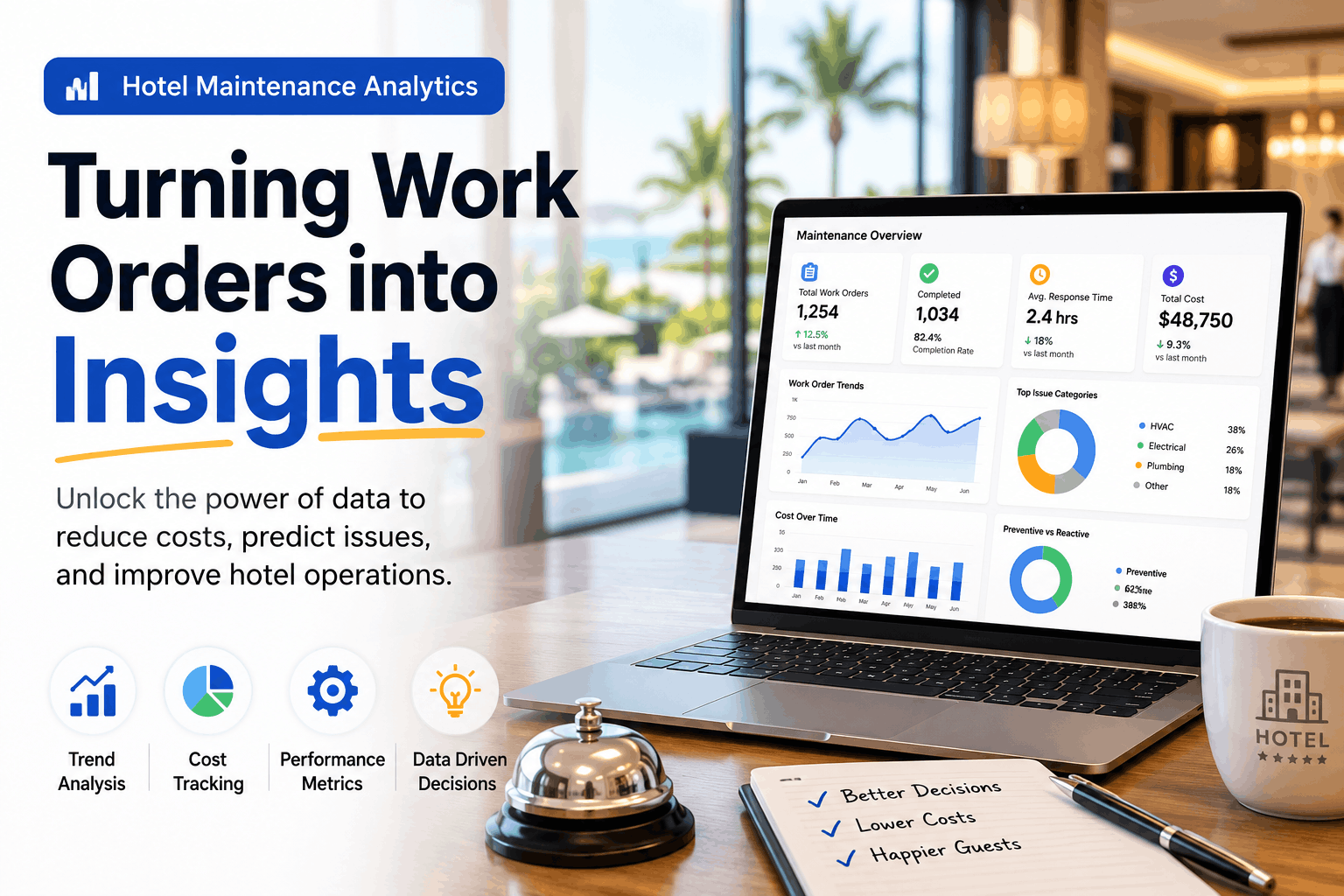
The morning shift engineering team at a 380-room resort opens their work order queue to find 47 pending tasks—a leaking toilet in room 612, a flickering ballroom chandelier with a 500-person gala starting in 6 hours, a swimming pool heater running 8°F cold, a VIP suite's minibar not cooling, a grease trap alarm in the main kitchen, and 42 other requests of varying urgency. The chief engineer spends 35 minutes manually sortingassigning, and sequencing tasks based on gut instinct and whoever complained loudest. The ballroom chandelier gets deprioritized because the banquet manager hasn't escalated yet. The pool heater waits because "it's winter." The VIP minibar gets assigned to the only available technician—who then can't respond when the kitchen grease trap overflows 90 minutes later. By noon, three guests have posted negative reviews, the banquet manager is furious, and the kitchen is partially shut down. Every one of these outcomes was preventable—not by hiring more technicians, but by letting AI score, sequence, and dispatch work orders based on data instead of guesswork.
Guest-Impact Delays
67%
AI Reduces: 67%
Sorting Time
35 min/day
AI Saves: 92%
Wrong-Tech Dispatch
28%
AI Cuts: 81%
Missed Escalations
3.2x risk
AI Prevents: 89%
Technician Idle
18-25%
AI Recovers: 34%
67%
Reduction in guest-impacting maintenance delays with AI-prioritized work order queues
34%
Improvement in technician productivity through intelligent task sequencing and routing
2.8 min
AI scoring time for 50+ work orders—replacing 35 minutes of manual chief engineer triage
AI-powered work order prioritization replaces the manual triage bottleneck with an intelligent scoring engine that evaluates every incoming work order against dozens of real-time variables simultaneously—guest impact, revenue exposure, safety risk, equipment criticality, technician skill match, parts availability, and historical repair patterns—then sequences the entire queue optimally in seconds. Hotels using OXmaint's intelligent work order management platform eliminate the guesswork that causes high-impact tasks to wait while low-priority items consume technician hours. Properties ready to see AI prioritization in action can schedule a free demonstration mapped to their actual maintenance operations.
How AI Work Order Prioritization Works in Hotels
AI prioritization isn't a single score—it's a multi-dimensional analysis engine that evaluates every work order across six weighted factors simultaneously, then continuously recalculates as conditions change throughout the day. A room repair that scored medium priority at 10 AM automatically escalates when the PMS shows a VIP checking into that room at 3 PM.
1
Guest Impact Score
Room Occupancy, Guest Tier, Check-in Timing, Complaint History, Review Risk Rating
VIP Detection
Review Risk
Satisfaction Score
2
Revenue Exposure
Room Rate, Event Revenue, F&B Impact, Out-of-Order Cost, Comp/Upgrade Avoidance
Dollar Impact
Revenue at Risk
Comp Prevention
3
Safety & Compliance
Life Safety Systems, Code Requirements, Liability Risk, ADA Compliance, Health Codes
Safety Priority
Code Urgency
Liability Score
4
Equipment Criticality
Asset Tier Rating, Failure Cascade Risk, Redundancy Status, Repair History, Age Factor
Failure Risk
Cascade Impact
Degradation Rate
5
Resource Optimization
Technician Skills, Location Proximity, Parts Availability, Tool Requirements, Shift Coverage
Skill Match
Route Efficiency
Parts Ready
6
Temporal Intelligence
Event Schedules, Check-in Waves, Quiet Hours, Seasonal Patterns, SLA Deadlines
Time Urgency
Event Conflict
SLA Countdown
The AI Prioritization Process: From Request to Resolution
Understanding how AI transforms a raw maintenance request into an optimally prioritized, skill-matched, route-optimized work order helps hotel engineering teams evaluate the technology's impact on daily operations.
1
Intake & Classification
Work orders from front desk, housekeeping, guest app, IoT sensors, and scheduled PMs are automatically classified by system type, location, and issue category
2
Multi-Dimensional Scoring
AI evaluates guest impact, revenue exposure, safety risk, equipment criticality, resource availability, and timing constraints—producing a composite priority score
3
Intelligent Dispatch
The system matches each task to the best-qualified available technician based on skill certifications, current location, active workload, and parts-in-hand status
4
Dynamic Reprioritization
As new requests arrive, conditions change, or tasks complete, AI recalculates the entire queue in real time—automatically escalating items approaching SLA thresholds
Let AI Sort Your Work Orders in Seconds
OXmaint's intelligent prioritization engine scores, sequences, and dispatches every work order based on guest impact, revenue risk, and resource availability—replacing 35 minutes of daily manual triage with 2.8 minutes of AI-optimized action.
What AI Prioritization Reveals: Top Hotel Optimization Wins
AI-driven work order management doesn't just sort tasks faster—it exposes systematic inefficiencies in how hotels allocate maintenance resources, respond to guest issues, and prevent escalations that damage satisfaction scores and online reputation.
What AI Reveals: VIP guests waiting longer than standard guests for identical issues, high-rate rooms deprioritized behind low-rate fixes, check-in timing conflicts where rooms aren't ready, repeat complaint patterns indicating root-cause failures never addressed
Impact: 67% fewer guest-impacting delays, +0.4 satisfaction score
What AI Reveals: Technicians traveling across property for low-priority tasks while high-priority work sits nearby, skill mismatches causing return visits, parts unavailability discovered on-site wasting 45 minutes per incident
Impact: 34% productivity improvement, 81% fewer wrong-tech dispatches
What AI Reveals: Minor issues that historically escalate into major failures if not addressed within specific time windows, seasonal patterns where certain task types spike, event-driven demand surges requiring pre-positioning of resources
Impact: 89% fewer missed escalations, 42% less emergency overtime
What AI Reveals: Out-of-order rooms costing $200+/night in lost revenue while low-impact PMs consume technician time, event spaces with maintenance issues hours before high-value bookings, F&B equipment failures during peak revenue service periods
Impact: $45K-$120K annual revenue protection per 300-room property
Manual Triage vs. AI-Powered Prioritization
The fundamental difference is speed, consistency, and data depth. Manual triage relies on one person's memory and judgment processing 47 variables in 35 minutes. AI processes 47 work orders across 200+ data points in under 3 minutes—and recalculates continuously as conditions change. Properties ready to bridge this gap can start with a free OXmaint account and experience intelligent prioritization on their actual work orders.
Speed:
35 min daily manual sorting
Consistency:
Varies by person, mood, pressure
Data Inputs:
5-8 factors from memory
Adaptation:
Static until next manual review
Dispatch:
Whoever is available, not optimal
Speed:
2.8 min for 50+ work orders
Consistency:
Identical logic every time, 24/7
Data Inputs:
200+ real-time variables
Adaptation:
Continuous recalculation
Dispatch:
Skill-matched, route-optimized
67%
fewer guest-impacting delays
34%
technician productivity gain
$45K-120K
annual revenue protection
ROI Timeline: What Hotels Actually Achieve
AI prioritization ROI begins immediately because the system starts optimizing work order sequences from day one. As the AI learns your property's unique patterns—which room types generate which issues, which equipment fails in which sequence, which events drive which maintenance demands—the intelligence compounds weekly.
Week 1
Instant Impact
Automated scoring active, Manual triage eliminated, Skill-based dispatch begins
Immediate time savings
Months 1-2
Pattern Learning
Guest impact patterns identified, Escalation prediction calibrated, Seasonal adjustments active
25% improvement visible
Months 3-6
Full Intelligence
Predictive escalation, Revenue-aware sequencing, Root-cause identification
67% delay reduction
Year 1+
Compounding Returns
Continuous optimization, Portfolio benchmarking, Staffing model intelligence
Full ROI sustained
Typical Payback Period for Hotels
30-60 Days
Expert Perspective: Why AI Wins in Hospitality Maintenance
Industry Insight
"The biggest misconception about AI work order prioritization is that it replaces the chief engineer's judgment. It doesn't—it amplifies it. Our chief engineer still makes the final call on complex situations, but now she makes those decisions with a pre-sorted queue where the AI has already identified that the ballroom chandelier is the highest-revenue-impact item, that Technician Mike has the electrical certification and is currently on Floor 3 (closest), and that the parts are in stock. She went from spending 35 minutes sorting 50 work orders to spending 5 minutes reviewing an AI-optimized queue. That's not replacement—that's leverage."
— VP of Operations, Multi-Brand Hotel Management Company
Augmentation, Not Replacement
AI handles the computational sorting that humans do poorly (50 tasks × 200 variables) while engineers retain judgment authority over complex, nuanced situations.
24/7 Consistent Intelligence
Night shift, weekends, holidays—AI prioritizes with identical quality regardless of who's on duty, eliminating the skill gap between experienced and junior supervisors.
Learning Property DNA
The AI learns your property's unique failure patterns, guest complaint triggers, and seasonal demands—becoming a custom-tuned intelligence engine for your specific hotel.
Stop Sorting Work Orders by Gut Feel
OXmaint's AI prioritization engine scores, sequences, and dispatches every maintenance task based on guest impact, revenue risk, safety urgency, and technician optimization. Your team gets an intelligent queue that updates in real time—no manual triage required.
Frequently Asked Questions
How does AI determine work order priority in a hotel?
AI prioritization engines evaluate each work order across multiple weighted dimensions simultaneously: guest impact (occupied room, VIP status, check-in timing, complaint history), revenue exposure (room rate, event revenue at risk, out-of-order cost), safety and compliance (life safety systems, code requirements, liability), equipment criticality (failure cascade risk, redundancy, repair history), resource match (technician skills, location proximity, parts availability), and temporal urgency (event schedules, SLA deadlines, quiet hours). Each dimension receives a weighted score based on your property's configured priorities, producing a composite score that determines queue position. The system recalculates continuously as new work orders arrive, tasks complete, or conditions change—a room repair automatically escalates when the PMS shows an imminent check-in.
Does AI prioritization replace the chief engineer's role?
No—AI augments the chief engineer's decision-making by handling the computational sorting that humans do poorly and slowly. Manually evaluating 50 work orders across 200 variables takes 35+ minutes and produces inconsistent results depending on the person, their experience, and daily pressure. AI performs this analysis in under 3 minutes with identical consistency every time. The chief engineer's role shifts from spending time on sorting tasks to reviewing an AI-optimized queue and applying judgment to complex situations—override authority remains with the human for any work order. Most chief engineers report that AI prioritization frees 4-6 hours weekly of triage time that they redirect toward strategic maintenance planning, vendor management, and team development.
What ROI can hotels expect from AI work order prioritization?
Hotels implementing AI-powered work order prioritization consistently report: 67% reduction in guest-impacting maintenance delays (translating directly to satisfaction score improvements), 34% improvement in technician productivity through intelligent routing and skill matching, 81% reduction in wrong-technician dispatches that cause return visits, 89% fewer missed escalations that become emergencies, 42% reduction in overtime costs through better workload distribution, and $45,000-$120,000 in annual revenue protection through faster out-of-order room resolution and event space readiness. Implementation costs for cloud-based AI prioritization platforms typically run $300-$800 monthly depending on property size, with payback periods of 30-60 days. The ROI compounds as the AI learns your property's unique patterns over the first 3-6 months.
How does AI prioritization integrate with existing hotel systems?
Modern AI prioritization platforms integrate with the hotel technology ecosystem through standard APIs and data feeds. PMS integration provides real-time occupancy, VIP status, check-in/check-out times, and room rates for guest impact scoring. BMS connections feed equipment status, alarm conditions, and system health data. IoT sensors provide real-time temperature, humidity, vibration, and leak detection data that can automatically generate and prioritize work orders. Event management systems feed banquet schedules and meeting room bookings for temporal urgency scoring. The AI platform sits as an intelligence layer above these systems, consuming data from each to produce optimized work order queues visible on mobile devices, desktop dashboards, and integrated with technician dispatch systems.
Can AI handle work order prioritization across multiple hotel properties?
Yes—portfolio-level AI prioritization is one of the technology's strongest advantages for hotel management companies. The AI learns patterns across all properties simultaneously, identifying best practices from top-performing hotels and applying those insights across the portfolio. A maintenance response pattern that reduces guest complaints at Property A can be automatically recommended at Properties B through Z. Cross-property benchmarking shows which properties have the fastest response times, lowest escalation rates, and best technician utilization—enabling regional engineering directors to identify coaching opportunities and resource allocation improvements. The system also enables centralized after-hours dispatch where a single overnight supervisor manages prioritized queues across multiple properties with AI ensuring nothing critical waits until morning regardless of which property it occurs at.
Ready to Let AI Optimize Your Maintenance Operations?
Join hundreds of hospitality properties using OXmaint to transform work order management from manual triage into intelligent, automated prioritization. Start with your free account today—AI scoring begins on your first work order.