Hotel AI Maintenance Alerts with Confidence Scores: Act on the Right Signals
By Mark Strong on April 22, 2026
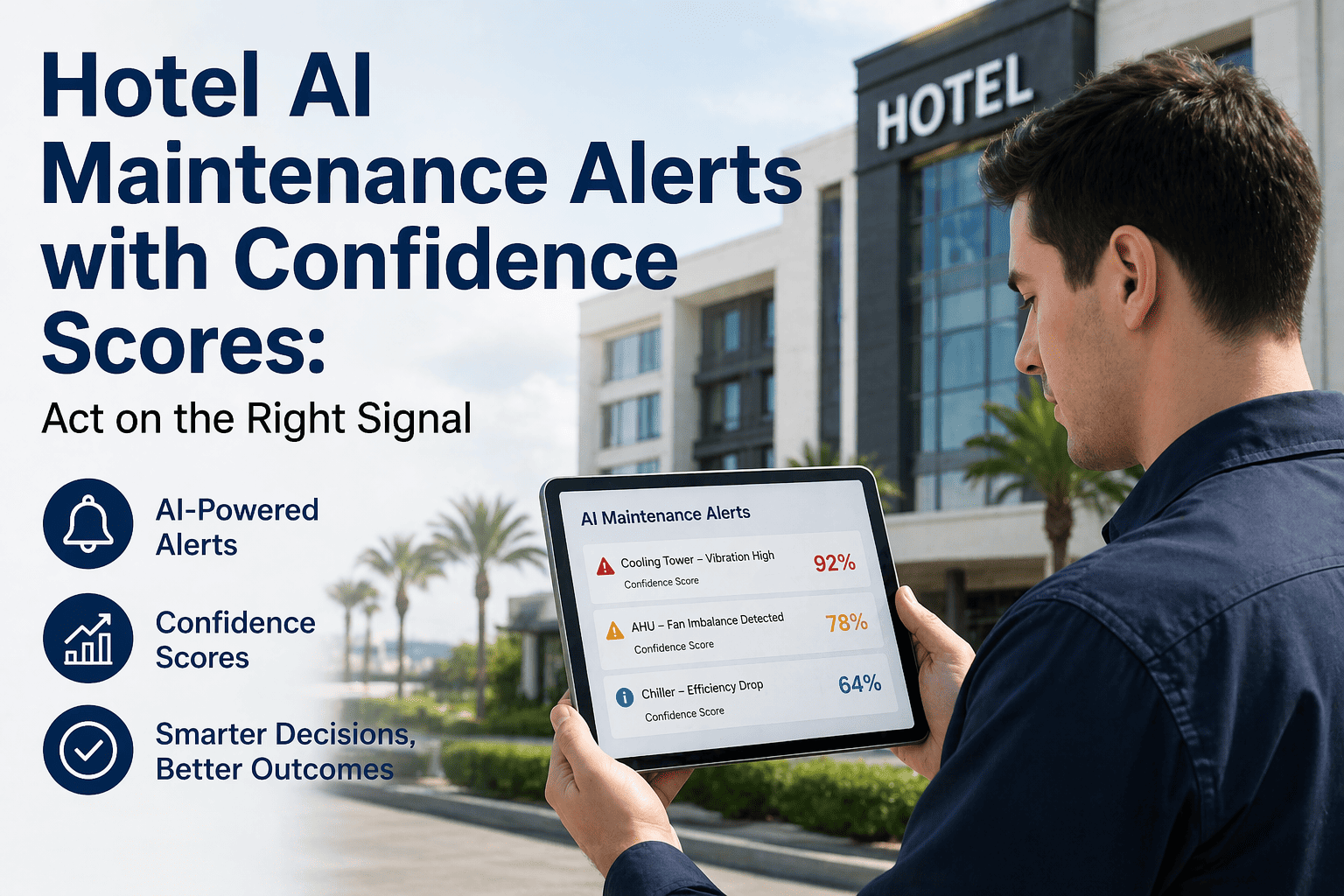
A single anomaly reading on a chiller amperage sensor is not an emergency. It might be a one-off load spike, a sensor drift event, or genuine early bearing stress — and without context, a hotel engineering team cannot tell the difference. When predictive maintenance systems fire alerts without confidence scores, cross-signal correlation, or remaining life estimates, they create a new problem on top of the old one: alarm fatigue. Teams learn to ignore the system.Engineering teams act on the right signals, at the right time, with the right information. Book a demo to see OxMaint's confidence-scored alerting configured for your hotel assets.
AI Maintenance Alerts with Confidence Scores
Every alert carries a score, a failure mode, a timeline, and the evidence — so your team acts on the right signals
<4%
False positive rate with multi-signal confirmation before any alert fires
87%
Example confidence score on a bearing degradation alert — 14–21 days before failure
2–12 wks
Lead time for AI alerts with failure mode classification and remaining life estimate
3-signal
Minimum cross-sensor confirmation required before OxMaint generates a priority work order
The Alarm Fatigue Problem — and Why It Starts With Alert Quality
Alarm fatigue is not a volume problem. It is a signal quality problem. When every alert looks the same — a threshold crossed, a flag raised, an asset name and a time stamp — engineers spend their shift deciding what each alert actually means before they can act. That decision-making overhead kills the value of predictive maintenance faster than any technical failure. The fix is not fewer alerts. It is alerts that arrive with enough context to be actioned immediately, without guesswork.
Raw Threshold Alerts
No confidence — team cannot trust it
A single sensor reading crosses a threshold. Is it a sensor drift event, a transient load spike, or real bearing stress? Without cross-signal confirmation, the answer requires manual investigation every time.
No timeline — cannot prioritise against other work
Is this asset failing in 3 days or 3 weeks? Without a remaining useful life estimate, every alert competes equally with every other — and the team defaults to reacting to whatever is loudest, not whatever is most critical.
No failure mode — technician arrives uninformed
An alert that says "vibration anomaly — Chiller 2" tells a technician nothing before they arrive. No failure mode, no prior context, no recommended action. Diagnosis time extends. First-time fix rate suffers.
OxMaint Confidence-Scored Alerts
Confidence score from cross-signal correlation
OxMaint requires confirmation across at least two independent signal types — vibration pattern shift and current draw deviation, for example — sustained over a minimum observation window before generating a priority alert. False positive rate: under 4%.
Remaining useful life estimate with confidence band
Every alert carries an RUL estimate and confidence interval: "Fan DE Bearing — 18–25 days to functional failure, 89% confidence." The team knows whether this is a weekend job or a same-day dispatch, without calling an analyst.
Failure mode classification pre-loaded
The alert identifies the specific failure developing — inner race bearing defect, shaft misalignment, refrigerant loss pattern — and the recommended action. The technician arrives knowing what to inspect and what parts to bring.
Predictive Alerts That Tell Your Team What to Do — Not Just That Something Is Wrong
OxMaint's AI alerting fires only after multi-signal confirmation, attaches a confidence score and RUL estimate to every alert, classifies the specific failure mode, and converts the alert directly into a pre-populated work order — without a single manual triage step. Machine learning trained on 200+ hospitality asset failure modes.
A percentage score expressing the AI's certainty that the detected pattern represents a developing failure — not sensor noise, a transient condition, or normal operational variation. Scores below a configurable threshold are suppressed or flagged as "watch" status rather than generating a work order.
Example: "Compressor DE Bearing — bearing inner race defect signature detected, 87% confidence. Three-signal confirmation: vibration 22% above baseline, current draw 8% elevated, bearing temperature +4°C over 72 hours."
02
Failure Mode Classification
The AI identifies the specific failure developing — not just that something is wrong, but what is wrong. Bearing inner race defect. Shaft misalignment. Refrigerant loss. Lint accumulation in exhaust duct. Coil fouling index exceeding fill cleaning threshold. The technician receives a diagnosis before they reach the asset.
Supported modes: 200+ hospitality asset failure mode library covering HVAC, chillers, boilers, kitchen equipment, elevators, pumps, and fan systems.
03
Remaining Useful Life Estimate
An estimate of how long the asset can continue operating before functional failure — expressed as a range with a confidence interval. This transforms prioritisation from a judgement call into a data-backed decision: an asset with 3–7 days RUL gets scheduled today; an asset with 18–25 days gets planned around low-occupancy windows.
Example output: "Fan DE Bearing — 18–25 days to functional failure, 89% confidence." Parts ordered. Maintenance window identified. Emergency avoided.
04
Cross-Signal Evidence Summary
The specific sensor readings, deviations from baseline, and trend duration that triggered the alert — displayed in the work order so the technician understands exactly what the AI saw and why it fired. A single anomaly does not generate a priority alert; sustained confirmation across multiple independent signals does.
Three-signal model: OxMaint requires at least two independent signal type confirmations sustained over a minimum observation window. This reduces false positive rate to under 4% across the deployed fleet.
05
Recommended Action & Pre-Populated Work Order
The alert converts automatically to a CMMS work order — pre-populated with the failure description, asset record, recommended action, required parts (checked against inventory), estimated repair time, and the optimal scheduling window relative to occupancy. No manual triage. No translation step. Prediction becomes execution in one automated flow.
Scheduling intelligence: Work orders are timed to occupancy calendar — the 380-room resort example above scheduled a pump motor swap in the kitchen's 6–10 AM dead zone, with zero service disruption.
Confidence Score in Action: Three Hotel Asset Scenarios
87% Confidence
Commercial Dishwasher Pump Motor
Signals detected:
Amperage draw 18% above 90-day baseline
Vibration pattern consistent with bearing inner race defect
Sustained over 72-hour observation window
Alert output:
Bearing degradation — 14–21 days to functional failure, 87% confidence. Replacement pump motor ordered ($340). Installation scheduled Monday 6–10 AM kitchen dead zone. No service disruption.
Without alert: Emergency breakdown mid-service, $3,800 call-out, $6,200 spoiled food, kitchen at half capacity — $24,000 total cascade impact.
72% Confidence
Cooling Tower Fan Motor — Watch Status
Signals detected:
Vibration frequency shift at 1x running speed
Motor current within normal range (second signal not confirmed)
Pattern observed over 24-hour window — observation continuing
Alert output:
Watch status — 72% confidence, second signal confirmation pending. Monitoring window extended 48 hours. No work order generated yet. Chief engineer notified for awareness only.
Without scoring: This alert fires as a priority at the same level as an 87% confidence bearing failure. Team learns to ignore both. Alarm fatigue sets in within weeks.
91% Confidence
Chiller Compressor — Refrigerant Loss
Signals detected:
Supply/return temperature differential narrowing — 6.2°F over 35-day trend
Compressor current draw rising 11% above seasonal baseline
Approach temperature 3.8°F above design — three signals confirmed
Alert output:
Refrigerant loss pattern — 21–28 days to capacity loss, 91% confidence. EPA-certified technician scheduled. Refrigerant charge and leak search work order created, parts pre-staged.
Without alert: Chiller operates at degraded capacity through peak season, energy cost rises daily, guest comfort complaints begin before the team connects the signals.
Frequently Asked Questions
A confidence score expresses the AI model's certainty that a detected sensor pattern represents a developing failure — rather than noise, sensor drift, or a transient operational condition. OxMaint calculates confidence by requiring confirmation across at least two independent signal types (for example, vibration pattern shift and current draw deviation) sustained over a minimum observation window. The higher the score, the more sensor evidence supports the finding. Alerts below a configurable threshold are held in "watch" status and do not generate work orders until confidence increases through continued monitoring.
OxMaint's three-signal confirmation model means a single anomaly reading never generates a priority work order on its own. The AI requires confirmation across at least two independent signal types, sustained over a minimum observation window, before classifying an asset as at-risk. This reduces the false positive rate to under 4% across the deployed fleet. When a technician inspects a flagged asset and finds it within normal tolerance, that outcome is fed back into the AI model as a negative confirmation — improving model accuracy for that asset type and operating condition over time.
A remaining useful life (RUL) estimate projects how many days an asset can continue operating before functional failure occurs, expressed as a range with a confidence interval — for example, "18–25 days to functional failure, 89% confidence." Engineering teams use RUL to prioritise correctly: an asset with 3–7 days RUL requires same-day or next-day action; an asset with 18–25 days can be scheduled around low-occupancy windows with parts pre-ordered and labour planned. Without RUL, all alerts compete equally — and teams default to whatever is most visible rather than whatever is most critical.
OxMaint requires 30 days of operating data to establish reliable baselines for each asset. During this period the system observes normal operational patterns across different conditions — high-occupancy peak load, overnight reduced load, and shoulder-season partial operation — to build an accurate asset-specific profile. Physics-based fault detection (threshold breaches, temperature exceedances, ORP alarms) activates immediately from day one, before AI model training is complete. Predictive failure forecasting — confidence-scored RUL estimates — becomes active from week four onwards, reaching 85–92% accuracy for major failure modes within 90 days.
Yes. Alert thresholds, confidence score minimums, and the observation window duration required before a priority work order fires are all configurable through the OxMaint console — no code required. For life-safety assets (fire systems, elevators) thresholds can be set tighter. For non-critical guest amenity assets, thresholds can be relaxed. Every configuration change is logged and reflected in the confidence scores attached to subsequent alerts, so the engineering team can see exactly why an alert did or did not fire at any point in time.
Assets with the highest combination of failure cost, guest impact, and detectable degradation signal benefit most: chiller compressors (refrigerant loss, bearing wear), cooling tower fan motors (bearing degradation, gearbox stress), commercial kitchen equipment (pump bearing wear, compressor degradation), boiler systems (combustion efficiency drift), and elevators. For assets with simpler failure signatures — pool chemistry, PTAC filters — threshold-based monitoring is sufficient and confidence scoring adds less marginal value over direct parameter monitoring.
Stop Triaging Alerts. Start Acting on Intelligence.
OxMaint fires alerts only after multi-signal confirmation, attaches a confidence score, failure mode classification, and RUL estimate to every finding, and converts it directly into a pre-populated work order — scheduled around your occupancy calendar. Machine learning trained on 200+ hospitality asset failure modes. False positive rate under 4%. Live in under 2 weeks.