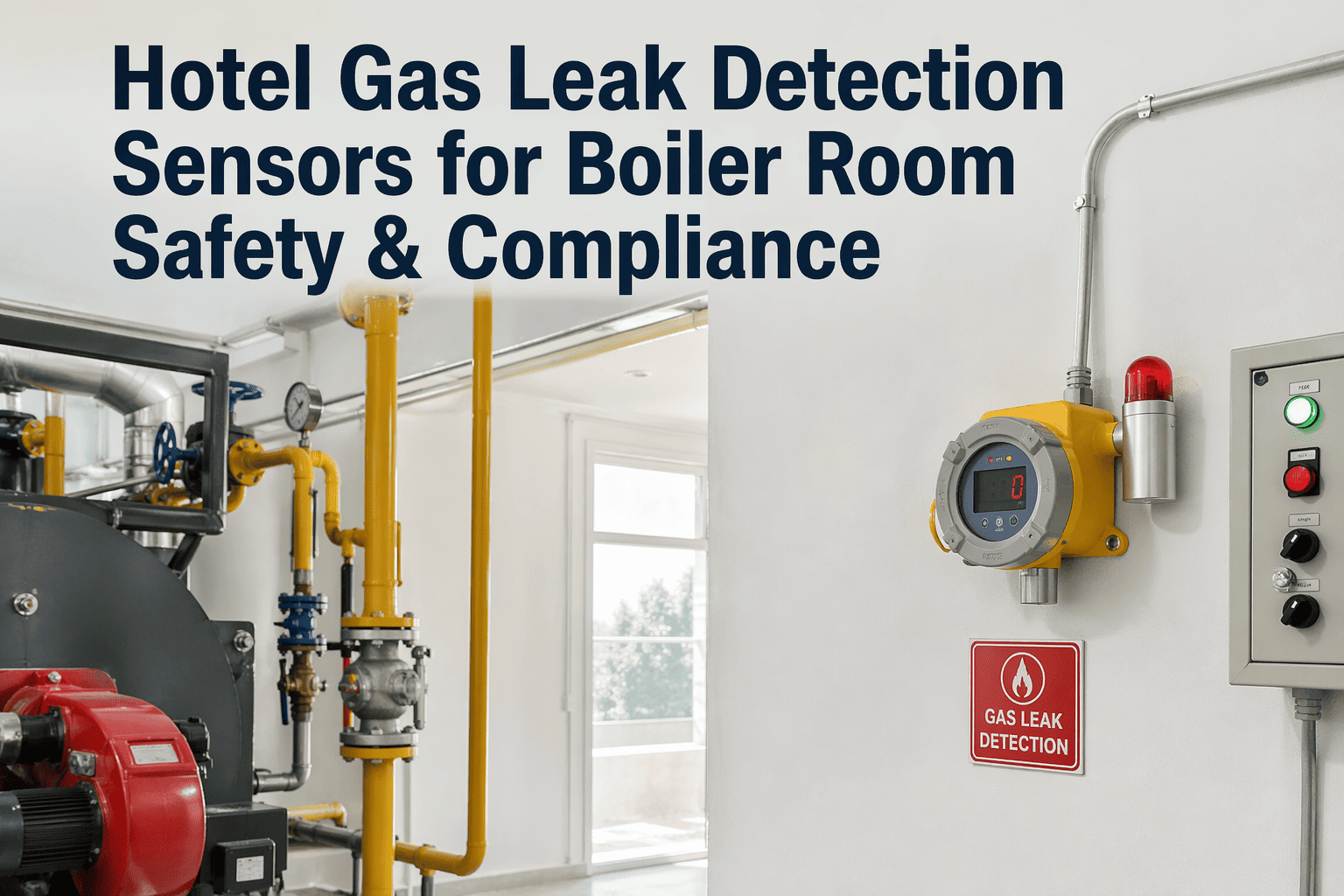
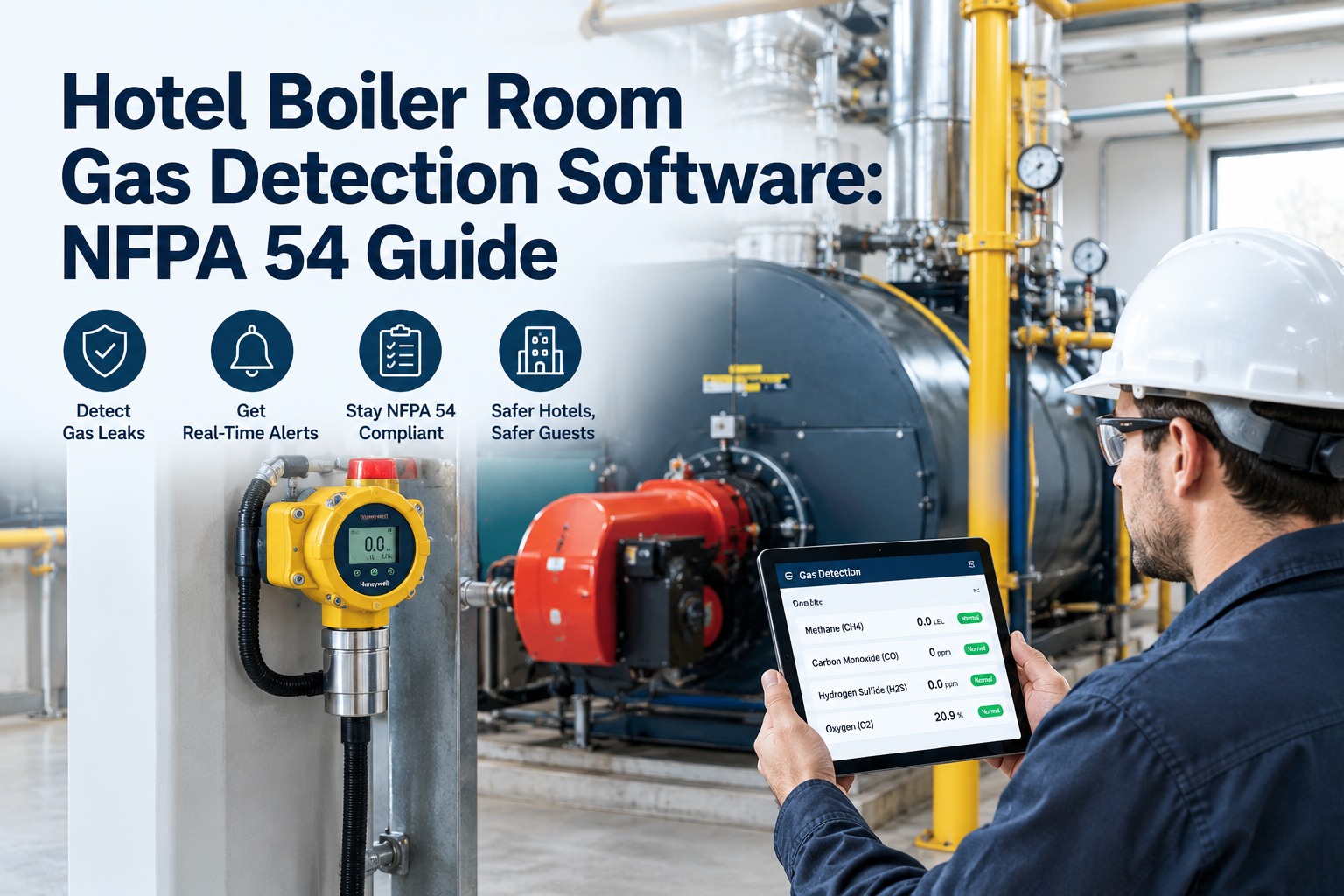
The hotel boiler room at 2 AM is one of the least-visited spaces on property. No guests, minimal staff, and the kind of mechanical hum that masks a great deal. It is also where a natural gas leak — undetected for four hours — can accumulate to 25% of its Lower Explosive Limit before anyone notices. At that concentration, a spark from a relay switching on is sufficient. Hotels that rely on scheduled inspections to protect these spaces are relying on a system designed for equipment reliability, not gas safety. Continuous gas detection with CMMS integration is not a luxury upgrade — it is the baseline that modern safety and compliance demand.
Live Monitoring · Automated Alerts · CMMS Integration
Hotel Gas Sensor Safety — Boiler Room to Plant Room
Continuous gas detection that triggers automated alerts, closes fuel valves, and generates CMMS work orders — before gas accumulation reaches dangerous levels.
$150M
Annual property damage from gas incidents in US commercial buildings
67%
Of hotel gas incidents originate in boiler rooms — the #1 risk zone
89%
Reduction in incident severity with early detection systems installed
45 sec
Detection-to-valve-closure time in documented hotel gas sensor deployments
40%
Insurance premium reduction achieved after certified gas detection installation
The Gases Hotels Must Monitor — and Why Each Is Different
Boiler rooms, plant rooms, and kitchen areas contain multiple hazardous gas types simultaneously — each with different physical properties, detection requirements, and response protocols. A single CO detector covers one risk. A comprehensive gas monitoring strategy accounts for all of them, with sensor placement that reflects how each gas behaves in the space.
CO
Carbon Monoxide
Toxic · Odourless · Invisible
Action Threshold
35 ppm (OSHA TWA) · 200 ppm (immediate danger)
Source in Hotels
Incomplete combustion in boilers, water heaters, kitchen equipment
Physical Behaviour
Similar density to air — distributes evenly, mounts at breathing height
Regulatory Ref.
NFPA 72 (Ch.17), IBC Section 915, OSHA 29 CFR 1910.1000
400+ annual US fatalities from CO poisoning — hotels are a high-risk occupancy under NFPA 101
CH4
Methane (Natural Gas)
Combustible · Lighter than air · Rapid expansion
Action Threshold
10–25% of LEL (Lower Explosive Limit = 5% by volume)
Source in Hotels
Gas supply lines, boiler burner connections, kitchen gas feeds
Physical Behaviour
Lighter than air — rises to ceiling and roof void. Sensor mounts high.
Regulatory Ref.
NFPA 54 (National Fuel Gas Code), IBC, local gas utility requirements
Hotels and large residential complexes account for 23% of commercial gas incidents — boiler rooms identified as primary source in 67% of cases
H2
Hydrogen
Combustible · Extremely light · Battery room risk
Action Threshold
10–25% of LEL (LEL = 4% by volume in air)
Source in Hotels
UPS battery rooms, backup generator battery banks, EV charging areas
Physical Behaviour
Far lighter than air — accumulates at ceiling level. Mount sensor at roof apex.
Regulatory Ref.
NFPA 111 (battery room H2 monitoring), NFPA 70 NEC
Battery backup systems in every hotel — hydrogen monitoring required by NFPA 111 but frequently overlooked in hotel safety audits
C3H8
Propane / LPG
Combustible · Heavier than air · Pooling hazard
Action Threshold
10–25% of LEL (LEL = 2.1% by volume in air)
Source in Hotels
Properties without mains gas, backup heating, outdoor kitchen or BBQ installations
Physical Behaviour
Heavier than air — pools at floor level, collects in pits and drains. Sensor mounts low.
Regulatory Ref.
NFPA 58 (Liquefied Petroleum Gas Code), local fire authority requirements
Pools at floor level — particularly dangerous in plant rooms with floor drainage where gas can accumulate undetected overnight
Hotel Zones Requiring Gas Monitoring
Main Boiler Room
CO · CH4 · CO2
Primary combustion equipment — highest gas volume, poorest natural ventilation, longest unoccupied periods overnight
Auto valve isolation + BMS alert + Oxmaint work order
Plant Room / Mechanical Room
CO · CH4
Gas pipework routing through enclosed space — joints and valves are primary leak points, room rarely occupied during off-peak hours
Local alarm + BMS alert + automated work order
UPS / Battery Backup Room
H2
Lead-acid battery charging emits hydrogen — room typically sealed with no exhaust ventilation. NFPA 111 requires monitoring but compliance often missed in hotels.
Ventilation activation + alert + work order
Commercial Kitchen
CO · CH4 · LPG
High staff occupancy — CO from range and oven combustion is primary risk. Gas supply line integrity monitoring at connection points for CH4/LPG.
Kitchen alarm + extraction fan activation + alert
Generator Room
CO · H2
Diesel generators produce CO during operation — critical during power events when ventilation may be compromised. Battery start systems also produce hydrogen.
Emergency exhaust activation + alert escalation
Laundry / Linen Room
CO · CH4
Gas-fired dryers and ironing equipment — periodic monitoring especially where equipment maintenance records show aging burner components
Local alarm + maintenance alert + work order
Oxmaint Gas Safety Integration
Connect Your Gas Sensors to Automated Maintenance Workflows
Every gas detection alert becomes a timestamped work order in Oxmaint — with zone, sensor reading, threshold breached, and recommended action. Compliance documentation created automatically.
Alert Levels and Automated Response Protocols
Effective gas monitoring is a three-tier system. A single threshold that triggers the same response regardless of concentration level creates both under-response (ignoring early warnings) and over-response (full evacuation for trace readings). The tiered alert structure below reflects industry best practice for hotel gas safety, mapping directly to automated actions in the Oxmaint CMMS workflow.
Level 1 — Advisory
10–20% LEL / 35 ppm CO
Early accumulation detected — below immediate hazard threshold but above baseline. Indicates active leak source or equipment fault requiring investigation.
Automated Response
Oxmaint work order created — Priority 2, assigned to on-call engineer
BMS notification sent to building management system
Enhanced ventilation activated (where BMS-integrated)
Sensor reading logged with timestamp for compliance record
Level 2 — Warning
20–40% LEL / 70 ppm CO
Significant accumulation in progress. Active hazard condition — requires immediate engineering response and zone isolation. Do not enter without gas-rated PPE.
Automated Response
Oxmaint work order escalated — Priority 1, immediate response required
Automated gas valve closure signal to BMS (where integrated)
Alert escalation to Director of Engineering and General Manager
Full ventilation maximum activation
Level 3 — Emergency
40%+ LEL / 200+ ppm CO
Explosive or life-safety threshold approaching. Immediate evacuation and emergency services notification. Zone must be isolated from all ignition sources.
Automated Response
Emergency work order created with full event log attached
Automatic fuel gas isolation valve closure
Fire alarm panel notification (NFPA 72 integration)
Full incident documentation chain for insurance and regulatory reporting
Sensor-to-CMMS: How Oxmaint Closes the Safety Loop
Continuous Sensing
IoT gas sensors sample air quality every 30–60 seconds across all monitored zones — 24 hours, 7 days. No gaps during off-peak or overnight periods when staff are absent.
Threshold Classification
Readings compared against Level 1/2/3 thresholds per gas type and zone. Classification determines response protocol — advisory, warning, or emergency — automatically.
Work Order Generated
Oxmaint creates a work order pre-populated with zone, sensor ID, gas type, reading level, time of detection, and response checklist — routed to the on-call engineer immediately.
Multi-Channel Alert
Engineer receives push notification via Oxmaint mobile app. BMS receives signal. Local alarm activates. At Level 3, escalation reaches General Manager and emergency services protocol triggers.
Compliance Record
Every event — detection, response time, corrective action, resolution — is timestamped and archived in Oxmaint. NFPA 72, IBC Section 915, and insurance audit trails generated automatically.
Compliance Framework: What Hotels Are Required to Monitor
NFPA 72
Carbon Monoxide Detection Standard
Governs installation, inspection, testing, and maintenance of CO detection systems. Requires annual functional testing with actual CO gas applied to each detector. Semiannual visual inspection mandatory. Former NFPA 720 requirements incorporated into NFPA 72 as of 2019.
Hotels with fuel-burning appliances: mandatory CO detection. Annual functional test required. Maintenance logged per NFPA 72 Section 14.
IBC Section 915
International Building Code CO Requirements
Adopted in all 50 US states at some level. Requires CO detection in buildings with fuel-burning equipment in central appliance rooms. Activation must trigger audible and visible alarm throughout the building, connected to fire alarm control unit in new buildings with required fire alarm systems.
Central fuel-burning appliance rooms: CO detection connected to fire alarm system. Alarm notification building-wide required.
NFPA 54
National Fuel Gas Code
Governs natural gas system design, installation, and safety in commercial buildings including hotels. Addresses combustible gas detection requirements, automatic gas valve isolation requirements, and performance-based detector placement methodology for boiler room applications.
Combustible gas detection in boiler rooms with confirmed gas leak triggering automatic fuel gas supply isolation.
NFPA 111
Stored Electrical Energy Systems
Requires hydrogen gas monitoring in battery backup rooms — applicable to every hotel with UPS systems, emergency power, or large-format battery backup installations. Frequently overlooked in hotel safety audits despite mandatory status for properties with emergency power systems.
Battery rooms for UPS and emergency power: mandatory H2 monitoring per NFPA 111 and NFPA 70 NEC.
Frequently Asked Questions
How does gas sensor data reach Oxmaint to generate work orders?
Gas sensors connect to Oxmaint via IoT gateway integration — either through the hotel's existing BMS (Building Management System) via BACnet, Modbus, or MQTT protocol, or directly via cellular IoT gateway for standalone sensor installations. When a sensor reading crosses a configured threshold, the integration layer sends a trigger to Oxmaint's API, which creates the work order, assigns it per the zone's maintenance routing rules, and sends the push notification. Setup typically takes 1–3 days per zone depending on existing BMS connectivity.
How often do gas sensors need to be tested and calibrated to maintain compliance?
NFPA 72 requires semiannual visual inspection of CO detectors and annual functional testing using actual CO gas applied to the detector. Combustible gas (CH4, H2, LPG) sensors typically require calibration every 6–12 months depending on sensor technology — electrochemical sensors drift over time and must be bump-tested and recalibrated against certified reference gas. Oxmaint schedules these tasks automatically based on sensor type, last calibration date, and applicable standard — generating reminders before compliance deadlines rather than after.
Why is hydrogen monitoring in hotel battery rooms often missed in safety audits?
Most hotel safety audit checklists are built around fire and CO compliance — hydrogen monitoring for battery rooms falls under NFPA 111 and NFPA 70, which are electrical system standards rather than fire safety codes. Safety managers focused on NFPA 72 and NFPA 54 compliance may not cross-reference the electrical standards that govern UPS and battery backup rooms. Every hotel with emergency power backup systems has lead-acid or lithium batteries that emit hydrogen during charging cycles — this is a mandatory monitoring point that is frequently absent from hotel safety programs.
Does the automated valve closure feature require special gas supply infrastructure?
Automatic gas isolation requires motorized shut-off valves installed on the gas supply lines — these are a standard component of compliant gas safety systems in commercial buildings. If your hotel's gas supply already has motorized isolation valves (required by many jurisdictions for commercial boiler installations), these can be integrated with the sensor system via relay output. Retrofit installations add motorized valves at the boiler room supply entry point. Oxmaint manages the valve test schedule and documents each test as part of the compliance maintenance record.
What documentation does Oxmaint generate for insurance and regulatory purposes?
Oxmaint's gas safety integration generates four categories of compliance documentation: inspection and calibration records per NFPA 72 requirements; event logs for every threshold exceedance with timestamp, zone, gas type, reading level, response time, and resolution; maintenance history per sensor asset; and test certificates for scheduled functional tests. Insurance carriers increasingly require demonstrated sensor maintenance programs for hospitality properties — the Oxmaint audit trail provides the documented evidence that inspection and response protocols were followed, which is critical for both premium negotiation and incident claims.
Hotel Gas Safety Platform
Gas Sensors That Actually Connect to Your Maintenance Workflow
Oxmaint integrates with your hotel's gas detection system to create automated work orders, maintain compliance documentation, and protect every zone from boiler room to battery room — 24 hours a day.