Behind every flawless guest experience at your resort lies an invisible network of back-of-house equipment working around the clock. The commercial kitchen refrigerators preserving tomorrow's breakfast, the laundry machines processing 300 pounds of linens daily, the HVAC systems maintaining perfect climate across 150 rooms—these assets represent millions in capital investment and determine whether guests leave five-star reviews or scathing complaints. Yet most resort operators manage this critical infrastructure with spreadsheets, paper logs, and reactive maintenance that costs 3-5 times more than preventing problems in the first place.
The numbers tell a sobering story. A 200-room resort reports an average of 1,500 equipment failures monthly, according to hospitality infrastructure research. With furniture, fixtures, and equipment costs averaging $10,000 per room annually, and a single serious maintenance failure potentially costing $600-$700 in complimentary stays, the financial case for systematic equipment tracking isn't theoretical—it's existential. Properties implementing digital asset tracking consistently report 35% maintenance cost reductions within the first year, with preventive maintenance delivering 200-500% ROI and 6-12 month payback periods. The question isn't whether your resort can afford modern equipment tracking—it's whether you can afford to operate without it.
Harden hospitality compliance using mobile inspections
The shift from reactive to proactive maintenance isn't just about cost savings—it's about building an audit-ready operation that protects your resort legally and operationally. Hotels allocate between 5-10% of total revenue to property operations and maintenance, yet properties relying on paper-based systems consistently fail compliance audits due to missing documentation, illegible records, or inability to prove maintenance was performed. Mobile inspection technology transforms this vulnerability into a competitive advantage by creating timestamped, GPS-verified, photo-documented evidence of every maintenance action.
Consider what happens when a health inspector arrives unannounced and requests proof that your commercial kitchen equipment has been properly maintained. With paper logs, staff scramble through filing cabinets, hope handwriting is legible, and pray nothing was missed. With digital compliance platforms, maintenance managers produce complete equipment histories in seconds—including photos of completed work, technician signatures, and exact timestamps proving regulatory requirements were met. This isn't just convenience; it's the difference between passing inspections with confidence and facing citations that average $500-$16,000 per violation.
Turning alerts into actions — a hospitality strategy with KPIs
Collecting maintenance data means nothing without converting it into actionable intelligence. World-class maintenance operations track specific Key Performance Indicators that directly connect equipment health to guest satisfaction and bottom-line results. The most critical KPIs for resort operations include Mean Time to Repair (MTTR), Mean Time Between Failures (MTBF), Planned Maintenance Percentage, and equipment availability—each providing distinct insights into operational efficiency and areas requiring improvement.
Industry benchmarks provide clear targets: world-class unscheduled downtime sits below 10%, while asset availability should exceed 90%. A planned maintenance percentage above 70% indicates acceptable proactive management, while anything exceeding 90% represents operational excellence. For resorts specifically, MTTR should target under 4 hours for guest-impacting equipment, with MTBF goals of 500-2,000 hours depending on asset criticality. Properties that implement structured KPI tracking consistently see 40-60% improvement in maintenance-related guest satisfaction scores.
| KPI | What It Measures | World-Class Benchmark | Warning Threshold |
|---|---|---|---|
| MTTR Mean Time to Repair |
Average time to restore failed equipment | Under 4 hours (guest-facing) | Over 8 hours |
| MTBF Mean Time Between Failures |
Average operational time before failure | 500-2,000 hours | Under 300 hours |
| PMP Planned Maintenance % |
Ratio of planned vs. reactive work | Above 90% | Below 70% |
| Equipment Availability Uptime Percentage |
Time equipment is operational | Above 90% | Below 85% |
| Work Order Backlog Pending Tasks per Tech |
Outstanding maintenance workload | 2 weeks per technician | Over 4 weeks |
| First-Time Fix Rate Resolution Efficiency |
Issues resolved on first visit | Above 85% | Below 70% |
The IoT Advantage: Condition Monitoring That Pays for Itself
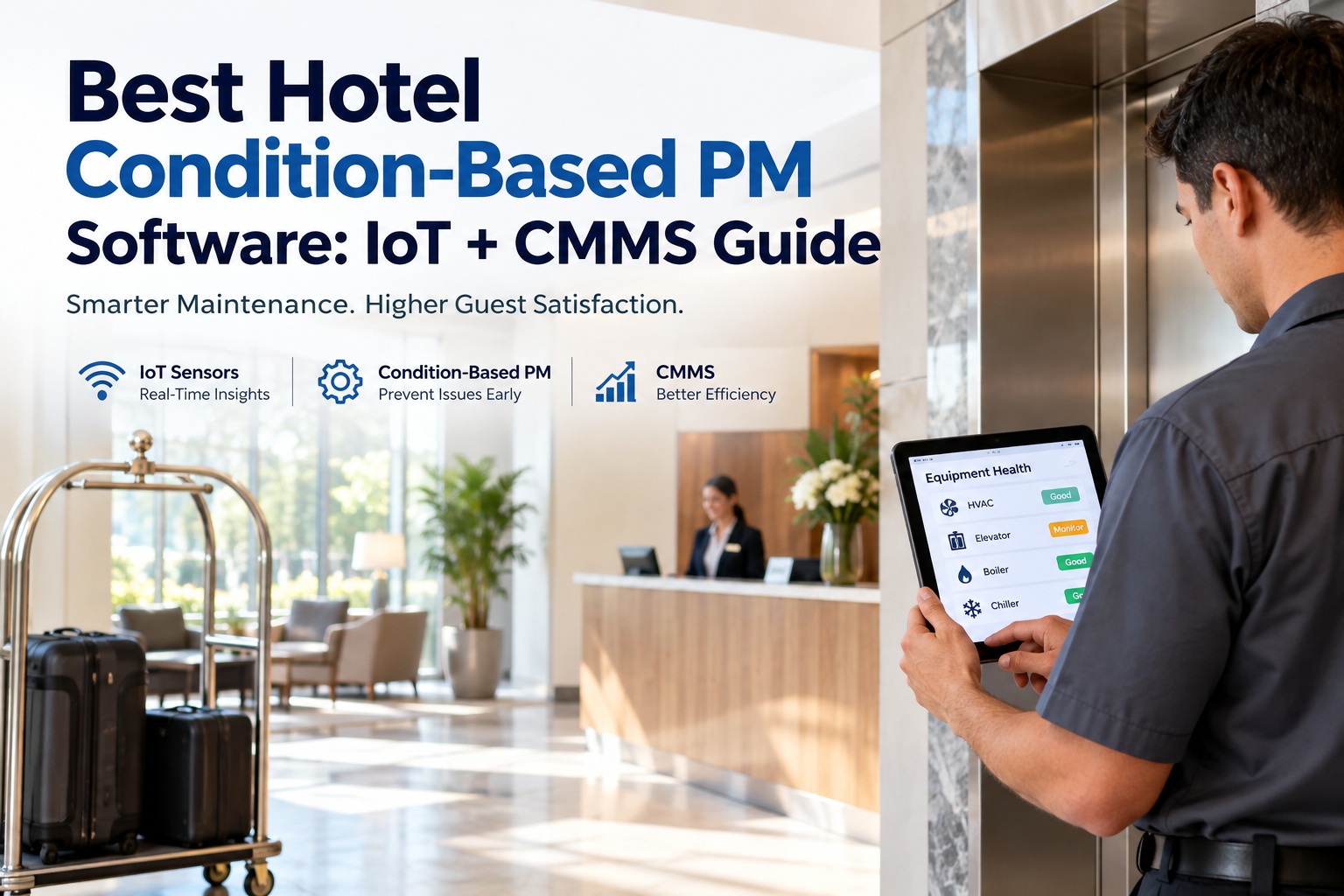
Internet of Things sensors represent the next evolution in resort equipment management, enabling predictive maintenance that prevents failures before they impact guests. By monitoring temperature, vibration, humidity, and energy consumption in real-time, IoT systems identify early warning signs of equipment degradation—a slight increase in compressor vibration, an HVAC unit drawing more power than normal, or refrigeration temperatures drifting outside acceptable ranges. This data-driven approach reduces breakdowns by 40-60%, decreases unplanned downtime by 30-50%, and extends equipment life by 20-30%.
For resorts, IoT integration addresses specific operational challenges. HVAC sensors in guest rooms detect malfunctions before guests notice temperature issues. Kitchen refrigeration monitoring ensures food safety compliance while alerting staff to compressor problems days before failure. Pool and spa equipment sensors maintain water quality parameters automatically, reducing chemical costs while ensuring guest safety. Properties implementing comprehensive IoT monitoring report 25-40% reductions in utility costs from optimized equipment operation, creating additional ROI beyond maintenance savings.
SLA Reporting: Holding Vendors and Teams Accountable
Service Level Agreements transform vague vendor relationships into measurable performance contracts. For resort maintenance operations, critical SLAs should define response times for different equipment priorities—2 hours for guest-impacting failures, 24 hours for non-critical repairs—along with resolution timeframes, parts availability requirements, and documentation standards. Without structured SLA tracking, vendors underperform without consequence, emergency repairs cost premium rates, and accountability evaporates when problems recur.
Effective SLA management requires systematic documentation that most resorts lack. When the HVAC contractor claims they responded within the required window, can you prove otherwise? When the elevator service company bills for a "quarterly inspection," do you have timestamped evidence the work was actually completed? Digital maintenance platforms provide this accountability automatically, tracking vendor response times against contracted SLAs, flagging violations in real-time, and generating performance reports that inform contract renewals. Properties using automated SLA tracking report 15-25% improvement in vendor performance within the first quarter of implementation.
Expert Review: Building Your ROI-Driven Maintenance Strategy
The properties seeing the strongest maintenance ROI share three characteristics: they've moved beyond reactive firefighting to systematic prevention, they measure what matters rather than drowning in data, and they treat OEM maintenance schedules as minimums rather than targets. Digital CMMS platforms make this transformation achievable for properties of any size—the question is whether leadership commits to the discipline required to capture the value.
Conclusion: From Cost Center to Competitive Advantage
Back-of-house equipment tracking represents one of the highest-ROI investments available to resort operators. The mathematics are straightforward: preventive maintenance costs 3-5 times less than emergency repairs, digital tracking reduces maintenance spend by 35% on average, and systematic KPI management improves guest satisfaction scores by 40-60%. Properties that continue relying on paper logs, reactive maintenance, and unstructured vendor relationships leave significant money on the table while exposing themselves to compliance risks and guest experience failures.
The implementation path is equally clear. Begin by inventorying critical assets and establishing baseline KPIs. Deploy digital tracking for highest-impact equipment first—typically HVAC, refrigeration, and kitchen systems where failures directly impact guests. Establish SLAs with maintenance vendors and hold them accountable through documented performance tracking. As the system matures, expand to IoT sensors for predictive capabilities and integrate condition monitoring that prevents problems before they occur. The resort that masters equipment tracking doesn't just reduce costs—it delivers consistently superior guest experiences while competitors struggle with preventable failures.