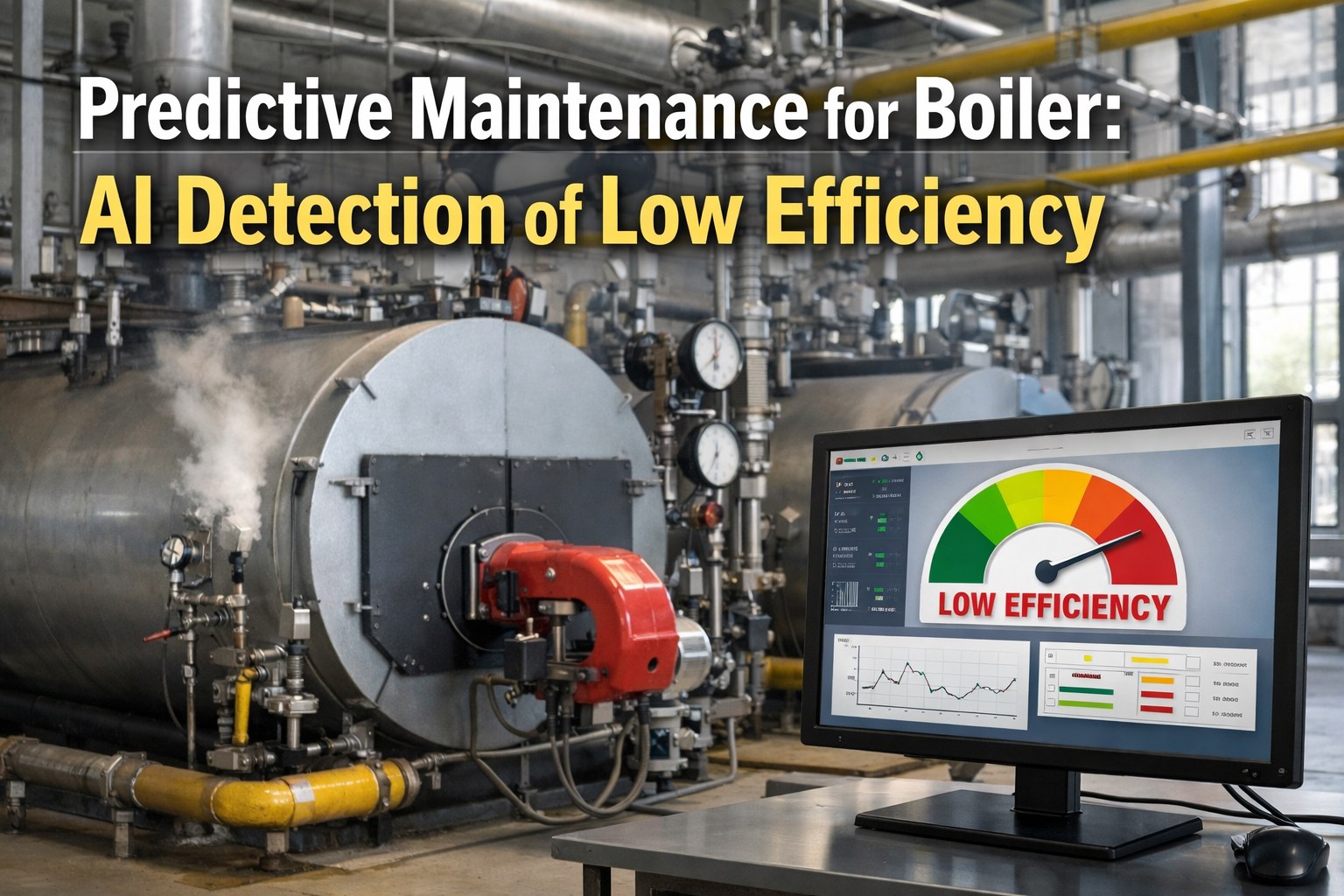
The operations manager received the emergency call at 2:23 AM on a Saturday—the main industrial boiler in the 450,000 sq ft manufacturing facility had experienced a catastrophic tube failure. Steam was flooding the boiler room, production lines were shut down, and 847 workers would be sent home when the morning shift arrived. The tube had been developing microscopic cracks for 14 weeks. Wall thickness had been declining since January. Thermal stress patterns showed anomalies for 67 days. Nobody analyzed the data. Emergency boiler repair: $85,000. Lost production over 9-day shutdown: $2.4 million. Expedited replacement parts: $42,000. OSHA investigation and penalties: $28,000. An AI monitoring system would have detected the tube degradation 10 weeks earlier—when a $12,000 scheduled tube replacement during planned maintenance would have prevented everything.
Production Loss
$500K-5M
AI Prevents: 90%
Emergency Repairs
4-8x Cost
AI Reduces: 75%
Safety Incidents
$50K-500K
AI Prevents: 85%
Regulatory Fines
$25K-100K
AI Prevents: 80%
Insurance Claims
+25-60%
AI Mitigates: 70%
82%
Of boiler tube failures show detectable warning signs 4-12 weeks before catastrophic failure
6-10 wks
Average warning window when AI monitors boiler tube health continuously
96%
Detection accuracy for AI systems predicting boiler tube leak failures
AI-powered predictive maintenance transforms boiler management from reactive emergency response to proactive asset protection. Instead of waiting for catastrophic tube failures—which often cause production shutdowns, safety hazards, and massive repair costs—machine learning algorithms detect the subtle thermal, acoustic, and chemical patterns that precede leaks weeks in advance. When facility teams implement AI-powered boiler monitoring, they're not just preventing equipment failures—they're building the operational intelligence that turns dangerous pressure vessel incidents into scheduled maintenance windows while maintaining continuous production and regulatory compliance.
How AI Detects Boiler Tube Leaks Before Catastrophic Failure
Traditional boiler monitoring systems track pressure, temperature, and water levels as threshold-based alarms—alerting only when parameters exceed safe limits. By then, tube integrity has already degraded, steam leaks have begun, and emergency shutdown is often imminent. AI takes a fundamentally different approach: analyzing dozens of correlated variables including acoustic signatures, thermal gradients, water chemistry trends, and combustion efficiency to identify the conditions that cause tube failures before any visible leak develops. This predictive capability provides weeks of advance warning instead of reactive crisis management.
1
Acoustic Signatures
Ultrasonic Emissions, Steam Leak Detection, Vibration Patterns
Frequency Analysis
Amplitude Trends
Leak Localization
2
Thermal Imaging
Surface Temperature, Heat Distribution, Hot Spot Detection
Gradient Mapping
Anomaly Detection
Trend Analysis
3
Water Chemistry
Dissolved Oxygen, pH Levels, Conductivity, Iron Content
Corrosion Rate
Scale Formation
Treatment Efficacy
4
Pressure Dynamics
Operating Pressure, Pressure Fluctuations, Differential Pressure
Cycle Stress
Surge Events
Load Patterns
5
Combustion Analysis
Flue Gas Composition, Flame Pattern, Efficiency Metrics
O2/CO Ratio
Heat Transfer
Fouling Index
6
Historical Patterns
Tube Age Data, Maintenance History, Operating Cycles
Failure Prediction
Life Expectancy
Risk Scoring
The AI Detection Process: From Sensor Data to Predictive Alert
Understanding how AI transforms raw boiler system data into actionable maintenance intelligence helps facility teams evaluate and implement predictive systems. The process runs continuously, analyzing thousands of data points every minute to identify developing tube degradation invisible to traditional threshold monitoring. When your team can see how AI detection works on your boiler systems, the potential for preventing catastrophic failures becomes immediately clear.
1
Continuous Data Capture
IoT sensors stream acoustic emissions, thermal readings, water chemistry, pressure dynamics, and combustion data every 30 seconds
2
Baseline Comparison
AI compares current readings against established baselines adjusted for load, ambient conditions, and tube age profiles
3
Pattern Recognition
Machine learning identifies subtle deviations matching known tube failure signatures including wall thinning, cracking, and corrosion patterns
4
Root Cause Analysis
AI determines probable cause—thermal fatigue, oxygen pitting, caustic corrosion, erosion, or hydrogen damage—with location identification
See What Your Boiler System Is Trying to Tell You
AI-powered monitoring detects boiler tube degradation weeks before traditional alarms trigger. Find out what predictive analytics would reveal about your pressure vessel health.
Common Boiler Tube Failure Modes: What AI Detects Early
Boiler tube failures don't appear suddenly—they develop through specific degradation mechanisms that AI can identify weeks before leaks occur or catastrophic ruptures develop. Understanding these patterns helps facility teams appreciate why AI monitoring succeeds where traditional threshold-based alarms fail. Each failure mode has distinct signatures that machine learning recognizes from historical failure data across thousands of boiler installations worldwide.
AI Detection Signals: Cyclic temperature variations, localized thermal stress patterns, microscopic crack propagation signatures, startup/shutdown stress accumulation, thermal gradient anomalies
8-12 weeks advance warning
AI Detection Signals: Elevated dissolved oxygen levels, localized wall thinning patterns, iron content increases in blowdown, acoustic signature changes, water chemistry trend deviations
6-10 weeks advance warning
AI Detection Signals: pH excursions in concentrated zones, heat flux anomalies, deposit accumulation patterns, localized gouging signatures, feedwater chemistry variations
4-8 weeks advance warning
AI Detection Signals: Wall thickness reduction trends, localized velocity changes, particle impact signatures, sootblower alignment issues, flue gas velocity anomalies
3-6 weeks advance warning
Traditional Monitoring vs. AI Predictive Detection
The fundamental difference between traditional boiler monitoring and AI predictive monitoring is timing. Traditional systems tell you there's a problem; AI tells you a problem is developing. This shift from reactive to predictive changes everything about how facilities protect their critical steam generation assets and maintain safe operations. ASME research confirms that predictive maintenance approaches reduce boiler unplanned downtime by up to 70%. Properties ready to see the difference can create a free account and start monitoring immediately.
Detection Timing:
After leak or alarm triggers
Warning Time:
Zero - emergency already occurring
Root Cause:
Post-failure forensic analysis
Tube Location:
Manual inspection required
Work Orders:
Created after shutdown begins
Detection Timing:
Pattern deviation detected early
Warning Time:
4-12 weeks advance notice
Root Cause:
AI-identified failure mechanism
Tube Location:
Pinpointed by sensor fusion
Work Orders:
Auto-generated with diagnosis
70%
less unplanned downtime
65%
lower maintenance costs
Implementation Lifecycle: From Pilot to Full Deployment
Successful AI boiler tube leak monitoring implementations follow a proven lifecycle—starting with baseline establishment, progressing through algorithm training, and culminating in fully automated predictive maintenance. This phased approach validates savings, builds internal expertise, and ensures the AI system learns your specific boiler characteristics, operating conditions, and fuel types before making critical predictions.
Baseline
Sensor installation, Data collection, Normal operation mapping, Tube profiling
Training
AI model calibration, Failure pattern loading, Threshold optimization, Alert tuning
Validation
Prediction testing, False positive reduction, Operator feedback, Model refinement
Automation
CMMS integration, Auto work orders, Compliance tracking, Dashboard deployment
Optimization
Continuous improvement, Accuracy tracking, Fleet expansion, ROI measurement
ROI: What Facilities Actually Achieve with AI Boiler Monitoring
The business case for AI-powered boiler tube leak detection extends beyond prevented failures. Eliminated unplanned shutdowns, reduced emergency repair premiums, avoided safety incidents, extended tube life, and optimized maintenance scheduling all contribute to ROI. Properties that receive customized ROI projections based on their boiler inventory, production criticality, and current maintenance approach.
Weeks 1-6
Baseline & Training
Sensor deployment, Data collection, AI learning operational patterns and tube signatures
Foundation building
Months 2-4
Early Detection
First predictive alerts, Wall thinning identified, Corrosion patterns flagged
25-40% savings begin
Months 5-8
Full Prediction
Mature AI models, Automated maintenance scheduling, Comprehensive monitoring
50-65% savings
Year 1+
Sustained Value
Continuous improvement, Life extension, Zero unplanned failures
65%+ sustained
Typical Payback Period
3-6 Months
Expert Perspective: Why AI Succeeds Where Traditional Monitoring Fails
Industry Insight
"Boiler tubes don't fail without warning—they degrade through predictable mechanisms over weeks and months. The problem is that traditional monitoring only sees the final catastrophic event. A tube wall doesn't go from full thickness to rupture overnight; it thins gradually through corrosion, erosion, or thermal stress. AI monitoring closes this visibility gap by watching for the degradation signatures that precede failures. The plants that achieve zero unplanned boiler outages aren't the ones with faster repair crews—they're the ones that see tube problems developing two months before the first steam wisp ever appears."
— Senior Boiler Engineer, PE, 28 years power generation and industrial steam experience
Multi-Sensor Fusion
AI correlates acoustic, thermal, chemical, and pressure data to identify degradation patterns invisible to any single monitoring approach.
Failure Mode Library
Machine learning leverages thousands of documented tube failures to recognize specific failure mechanisms—thermal fatigue, oxygen pitting, caustic attack.
Tube-Level Localization
AI pinpoints degrading tubes to specific locations, enabling targeted repairs without extensive inspection shutdowns.
Implementation Requirements: What AI Monitoring Needs
AI boiler tube leak monitoring builds on existing infrastructure where possible but requires specific technical foundations for accurate failure prediction. Understanding these requirements helps facility teams evaluate implementation feasibility and plan integration strategically while maintaining ASME and jurisdictional compliance.
Acoustic sensors, Thermal imaging, Water chemistry monitors, Pressure transmitters, Ultrasonic thickness
Comprehensive data capture
Industrial gateway, Edge computing, Cloud platform connection, Secure data transmission, Redundant paths
Real-time data streaming
Cloud AI platform, Machine learning models, CMMS integration, Mobile alerts and dashboards, Reporting suite
Predictive intelligence
Stop Boiler Tube Failures Before They Shut Down Production
Oxmaint's AI-powered predictive maintenance gives facility teams 4-12 weeks advance warning before boiler tube leaks develop. Protect your production, protect your people, protect your bottom line.
Frequently Asked Questions
How accurately can AI predict boiler tube leak failures?
Modern AI predictive maintenance systems achieve 93-97% accuracy in detecting conditions that lead to boiler tube failures 4-12 weeks before leaks would develop or catastrophic ruptures occur. This compares to essentially 0% predictive capability from traditional threshold-based monitoring, which only alerts after pressure drops, steam leaks, or efficiency losses are already occurring. Accuracy improves over time as AI learns your specific boiler characteristics, operating patterns, water chemistry profiles, and fuel types. The key is comprehensive sensor integration—systems monitoring acoustic emissions, thermal patterns, water chemistry, and pressure dynamics achieve the highest accuracy.
What types of boiler tube failures can AI detect before they cause shutdowns?
AI excels at detecting the gradual degradation mechanisms that cause tube failures: thermal fatigue cracking (30-40% of cases), oxygen pitting corrosion (20-30%), caustic corrosion and under-deposit attack (15-20%), and erosion/fly ash damage (10-15%). Each has distinct signatures—thermal fatigue shows as cyclic stress accumulation and localized temperature anomalies, oxygen pitting appears as dissolved oxygen trends and wall thinning patterns, caustic corrosion correlates with pH excursions and heat flux changes. Traditional monitoring only sees the final failure; AI sees the developing conditions weeks earlier.
How much does AI boiler tube leak monitoring cost to implement?
Initial implementation typically costs $15,000-45,000 per boiler for comprehensive sensor deployment, plus $2,000-8,000 for gateway equipment if needed, with ongoing cloud platform subscriptions of $500-1,500/month depending on boiler count and complexity. Most facilities recover this investment within 3-6 months through a single prevented unplanned shutdown. Consider: an emergency tube failure costing $85,000+ in repairs plus $500,000+ in lost production versus a $12,000 scheduled tube replacement during planned maintenance demonstrates the compelling value proposition. Payback accelerates with critical production operations where downtime costs exceed $50,000/day.
How does AI monitoring affect ASME and jurisdictional boiler compliance?
AI monitoring enhances ASME and jurisdictional compliance by providing continuous condition documentation that supplements required periodic inspections. The AI system generates compliance reports automatically, tracks inspection schedules, and identifies potential code issues before they become violations. This proactive approach often exceeds regulatory requirements while providing the audit trail inspectors value. AI monitoring complements—not replaces—required jurisdictional inspections per ASME and National Board requirements, but significantly reduces the risk of findings during those inspections.
Does AI monitoring work with all boiler types and manufacturers?
Yes—AI monitoring platforms are designed to integrate with water-tube boilers, fire-tube boilers, and packaged boilers from all major manufacturers including Cleaver-Brooks, Babcock & Wilcox, Victory Energy, Hurst, and others. The AI learns the specific characteristics of your boiler type, operating pressure, fuel source, and tube configuration. Modern addressable sensor networks can be retrofitted to existing boilers without modifications to pressure-containing components. The AI platform operates as an analytics layer above existing control systems, enhancing monitoring without affecting boiler certifications or safety systems.
Ready to Predict Boiler Tube Failures Before They Happen?
Join thousands of facility managers using Oxmaint to predict boiler tube leaks weeks in advance. Start protecting your production and your people today.