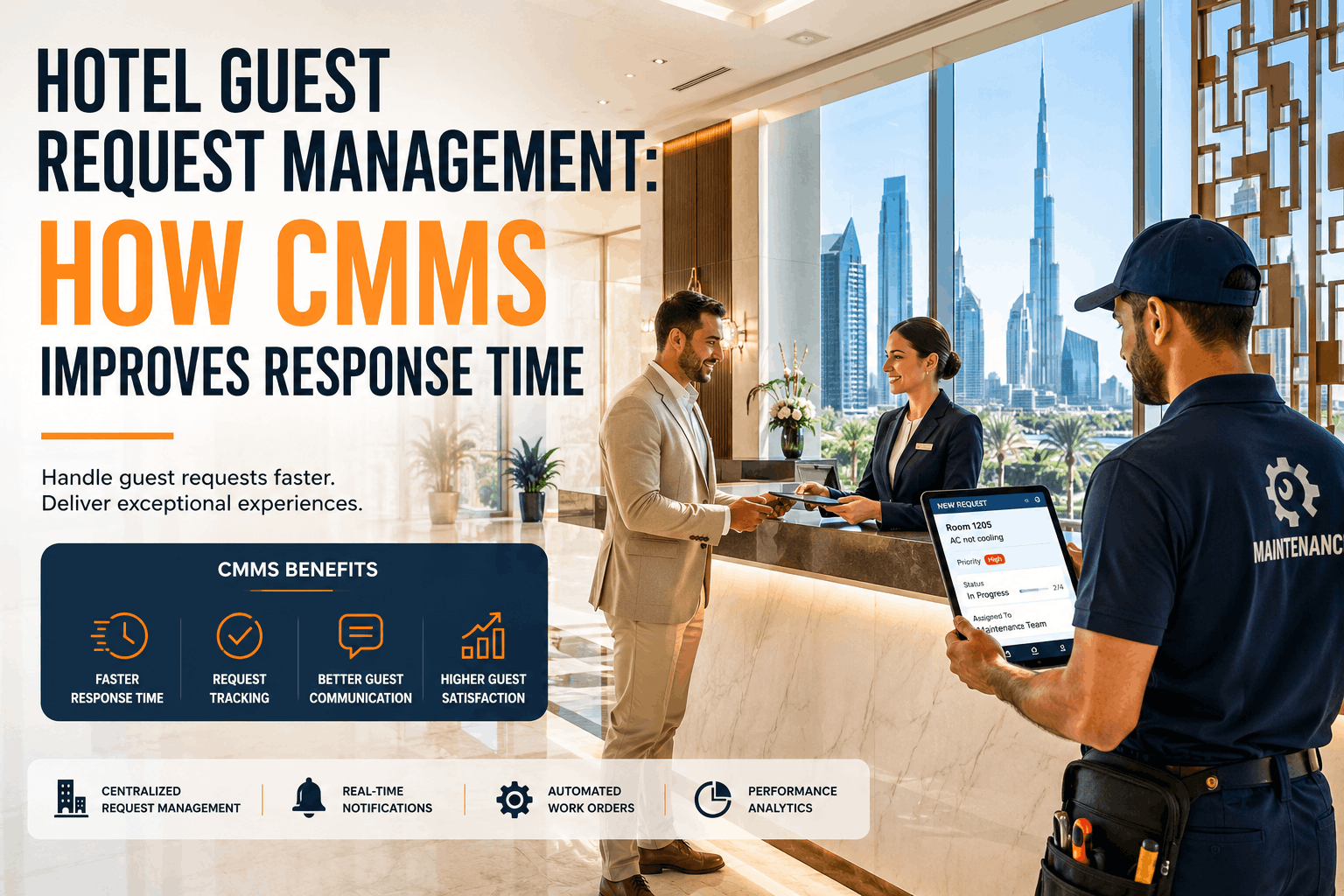
A 280-room full-service hotel in Austin was averaging 4.3 hours between a guest maintenance complaint and confirmed resolution. Their engineering team was capable. Their assets were maintained. The gap was not effort — it was architecture. The PMS logged complaints. The engineering team managed work orders. The two systems did not speak to each other. A front desk agent logging "no hot water in room 418" at 11:47 PM produced a sticky note, a radio call, and a memory — not a timestamped work order, not a dispatched engineer, and not a record that anything was ever done. Six weeks after deploying Oxmaint's CMMS platform, the same hotel averaged 26 minutes from complaint to confirmed resolution. The same staff. The same assets. A different system connecting them.
Improving Guest Satisfaction with CMMS
How three hotel properties used Oxmaint to close the maintenance-to-guest-experience gap — reducing complaint-to-resolution time, eliminating repeat failures, and recovering measurable satisfaction scores within 90 days of deployment.
Why Maintenance System Architecture Is a Guest Satisfaction Variable
Hotels with well-maintained assets and capable engineering teams still produce maintenance-related negative reviews. The mechanism is not technical failure — it is system failure. When the maintenance workflow relies on radio calls, verbal handovers, and paper logs, three things happen consistently: complaints are delayed in reaching engineers, completed repairs are not confirmed back to front desk, and the same faults recur because there is no asset history connecting the current repair to previous ones. Every one of those outcomes produces a guest experience failure that a capable engineering team and a well-maintained asset cannot prevent — because the failure is in the information layer between the guest complaint and the engineering response, not in the repair itself.
A CMMS addresses all three failure modes simultaneously: it closes the complaint-to-dispatch loop automatically, closes the repair-to-room-status loop automatically, and accumulates the asset history that prevents repeat failures. Book a demo to see Oxmaint close all three loops in a live hotel environment.
- Guest complaint logged in PMS — sits as text notation with no action trigger
- Front desk relays verbally to supervisor by radio or phone — relay delay: 15–40 min
- Supervisor dispatches by radio to nearest engineer regardless of skill match
- Engineer arrives with no asset history — diagnoses from zero
- Repair completed — no notification back to front desk
- Room assigned to next guest before repair confirmation
- Same fault recurs — no pattern data to prevent it
- PMS complaint auto-generates structured work order — 0-second delay, timestamped
- Work order classified by priority tier and dispatched to skill-matched engineer — under 2 min
- Engineer receives mobile push with asset history, SLA deadline, room occupancy status
- Engineer repairs with full context — first-time fix rate increases 60%
- Work order closed with photo documentation — PMS room status auto-updated
- Room released for assignment only on confirmed closure — no accidental re-assignment
- Repeat fault pattern detection flags asset for root-cause PM — recurrence eliminated
Three Hotels. Three Starting Points. Consistent Outcomes.
The three case studies below represent a small urban property, a mid-scale select-service hotel, and an eight-property chain — each with a different pre-CMMS challenge profile and a different primary guest satisfaction failure mode. All three deployed Oxmaint. All three produced measurable guest satisfaction improvements within 90 days. Sign up to replicate these outcomes at your property — free to start.
PMS and engineering system completely disconnected. Maintenance complaints entered PMS as text notes and sat until a supervisor checked the system or the front desk called engineering directly. Average complaint-to-response time exceeded 4 hours on night shifts when supervisor coverage was minimal. Engineering spent 35% of every shift on administrative work — locating parts, filling paper logs, and finding out what had already been attempted on repeat faults. OTA review score: 3.9 stars.
Paper work orders, no preventive maintenance schedule, and no asset history at the unit level. The same HVAC units were being repaired repeatedly without any system tracking the pattern — the third repair on Fan Coil Unit 218-B was treated as a fresh job because there was no record of the first two. Average 2.3 equipment failures per week impacted occupied rooms. Maintenance spend was trending 22% over budget without any data to explain the overrun. Maintenance-related satisfaction scores were the property's lowest-rated category across all review platforms.
Eight properties running on eight different maintenance tracking methods — three used paper binders, two used spreadsheets, two used a generic task app, and one used a whiteboard and radio exclusively. Corporate engineering had no cross-portfolio visibility. Brand audit preparation required 60+ hours per property per year and routinely produced documentation gaps. Warranty claims were consistently missed because no property had a system that automatically flagged equipment approaching warranty expiry or preserved the repair documentation required for claim submission.
How Guest Satisfaction Improvements Unfold After CMMS Deployment
Guest satisfaction improvements from CMMS deployment are not instantaneous — they follow a predictable pattern across five phases. Understanding this timeline sets accurate expectations and explains why properties that sustain their CMMS program past the 90-day mark see compounding improvements rather than a one-time step change. Sign up to start building your property's improvement timeline in Oxmaint today.
Intake and Dispatch Automation Live
Multi-channel work order intake activated. Priority queue configured. First structured, timestamped, skill-dispatched work orders created and closed on mobile. Engineering team experiences the new workflow for the first time.
SLA Compliance and Repeat Complaint Reduction
Escalation alerts firing automatically at SLA thresholds. Night shift complaint resolution times converge with day shift for the first time. Front desk begins receiving automatic room status updates on work order closure — accidental re-assignment of rooms under maintenance drops to near zero.
Asset Pattern Intelligence and First Review Score Data
30 days of structured work order history enables recurring fault detection. First asset cost report identifies the units driving disproportionate repair spend. First OTA review data reflecting the improved response times begins appearing — maintenance-specific mentions in reviews shift from negative to neutral or positive.
PM Integration and Compliance Documentation
PM work orders appearing in the unified queue alongside reactive tasks for the first time. PM completion rate above 85%. First brand audit compliance report generated on demand in under 10 minutes. Engineering director presents first asset cost data to GM — capital replacement decisions become evidence-based rather than intuition-based. Book a demo to see Month 3 analytics live.
Compounding Improvement and Full Guest Satisfaction Recovery
PM program reduces reactive callout frequency. Repeat failures near zero. OTA review score improvement measurable against pre-CMMS baseline. Guest compensation costs reduced by 60–90% from pre-CMMS levels. Engineering team productive repair time above 55% of shift. Reactive-to-planned work order ratio below 50% at 18 months.
The question we get from GMs is always some version of: how does a maintenance platform improve guest satisfaction scores? The answer we give them is the same one we got when we deployed Oxmaint: it does not improve guest satisfaction. It removes the operational failures that degrade it. Our maintenance team did not get better — they got the tools to do what they were already capable of doing. The improvement in our scores was not because we hired better engineers. It was because we gave the engineers we had a system that let them do their jobs instead of spending half their shift on coordination. When you remove the coordination overhead, the capability that was always there becomes visible.
Frequently Asked Questions
How does CMMS adoption directly improve hotel guest satisfaction scores?
How long does it take to see guest satisfaction improvement after CMMS deployment?
What is the ROI of CMMS investment for a hotel focused on guest satisfaction improvement?
Can a CMMS help hotels that already have good maintenance teams but poor satisfaction scores?
Your Engineering Team Is Already Capable. Give Them the System That Makes It Visible.
Oxmaint connects your PMS complaints to your engineering queue, closes the repair-to-room-status loop, accumulates the asset history that prevents repeat failures, and generates the compliance documentation that takes days to compile manually — free to start, live in 3–5 days.