On November 14th, a 180-room full-service hotel in the Midwest shut off guest hot water at 6:45 AM. A corroded low-water cutoff had failed silently overnight — the boiler had been cycling on residual heat for six hours before an early-rising guest noticed. The emergency service call took four hours to diagnose and 72 hours to repair. The hotel spent $38,000 on the repair, issued $12,000 in room refunds, and received a state notice of violation for operating a boiler with a failed safety device. Every part of that outcome was preventable. Sign up for Oxmaint and schedule your hotel boiler's annual inspection and winter readiness program today — before the heating season begins.
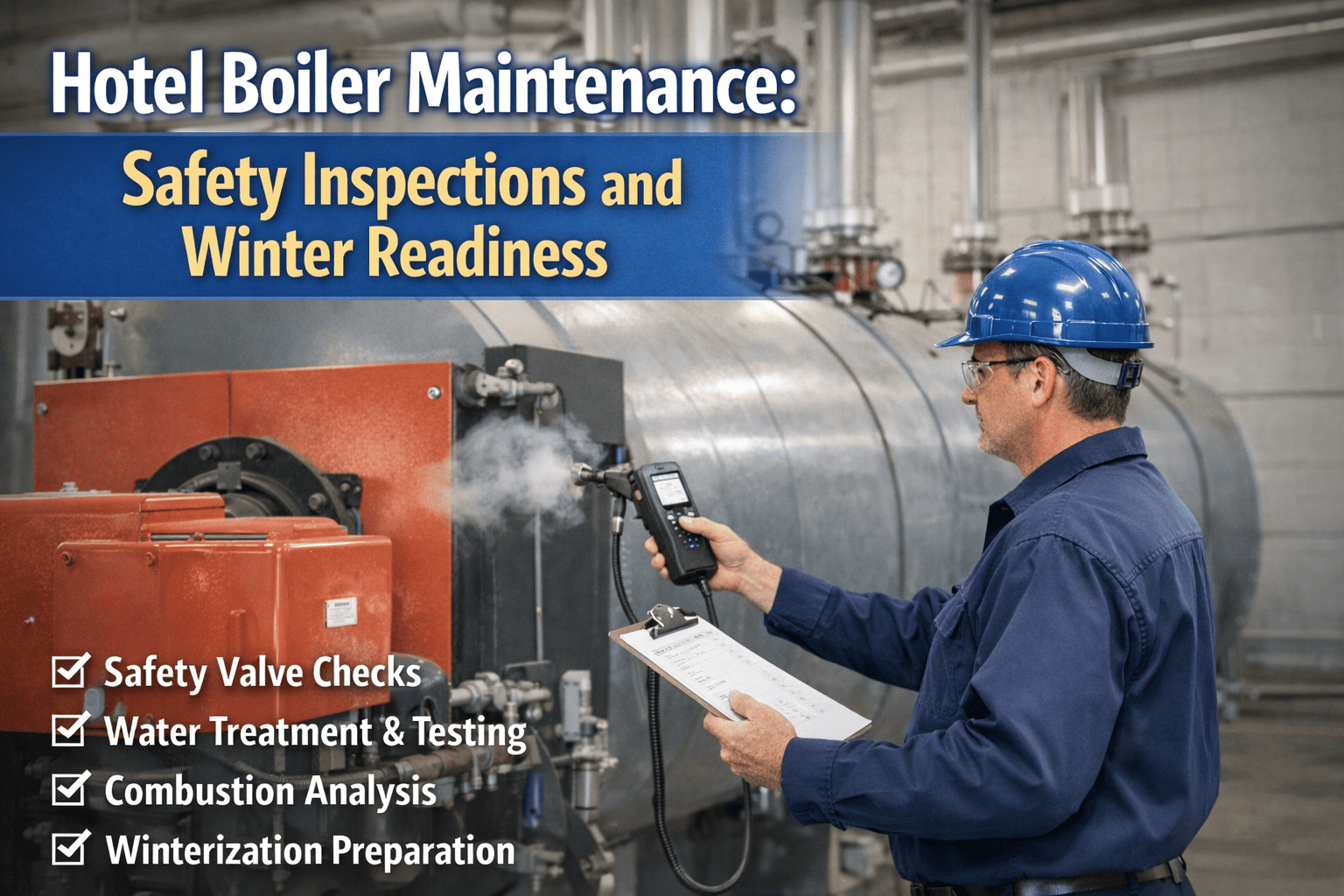
Hotel Boiler Maintenance: Safety Inspections & Winter Readiness Checklist
A complete inspection and preventive maintenance framework for hotel engineering teams, operations managers, and property owners — covering safety valves, water treatment, combustion analysis, venting systems, and regulatory compliance for both hot water and steam boilers.
The Cost of Running a Hotel Boiler Without a PM Program
Hotel boilers are classified as pressure vessels — regulated assets with mandatory inspection intervals, operating certificates, and failure liability that falls directly on property ownership. Unlike HVAC or laundry equipment, a boiler failure is not just an operational disruption: it is a safety event, a regulatory event, and a guest experience event simultaneously. Properties that run boiler PM programs on paper, spreadsheets, or memory face three compounding risks: missed inspection deadlines, undetected safety device degradation, and no documented defense when a state inspector or insurer reviews the service record. Oxmaint tracks every boiler as a compliance asset — with inspection due dates, service logs, and certificate storage that puts your team one click ahead of any audit.
Five-Section Hotel Boiler Safety Inspection Checklist
This checklist covers the five core inspection domains required for both hot water and steam boiler systems in hotel operations. Each section includes an inspection code, the tasks required, and what each task is designed to detect. Load this entire checklist into Oxmaint free — assign each section to the right technician and generate a completed inspection report in a single click.
The pressure relief valve is the boiler's last line of defense against catastrophic overpressure. It also fails silently — not visibly — until the moment it is needed and does not open. Quarterly manual lift tests and annual certified inspections are not optional: ASME requires them, state boiler codes mandate them, and insurance carriers expect documented proof of compliance.
Untreated boiler water is the primary cause of scale buildup and internal corrosion. Scale is not just an efficiency problem — it is a structural problem. Scale acts as an insulator on heat transfer surfaces: the boiler fires harder and longer, metal temperatures rise above design limits, and the pressure vessel degrades from the inside where no visual inspection can reach. A water treatment program costs $200–$600 per month. A scaled-up pressure vessel replacement costs $40,000–$120,000.
Combustion efficiency determines both operating cost and safety. Every 15% of excess air reduces combustion efficiency by approximately 1%. Insufficient air produces carbon monoxide — an invisible life-safety hazard in any occupied building. Annual combustion analysis with a calibrated analyzer is the only way to verify the boiler is operating within safe and efficient parameters. A visual flame inspection cannot detect CO production or quantify excess air.
The boiler venting system moves combustion gases — including carbon monoxide — safely from the combustion chamber to the outdoors. A blocked, deteriorated, or improperly configured vent system is the primary cause of CO infiltration into occupied hotel spaces. Modern condensing boilers add a condensate drainage requirement: acidic condensate from PVC flue systems must be neutralized before disposal. The vent inspection is non-negotiable before every heating season start.
The boiler's safety control system — low-water cutoff, high-limit thermostat, pressure controls, and pressure/temperature gauges — is the automated defense layer between normal operation and a dangerous overpressure or overtemperature event. These controls are tested, not just inspected. A control that appears functional may fail its designed protective function when actually needed. Testing requires intentionally creating the fault condition and verifying the protective response occurs.
Hotel Boiler Winter Readiness: The Pre-Season Startup Sequence
The heating season start is the highest-risk moment in annual boiler operations. A boiler idle for six months surfaces deferred issues, seasonal corrosion, and waterside deposits during the first few firing cycles. The pre-season sequence should be completed 30–60 days before the first cold night — not the day before, and not reactively when the first guest calls the front desk about cold water at 11 PM in December.
Schedule the annual boiler inspection with a licensed technician and, if required in your state, coordinate with the state boiler inspector or your insurance carrier. Audit current spare parts inventory — relief valve, LWCO float assembly, circulator pump impeller, burner igniter, and combustion controls are the highest-turnover components. Parts ordered 60 days out arrive before they are needed. Parts ordered the day the boiler fails arrive 3–5 days after guest complaints begin. Oxmaint tracks boiler parts inventory with automatic reorder alerts.
Perform the annual internal inspection while the boiler is cold and drained: inspect the pressure vessel for pitting, scale deposits, and corrosion. Pull and inspect handhole plates and inspection ports. Submit a water sample to your water treatment vendor for laboratory analysis — not just a field test strip — and adjust the chemical program for the incoming season's load profile. Hotels at higher winter occupancy need more frequent blowdown cycles than summer baseline programs provide.
With the boiler refilled and at operating temperature, perform the complete controls and safety system test from the CNT section above. This is when the LWCO test, high-limit test, and pressure control test must all pass — not during a cold snap at 90% occupancy when a failed test means a guest cold-water complaint at 2 AM. Test every safety device. Log every result with technician signature. See how Oxmaint generates a signed, timestamped safety test report.
Perform the combustion analysis and full venting system inspection from CMB and VNT sections. Any adjustments, burner cleaning, or vent repairs identified must be completed with enough lead time to retest before the season begins. A burner requiring a replacement part after combustion analysis gives you 14 days to source and install it before the season — not overnight at emergency pricing during the first heating call.
Confirm the current boiler operating certificate is posted at the boiler or available in the digital asset record. Verify all corrective actions from the annual inspection have been completed and documented. File all inspection reports, water treatment logs, and safety control test records in the boiler's digital asset record in Oxmaint. State inspectors, insurance carriers, and corporate risk management may request these records with 24 hours notice — organized digital records are available on demand, not after an hour of searching through binders.
Boiler Compliance Requirements Hotel Operators Must Know
Hotel boilers are regulated at the state level, with most states adopting the ASME Boiler and Pressure Vessel Code as the technical standard and maintaining a state boiler safety program with inspection authority. Failure to maintain a current inspection certificate — or operating a boiler that a state inspector has ordered out of service — exposes ownership to fines, forced shutdown, and personal liability in the event of a safety incident.
ASME Boiler and Pressure Vessel Code Section I covers power boilers (steam above 15 psi). Section IV covers heating boilers (steam at or below 15 psi, hot water below 160 psi and 250°F). The ASME code governs design, materials, fabrication, and inspection requirements. Most state boiler safety laws adopt ASME by reference — any boiler not meeting ASME standards is non-compliant regardless of age or operational status.
48 U.S. states operate boiler safety programs requiring periodic inspection by a state inspector or authorized insurance inspector. Hotel boilers above the exemption threshold (typically 200,000 BTU/hr or 30 gallon capacity) require an operating certificate renewed annually. Operating a boiler without a current certificate is a strict liability violation in most states — the inspection gap is the violation, regardless of actual boiler condition.
Most commercial property insurance policies covering hotel boiler systems include a boiler and machinery endorsement with mandatory inspection requirements. A boiler failure occurring when the insurer's inspection records are not current is grounds for claim denial. Documented PM records are the property's defense in any coverage dispute. State-authorized insurance inspectors typically serve as both the compliance inspector and the coverage verification for these endorsements.
Properties that let inspection certificates lapse rarely know it until a state inspector visits or an insurance claim review surfaces the gap. Oxmaint stores inspection certificates, tracks renewal dates, and sends advance alerts — so the engineering team knows the deadline before the insurer or the state inspector does.
How Oxmaint Manages Your Hotel Boiler Compliance Program
Each boiler is a named asset in Oxmaint with its operating certificate, inspection records, ASME nameplate data, and service history. Certificate expiration dates are tracked with advance alerts at 90, 60, and 30 days before renewal — to the engineering manager and operations lead. No expired certificates discovered during audits. Set up your boiler asset record free.
The five inspection sections in this checklist each have different inspection frequencies. Oxmaint creates and assigns each task on its correct interval automatically. Monthly LWCO tests are assigned on the first of every month. Annual combustion analyses are scheduled 60 days before heating season. Winter readiness steps appear in sequence at the right intervals. The schedule runs without the engineering manager having to remember it.
Every LWCO test, relief valve lift test, and high-limit test completed in Oxmaint is timestamped, signed by the completing technician, and stored against the boiler asset record. When a state inspector or insurance auditor requests safety control records, the engineering team generates a signed, formatted compliance report in under two minutes — not from a handwritten binder that may be incomplete. See the compliance report demo.
Monthly water chemistry results are logged in Oxmaint against the boiler asset — creating a longitudinal record that surfaces pH drift and hardness trends over time rather than treating each month as an isolated snapshot. Spare parts for boiler PM — LWCO floats, relief valves, igniter assemblies — are tracked in inventory with automatic reorder alerts when stock drops below the defined minimum, eliminating emergency sourcing during heating season failures.
We had a state boiler inspection on a Thursday morning. Our chief engineer was in the system by 8:00 AM and had printed the full inspection package — LWCO test logs, relief valve records, combustion analysis results, and the prior year's inspection certificate — by 8:20. The inspector was in our boiler room by 9:00. He said it was the best-organized inspection he had seen in that building in fifteen years. That preparation used to take two days of digging through binders. Now it takes twenty minutes.