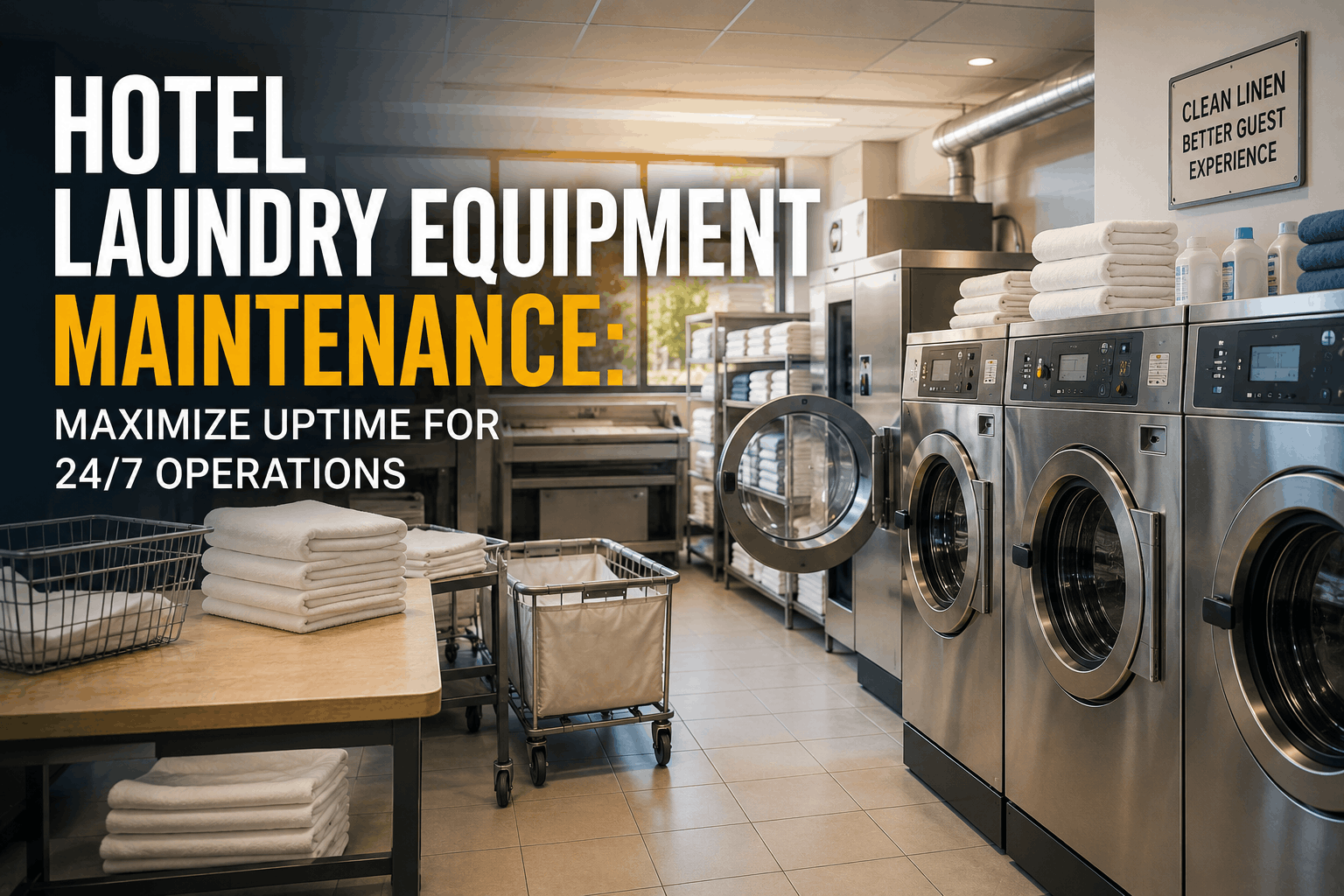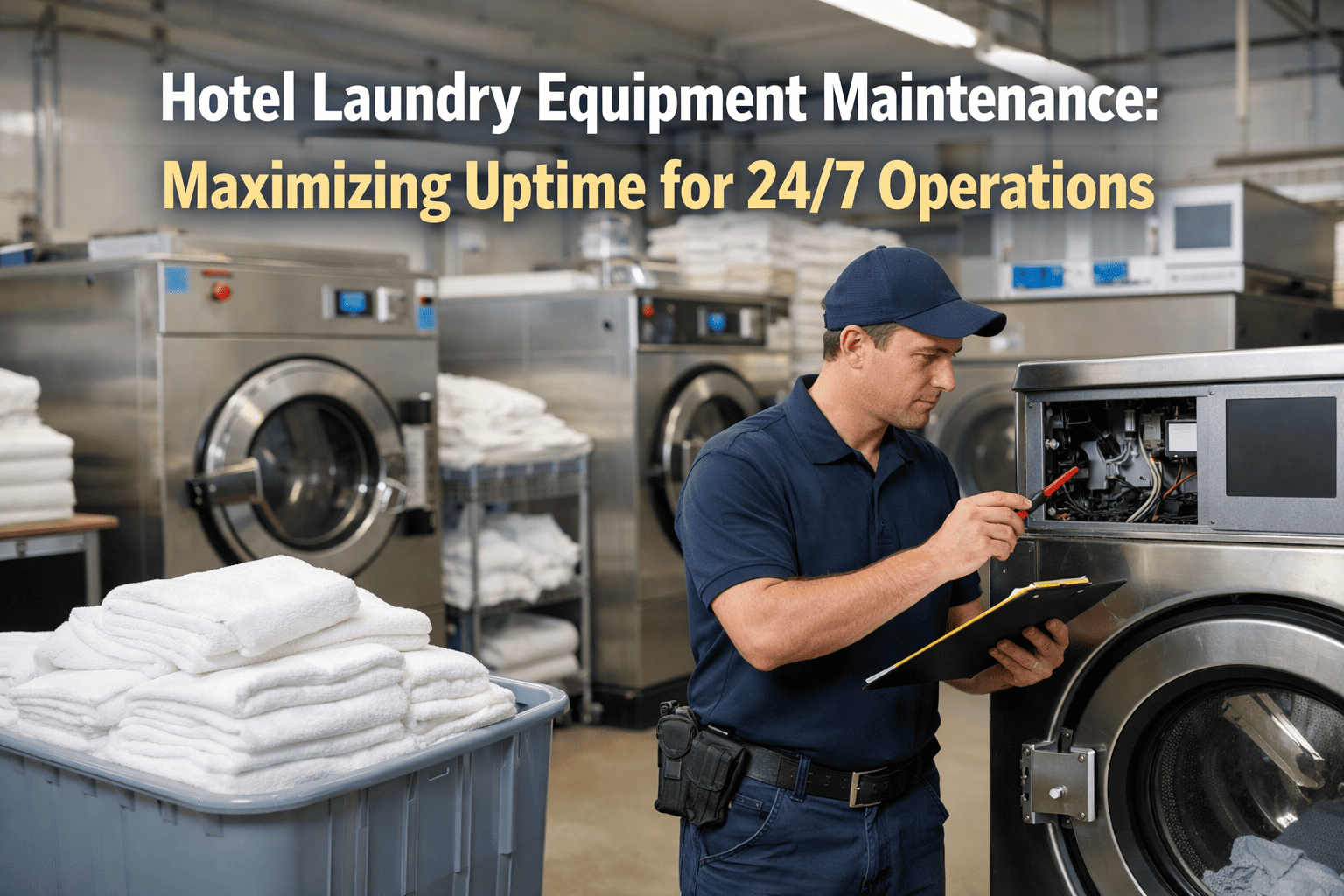
Hotel Laundry Equipment Maintenance: Maximizing Uptime for 24/7 Operations

By Peter Parker on February 27, 2026

hotel-laundry-equipment-maintenance-maximizing-uptime

A 200-room full-service hotel processes 1,800–2,400 pounds of linen per day — sheets, towels, restaurant tablecloths, kitchen uniforms, and pool towels. When a commercial washer fails mid-cycle on a Monday morning, the cascade is immediate: housekeeping runs out of clean sheets by 10 AM, room turnovers stall, front desk delays check-ins, and guests who paid $300 per night are told their room isn't ready. An unplanned laundry equipment failure does not just cost a repair bill — it costs the revenue of every room that wasn't turned over on time. Properties using Oxmaint to schedule and track laundry equipment PM reduce unplanned laundry downtime by over 70% and catch mechanical failures before they disrupt operations.

Asset Management  ·  Preventive Maintenance

Hotel Laundry Equipment Maintenance: Maximizing Uptime for 24/7 Operations

Industrial washers, dryers, flatwork ironers, and tunnel washers are the mechanical backbone of hotel housekeeping operations. Structured preventive maintenance keeps them running at capacity — and keeps housekeeping on schedule.

1,800+pounds of linen processed daily at a 200-room full-service hotel
$4,200average emergency repair cost for commercial washer compressor failure
72 hrsaverage wait for commercial laundry technician in most metro markets
70%downtime reduction with structured PM program vs. reactive-only approach
Equipment Overview

The Four Machines Your Hotel Cannot Afford to Have Down

Every piece of laundry equipment has a defined PM interval, a set of wear components with predictable failure patterns, and a replacement timeline that — if tracked digitally — never needs to surprise the engineering team. What follows is the maintenance framework for each asset class. Oxmaint tracks all four as separate digital assets with individual PM schedules, service histories, and cost records.

WSH
Commercial Washer-Extractors
80–400 lb capacity  ·  Core housekeeping asset

The washer-extractor is the highest-failure-risk machine in the laundry room. Bearings, seals, belts, and drain pumps degrade predictably under daily loads — but only if you are tracking the hours and cycle counts that determine when service is due. A bearing that fails during a heavy load cycle can take the drum shaft with it, turning a $400 bearing replacement into a $6,000–$12,000 shaft and drum assembly repair.

Key PM Intervals
DailyClean door gasket, lint trap, drum
MonthlyBelt tension, door seal, drain pump strainer
QuarterlyBearings, shock absorbers, water inlet valves
AnnualFull mechanical inspection, motor brushes, OEM service
Typical lifespan: 10–15 years with structured PM  ·  6–8 years reactive-only
DRY
Commercial Tumble Dryers
75–200 lb capacity  ·  Fire risk without PM

Commercial dryers are the highest fire-risk equipment in hotel operations. Lint accumulation in the exhaust duct is the number one cause of hotel laundry room fires — and the most preventable. A dryer that is not draining heat efficiently also extends drying cycles, consuming 20–35% more gas or electricity per load while degrading linen fiber faster due to excess heat exposure.

Key PM Intervals
DailyLint screen — every load, without exception
WeeklyInterior drum, moisture sensors, door seals
MonthlyFull exhaust duct inspection and cleaning
QuarterlyGas burner, igniter, thermostat calibration
Fire risk: Lint-blocked ducts ignite at 451°F — most hotel dryers reach 375°F routinely
FLT
Flatwork Ironers
Sheets, tablecloths, pillowcases  ·  High heat components

The flatwork ironer (also called a calender or spreader-ironer) processes the bulk of bed linen and restaurant flatwork at high throughput. The chest (heated cylinder) must be maintained at consistent temperature, and the chest-to-roll gap must be calibrated correctly — a gap that is too tight shreds linen; too loose produces wrinkled output that requires hand-ironing and adds labor cost.

Key PM Intervals
DailyChest temperature, wax strips, linen guides
WeeklyPadding and cover inspection for wear or burns
MonthlyGap calibration, chain lubrication, steam traps
AnnualChest resurfacing if needed, full OEM service
Cover replacement: $800–$2,400 per replacement vs. $3,200 labor if covers fail mid-run
FLD
Linen Folding and Sorting Systems
Automated folders  ·  Output throughput assets

Automated linen folders and stacking conveyors are often overlooked in PM programs because they have no heating elements and fail quietly — a misaligned fold guide produces incorrectly folded linen that reaches housekeeping carts and gets blamed on the ironer or the washer. Sensor calibration, belt alignment, and conveyor tension checks are the maintenance tasks that keep output quality consistent without requiring any manual inspection of finished linen.

Key PM Intervals
DailySensor check, fold guide alignment visual
WeeklyBelt tension, conveyor rollers, photo-eye sensors
MonthlyFull calibration, lubrication, electrical connections
AnnualBelt replacement if stretched, OEM recalibration
Fold quality directly affects linen presentation in rooms — failures surface as brand complaints
Preventive Maintenance Program

Daily, Weekly, and Monthly PM Tasks for the Hotel Laundry Room

The difference between a laundry room that operates reliably and one that generates emergency repair calls every quarter is almost entirely determined by whether daily and weekly PM tasks are completed consistently. These tasks take less than 30 minutes per day. They prevent failures that take 72 hours to repair and cascade through the entire housekeeping operation. Sign up free to load these PM tasks into Oxmaint with automated daily and weekly assignments.

D
Daily Operator Checks — Every Morning Before First Cycle
Daily  ·  Laundry Operator or Housekeeping Lead

Washer door gasket wipe-down Wipe the door gasket and drum opening with a damp cloth. Remove any residual fabric, lint, or foreign objects trapped in the folds. A torn gasket from an embedded object costs $180–$400 to replace and causes every subsequent load to leak.

Dryer lint screen — mandatory before every load The lint screen must be cleared before each drying cycle — not once per day, but before every single load. A blocked lint screen increases drying time by 20–30%, raises internal temperature, and is the primary precursor to dryer fires in hotel laundry rooms.

Flatwork ironer chest temperature verification Confirm the ironer chest has reached operating temperature before feeding linen. Running linen through a cold or unevenly heated chest causes moisture retention in finished linen and accelerates fabric degradation from repeated thermal stress.

Drain pump and lint trap inspection Check the washer's drain pump trap for lint, coins, buttons, and fabric debris. A blocked drain pump is the second most common cause of mid-cycle washer failures — and a 5-minute daily check prevents a 2-day repair timeline.

Vibration and noise baseline check Before loading, run the washer empty for 30 seconds and listen for any abnormal vibration, grinding, or knocking sounds that were not present the previous day. New sounds indicate bearing or drum issues that should be flagged to engineering before they develop further.

Chemical supply levels confirmation Verify that detergent, softener, and any other chemical dispensers are above minimum levels before the morning run begins. Running a cycle without detergent does not just produce unclean linen — it re-deposits soils onto drum walls that contaminate subsequent loads.
W
Weekly Maintenance — Engineering Team Responsibility
Weekly  ·  Engineering Technician or Laundry Supervisor

Exhaust duct inspection and partial cleaning The dryer exhaust duct should be partially cleaned weekly using a flexible brush through the accessible duct sections. Full duct cleaning is a monthly task, but weekly partial cleaning prevents the rapid lint accumulation that creates fire risk when weekly checks are missed.

Door seal and hinge inspection on all machines Check washer and dryer door seals for cracks, tears, or compression loss that reduces sealing effectiveness. Check door hinges for alignment — a door that does not seal squarely against the gasket causes both moisture loss and accelerated gasket wear.

Flatwork ironer wax strip replacement Replace ironer wax strips on the standard weekly cycle. Depleted wax strips cause linen to drag on the chest surface, increasing fabric tension and causing premature linen thinning. Replacement costs approximately $12 per strip — deferred replacement costs the linen it destroys.

Water inlet filter screens — all washers Remove and rinse the water inlet filter screens on all washer-extractors. Clogged inlet screens restrict fill volume and pressure, extending fill cycles, reducing wash effectiveness, and potentially triggering fill-timeout error codes that require manual reset and re-run.

Control panel error code log review Pull the error code history from each machine's control panel. Log any recurring codes in the Oxmaint asset record even if they self-cleared. A code that appears twice in one week and clears both times will appear a third time as a hard fault — the log history is the evidence that accelerates service scheduling.

Load cell and balance verification Confirm the washer's electronic load cell is reading within 5% of actual load weight using a calibrated test load. A miscalibrated load cell allows operators to inadvertently overload the drum, accelerating bearing and shock absorber wear at a rate that halves normal component life.
Never miss a laundry PM date again. Oxmaint schedules daily, weekly, and monthly laundry room tasks automatically — assigns them to the right team member, sends reminders before they are due, and logs every completion to the asset record. Sign up free to set up your first laundry PM schedule.
Failure Modes

The Six Most Common Laundry Equipment Failures — and What Prevents Each One

These are not rare equipment catastrophes. They are the routine failures that occur at predictable intervals in hotel laundry rooms without a structured PM program — and that are almost entirely preventable with the maintenance tasks described in this guide.

01
WSH
Bearing Failure — Commercial Washer
CauseConsistent overloading beyond rated capacity and missed quarterly bearing lubrication over 12–18 months
Repair cost$1,800–$6,000 depending on shaft damage; 3–5 days downtime in most markets
PreventionLoad cell calibration verification every 90 days; bearing inspection and lubrication quarterly per OEM spec
02
DRY
Exhaust Duct Fire — Commercial Dryer
CauseLint accumulation in exhaust duct from skipped daily lint screen cleaning and no monthly duct service
Repair cost$15,000–$80,000 fire damage; full laundry room OOS 1–3 weeks; OSHA investigation mandatory
PreventionLint screen before every single load; monthly full duct cleaning; quarterly gas burner inspection
03
WSH
Door Gasket Failure — Mid-Cycle Leak
CauseForeign objects embedded in gasket folds from missed daily wipe-downs cause tears under door pressure
Repair cost$180–$420 gasket replacement; 4–8 hours downtime; potential floor water damage if undetected
PreventionDaily gasket wipe-down and visual inspection; weekly door seal compression check
04
FLT
Ironer Chest Overheating — Cover Fire
CauseThermostat drift combined with depleted wax strips causes friction heat buildup on the ironer chest cover
Repair cost$800–$2,400 cover replacement; $400 thermostat replacement; 1–2 days downtime
PreventionDaily temperature verification; weekly wax strip replacement; quarterly thermostat calibration
05
WSH
Drain Pump Blockage — Mid-Cycle Shutdown
CauseAccumulated lint, coins, buttons, and fabric fragments block the drain pump impeller completely
Repair cost$0–$80 if caught early; $400–$1,200 if impeller is damaged; 2–6 hours downtime minimum
PreventionDaily drain pump trap inspection and clearing before first cycle; monthly pump strainer deep clean
06
DRY
Moisture Sensor Failure — Linen Over-Drying
CauseMineral deposit buildup on drum-mounted moisture sensors causes them to read dry when linen is still damp
Repair cost$120–$280 sensor replacement; accelerated linen deterioration costs $2,000–$8,000 per year in early linen replacement
PreventionMonthly sensor wipe-down with moisture sensor cleaning solution; quarterly calibration verification
Operational Impact

The Housekeeping Cascade: Why One Laundry Failure Affects Every Room on the Floor

Hotel laundry failures are not self-contained events. They cascade through housekeeping operations in a sequence that becomes harder to recover from with every passing hour. Understanding the cascade makes the business case for preventive maintenance immediate and concrete — not theoretical.

7:00 AM
Washer Fails Mid-Cycle

The morning's first heavy washer load — 200 lbs of king sheets from last night's checkouts — is locked in the drum. The drum will not drain or open until the fault is diagnosed and reset. The load is tied up for an unknown period.

8:30 AM
Clean Linen Buffer Depleted

Housekeeping begins pulling rooms for the day and discovers the clean linen buffer — typically 1.5 room sets on hand — is now below the threshold needed to cover the morning checkout rooms. Supervisors start rationing clean sheets by floor and prioritizing VIP rooms.

10:00 AM
Room Turnovers Stall on Two Floors

Housekeeping cannot complete room turnovers on floors 3 and 4 because no clean king sheets are available. Room attendants move to other tasks and return, creating workflow inefficiency. The front desk is now holding 14 check-ins that cannot be confirmed as ready.

11:00 AM
Check-In Delays Begin — Guest Dissatisfaction

Guests checking in at standard 11 AM arrival find their rooms are not ready. Front desk staff offer the guest lounge and a 15-minute estimate that becomes 90 minutes. Three guests take photos of the "room not ready" sign for their reviews. One requests a rate discount.

2:00 PM
Service Technician Arrives — Full Day Lost

The service technician arrives 6 hours after the failure. The fault is diagnosed, a part is ordered, and the repair is scheduled for the following day. The hotel processes the remaining linen through the functioning washer at reduced capacity for the next 30 hours. Total impact: 18 delayed check-ins, 3 review mentions, 1 discount granted, $4,200 emergency repair cost.

$4,200
What the repair costs

The quarterly bearing inspection that would have prevented this failure costs $180 in technician time and parts. The PM task takes 45 minutes. Oxmaint would have scheduled it automatically, assigned it to the right technician, and confirmed completion with a photo log.

How Oxmaint Helps

How Oxmaint Manages Your Hotel Laundry Equipment Program

01
Individual Asset Records per Machine

Each washer, dryer, ironer, and folder is a named digital asset in Oxmaint with its own purchase date, model number, service history, warranty status, and component replacement log. When the bearing on Washer 2 is replaced, that replacement is recorded against Washer 2 — not in a shared maintenance log where it gets buried and forgotten.

Per-machine historyComponent log
02
Automated PM Scheduling — Daily, Weekly, Monthly

Set up the PM schedule once per asset type. Oxmaint generates daily, weekly, and monthly task assignments automatically, sends reminders to the assigned team member before each deadline, and escalates to the supervisor if a task is not completed on schedule. Sign up free to configure your first laundry PM schedule.

Auto-schedulingDeadline alerts
03
Error Code Logging and Pattern Detection

When a technician logs an error code from a washer's control panel into Oxmaint, the system tracks it against that specific asset. A code that appears three times in 30 days triggers an automatic alert to the engineering supervisor — surfacing the pattern before it becomes a hard fault that takes the machine out of service during peak laundry hours.

Error code trackingPattern detection
04
Downtime Cost Tracking and Replacement Forecasting

Every repair — parts cost, labor hours, and hours of downtime — is logged against the asset record. When a machine accumulates repair costs approaching 40% of its replacement value, Oxmaint surfaces a replacement recommendation based on lifecycle cost data. Capital decisions backed by 3 years of actual repair cost history are approved by ownership faster than requests supported by memory. Book a demo to see the lifecycle cost dashboard.

Repair cost logReplacement forecast
"

We were replacing bearings reactively — when the washer started grinding, we called the technician. When I mapped our repair history in Oxmaint after the first six months, I could see we were replacing bearings on the same washer every eight months. That is a clear overload pattern. We adjusted the load protocols for that machine, added a quarterly bearing service to the PM schedule, and have had zero bearing failures in 14 months. The data was always there. We just did not have a system to see it.
Chief Engineer  ·  310-Room Full-Service Hotel, Pacific Northwest
Frequently Asked Questions

Hotel Laundry Equipment Maintenance FAQs

How often should commercial hotel washers receive preventive maintenance?
At minimum: daily operator checks (door gasket, drain pump trap, lint screen on dryers), weekly engineering checks (door seals, water inlet filters, error code log review), monthly mechanical service (belt tension, bearings lubrication, exhaust duct cleaning on dryers), and an annual full OEM service by a certified commercial laundry technician. Properties processing more than 2,000 lbs of linen per day — common at 200+ room full-service hotels — should consider quarterly OEM service intervals instead of annual. Oxmaint automates all four levels of scheduling from a single asset record.
What is the most common cause of commercial hotel dryer fires?
Lint accumulation in the exhaust duct. Hotel dryers process linen in continuous cycles throughout the day — each cycle deposits lint in the duct. Without a daily lint screen clearing before every load and monthly full duct cleaning, the accumulated lint reaches ignition temperature during normal operation. Commercial dryers run at temperatures between 320°F and 400°F; lint ignites at 451°F, and the margin narrows quickly in a fully blocked duct. This is entirely preventable with a daily habit that takes 30 seconds per load. OSHA investigations following hotel laundry fires consistently cite missed daily lint screen cleaning as the proximate cause.
How long should commercial laundry equipment last in a hotel environment?
With a structured preventive maintenance program: commercial washer-extractors 10–15 years, commercial dryers 12–18 years, flatwork ironers 15–20 years, folding systems 10–12 years. Without structured PM, these lifespans typically contract by 40–50% — a $22,000 commercial washer that should last 12 years often requires replacement at 6–7 years in reactive-maintenance environments, representing a direct cost of $11,000–$13,000 in accelerated depreciation per machine per cycle. A 10-room laundry suite with four machines compounds this to $44,000–$52,000 in unnecessary early replacement capital across a 15-year planning horizon.
Should the engineering team or the laundry operator perform daily maintenance checks?
Daily operator checks — door gasket wipe-down, lint screen clearing, drain trap inspection, vibration baseline — are performed by the laundry operator or the housekeeping lead assigned to the laundry room. These do not require engineering expertise and should be completed before the first cycle every morning. Weekly checks involving door seals, filter screens, error code log review, and load cell calibration verification should be performed by an engineering technician. Monthly and quarterly mechanical tasks — belts, bearings, exhaust duct cleaning, thermostat calibration — require a trained technician and should be performed by engineering or a contracted commercial laundry service technician. Book a demo to see how Oxmaint routes tasks to the correct team by role and task type.

Asset Management  ·  Preventive Maintenance  ·  Free to Start

Stop Reacting to Laundry Failures. Start Preventing Them.

Oxmaint tracks every washer, dryer, ironer, and folding system as a digital asset — with individual PM schedules, error code logs, repair cost history, and automatic replacement forecasting. Daily tasks assigned. Deadlines tracked. Failures prevented before housekeeping ever notices a problem.


Share This Story, Choose Your Platform!