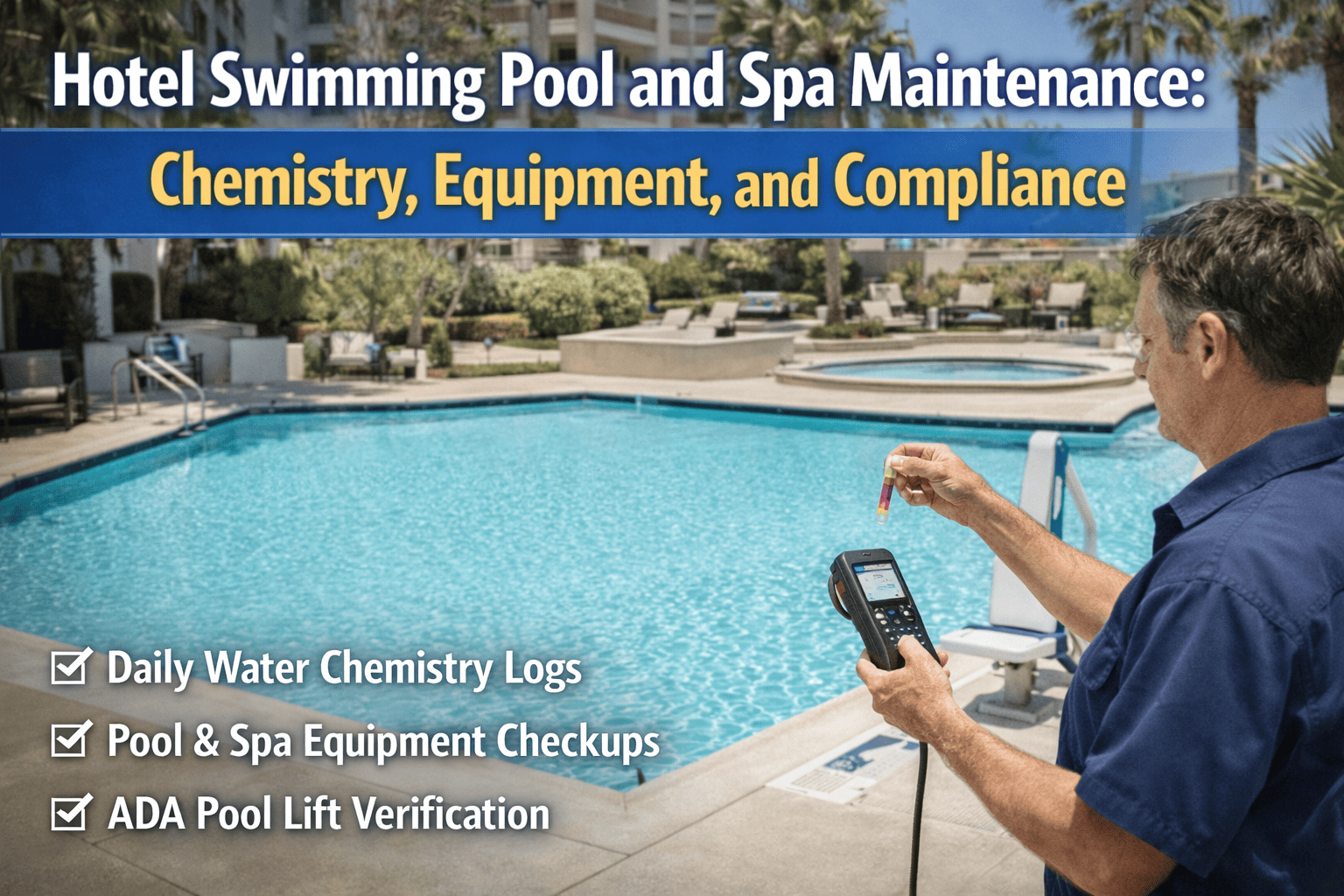
Hotel Swimming Pool and Spa Maintenance: Chemistry, Equipment, and Compliance
By Peter Parker on February 27, 2026
On a Saturday afternoon in July, a county health inspector walked into a 340-room full-service hotel and closed its outdoor pool. The combined chlorine reading was 0.8 ppm — four times the legal limit of 0.2 ppm — and the last water chemistry log entry was three days old. The pool was closed for 48 hours, the weekend revenue from that amenity was lost, and the violation was posted publicly in the county health department database. The root cause was not a chemical system failure. It was a missed daily test. Sign up for Oxmaint and put every pool and spa chemistry test, equipment inspection, and compliance verification on an automated daily schedule — with the digital log that keeps your property audit-ready 365 days a year.
Compliance Management · Asset Management
Hotel Swimming Pool & Spa Maintenance: Chemistry, Equipment & Compliance Checklist
A complete daily, weekly, and monthly maintenance framework for hotel aquatic facilities — covering water chemistry protocols, circulation and filtration equipment, deck safety, ADA pool lift compliance, and health code inspection readiness for both swimming pools and hot tub spas.
of hotel pool closures caused by chemistry violations caught in routine testing
48
U.S. states require licensed commercial pool operators with documented inspection logs
$4K
average health code violation fine for a first-offense hotel pool chemistry closure
2x
daily chemical tests required by most state health codes for commercial hotel pools
Why Hotel Pool Maintenance Cannot Be Reactive
Hotel swimming pools and hot tub spas are regulated assets — not amenities. Every U.S. state with a commercial pool code requires documented chemical testing logs, equipment inspection records, and operator certification. A missed daily chemistry test is not just an operational oversight: in most jurisdictions, it is a health code violation that gives an inspector grounds for immediate closure without warning. Oxmaint automates every daily pool chemistry log and inspection task — assigning them to the right team member, sending reminders before they are due, and generating the complete log record that satisfies health department audits.
2x/dayChemistry testing frequency required by most state codes
$4K–$25KHealth code violation fines for documented chemistry violations
48 hrsMaximum closure duration before reputational impact compounds on review platforms
VGB ActFederal law requiring certified drain covers and entrapment prevention on all commercial pools
CHM — Water Chemistry Reference & Daily Testing Checklist
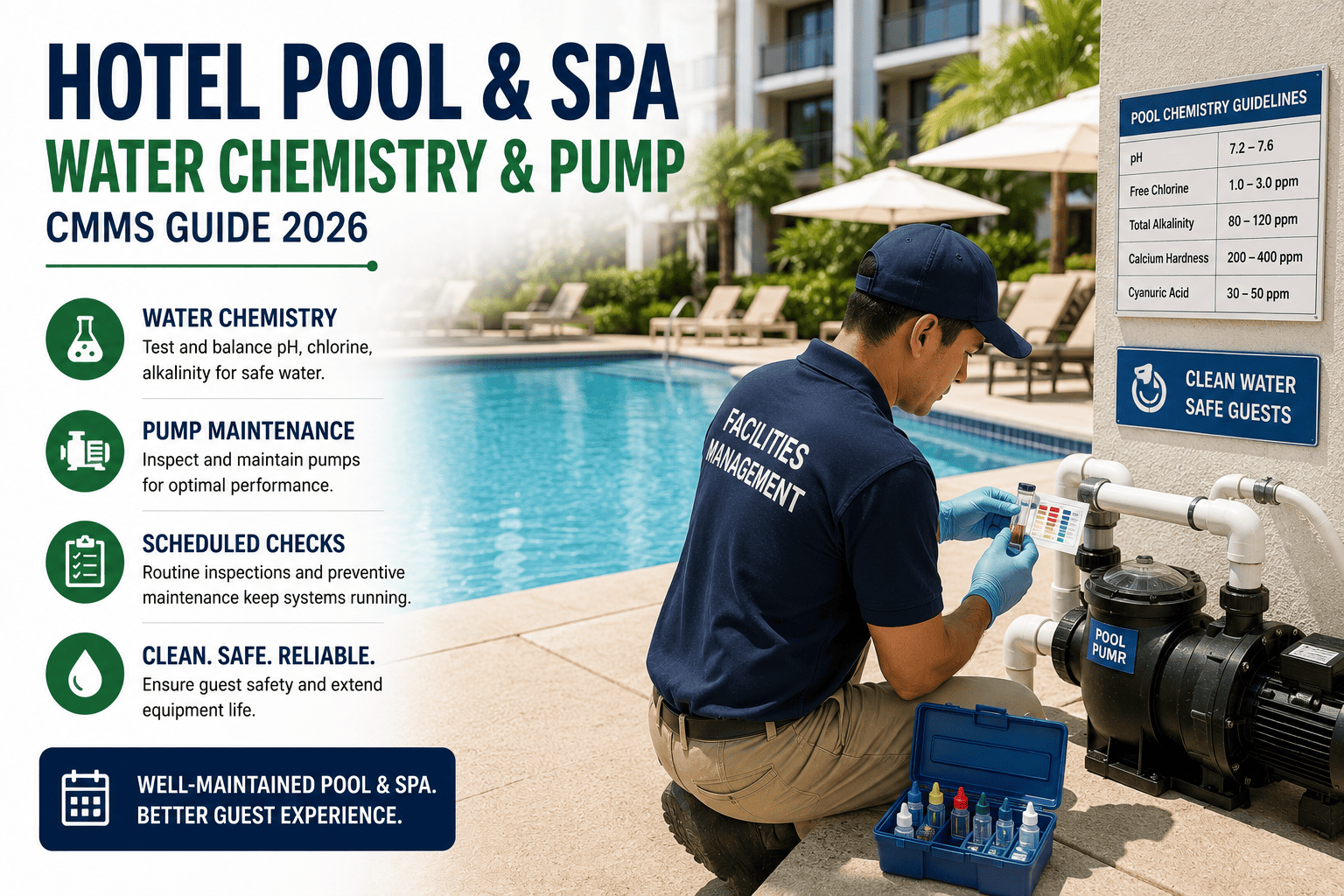
Water chemistry is the primary regulatory compliance domain for hotel pool operations. Most state health codes require chemical testing at least twice daily — at opening and at midday — with all results recorded in a dated log book or digital log system that inspectors may request at any time. The table below shows the target ranges required for both swimming pools and hot tub spas. Load this daily testing checklist into Oxmaint free — every result is timestamped and stored in the pool's digital asset record.
Parameter
Swimming Pool
Hot Tub / Spa
Test Frequency
Risk if Out of Range
Free Chlorine
1.0 – 3.0 ppm
3.0 – 5.0 ppm
2x daily
Bacterial contamination — immediate closure required if below 0.5 ppm
Combined Chlorine
<0.2 ppm
<0.2 ppm
2x daily
Chloramine odors, eye/skin irritation, health code violation above 0.4 ppm
Low: pH bounce and corrosion. High: pH drift, cloudy water, scale on surfaces and equipment
Calcium Hardness
200 – 400 ppm
150 – 250 ppm
Weekly
High: calcium scale on heater, tile, and pump. Low: water draws calcium from plaster, etching surfaces
Cyanuric Acid
30 – 50 ppm (outdoor)
Not applicable
Monthly
Above 90 ppm: chlorine lock — chlorine reads present but does not sanitize. Drain and refill required
Water Temperature
78 – 84°F
100 – 104°F max
Daily
Spa above 104°F: immediate health code violation. Requires posted thermometer and closure protocol
Turbidity / Clarity
Visible main drain
Visible main drain
Daily
Inability to see main drain bottom from pool edge: mandatory immediate closure per state health code
Swipe horizontally to view all columns on mobile
CHM
Daily Chemistry Testing Checklist
Complete at opening and midday · Log all results with timestamp · Corrective action within 2 hours of out-of-range reading
DetectsChemistry drift toward closure-trigger levels before a health inspector documents the violation — the difference between a correction and a closure noticeMissing log entries that create the documentation gap most commonly cited in health code violation reports at hotel aquatic facilities
Pool and spa equipment failures cascade faster than most hotel mechanical failures: a circulation pump that fails at 10 AM means chemistry stratification by noon, an out-of-compliance chemistry reading by 2 PM, and a closure notice by 4 PM if an inspector happens to visit. Equipment PM prevents that cascade. Track every pump, filter, heater, and UV system as an individual asset in Oxmaint — with PM schedules, service history, and replacement forecasting by equipment type.
DetectsNon-compliant VGB drain covers — a federal law violation and life-safety entrapment hazard only detectable by physical inspection with the cover handle testReduced flow from dirty filters and worn impellers that cause chemistry stratification producing false-compliant surface readings at standard test locations
Every pool and spa task in this checklist runs automatically in Oxmaint.
Daily chemistry tests are assigned each morning. Equipment inspections are scheduled by interval. Overdue tasks escalate to the supervisor before the inspector arrives. Set up your aquatic facility PM program free today.
Pool deck and safety equipment inspections are the most visible compliance domain during a health department inspection. Missing safety signage, a broken reach pole, or a first aid kit without a CPR face shield transitions an inspection from a routine visit to a violation notice in under five minutes. These inspections take less time than opening the pool — and must happen before every opening.
DCK
Deck Safety & Opening Inspection
Daily before opening · Weekly depth marker and signage inspection · Monthly life safety equipment audit
DetectsMissing safety equipment and signage — the most commonly cited health code violations in hotel pool inspection reports, fully correctable before openingFailing gate hardware and fence gaps creating child drowning risk — detectable only through physical testing of self-close and self-latch mechanisms
ADA & Health Code Compliance Verification
Hotel swimming pools must comply with the 2010 ADA Standards for Accessible Design, which require at least two accessible means of entry for pools 300 linear feet or greater in perimeter — typically a pool lift and a sloped entry or zero-entry beach. Pool lifts that are present but non-functional on the day of an inspection are treated as absent. Book a demo to see how Oxmaint tracks ADA pool lift certification and annual inspection dates.
ADA
Pool Lift Compliance & Monthly Inspection
HLT
Health Code & Operator Certification Records
How Oxmaint Manages Your Hotel Aquatic Facility Program
01
Pool and Spa as Individual Compliance Assets
Each pool and hot tub spa is a named asset in Oxmaint with its own operating permit, inspection history, equipment records, and chemical log. When a health department inspector asks for the last 90 days of chemistry records for the outdoor pool, the engineering team generates a complete, formatted log from Oxmaint in under three minutes — not from handwritten log books that may be incomplete or illegible. Set up your pool asset records free.
Operating permit trackingChemistry log archive
02
Automated Daily Chemistry Test Assignment
Oxmaint generates and assigns the morning and midday chemistry test tasks automatically — to the specific pool operator on each shift — before each test is due. If the morning test is not completed by 9 AM, the task escalates to the engineering supervisor automatically. The daily chemistry log record is created from the mobile test entry, timestamped, and stored against the pool asset record without any manual data entry.
Shift-based assignmentAuto-escalation
03
ADA Pool Lift and Permit Expiration Tracking
Pool lift monthly inspection tasks and annual certification renewals are tracked in Oxmaint with advance alerts at 30, 14, and 7 days before each deadline. Operating permit expiration dates generate renewal alerts at 60 and 30 days. CPO/AFO certificate expirations trigger recertification reminders to the responsible staff member. No compliance deadline slips because it was not in anyone's calendar. See the compliance alert dashboard in a live demo.
Permit renewal alertsADA lift scheduling
04
Equipment Service History and Failure Pattern Detection
Every pump, filter, heater, and UV system is a sub-asset under the pool record. When the circulation pump on the outdoor pool requires a third impeller replacement in 18 months, that pattern surfaces in the asset record before the fourth failure — enabling the engineering team to address the underlying cause (overload, undersized motor, or water chemistry attacking the impeller) rather than repeatedly replacing the same component. Start tracking equipment history free.
Equipment sub-assetsFailure pattern detection
"
We had a county health inspector walk in on a Thursday with no advance notice. Our pool operator had logged both chemistry tests that morning and midday in Oxmaint. When the inspector asked for the last 30 days of chemical records, I pulled up the report on my phone and emailed it to him while we were standing at the pool deck. He said in fifteen years of hotel inspections he had never received the records before he left the property. We passed with zero violations. The log was the whole inspection.
Director of Engineering · 260-Room Full-Service Resort Hotel, Mid-Atlantic Region
Frequently Asked Questions
Hotel Pool & Spa Maintenance FAQs
How often must hotel pool water chemistry be tested?
Most U.S. state health codes require chemical testing at least twice daily — at opening and at midday. High-bather-load periods (summer weekends, pool parties, resort peak seasons) may require testing every 2 hours per your state code or your property's operating permit conditions. All test results must be recorded in a dated log that is retained on-site for the period specified by your jurisdiction (typically 1–3 years) and available for health department inspection on request. Oxmaint automatically generates a timestamped chemistry log from mobile test entries — no manual log books required.
What are the ADA requirements for hotel swimming pool accessibility?
Under the 2010 ADA Standards for Accessible Design (Section 1009), hotel swimming pools with a perimeter of 300 linear feet or greater require at least two accessible means of entry — typically a pool lift plus a sloped entry, zero-entry beach, or transfer wall. Pools under 300 linear feet require at least one accessible means of entry. Pool lifts must be independently operable (no water-side assistance required), must have a seat at least 16 inches wide, must have a weight capacity of at least 300 lbs, and must be kept operational during all hours the pool is open to guests. A pool lift that is present but non-functional on the date of inspection is treated as absent for ADA compliance purposes. Book a demo to see how Oxmaint tracks pool lift inspection and certification status.
What is the VGB Act and how does it affect hotel pool maintenance?
The Virginia Graeme Baker Pool and Spa Safety Act (VGB Act) is a federal law requiring that all commercial pool and spa drains be equipped with certified anti-entrapment drain covers meeting ANSI/ASME A112.19.8 standards. Non-compliant covers must be replaced, and replacements must be recertified at the intervals specified by the manufacturer (typically 5–10 years). VGB Act compliance is enforced at the state level and is verified during health department inspections. Any commercial pool with a non-certified, cracked, missing, or improperly secured drain cover must be closed immediately until the cover is replaced with a certified component.
How does a digital maintenance platform improve hotel pool compliance?
A digital platform like Oxmaint eliminates the three most common hotel pool compliance failures: missed chemistry tests (no one remembered to assign them), incomplete log books (handwritten entries that skip a day), and undocumented violations (corrective actions taken without a written record). Oxmaint assigns chemistry tests automatically each morning and midday, stores all test results in a searchable digital log, and generates compliance reports covering any date range in under five minutes. Operating permit expirations, CPO certificate renewals, and pool lift inspection due dates are all tracked with advance alerts — so nothing slips through until an inspector finds it first. Sign up free to set up your pool compliance program today.
What hot tub spa maintenance is different from swimming pool maintenance?
Hot tub spas require more frequent chemical testing than swimming pools (every 2 hours in most jurisdictions during operating hours, vs. twice daily for pools) because the higher water temperature, smaller volume, and higher bather load per square foot deplete chlorine significantly faster. Spas require a higher free chlorine residual (3.0–5.0 ppm vs. 1.0–3.0 ppm for pools), a higher pH buffer through total alkalinity (100–150 ppm vs. 80–120 ppm), and a mandatory maximum water temperature of 104°F that must be verified with a calibrated thermometer — not the heater controller — before each opening. The spa filter and circulation pump also require more frequent backwash and service intervals due to the higher volume of organic loading per gallon of water capacity.