Hotel Corridor Lighting Inspection And Maintenance
By Andrew Smith on February 9, 2026
A guest returning to her room at 11:42 PM on the 7th floor of a 340-room downtown hotel trips over a room service tray left outside Room 718—because the three closest corridor light fixtures have been out for 9 days. Housekeeping reported them on Day 2; engineering added it to a paper list that got buried under HVAC priorities. The guest fractures her wrist in the fall. Her attorney's demand letter arrives 14 days later citing premises liability and negligent maintenance—requesting $340,000 in damages. The hotel's insurance investigator discovers no documented lighting inspection history for that corridor in 7 months. Settlement: $185,000 plus $12,000 in legal fees. This isn't unusual. The National Floor Safety Institute reports that inadequate lighting is a contributing factor in 24% of hotel slip-and-fall claims, making corridor lighting the single most litigated maintenance category in hospitality after wet floors. A 300-room hotel with 1,200+ corridor fixtures, 400+ emergency lights, and 200+ exit signs generates 15-25 lighting failures per week—and without structured inspection schedules, most are discovered by guests walking through dark hallways, not by maintenance teams catching them proactively. Hotels that implement systematic lighting maintenance with CMMS tracking reduce lighting-related incidents by 87%, cut emergency lighting violations to near zero, and eliminate the documentation gaps that turn minor slip-and-fall claims into six-figure settlements.
87%
Of Lighting Failures Discovered by Guests
Without structured inspection routes, the majority of burned-out corridor fixtures are reported by guests—not caught by maintenance. Proactive zone-based lighting inspections eliminate guest-discovered outages entirely and create the documented maintenance history that defeats liability claims.
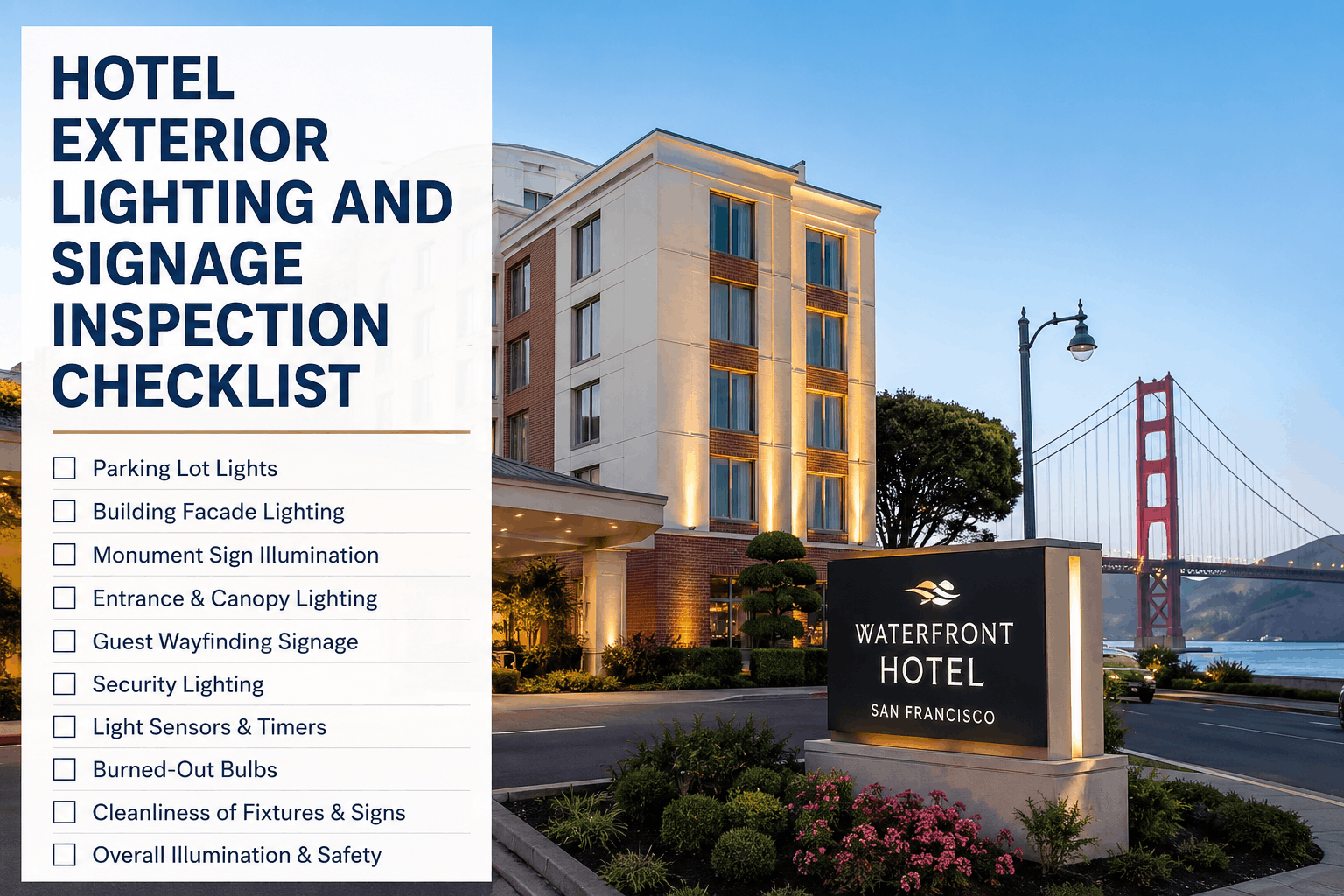
Corridor lighting maintenance spans far more than replacing burned-out bulbs—it includes emergency egress lighting with battery backup testing, exit sign illumination verification, dimming system calibration, motion sensor functionality, and fire code compliance documentation that inspectors audit annually. Properties that schedule a consultation with maintenance optimization specialists discover that most lighting compliance failures trace to missing documentation rather than actual equipment failures—a gap that structured CMMS tracking eliminates permanently.
The Real Cost of Lighting Maintenance Failures
What Hotels Risk Without Structured Lighting Inspections
$185K
Average settlement for lighting-related slip-and-fall claims—tripled when no inspection records exist
$2K-15K
Fire marshal fines per emergency lighting violation—exit signs and egress lights tested monthly per NFPA 101
15-25/wk
Lighting failures per week in a 300-room hotel—LED, fluorescent, emergency backup, and exit sign combined
9.2 days
Average time a burned-out corridor fixture stays dark without structured inspections—guest exposure window
6 Core Components of Corridor Lighting Maintenance
Complete Lighting Inspection & Maintenance System
1. General Corridor Fixtures
LED downlights, wall sconces, and ceiling-mounted fixtures inspected per zone—checking lamp output, lens clarity, mounting security, and dimming function across every floor.
2. Exit Sign Illumination
Every exit sign verified for visibility from 100 feet, proper directional arrows, backup battery function, and NFPA 101 compliance—failures are immediate fire code violations.
3. Emergency Egress Lighting
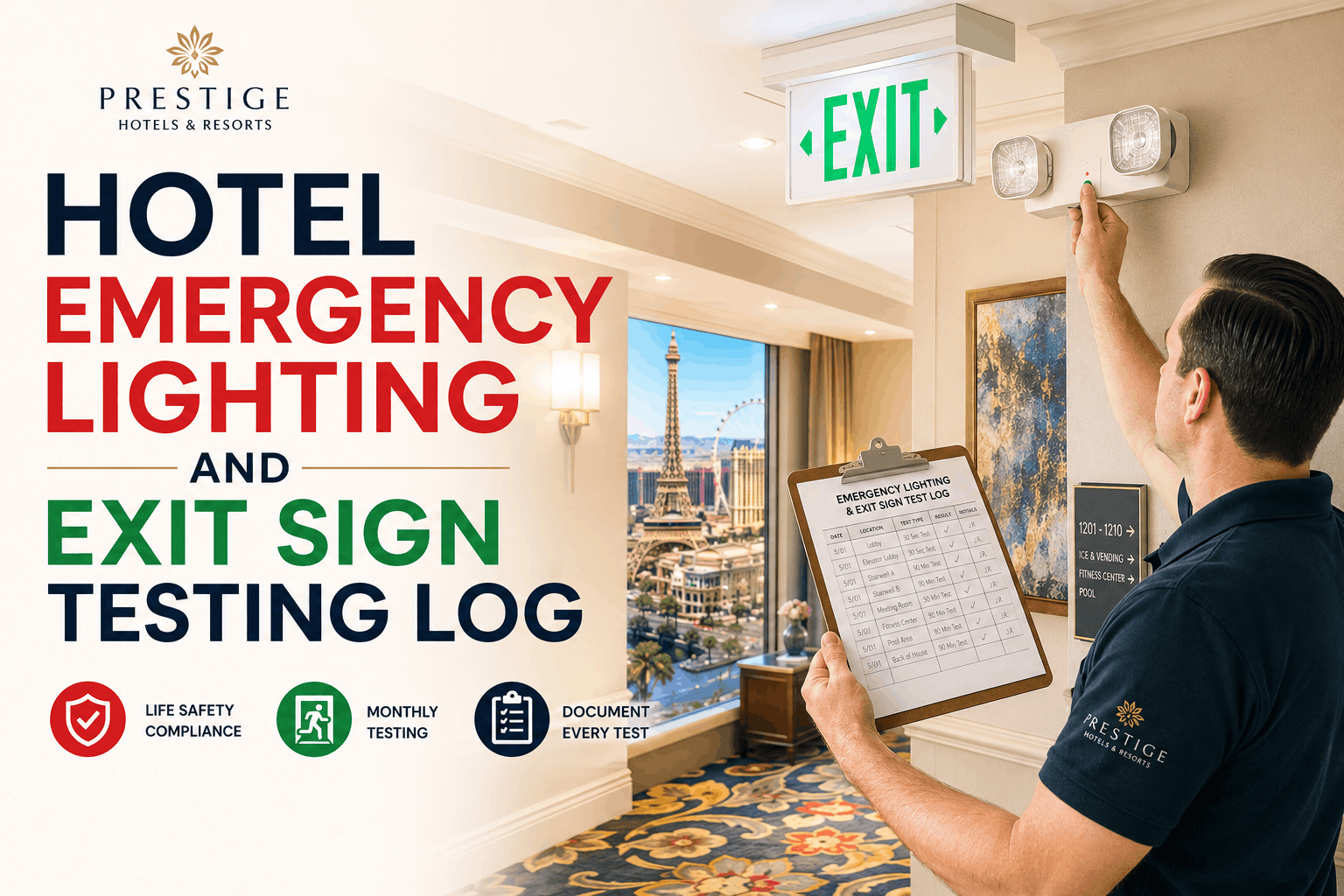
Battery-backed emergency lights tested monthly for 30-second function and annually for 90-minute duration per NFPA 101 and IBC—with documented results for fire marshal inspection.
4. Motion Sensors & Controls
Occupancy sensors, photocells, and dimming controllers calibrated for proper activation range, timeout settings, and minimum light levels that meet ADA and safety requirements.
5. Electrical Safety Inspection
Junction boxes, wire connections, ballasts, LED drivers, and dimmer switches inspected for overheating, loose connections, corrosion, and arc-fault risk during scheduled rounds.
6. Light Level Verification
Lux meter readings at floor level documenting minimum 50 lux in corridors, 100 lux at stairwells, and 10 lux in emergency mode—creating defensible records for liability protection.
Corridor Lighting Inspection Protocol
Zone-Based Inspection Sequence
Systematic approach to corridor lighting inspection and documentation
01
Fixture Inventory & Zone Mapping
Document every corridor fixture by floor and zone—type, wattage, lamp model, installation date, and location. Create inspection routes that cover every fixture in 2-week cycles.
02
Visual Walk-Through Inspection
Walk each zone checking for outages, flickering, discoloration, lens damage, loose mounting, and uneven light distribution. Note fixture numbers and failure types on mobile CMMS.
03
Emergency Light & Exit Sign Testing
Press test buttons on every emergency fixture for 30-second monthly test. Verify exit sign visibility, directional accuracy, and battery charge indicators. Log pass/fail per unit.
04
Light Level Measurement
Take lux readings at floor level every 50 feet along corridors, at stairwell entries, elevator lobbies, and emergency exits. Compare against minimum code requirements and document results.
05
Work Order Generation & Tracking
Failed fixtures generate prioritized CMMS work orders immediately. Emergency lighting failures get same-day priority. Track mean time to repair and closure rates per zone.
Preventive Maintenance Schedule
Corridor Lighting PM Matrix by Component
Component
Weekly
Monthly
Quarterly
Annually
LED Corridor Fixtures
Zone walk-through
Lens cleaning
Driver inspection
Lux level audit
Emergency Egress Lights
Visual check
30-second battery test
Transfer switch verify
90-minute full test
Exit Signs
Visibility check
Battery/lamp test
Arrow direction audit
Candela measurement
Motion Sensors
Activation test
Coverage calibration
Timeout adjustment
Sensor replacement eval
Dimming Controls
Level verification
Schedule audit
Scene programming check
Full system recalibration
Electrical Connections
—
Visual panel check
Thermal scan
Full circuit testing
OXmaint auto-generates work orders for each PM task, tracks technician completion, and flags overdue inspections before fire marshal visits.
Compliance & Safety Standards
Lighting Compliance Requirements Hotels Must Meet
Fire & Life Safety Codes
NFPA 101 emergency lighting tests
Monthly 30-sec battery function test
Annual 90-minute duration test
Exit sign visibility from 100 feet
IBC minimum corridor illumination
100%
compliance with documented CMMS inspection records
Liability & Insurance Standards
Documented inspection history
Timestamped work order records
Lux level measurement logs
Repair response time tracking
ADA accessibility verification
87%
reduction in lighting-related liability claims
Eliminate Dark Corridors Before Guests Find Them
OXmaint automates corridor lighting inspections—scheduling zone walk-throughs, tracking emergency light testing, generating work orders for outages, and building the compliance documentation that protects your property from fines and lawsuits.
Based on hotel maintenance benchmarks and insurance claim data
87%
Fewer lighting-related guest incidents and liability claims
95%
Emergency lighting compliance rate with scheduled testing
65%
Reduction in guest-reported outages through proactive inspections
40%
Energy savings from LED upgrades and dimming optimization
"The corridor is the most overlooked maintenance zone in every hotel—and the most litigated. A single burned-out fixture costs nothing to replace but $185,000 when a guest falls in the dark and your attorney can't produce an inspection record. The hotels that never face these claims aren't spending more on lighting—they're documenting every inspection, every replacement, and every lux reading through their CMMS. That paper trail is worth more than every bulb in the building combined."
— Director of Risk Management, Multi-Property Hotel Management Company
Implementation Timeline
Corridor Lighting Program Deployment Roadmap
Week 1
Inventory
Fixture count by floor • Zone mapping • Emergency light audit • Exit sign inventory • Current condition baseline
Weeks 2-3
Setup
CMMS asset entry • Inspection routes built • PM schedules configured • Work order templates • Staff training
Automated PM cycles active • Compliance reports generated • Energy savings tracked • Zero guest-reported outages
Make Every Corridor Inspection-Ready, Every Night
OXmaint brings structure to corridor lighting maintenance—automated zone inspections, emergency light testing schedules, lux level documentation, work order tracking, and compliance records that protect your property from fire code violations and liability claims.
How often should hotel corridor lighting be inspected?
General corridor fixtures should receive visual walk-through inspections weekly using zone-based rotation routes that cover every floor within a 2-week cycle. Emergency egress lighting requires monthly 30-second battery function tests per NFPA 101 Life Safety Code, plus a full 90-minute annual duration test that must be documented with dates, results, and technician identification. Exit signs need monthly lamp and battery verification plus quarterly directional accuracy audits. Motion sensors and dimming controls should be tested monthly for proper activation and calibrated quarterly. Light level measurements with a lux meter should be taken quarterly at floor level to verify minimum 50 lux in corridors and 100 lux at stairwell entries. A CMMS platform automates all scheduling, tracks completion, and stores documentation for fire marshal and insurance audits.
What are the fire code requirements for hotel emergency corridor lighting?
NFPA 101 Life Safety Code and the International Building Code (IBC) require emergency lighting in all corridors, stairwells, and exit paths that automatically activates within 10 seconds of normal power loss and provides minimum 1 foot-candle (10.8 lux) at floor level for at least 90 minutes. Exit signs must be illuminated at all times with minimum 5 foot-candles on the sign face, visible from at least 100 feet, and equipped with battery backup. Monthly functional tests require pressing the test button for 30 seconds to verify battery and lamp operation. Annual testing requires a full 90-minute battery discharge test with documented results. Failure to maintain these standards results in immediate fire code violations with fines ranging from $2,000-$15,000 per citation depending on jurisdiction, plus potential forced closure of affected areas until corrected.
How does corridor lighting maintenance reduce hotel liability exposure?
Documented lighting maintenance is the most powerful defense in premises liability litigation. When a guest slips, trips, or falls in a hotel corridor, the plaintiff's attorney first subpoenas maintenance records for the area where the incident occurred. Properties with timestamped CMMS records showing regular zone inspections, prompt outage repairs, lux level measurements meeting code minimums, and emergency light test documentation can demonstrate reasonable care—the legal standard that defeats negligence claims. Without these records, hotels face presumptive negligence where the court assumes inadequate maintenance. Insurance claim data shows that properties with documented lighting inspection programs settle slip-and-fall claims at 60-75% lower amounts than properties without records, and 87% fewer claims proceed to litigation. The average cost of a lighting-related settlement without documentation is $185,000 versus $28,000-$45,000 with complete inspection history.
What is the best approach for LED conversion in hotel corridors?
LED conversion in hotel corridors should follow a phased approach prioritized by energy savings potential and fixture condition. Start with highest-traffic corridors and stairwells where fixtures run 24/7—these deliver the fastest ROI with 40-60% energy reduction per fixture. Select LED replacements in the 3000K-3500K color temperature range for warm hospitality ambiance while maintaining minimum 50 lux at floor level. Choose LED drivers rated for dimming compatibility with existing controls to preserve energy-saving schedules. For properties with 500+ corridor fixtures, bulk purchasing typically reduces per-unit cost by 20-35%. Budget $15-$45 per fixture for retrofit lamps or $80-$200 per fixture for complete luminaire replacement depending on style requirements. A 300-room hotel with 1,200 corridor fixtures investing $60,000-$120,000 in full LED conversion typically achieves 2-3 year payback through energy savings alone, with additional savings from reduced replacement frequency as LEDs last 50,000+ hours versus 10,000-15,000 for fluorescent equivalents.