Hotel fitness centers operate under conditions that no commercial gym faces: equipment used by complete strangers across every fitness level, with no staff supervision of form or technique, 18 to 22 hours a day, 365 days a year. A treadmill belt that slips under a guest at 8 mph is not a maintenance failure — it is a liability incident. A cable machine with a frayed wire that snaps under load is not a repair backlog item — it is a lawsuit. Unlike most hotel amenities, the fitness center carries the kind of direct physical injury risk that makes documented maintenance records the difference between a settled claim and a seven-figure verdict. Start your free Oxmaint account to digitise every inspection below, auto-generate work orders from failed items, and build the timestamped safety documentation that protects the property in any liability scenario.
Complete Fitness Center Maintenance Checklist
Each section below covers a critical category of hotel fitness center maintenance. Frequency guidelines are minimum standards — properties with high fitness center utilisation or premium positioning should increase to the next frequency tier. Sign in to Oxmaint to deploy each section as a scheduled mobile inspection with photo capture, risk-level tagging, and instant work order generation.
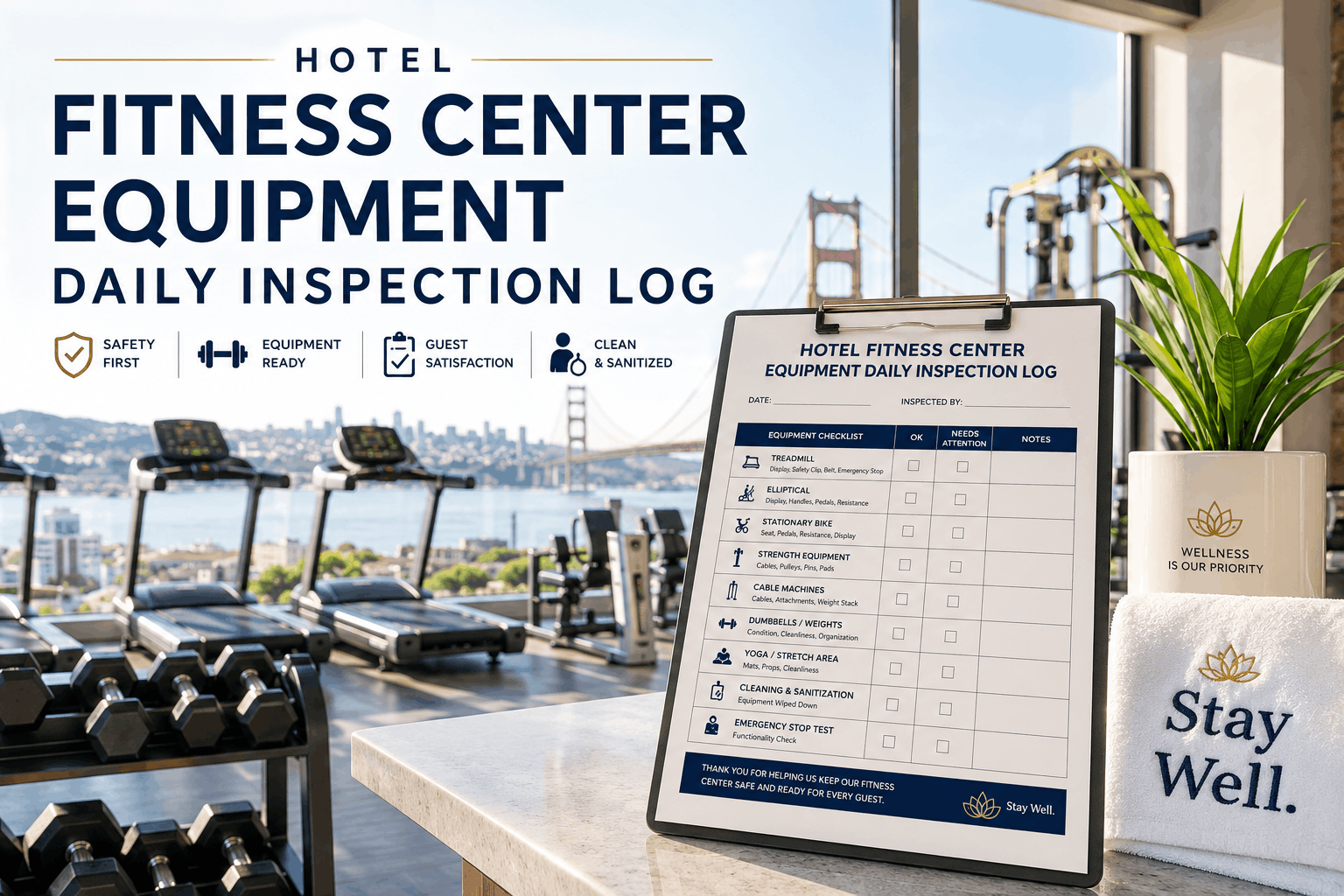
Treadmills, ellipticals, stationary bikes, and rowing machines are the highest-utilisation assets in any hotel gym and the most mechanically complex. Belt and deck systems on treadmills wear from friction and heat; when they fail under a running guest, the injury is immediate and severe. Pre-opening checks and post-use inspections are both required — waiting for weekly rounds to catch a degraded belt is not adequate given daily injury risk.
Free weight areas carry some of the highest injury potential in any gym — but the maintenance requirements are often dismissed because the equipment looks simple. Dumbbell heads that are loose become projectiles. Barbell collars that do not grip allow plates to slide under load. Weight rack instability under heavy dumbbells causes the rack to tip toward a standing guest. None of these failures require sophisticated diagnosis — they require a daily walk-through with hands on each piece.
Resistance machines are mechanically complex systems with cables, pulleys, weight stacks, and adjustment mechanisms that each degrade independently. A cable that frays internally but shows no external damage can fail without warning under maximum load. Selector pin failures allow weight stacks to fall freely. Pulley bearings that seize cause sudden load reversal. These are not wear-and-tear issues — they are mechanical failure modes that a trained inspector catches on a daily walkthrough before a guest experiences them. Book a demo to see how Oxmaint creates daily resistance machine inspection workflows.
Gym flooring failures are among the most straightforward to prevent and the most expensive to defend. A lifted rubber tile edge that catches a running guest's toe causes a fall injury directly attributable to documented neglect if no inspection records exist. Anti-fatigue matting that has compressed below specification removes its impact-absorption function, contributing to overuse injuries that guests may attribute to the property. Mirror installations that are inadequately anchored present a catastrophic failure risk.
Hotel fitness centers are among the highest cardiac event environments in the property. Guests exercising at intensities they have not maintained, in environments with elevated temperature, without a personal trainer or staff supervision, are statistically at elevated cardiac risk. An AED that cannot deliver a shock because the electrode pads have expired or the battery is depleted is not a safety asset — it is a liability document. These checks must be completed on every opening round and logged with a timestamp. Sign up to Oxmaint to make AED checks a mandatory first step of every daily opening inspection with failure escalation to management.
Hotel fitness center hygiene failures carry two distinct consequences: guest health risks from pathogen transmission via shared equipment surfaces, and reputational damage that drives the kind of review language — "disgusting," "never cleaned," "sweaty equipment" — that no marketing response can counteract. Post-COVID guest expectations for visible cleaning evidence are permanent. Equipment cleaning is not a backstage task — it must be visible, documented, and scheduled on an interval that reflects actual utilisation, not a convenient timeframe.
The gym environment itself — temperature, air quality, lighting, and locker room systems — directly affects both guest experience and injury risk. A fitness center that is 4°F too warm significantly elevates exertion-induced cardiac risk. Poor ventilation allows CO₂ and humidity to accumulate, reducing performance and increasing fatigue-related injury risk. Inadequate lighting creates shadow zones where equipment hazards are not seen by users. Sign up to Oxmaint to set HVAC temperature and ventilation threshold alerts that auto-generate work orders before guests arrive.
Oxmaint records every checklist completion with inspector ID, timestamp, photo evidence, and work order linkage. When a guest claims injury from equipment that was "never maintained," you can produce a complete inspection record from the date of purchase. That record is the difference between a dismissed claim and an indefensible lawsuit.
How Oxmaint Protects Hotel Fitness Centers
When an inspector marks a treadmill belt or cable machine as a Critical failure in Oxmaint, the platform immediately generates an Out-of-Service work order and notifies the duty manager via push notification — before the next guest enters the fitness center. Critical failures automatically trigger equipment tagging instructions and guest communication templates.
Oxmaint schedules the daily opening inspection for the designated fitness center technician automatically — it cannot be skipped and cannot be marked complete without all required fields and photos submitted. Supervisors see a real-time dashboard showing completion status across every inspection round for every day, with a full history exportable for liability documentation.
Every inspection, work order, repair, and parts replacement is linked to the specific equipment asset record in Oxmaint. If a guest injury claim references a specific treadmill, the property can produce the complete maintenance history for that unit — every inspection pass, every grease application, every belt replacement — with timestamps and technician records going back to commissioning.