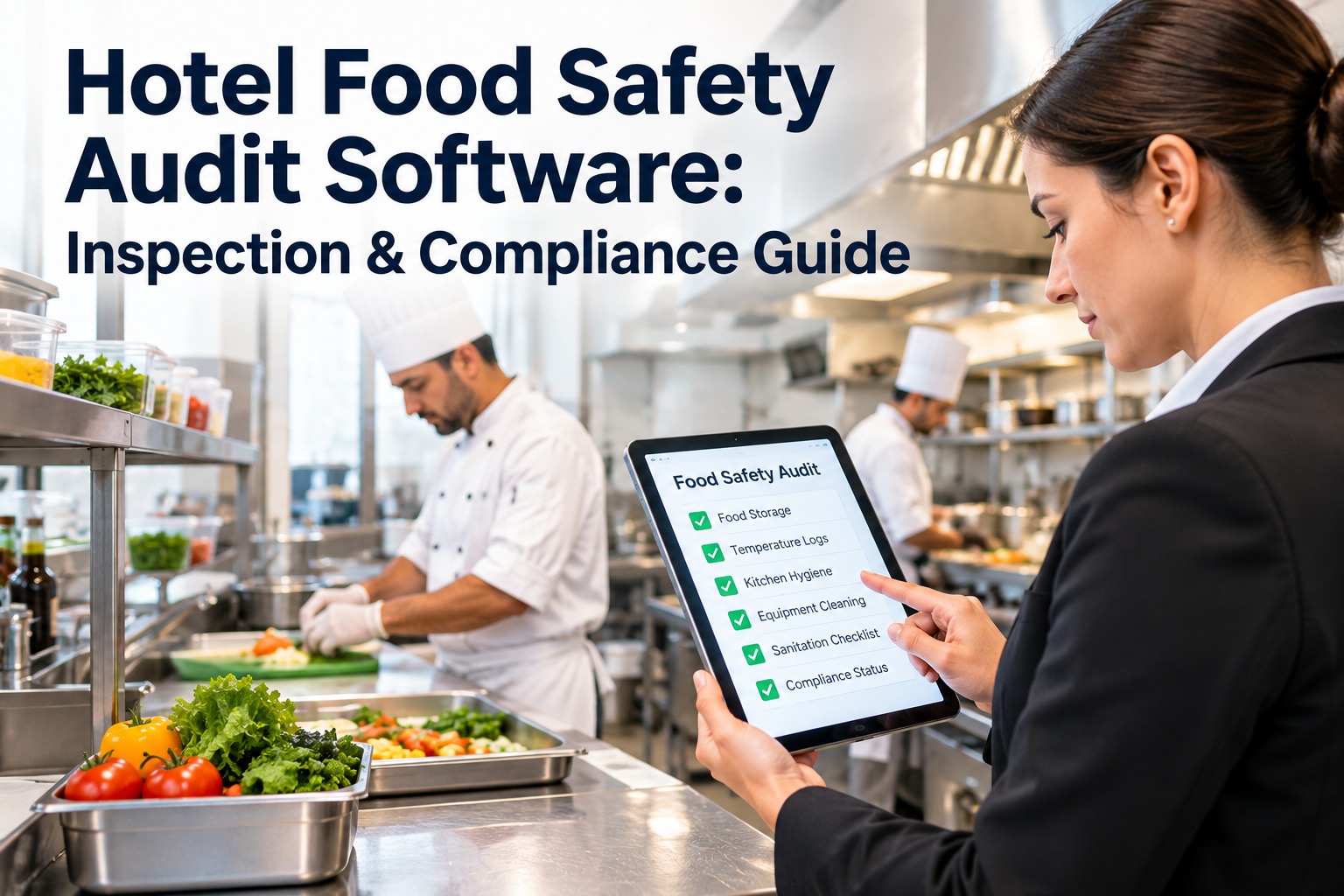
In August 2023, a 312-room full-service hotel in Nashville served dinner to 240 banquet guests at a corporate event. By the following morning, 63 guests had reported gastrointestinal illness. The Nashville Metro Public Health Department opened an investigation. Their findings: the hotel's walk-in cooler had recorded an internal temperature of 48°F across a 6-hour window during the previous evening's prep — 7 degrees above the safe food holding limit of 41°F. The temperature log for that cooler showed no entry during that 6-hour window. The cooler's compressor had been cycling intermittently for 11 days before the banquet, an issue documented in the chief engineer's notebook but never converted to a formal work order and never inspected by the food service team. The civil lawsuit settled for $1.4 million. A digital temperature monitoring program and a maintenance work order for the compressor cycling issue would have cost $400 and 2 hours of labor. Start your hotel HACCP compliance program in Oxmaint free.
Hotel Food Safety and Kitchen Compliance: HACCP Maintenance Requirements
HACCP — Hazard Analysis and Critical Control Points — is the food safety framework required by the FDA Food Safety Modernization Act for all commercial food service operations. For hotels, HACCP applies to every food service outlet: the restaurant, the bar, room service, banquet operations, continental breakfast service, pool bar, and employee cafeteria. Each outlet has its own Critical Control Points (CCPs) — the specific points in the food preparation process where temperature, time, or hygiene controls must be verified and documented to prevent foodborne illness.
What most hotel engineering and food service teams do not realize is that HACCP compliance is as much a maintenance discipline as it is a food handling discipline. A kitchen that follows perfect food handling procedures but operates with a miscalibrated probe thermometer, a walk-in cooler with a failing compressor, or a mechanical dishwasher with a degraded final rinse temperature is not HACCP compliant — it is producing food safety documentation that does not reflect actual food safety conditions. Oxmaint manages both the equipment maintenance and compliance documentation for every kitchen asset.
The Kitchen Equipment That Controls HACCP Compliance — and How to Maintain Each
Every HACCP Critical Control Point depends on a piece of equipment functioning correctly. The documentation that proves HACCP compliance at each CCP is only valid if the equipment measuring and controlling that CCP has been maintained, calibrated, and verified on schedule. A temperature log from a probe thermometer that was last calibrated 14 months ago is not defensible HACCP documentation — it is a record of what a miscalibrated instrument reported. Book a demo to see how Oxmaint tracks calibration schedules for every kitchen measurement instrument.
The walk-in cooler is the single most consequential piece of equipment in hotel HACCP compliance — it holds the largest volume of potentially hazardous food and must maintain 41°F or below continuously, including overnight, during high-traffic service periods, and following any maintenance work. A walk-in that holds 41°F at 8 AM but climbs to 48°F during a busy lunch preparation period — because the door gasket is worn and staff are opening the door repeatedly — is producing a CCP-1 failure that is invisible without continuous monitoring.
Every temperature reading in a HACCP log is only as accurate as the probe thermometer that produced it. A probe thermometer that reads 2°F high reports 159°F for a chicken breast that is actually at 157°F — 2 degrees below the 165°F minimum for poultry. The cook passes the CCP-2 check on the log. The chicken goes to service. The HACCP system documented a food safety failure as a pass. Probe thermometers must be calibrated weekly using the ice-water method (32°F ± 2°F) or boiling water method, and any thermometer reading outside the acceptable range must be removed from service until recalibrated.
High-temperature mechanical dishwashers achieve sanitization through final rinse temperature — the final rinse must reach 180°F at the dish surface to achieve the required 5-log bacterial reduction. The temperature gauge on the dishwasher front panel reports the water temperature at the manifold, not the dish surface. Actual dish surface temperature is measured with a dishwasher maximum registering thermometer or temperature-sensitive test strips placed inside the machine during a complete cycle. A dishwasher that reads 180°F on the front panel gauge but is only delivering 165°F at the dish surface due to heat loss in the distribution manifold is not meeting CCP-5 requirements.
Steam tables, heat lamps, holding ovens, and chafing dishes must maintain food at 135°F or above from the time food is placed in the unit to the time it is served. Most hot holding failures are equipment maintenance failures rather than procedural failures: a steam table whose heating element is degraded may hold the first pan of food at 138°F and the sixth pan — at the far end of the steam table — at only 126°F. The temperature gradient across a long steam table with a degraded element is invisible without systematic end-to-end temperature documentation at each service period setup.
Ice is classified as a food under the FDA Food Code — it is a ready-to-eat product that contacts beverages, food, and guest hands directly. Hotel ice machines are among the most consistently non-compliant pieces of kitchen equipment because their interior is invisible during normal operation and most hotels do not have a documented ice machine cleaning schedule. The FDA Food Code and most manufacturer recommendations require commercial ice machines to be cleaned, sanitized, and inspected every 6 months. Black mold growth on evaporator plates or in the ice bin is a critical food safety violation — the mold is harvested with every scoop of ice.
The three-compartment sink is the manual warewashing system — wash, rinse, sanitize — and the sanitizer concentration in the third compartment must be verified and logged at each setup and every 2 hours during service. Chlorine-based sanitizers at the standard hotel kitchen concentration of 50–200 ppm are only effective for 30 minutes after mixing before organic load (food residue) degrades the active chlorine below effective concentration. A sanitizer solution prepared at 7 AM and checked again at noon has been working in an increasingly degraded state for 5 hours — the HACCP log showing a 9 AM check and a noon check has a 3-hour gap during which sanitizer effectiveness is undocumented.
HACCP Requirements by Hotel F&B Outlet Type
Hotel food service operations are more complex than standalone restaurants because multiple distinct food service outlets — each with its own equipment, staff, and food handling workflow — must maintain HACCP compliance simultaneously. A hotel with a restaurant, room service kitchen, banquet operation, pool bar, and continental breakfast service has five separate food service environments, each with its own critical control points and documentation requirements. Load outlet-specific compliance checklists for every F&B operation in Oxmaint free.
The full-service restaurant is the highest-complexity F&B outlet for HACCP compliance — it operates all six CCPs simultaneously during service, with cooking temperatures varying by protein, hot holding at multiple stations, and rapid cooling of leftover food at the end of service. HACCP documentation for the restaurant must include: opening equipment temperature checks (all refrigeration at 41°F or below, all hot holding equipment pre-heated to 135°F+ before food placement), cooking temperature logs for every protein type served, hot holding temperatures checked and logged every 2 hours during service, and end-of-service cooling log for all food cooled in-house overnight.
Banquet operations present the highest single-event foodborne illness risk in hotel food service — large volumes of food are prepared in advance, held for extended periods, and served to large groups simultaneously. The Nashville incident described in the opening paragraph is a classic banquet HACCP failure. HACCP documentation for banquet events must include: walk-in temperature verification for all holding equipment beginning 4 hours before event setup, a separate temperature log for each food item prepared and held, hot holding temperature checks at 30-minute intervals during service for events exceeding 2 hours, and end-of-event disposition documentation for all leftover food. Book a demo to see banquet event HACCP documentation in Oxmaint.
Continental breakfast service is one of the most frequently cited F&B operations during hotel health inspections — not because of cooking complexity but because of time and temperature management during an unattended or minimally staffed service period. Hot items on a buffet line must be maintained at 135°F or above throughout the entire service period. Cold items — yogurt, cheese, cut fruit, cold cuts — must remain at 41°F or below. When a continental breakfast is set up at 6 AM and served until 10 AM with minimal staff presence, the 4-hour service window requires documented temperature checks at minimum at 6 AM, 8 AM, and 10 AM — with corrective action documentation if any item falls outside the safe range. Set up automated breakfast HACCP check reminders in Oxmaint free.
ServSafe Certification, Training Records, and HACCP Documentation Retention
Every food handler must hold a current, valid food safety certification from an ANSI-accredited program such as ServSafe. Certifications are valid for 2–5 years depending on the program and jurisdiction. In a hotel F&B operation with 20–40 food service employees, certifications expire at different times throughout the year. A single food handler working with an expired certification is a health code violation. Tracking expiration dates manually across a rotating staff — with turnover rates in hotel F&B averaging 73% annually — produces gaps on every inspection cycle without a digital per-employee tracking system. Track per-employee certification expiry with 60-day alerts in Oxmaint — sign up free.
The FDA Food Safety Modernization Act requires that HACCP records be retained for a minimum of 2 years for most food establishments and 3 years for low-acid canned food and acidified food operations. Hotel records that must be retained include: temperature logs (all CCPs), cooking temperature records, cooling logs, equipment calibration records, thermometer calibration logs, cleaning and sanitation logs, pest control records, and food handler certification records. Records that cannot be produced during a health department inspection — regardless of whether the activities were actually performed — produce citations. Book a demo to see Oxmaint's 2-year HACCP record export — ready in under 3 minutes for any inspection.
A corrective action entry is required any time a CCP monitoring result falls outside the acceptable range. The corrective action entry must include: the date and time of the CCP failure, the value recorded (e.g., walk-in at 46°F), the corrective action taken (e.g., product moved to compliant cooler, maintenance called for failed unit), the disposition of any food that may have been exposed to the CCP failure (discarded, retained as safe, or evaluated by the food safety manager), and the signature of the person taking the corrective action. A HACCP log that shows only passing temperature readings with no corrective action entries is suspicious — real operations have temperature deviations. A log without any corrective actions suggests the log was not completed in real time. Log corrective actions from mobile in Oxmaint — timestamped, linked to the CCP failure record, and photo-documented.
After the Nashville settlement made industry news, our ownership required a full HACCP audit within 90 days. The auditor found our walk-in temperature logs had gaps averaging 3.2 hours per shift and our probe thermometer had no calibration record for 11 months. We implemented Oxmaint for every F&B compliance task — walk-in logs, thermometer calibration, dishwasher temperature, sanitizer checks — and loaded our banquet event HACCP workflow as a template. Our next health inspection resulted in zero food safety citations for the first time in four years. The inspector asked about our documentation system by name.