A guest at a 220-room hotel in Las Vegas reported an unauthorized entry to her room at 2:18 AM. Security reviewed the access control log and found the door lock had not reported a successful card read. The CCTV camera covering that corridor had been offline for 11 days — a lens condensation fault that generated an alert nobody actioned. The access control panel for floors 8–12 had missed its last two quarterly firmware updates. Three systems failed simultaneously, not because they were cheap or old, but because none of them had a documented maintenance schedule. The incident produced a civil lawsuit, a brand standard deficiency citation, and a $220,000 settlement. Every one of those systems would have been caught by a quarterly inspection. Start your hotel security system maintenance program in Oxmaint — free.
Hotel Security System Maintenance: Cameras, Access Control, and Guest Safety
This checklist covers the five hotel security system zones — CCTV surveillance, access control, electronic door locks, in-room safes, and intrusion alarm systems. Each zone includes quarterly and annual inspection items, the most common failure mode, and the consequence when that failure reaches a guest. Oxmaint tracks every security system as a named asset with its own inspection schedule and finding history.
Hotel CCTV surveillance is the primary post-incident forensic tool for security events — and a camera that is offline, obscured, or recording at degraded resolution is a camera that produces nothing useful after a guest complaint, a theft, or an assault. The maintenance gap that matters most in CCTV systems is not the total number of cameras but the percentage that are in verified operational status at any given time. A 180-camera system with 22 cameras offline or degraded has blind zones that are invisible to security staff reviewing live feeds. Track each camera as a named asset in Oxmaint with individual operational status history — sign up free.
Access control systems in hotels manage two distinct credential populations simultaneously: guest key cards that change with every room turnover, and staff credentials that accumulate over years of employee hiring, termination, and role changes. The guest credential side is managed by the PMS. The staff credential side is managed — or not managed — by whoever has administrator access to the access control panel. At most hotels, staff credentials are not audited between annual reviews, and terminated employees are rarely removed from the system on the day of termination. Book a demo to see access control credential audit tracking in Oxmaint.
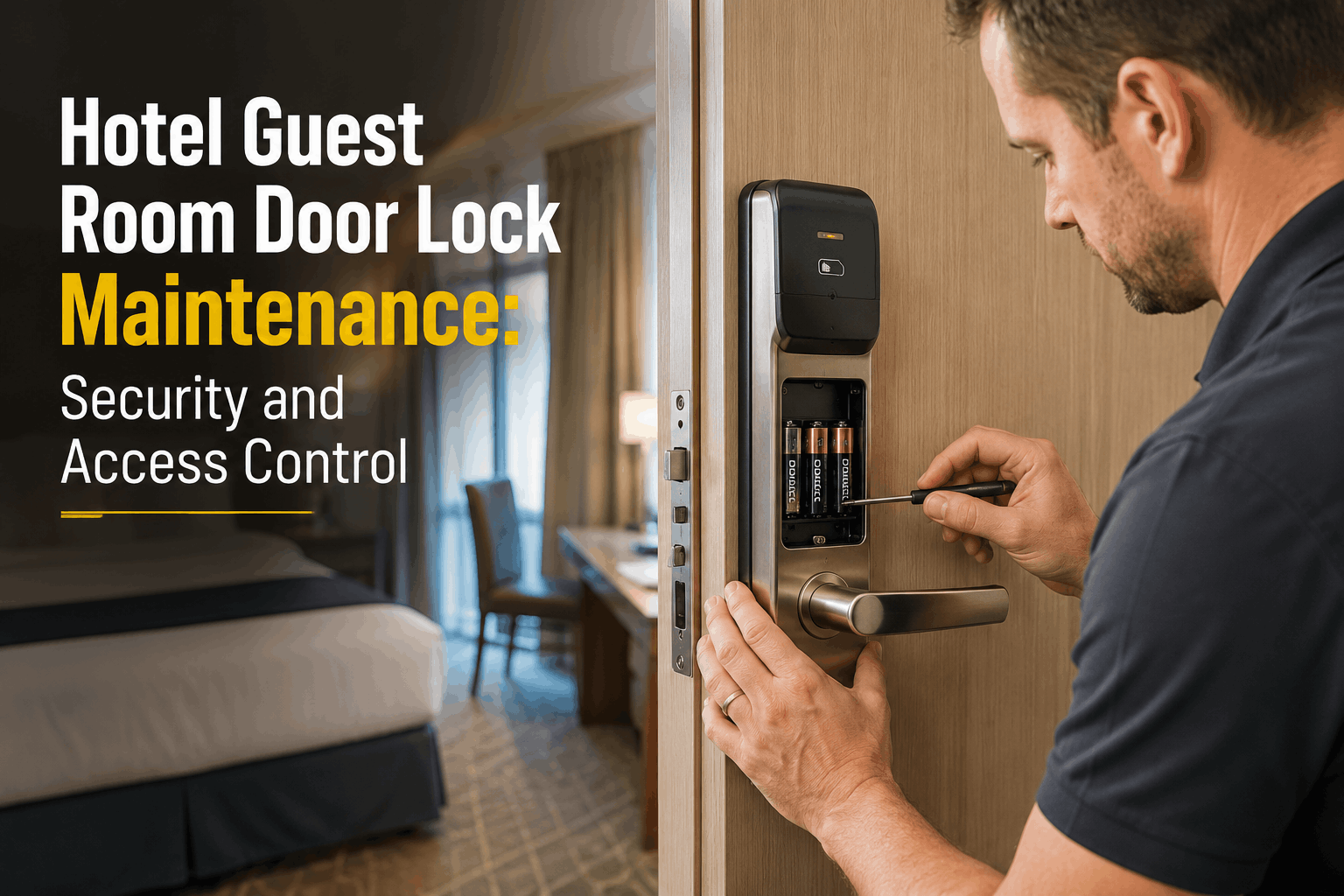
Electronic door locks are the single most guest-visible security system in a hotel — and the system that generates the most direct liability when it fails. A guest locked out of their room because a lock battery died at 11 PM is a service issue. A guest whose room door fails to deadlock because the latch mechanism has worn beyond tolerance is a safety issue. An electronic lock that accepts a key card cloned from a previous guest's card — a vulnerability addressed by regular re-encryption of the lock system — is a security incident. Track every door lock as a named asset in Oxmaint with battery replacement history and fault log — sign up free.
In-room safes are the guest-facing security device most commonly ignored in hotel security maintenance programs — because they operate with minimal maintenance for years and failures are reported by guests rather than identified proactively. However, in-room safe failures produce guest complaints at a high rate when they occur, and override management — the process of accessing a safe when a guest locks property inside and departs — is a security and liability procedure that requires documented controls. Book a demo to see in-room safe asset tracking and override logging in Oxmaint.
Hotel intrusion alarm and duress systems protect both guest-accessible areas after hours and staff working in isolated areas — housekeepers entering rooms alone, late-night front desk staff, maintenance technicians in mechanical rooms. The AHLA's 5-Star Promise requires hotels to provide safety devices to all customer-facing employees. These devices are monitored systems — and a monitored system that has a lapsed monitoring subscription, a failed cellular communicator, or an untested notification pathway provides zero protection regardless of how many devices have been distributed. Schedule quarterly panic button and duress system testing in Oxmaint — sign up free.
How Oxmaint Manages Your Hotel Security System Maintenance Program
Each CCTV camera, access control panel, door lock, in-room safe bank, and duress device is a named asset in Oxmaint with its own inspection schedule, battery replacement history, firmware version log, and finding record. When a security incident requires a forensic review of system maintenance history, that history is available in 60 seconds — not located in binders in an office that may not exist anymore. Create your security asset inventory free.
Quarterly staff credential audits are scheduled as recurring tasks in Oxmaint with advance alerts 14 days and 3 days before due date. The audit task includes a checklist: cross-reference HR termination report, deactivate identified credentials, confirm access levels for remaining staff, log result. When the task is completed, the completion record with findings and actions becomes part of the access control system's documented compliance history. See credential audit scheduling in a live demo.
Every security system inspection is completed from a mobile device with photo documentation — the CCTV coverage map photo, the access control panel status screen, the door lock latch mechanism. Photo documentation creates a verifiable inspection record that paper-based programs cannot produce and that security incident litigation requires. A photo-documented quarterly inspection conducted 8 months before an incident demonstrates that the system was operational and in good condition at the time of that inspection. Start photo-documented security inspection free in Oxmaint.
When a security incident occurs, the director of security can pull the complete maintenance history for every system involved in the incident — camera operational status history, access control panel firmware version and credential audit history, door lock battery replacement and mechanical inspection records — directly from Oxmaint. This history is the property's primary evidence of a systematic security maintenance program, and its availability in the immediate aftermath of an incident determines the scope of liability exposure. Book a demo to see incident-linked system history in Oxmaint.
After the Las Vegas incident we conducted a full security systems audit across all seven properties in our portfolio. Every property had gaps — some had cameras offline for over 30 days with no work orders, two had staff credentials that should have been deactivated 8–14 months earlier, and none had documentation of the last lock re-encryption date. We implemented Oxmaint for security system PM across all seven properties in 6 weeks. The next quarter, we found and corrected 34 security system deficiencies that our previous manual process had missed entirely.