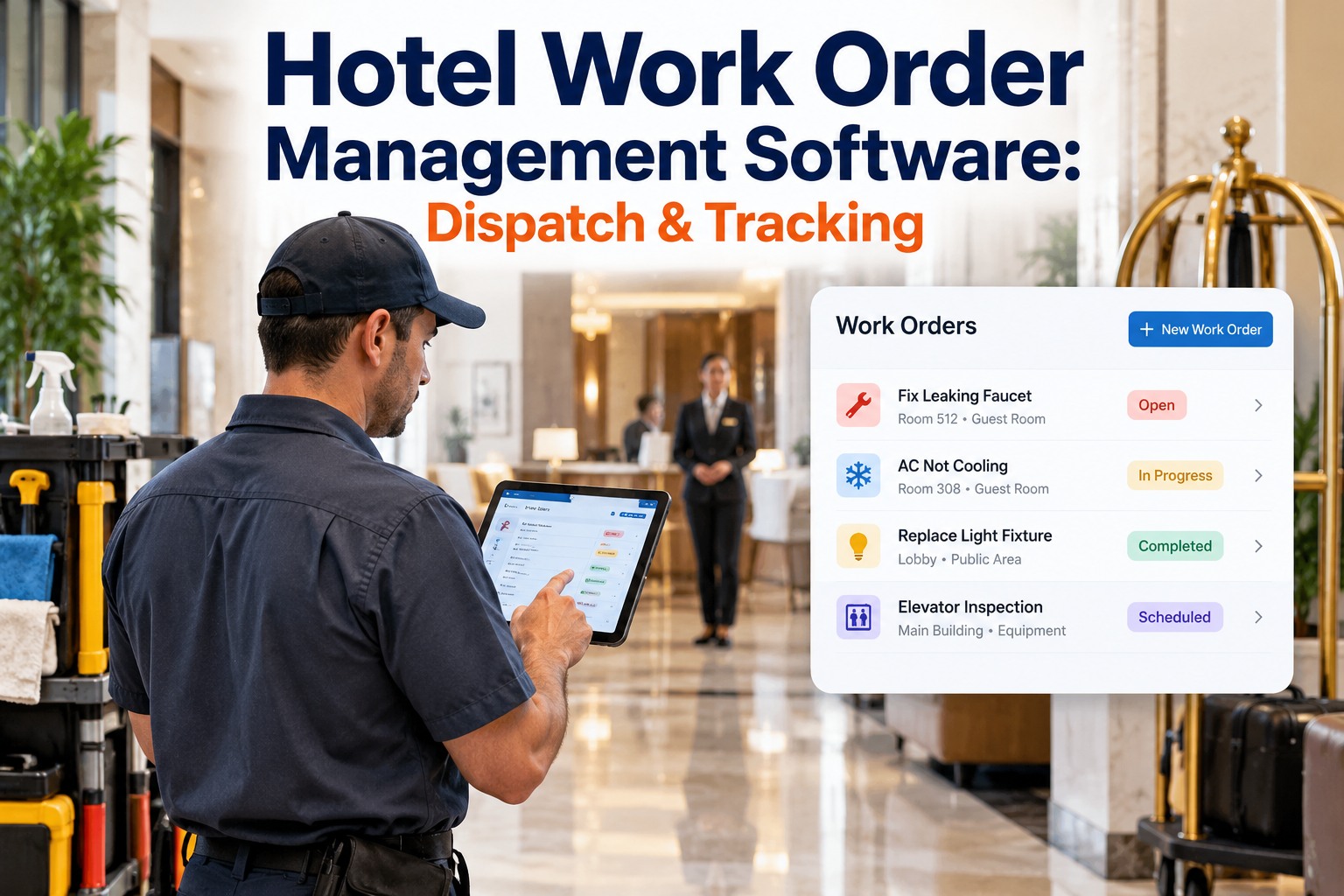
The maintenance director at a 450-room resort property reviewed last month's emergency repair costs: $47,000 in after-hours HVAC callouts, $23,000 in rushed plumbing repairs, and $18,000 in elevator downtime penalties. The team had responded to 847 work orders, but without a centralized tracking system, they had no visibility into recurring issues, couldn't prioritize effectively, and struggled to prove maintenance value to ownership. Guest complaints about room temperature, slow service, and facility conditions continued to escalate while the maintenance budget spiraledbeyond projections.
Digital Work Order Systems
Comprehensive CMMS Platforms
Cloud-based maintenance management systems that centralize all work order requests, automate workflows, track completion, and provide real-time visibility across entire hotel portfolios
Mobile Apps
Automated Routing
Real-Time Analytics
Guest Integration
Preventive Maintenance
Proactive Scheduling Systems
Automated scheduling for routine inspections, equipment servicing, and preventive tasks that reduce emergency repairs and extend asset life
Reduces emergency repairs by 30-40%
Asset Tracking
Equipment Lifecycle Management
Complete visibility into equipment performance, maintenance history, warranties, and replacement planning across all hotel assets
Track 10,000+ assets per property
Mobile Solutions
On-the-Go Work Management
Technician apps for receiving assignments, updating status, capturing photos, tracking time, and closing work orders from anywhere in the property
95% faster work order updates
The Critical Reality
Hotel properties without digital work order management waste 20-30% of maintenance capacity on communication delays, duplicate efforts, and reactive firefighting. Modern CMMS platforms don't just track work—they transform maintenance from a cost center into a strategic asset that drives guest satisfaction and operational efficiency.
Hotel maintenance teams manage exponentially more complexity than typical commercial properties. Between guest rooms, common areas, restaurants, pools, fitness centers, meeting spaces, and back-of-house operations, a mid-sized hotel can generate 500-1,500 work orders monthly. Properties that implement digital work order management discover that the challenge isn't handling more requests—it's capturing, prioritizing, and completing them systematically while maintaining service quality standards.
Understanding the Work Order Management Challenge
Traditional paper-based or spreadsheet maintenance systems collapse under hospitality's unique demands. When housekeeping reports a malfunctioning HVAC unit at 2 PM, front desk logs a guest complaint about a leaking faucet at 3 PM, and engineering discovers a faulty elevator sensor during rounds at 4 PM, properties without integrated systems struggle to coordinate responses. Properties that consult with maintenance optimization experts consistently identify work order chaos as their primary operational bottleneck.
Communication: 25%
Response Delays: 20%
Cost Overruns: 15%
Lost Tracking: 10%
Communication Breakdowns
Phone calls, text messages, sticky notes, and verbal requests create confusion—25% of maintenance time spent clarifying work orders
Prioritization Failures
Without visibility into all pending work, teams address the loudest complaint rather than the most critical need—guest dissatisfaction increases
Lost Documentation
Paper work orders disappear, completion data goes unrecorded, and repeat issues go unnoticed—no audit trail for accountability
42%
of work orders incomplete without digital tracking
3.2 hrs
average response time with paper systems
$85K
annual cost of maintenance inefficiency per 100 rooms
Core Features of Modern Hotel Work Order Software
Effective work order management systems serve as the central nervous system for hotel maintenance operations. The right platform transforms scattered requests into organized workflows, reactive firefighting into proactive management, and maintenance costs into measurable ROI. When properties evaluate solutions, understanding which features deliver operational value versus marketing hype becomes critical.
| Feature Category |
Core Functionality |
Operational Impact |
Implementation Priority |
| Request Intake |
Multi-channel work order creation (mobile, web, email, guest portal, PMS integration) |
Captures 100% of maintenance needs with timestamps and requestor details |
Critical—Week 1 |
| Automated Routing |
Intelligent assignment based on skill set, location, availability, and priority |
Reduces response times by 40-60%, eliminates manual dispatch |
Critical—Week 1 |
| Mobile Execution |
Technician app for receiving, updating, and closing work orders with photos and notes |
Real-time status visibility, eliminates end-of-day paperwork |
Critical—Week 2 |
| Priority Management |
Customizable urgency levels, SLA tracking, escalation workflows |
Ensures guest-impacting issues receive immediate attention |
High—Week 2 |
| Parts & Inventory |
Track materials used, trigger reorder points, link inventory to work orders |
Prevents stockouts, accurately captures job costs, optimizes inventory |
High—Month 2 |
| Preventive Maintenance |
Automated PM schedules, checklists, meter-based triggers, compliance tracking |
Reduces equipment failures by 30-40%, extends asset life |
High—Month 2 |
| Analytics & Reporting |
Work order metrics, technician performance, cost tracking, trend analysis |
Data-driven decision making, budget justification, continuous improvement |
Medium—Month 3 |
| Guest Communication |
Automated status updates, completion notifications, satisfaction surveys |
Improves guest experience, reduces follow-up calls to front desk |
Medium—Month 3 |
Swipe to see full table
Transform Your Hotel Maintenance Operations
See how Oxmaint's hotel-specific work order management platform helps properties reduce response times, increase team productivity, and deliver exceptional guest experiences through better maintenance.
The Digital Work Order Workflow: From Request to Resolution
Modern work order management eliminates the chaos of traditional maintenance coordination. Instead of scattered communication channels and manual tracking, digital systems create standardized workflows that capture every request, route it intelligently, track progress in real-time, and close the loop with verification and documentation. Properties implementing comprehensive CMMS platforms typically see 50-70% improvements in work order completion rates within the first three months.
1
Request Capture
Issue reported via mobile app, web portal, email, or PMS integration with photos, location, and priority
2
Intelligent Routing
System assigns to qualified technician based on skills, availability, location, and workload balance
3
Mobile Execution
Technician receives notification, navigates to location, updates status, documents resolution with photos and time tracking
4
Verification & Close
Supervisor reviews, requestor confirms resolution, system archives with full audit trail for analysis and compliance
85%
reduction in work order processing time
45 min
average response time with digital routing
98%
work order completion rate with mobile tracking
Industry Insights: Work Order Management Best Practices
"The properties that excel at maintenance don't have better equipment or bigger budgets—they have better systems. Digital work order management transforms maintenance from reactive chaos into proactive service delivery. When you can see every request, track every response, and analyze every trend, you move from firefighting to strategic asset management."
— Director of Engineering, National Hotel Chain
Guest Satisfaction Impact
Properties with sub-60-minute response times see 23% higher guest satisfaction scores. Work order systems that prioritize guest-facing issues and provide status transparency directly impact review ratings and repeat bookings.
Labor Optimization
Digital work order management increases technician productivity by 30-40% by eliminating communication delays, reducing travel time through intelligent routing, and automating documentation that previously consumed 60-90 minutes daily.
Preventive Maintenance ROI
Properties that allocate 40-50% of maintenance capacity to preventive work orders see 35% lower total maintenance costs. Scheduled maintenance prevents failures that cost 3-5x more to repair reactively.
Hotels that implement strategic work order management consistently report that the transformation extends beyond maintenance efficiency. Operations teams gain visibility into facility conditions, housekeeping coordinates better with engineering, front desk can provide accurate status updates to guests, and general managers finally have data to support capital expenditure decisions.
Measuring Work Order Management Success
Transitioning from paper-based or fragmented work order tracking to integrated digital systems delivers measurable operational improvements across multiple dimensions. Properties with clear implementation strategies and executive support typically achieve full operational maturity within 3-4 months, with ROI positive within the first quarter through reduced emergency repair costs and improved labor efficiency.
Traditional Systems
Work order response time: 3-4 hours
Completion tracking: manual, incomplete
Technician communication: phone calls, texts
Work order documentation: 60-90 min daily per tech
Emergency repairs: 40-50% of maintenance budget
Guest satisfaction: impacted by slow response
Digital CMMS Platform
Work order response time: 30-45 minutes
Completion tracking: real-time, 100% accurate
Technician communication: automated, in-app
Work order documentation: 5-10 min daily per tech
Emergency repairs: 15-20% of maintenance budget
Guest satisfaction: improved through faster resolution
$95K-180K
annual labor savings per 200-room property
60-90 days
typical payback period for CMMS investment
4.2 pts
average guest satisfaction score improvement
Every successful work order management transformation starts with recognizing that maintenance isn't just about fixing things—it's about creating systems that deliver consistent, measurable service quality. Properties that document current state, set clear KPIs, and implement purpose-built hotel maintenance software consistently achieve results that exceed initial projections.
Ready to Transform Your Hotel Maintenance?
Oxmaint helps hotel properties eliminate work order chaos and build world-class maintenance operations. From boutique properties to national chains, see how our platform delivers measurable improvements in response time, completion rates, and guest satisfaction.
Frequently Asked Questions
What is hotel work order management software?
Hotel work order management software is a digital platform (typically cloud-based CMMS) that centralizes all maintenance requests, automates assignment to qualified technicians, tracks completion in real-time, and provides analytics on maintenance operations. These systems replace paper-based processes, phone calls, and spreadsheet tracking with integrated workflows that capture work orders from multiple sources (mobile apps, web portals, PMS integration, email), route them intelligently based on priority and technician availability, enable mobile execution with photo documentation, and archive complete maintenance history for analysis and compliance. Modern platforms integrate with property management systems, energy management systems, and IoT sensors for comprehensive facility management.
How does digital work order management improve guest satisfaction?
Digital work order systems improve guest satisfaction through faster response times (30-45 minutes vs. 3-4 hours with traditional methods), better communication (automated status updates eliminate "when will it be fixed?" calls), and higher completion rates (98% vs. 60-70% with paper tracking). When a guest reports a room issue, the system immediately routes the request to the nearest qualified technician, tracks progress in real-time, and can send completion confirmations directly to the guest's mobile device. Properties with sub-60-minute response times see 23% higher guest satisfaction scores and significantly better online reviews. The transparency and accountability of digital systems ensure nothing falls through the cracks during shift changes or busy periods.
What ROI can hotels expect from work order management software?
Hotels typically achieve ROI within 60-90 days through multiple value streams. Labor efficiency improvements generate $95K-$180K annually per 200-room property by eliminating communication delays, reducing documentation time from 60-90 minutes to 5-10 minutes daily per technician, and optimizing routing to minimize travel time. Emergency repair reduction saves 20-30% of maintenance budgets as preventive maintenance programs prevent failures that cost 3-5x more to repair reactively. Avoided downtime prevents revenue loss—a single day of elevator outage or pool closure can cost $5K-$15K in guest compensation and negative reviews. Improved asset life through documented maintenance extends equipment lifecycle by 15-25%. Combined, mid-sized properties report $150K-$300K in annual value creation from comprehensive CMMS implementation.
How long does it take to implement work order management software?
Cloud-based work order management platforms can be operational within 2-4 weeks with a phased approach. Week 1 focuses on equipment inventory, QR code tagging of critical assets, and basic work order workflow configuration. Week 2 involves technician mobile app training and integration with existing systems (PMS, email, web portals). Week 3 covers preventive maintenance schedule setup and advanced features like parts inventory tracking. Week 4 focuses on reporting configuration and process refinement. Full operational maturity—where preventive maintenance programs are optimized, analytics drive decision-making, and the system is deeply integrated into daily workflows—typically takes 3-4 months. Properties with dedicated implementation project managers and executive sponsorship achieve faster adoption and better results.
What features are most important in hotel work order software?
Essential features include multi-channel request intake (mobile, web, email, PMS integration, guest portals) that captures all work orders regardless of source; intelligent automated routing based on technician skills, availability, location, and priority to ensure optimal response times; mobile apps for technicians to receive assignments, update status, capture photos, track time, and close work orders without returning to the office; preventive maintenance scheduling with automated task generation, checklists, and compliance tracking; parts and inventory management to track materials used, prevent stockouts, and accurately capture job costs; real-time analytics and reporting for KPIs like response time, completion rate, cost per work order, and technician productivity; and integration capabilities with property management systems, building automation systems, and energy management platforms for comprehensive facility oversight.