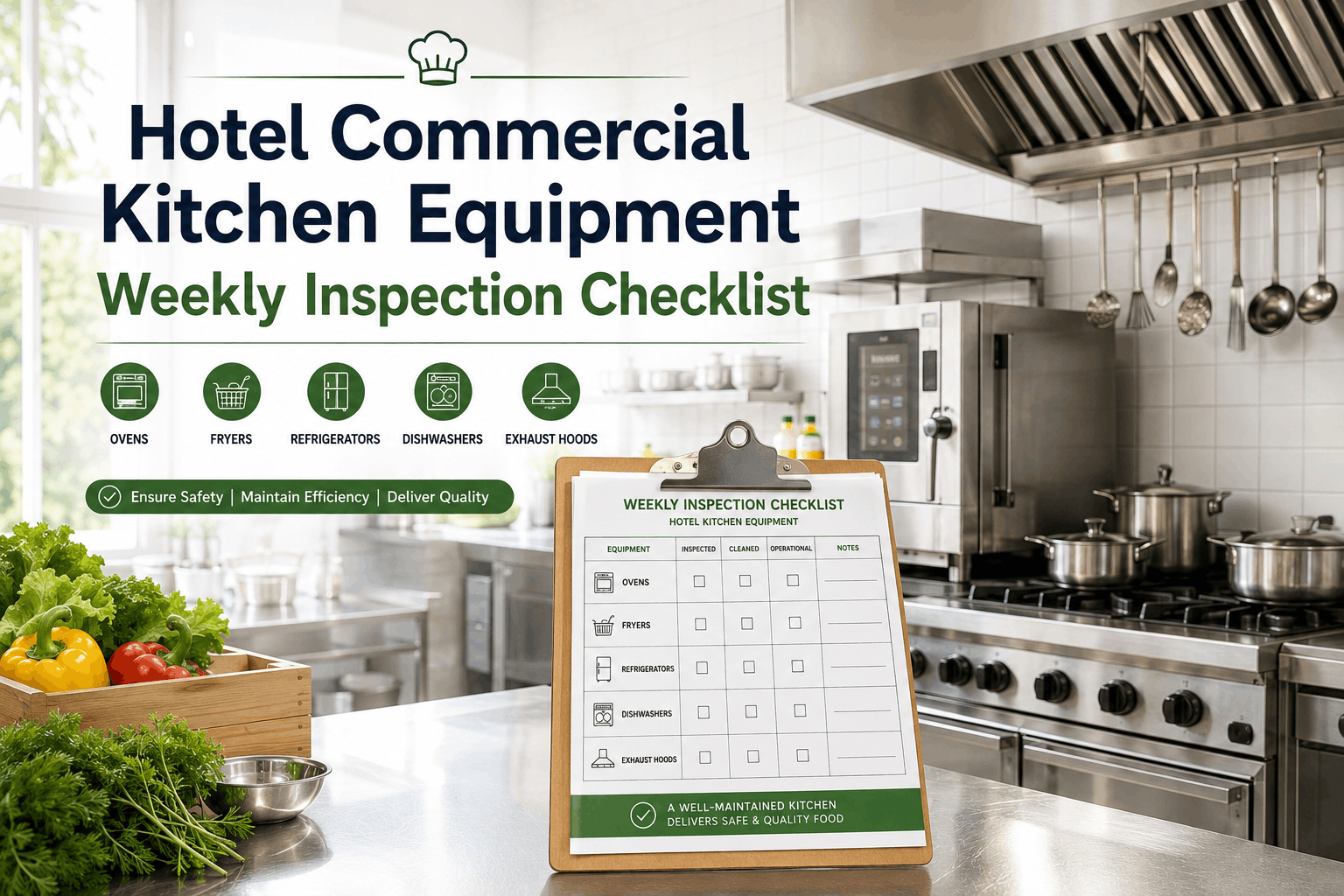
The head chef noticed it during the Saturday dinner rush—the walk-in cooler temperature had climbed to 45°F. By the time the repair technician arrived Sunday morning, $4,200 worth of prime cuts, seafood, and dairy had spoiled. The diagnosis: a condenser coil clogged with grease and debris that hadn't been cleaned in eight months. Emergency repair call on a weekend: $850. Lost inventory: $4,200. Health department violation for improper food storage: $1,500 fine. Total cost of skipped maintenance: $6,550. A systematic weekly coil inspection—requiring 15 minutes and a $30 brush—would have prevented the entire disaster.
A comprehensive kitchen equipment maintenance checklist transforms expensive emergency repairs into manageable scheduled maintenance. When kitchen teams can identify, document, and track potential issues before they become health code violations and equipment failures, operations run smoothly, food safety stays compliant, and budgets stay intact. Properties that implement digital kitchen maintenance tracking report 70% fewer emergency breakdowns and dramatically lower food spoilage losses.
Understanding Kitchen Equipment Failure Impact: The Numbers That Matter
Kitchen equipment failures aren't just maintenance problems—they're food safety violations, revenue killers, and reputation destroyers. Health department regulations require specific temperature ranges, cleaning frequencies, and equipment conditions. Missing these requirements triggers citations, potential closures, and increased inspection scrutiny. Understanding the full impact helps prioritize maintenance in your kitchen operations.
Typical daily revenue loss when critical cooking equipment fails during peak service hours
48 hrs
Health Closure Risk
Time health departments may require closure for critical equipment violations until repairs verified
Additional energy consumption from poorly maintained refrigeration and cooking equipment
Health Department Compliance Requirements
FDA Food Code requires cold holding below 41°F, hot holding above 135°F, and documented equipment maintenance logs. Critical violations can result in immediate closure, fines ranging from $250-$10,000+ depending on jurisdiction, and mandatory re-inspection fees. Systematic maintenance checks create the documentation trail that proves compliance—or reveals problems before inspectors arrive.
Complete Kitchen Equipment Maintenance Issue Checklist
Effective kitchen maintenance requires systematic inspection of every equipment category. This checklist covers the complete commercial kitchen from refrigeration to cooking lines, organized by equipment type and failure likelihood. Work through each section methodically, documenting all findings. When your team can see how digital checklists streamline kitchen maintenance, compliance becomes automatic instead of stressful.
Walk-In Coolers & Freezers
Temperature reading within range (cooler ≤41°F, freezer ≤0°F)
Door gaskets seal properly, no gaps or tears
Condenser coils clean and unobstructed
Evaporator fan running, no ice buildup
Floor drains clear, no standing water
Reach-In Units & Prep Tables
Digital thermometer calibrated and accurate
Compressor cycling normally (not running continuously)
Interior lights functioning
Shelving clean and properly positioned
Drain pan empty and clean
Why Priority 1:
Refrigeration failures cause immediate food safety violations and inventory loss—75% of health department critical violations involve temperature control
Ranges, Ovens & Grills
Burner flames blue and even (gas equipment)
Oven thermostat accurate (±25°F tolerance)
Door hinges and seals intact
Grease traps and drip pans cleaned
Pilot lights stable (if applicable)
Fryers & Griddles
Oil level and quality acceptable
High-limit safety functioning
Thermostat reaching set temperature
Filtration system operating properly
No oil leaks around fittings
Why Priority 2:
Cooking equipment failures halt production immediately—a single fryer failure during lunch rush can cost $2,000+ in lost sales
Hood & Exhaust Systems
Grease filters clean and properly seated
Exhaust fans running at proper CFM
Ductwork connections secure
Makeup air system balanced
Hood lights functioning
Fire Suppression
Ansul system inspection current (semi-annual)
Manual pull stations accessible
Nozzles properly aimed at hazards
Fire extinguishers charged and tagged
Gas shut-off valve accessible
Why Priority 3:
Ventilation failures create fire hazards and indoor air quality violations—grease buildup is the #1 cause of commercial kitchen fires
Dishwashing Systems
Wash temperature ≥150°F (high-temp) or chemical concentration verified (low-temp)
Rinse temperature ≥180°F (high-temp)
Sanitizer dispenser functioning
Spray arms clean and rotating freely
Drain screens and filters clean
Waste Management
Grease trap/interceptor level checked
Garbage disposal functioning
Trash compactor operating properly
Floor drains clear and flowing
Hand sink soap/towel dispensers stocked
Why Priority 4:
Sanitation equipment failures create immediate health violations—inadequate dish sanitization is a critical violation requiring immediate correction
Document Every Inspection, Track Every Issue
See how kitchen managers are using digital checklists to create health department-ready documentation, track repair timelines, and prevent costly equipment failures.
Maintenance Frequency by Equipment Type
Different kitchen equipment requires different maintenance frequencies based on usage intensity, food safety criticality, and failure consequences. High-volume operations need more frequent checks than lower-volume facilities. Adjust your schedule based on these factors and always document completion.
| Equipment Type |
Daily |
Weekly |
Monthly |
Quarterly |
| Walk-In Cooler/Freezer |
Temp log, visual check |
Coil cleaning, gasket check |
Drain line flush, fan inspection |
Professional PM service |
| Commercial Fryers |
Oil quality, temp verify |
Deep clean, filter check |
Thermostat calibration |
Full service, parts inspection |
| Convection Ovens |
Interior wipe, temp check |
Deep clean, door seal check |
Calibration verification |
Professional calibration |
| Commercial Dishwasher |
Temp/chemical verify, clean |
Delime, spray arm clean |
Full inspection, gasket check |
Professional service |
| Hood/Exhaust System |
Filter check |
Filter cleaning/rotation |
Fan belt inspection |
Professional duct cleaning |
| Ice Machine |
Visual inspection |
Exterior cleaning |
Sanitize, filter change |
Professional deep clean |
Equipment Issue Detection Methods: Tools and Techniques
Different equipment issues require different detection methods. A complete compressor failure is obvious, while a slow refrigerant leak requires sensitive detection. Your checklist should specify which method to use for each inspection point. Properties that track detection method results digitally can identify patterns and predict where failures are likely to develop.
TEMPERATURE
Infrared Thermometer
Non-contact measurement
Best for: Surface temps
Quick spot checks
±2°F accuracy
Ranges to 1000°F+
$25-$150 cost
Essential for verifying cooking and holding temperatures
CALIBRATION
Probe Thermometer
Internal temp reading
Best for: Food safety
NSF certified options
±1°F accuracy
Waterproof models
$15-$80 cost
Required for food temperature verification and calibration checks
ELECTRICAL
Multimeter/Amp Clamp
Voltage and amperage
Best for: Motor health
Identifies overloads
Compressor diagnosis
Requires training
$50-$300 cost
Critical for identifying electrical issues before failure
SANITATION
ATP Testing System
Measures cleanliness
Best for: Verification
Results in seconds
Objective measurement
Training required
$200-$500 cost
Validates sanitization effectiveness on equipment surfaces
Documentation Requirements for Health Inspections
Health inspectors don't accept "we think we checked it" as documentation. When they request maintenance records, temperature logs, and cleaning schedules, you need dates, readings, technician signatures, and corrective actions—instantly accessible. Paper systems make this nearly impossible. Digital tracking makes it automatic. The difference shows up when inspectors arrive.
| Document Type |
What to Record |
Why It Matters |
Retention Period |
| Temperature Logs |
Time, temp, equipment ID, employee initials |
Proves cold/hot holding compliance |
90 days minimum |
| Equipment Cleaning |
Date, equipment, method, employee |
Demonstrates sanitation compliance |
90 days minimum |
| Corrective Actions |
Issue found, action taken, verification |
Shows proactive food safety culture |
1 year minimum |
| Calibration Records |
Thermometer ID, date, method, results |
Validates temperature accuracy |
1 year minimum |
| Professional Service |
Date, contractor, work performed, parts |
Documents specialized maintenance |
Life of equipment |
Swipe to see full table
Critical violations require documented corrective action within 24-72 hours—digital tracking ensures you never miss a deadline
Paper Logs vs. Digital Kitchen Maintenance Tracking
When health inspectors request your maintenance records, or when you need to prove a piece of equipment was serviced before failure, the documentation method matters. Paper clipboards get lost, coffee-stained, and incomplete. Digital systems create automatic, timestamped, searchable records that protect your operation.
Paper-Based Logs
to compile inspection records
Temperature trending:
Manual review
Issue escalation:
Verbal only
Inspection readiness:
High risk
Digital CMMS
complete inspection package
Temperature trending:
Automatic alerts
Issue escalation:
Auto-notify
Inspection readiness:
Always ready
70%
fewer emergency breakdowns
100%
inspection documentation complete
$0
fines with proper tracking
Expert Perspective: What Separates Top-Performing Kitchens
"The kitchens that never have surprise equipment failures share one characteristic: they treat maintenance as a scheduled activity, not a reaction to problems. Every piece of equipment has an owner, a schedule, and documentation. When I consult with operations struggling with equipment reliability, the first thing I look at is their maintenance logs. Operations with digital tracking have 60% fewer emergency repairs and their equipment lasts 3-5 years longer on average."
— Commercial Kitchen Consultant, 22 years experience
Equipment Ownership
Assign specific staff to specific equipment. When someone owns maintenance, accountability improves dramatically.
Scheduled Prevention
Block time for maintenance just like prep time. Equipment that's maintained during slow periods doesn't fail during rush.
Documentation Culture
If it's not documented, it didn't happen. Digital records protect you during inspections and warranty claims.
Common Equipment Issue Indicators: What to Watch For
Not every equipment problem requires a service technician to identify. Experienced kitchen staff recognize visual, auditory, and performance indicators that suggest developing issues. Training your team to spot these signs during daily operations catches problems early—before expensive repairs are needed.
Frost buildup in freezers or on evaporator coils
Water pooling under refrigeration units
Grease buildup around vent hoods
Rust or corrosion on equipment surfaces
Worn or cracked door gaskets
Unusual compressor cycling (too frequent/constant)
Grinding or squealing from motors
Clicking from failed ignition attempts
Rattling from loose components
Hissing from gas or refrigerant leaks
Longer preheat times than normal
Uneven cooking or heating
Temperature fluctuations beyond tolerance
Reduced ice production
Dishes not fully sanitized
Energy bills increasing without usage change
More frequent temperature alarms
Increasing repair frequency on same unit
Food quality complaints increasing
Longer recovery times after door openings
Team Roles for Kitchen Equipment Maintenance Program
Effective kitchen maintenance isn't a one-person job. Successful programs distribute responsibility across the kitchen team, with clear accountability for inspections, documentation, and escalation. This structure ensures nothing falls through the cracks and equipment stays reliable through the busiest services.
Program Owner
Executive Chef or Kitchen Manager
Sets maintenance schedules and standards
Reviews completion reports weekly
Approves repair expenditures
Equipment Champion
Sous Chef or Lead Line Cook
Performs daily equipment checks
Documents findings in CMMS
Coordinates with service contractors
Station Owners
Line Cooks & Prep Staff
Maintain assigned equipment daily
Report issues immediately
Complete end-of-shift cleaning
Compliance Officer
GM or Operations Manager
Audits documentation monthly
Manages health inspection prep
Tracks equipment lifecycle costs
Stop Equipment Failures Before They Stop Your Kitchen
Oxmaint gives kitchen teams complete equipment tracking, automatic maintenance scheduling, and health department-ready documentation. Protect your equipment, protect your food safety, protect your reputation.
Frequently Asked Questions
How often should commercial kitchen equipment be inspected?
Inspection frequency varies by equipment type and criticality. Refrigeration equipment should be temperature-checked daily and thoroughly inspected weekly. Cooking equipment needs daily visual inspection and weekly deep cleaning with monthly calibration verification. Ventilation systems require weekly filter checks and quarterly professional cleaning. Dishwashers need daily temperature and chemical verification with monthly comprehensive inspection. High-volume operations should increase frequencies accordingly.
What temperature records are required by health departments?
Most health departments require documented temperature logs for cold holding equipment (must maintain ≤41°F), hot holding equipment (must maintain ≥135°F), and dishwasher wash/rinse cycles (typically ≥150°F wash, ≥180°F final rinse for high-temp machines). Logs should include time of reading, temperature, equipment identification, and employee initials. Digital logging systems that create automatic timestamps are preferred by many jurisdictions.
What are the most common causes of commercial kitchen equipment failure?
The top causes of kitchen equipment failure are: dirty condenser coils on refrigeration (causing 35% of failures), worn door gaskets allowing temperature loss, clogged grease filters reducing ventilation efficiency, scale buildup in dishwashers and ice machines, and thermostat drift from lack of calibration. All of these are preventable with systematic maintenance—equipment with proper PM programs lasts 3-5 years longer than neglected equipment.
How much does poor kitchen equipment maintenance really cost?
Poor maintenance creates compounding costs: emergency repairs cost 3-5x scheduled service, spoiled inventory from refrigeration failure averages $2,000-$5,000 per incident, health department violations range from $250-$10,000+ with potential closure, and equipment replacement cycles shorten by 25-40%. A typical full-service restaurant can lose $15,000-$30,000 annually from preventable equipment issues. Systematic maintenance programs typically cost $3,000-$6,000 annually but prevent 10x that amount in losses.
What documentation do I need for health department inspections?
Health inspectors typically request: temperature logs for refrigeration and hot holding (minimum 90 days), cleaning and sanitizing schedules with completion records, thermometer calibration logs, corrective action documentation for any issues found, and professional service records for specialized equipment like hood cleaning and fire suppression. Digital CMMS systems automatically generate compliant documentation that can be produced instantly during inspections.
Ready to Implement a Comprehensive Kitchen Maintenance Program?
Join thousands of food service operations using Oxmaint to track equipment, document inspections, and maintain health department compliance automatically. Start preventing costly breakdowns today.