Most hotel maintenance problems are not caused by bad equipment or bad technicians. They are caused by the absence of a system — a connected, documented, accountable process that turns daily maintenance activity into managed operations. The properties that consistently outperform on guest satisfaction, operational cost, and asset reliability all share one structural characteristic: they treat maintenance as a managed discipline, not a reactive function. This guide covers every layer of that discipline — from the foundational asset register through preventive maintenance programs, CMMS deployment, workforce management, and the analytics that convert maintenance data into strategic decisions. If you want to see how OxMaint supports every layer described here, sign up free or book a demo with our hospitality team.
Complete Guide
Hotel Maintenance Management with CMMS and Digital Tools
Asset tracking, work order management, preventive maintenance, and operational analytics — the full playbook
Asset Management
Work Orders
Preventive Maintenance
CMMS
Analytics
Workforce Planning
Hotel Maintenance Maturity Scale
Scheduled PM
31%
of hotels
Digital CMMS
22%
of hotels
This guide takes you from wherever you are now to the top 9%
Guide Chapters
01
Why Hotel Maintenance Fails
02
Building the Asset Register
04
Preventive Maintenance Strategy
05
CMMS Selection and Deployment
Chapter 01
Why Hotel Maintenance Fails — The Root Cause Pattern
Every hotel maintenance failure — whether it is a burst pipe at 3 AM, a chiller failing during peak summer, or a brand audit citation — traces back to the same three root causes. Identifying them is the prerequisite to fixing them.
01
No Asset Visibility
Teams cannot maintain what they cannot see. Without a complete asset register — equipment location, service history, PM schedule, warranty status — maintenance is managed by memory and verbal knowledge that walks out the door when experienced staff leave.
Signal: Emergency repairs that "could not have been predicted" — on assets with no documented history
02
No Task Accountability
A PM schedule in a spreadsheet or paper binder is not a PM program. Without digital assignment, tracking, escalation, and completion verification, scheduled maintenance tasks are completed at 41% rates — which means 59% of planned preventive work never happens.
Signal: PM completion rates below 70% — measured only after a CMMS is deployed to count them accurately
03
No Data for Decisions
Capital budgets are approved by finance teams that require evidence, not intuition. Without maintenance cost history, failure frequency data, and asset condition trends, engineering teams cannot build the business case for investments that would prevent the failures they keep firefighting.
Signal: Repeatedly denied capital requests — because the data that would justify them was never captured
Chapter 02
Building the Hotel Asset Register
The asset register is the foundation on which every other maintenance capability is built. A PM program without an asset register is a schedule without addresses. Work orders without an asset register are repairs without history. The register does not need to be perfect on day one — it needs to exist, and it needs to grow. Sign up free to start building your hotel's asset register in OxMaint today.
Asset Register Build: What to Capture for Each Asset
Minimum required fields and enrichment data — build in this order for fastest operational value
Layer 1 — Day 1
Core Identity Fields
Asset name and category
Location (floor, zone, room number)
Make, model, serial number
Install date or estimated age
QR code or asset tag number
Layer 2 — Week 1
Operational Context
Warranty expiry date and terms
Service vendor contact and contract number
Replacement cost estimate
Criticality rating (life safety / high / standard)
Linked PM schedule assignment
Layer 3 — Month 1
Service History
Prior repair records (import from paper where available)
Parts replacement history
Inspection and test records
Photo documentation of current condition
Running hours or cycle count (where applicable)
Asset Count Benchmarks by Hotel Category
180–320
Limited Service (100–200 rooms)
480–900
Full Service (200–400 rooms)
900–2,400
Resort (400–800 rooms + amenities)
2,400+
Convention / Casino (800+ rooms)
Chapter 03
Work Order Management: From Radio Call to Tracked Lifecycle
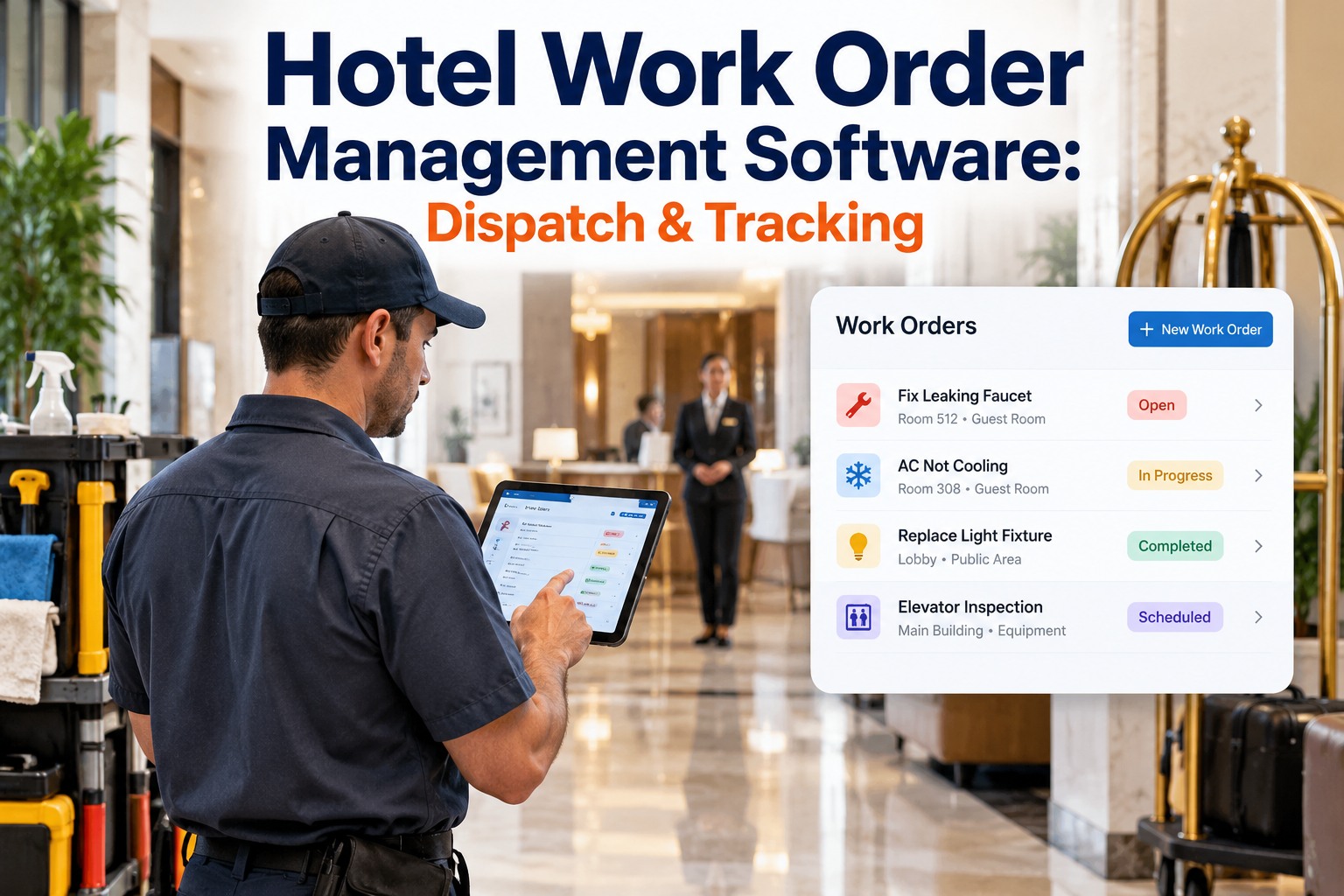
Work order management is the operational core of hotel maintenance. Every task — whether it is a guestroom repair, a PM completion, or a safety inspection — should travel through a defined lifecycle that creates accountability, captures history, and feeds the analytics that drive better decisions. Without that lifecycle, maintenance is a series of events that generate cost but no data.
The Seven-Stage Work Order Lifecycle
Every maintenance task should travel through all seven stages — each stage captured digitally in OxMaint
1
Creation
Guest complaint / Housekeeping flag / Engineering observation / Automated sensor alert
›
2
Classification
Priority level / Task type / Asset linked / SLA timer starts
›
3
Assignment
Routed by skill level / Shift schedule / Current workload
›
4
Execution
Mobile task completion / Photos / Parts logged / Asset history accessed
›
5
Escalation
SLA breach alert / Auto-escalate to chief engineer / Reassign if needed
›
6
Completion
Digital sign-off / Photo proof / Timestamp stored / Front desk notified
›
7
Analytics
Added to asset history / KPI updated / Pattern detection / Capital data
Build the complete work order lifecycle in your hotel today
OxMaint's Work Order Management module tracks every maintenance task through all seven lifecycle stages — creating accountability, asset history, and the analytics data your team needs to improve.
Sign up free and run your first fully tracked work order within hours.
Chapter 04
Preventive Maintenance Strategy: What to Schedule and When
A preventive maintenance program is not a list of tasks — it is a risk management strategy applied to every asset on the property. The goal is to schedule the minimum maintenance effort that prevents the maximum failure risk. Too little PM produces failures. Too much PM wastes labor on assets that do not need it. The table below maps the most common hotel asset categories to their PM frequency requirements and the failure consequences of deferral. Book a demo to see OxMaint's hospitality PM templates pre-loaded for your property type.
Hotel Preventive Maintenance Frequency Matrix
Recommended intervals and deferral risk by asset category — based on ASHRAE 180 and hospitality industry standards
Swipe to view full table
The PM Completion Gap — Paper vs. Digital
The 56-point gap between those two completion rates is where hotel equipment failures are born. Every deferred PM is a future emergency with a 5x price tag.
Chapter 05
CMMS Selection and Deployment: What to Look for and How to Go Live
A CMMS is not an IT project — it is an operational transformation. The properties that deploy successfully treat it as a change management effort with a defined rollout sequence, not a software installation. The framework below covers both platform selection criteria and a proven deployment sequence that has hotel teams fully operational within 30-60 days. Sign up to access OxMaint's hospitality onboarding support from your first day.
CMMS Evaluation Criteria for Hotel Operations
Ten requirements that separate a hotel-ready CMMS from a generic work order tool
Mobile-First for Field Teams
Technicians complete work orders on smartphones — offline capable, photo attachment, QR code scan. Not a desktop system accessed from a phone.
Multi-Department Access
Front desk, housekeeping, F&B, and engineering all access the same platform with role-appropriate views — not separate systems with no cross-visibility.
Hospitality PM Templates
Pre-built PM schedules for common hotel asset categories — not blank templates requiring weeks of manual configuration before go-live.
SLA Management and Escalation
Response time targets set per task category, automatic escalation when SLAs are breached — without requiring a manager to manually monitor every open task.
Compliance Export on Demand
Brand audit, insurance, and regulatory compliance reports generated in minutes — not assembled manually from paper records over multiple days.
Vendor and Contractor Portal
External contractors access assigned work orders, view asset history, and submit service documentation — all within the same platform, not via email attachments.
Asset Health Analytics
Failure frequency, repair cost trend, and health score by asset — the data needed to justify capital replacement before the emergency that forces it.
Shift Logbook Integration
Shift entries and work orders in one system — logbook entries automatically generate work orders, and work order completions close logbook items without manual reconciliation.
PMS and BAS Integration
Room status from PMS feeds maintenance requests automatically. BAS sensor data feeds asset condition monitoring. No manual data bridging between systems.
Multi-Property Portfolio Support
Regional directors see performance across every property in a single dashboard. Standards deployed portfolio-wide. Each property retains operational autonomy with corporate oversight.
CMMS Deployment Sequence — 60 Days to Full Operations
The phase sequence that gets hotel teams operational without disrupting active maintenance work
Days 1–14
Foundation
Asset inventory and registration — all critical categories
Import existing service records where available
Configure PM templates for HVAC, life safety, and boiler
Engineering pilot — first digital work orders live
Days 15–30
Activation
Full PM schedule live for all asset categories
SLA thresholds configured per task type
Front desk and housekeeping request submission active
First cross-department visibility. PM completion tracking live.
Days 31–45
Integration
Vendor portal configured for key contractors
Shift logbook connected to work order queue
Alert rules and escalation thresholds set
Paper processes retired. All departments on single platform.
Days 46–60
Analytics
First GM performance summary report generated
Asset health trends surfacing from 60 days of data
Capital planning report built from real failure history
First data-backed budget request. Compliance report ready.
OxMaint checks every box in the CMMS evaluation list above
Mobile-first, multi-department, hospitality PM templates, SLA management, compliance export, vendor portal, analytics, shift logbook integration, and PMS connectivity — all in one platform.
Book a demo to see each capability configured for your property type.
Chapter 06
ROI and Business Case: Making the Investment Decision
The business case for hotel CMMS is built on five financial benefit streams that each compound over time. The first year is dominated by emergency repair reduction and technician productivity gains — visible, measurable, and fast. Years two and three add asset life extension value and capital planning accuracy as the system accumulates the data history that paper never could. Sign up free and start building your own verified ROI baseline from day one.
CMMS ROI: Five Value Streams — Annual Impact
280-room full-service hotel — conservative estimates across all five sources
Emergency Repair Reduction
55% fewer emergency repairs at 2.4x standard labor rate — most immediate and measurable return
Technician Productivity
40% of admin time recaptured — equivalent to 1.6 additional technicians per year without headcount
Asset Lifespan Extension
30-year vs. 15-year HVAC lifespan — $24K annual CapEx deferral value on $1.2M asset portfolio
Guest Satisfaction
3 fewer maintenance incidents per month at $2,400 each — protected revenue from avoided complaints and room recovery
Compliance Savings
Audit prep from 3 days to 15 minutes, 2 audits/year — plus avoided citation costs and insurance premium reduction
Total Annual Value
280-room full-service hotel — conservative across all five streams
$140,000
vs. OxMaint at ~$7,800/yr — 18x return
Frequently Asked Questions
How is CMMS different from the maintenance module in our PMS?
A property management system (PMS) maintenance module handles guest-reported room issues — a complaint logged at reception routes to engineering as a request. A CMMS manages the entire engineering operations program: preventive maintenance scheduling for all assets, full work order lifecycle management with asset history, spare parts and inventory, vendor management, compliance documentation, shift logbook, and analytics reporting. The two serve complementary functions — PMS handles reactive guest-service requests while CMMS drives the proactive maintenance program that prevents those requests from occurring. OxMaint integrates with major PMS platforms so both work together without manual data bridging.
How long does CMMS implementation take for a full-service hotel?
Most full-service hotels are fully operational in OxMaint within 30-60 days using the phased deployment sequence described in Chapter 5 of this guide. The foundational asset inventory for a 280-room property typically takes 3-5 days using mobile bulk registration or spreadsheet import. PM schedule configuration using hospitality templates takes an additional 3-4 days. Technician training on mobile work orders requires 2-4 hours per person. By day 14, engineering is running digital work orders. By day 45, all departments are connected. By day 60, the analytics dashboard has enough data to surface the first actionable patterns.
What is the minimum team size that justifies a CMMS investment?
Hotels with as few as two engineering staff and 80 rooms produce positive CMMS ROI within 12 months. The threshold is not team size — it is asset value and the cost of reactive maintenance relative to the platform cost. Any property with HVAC replacement value above $200,000, a chiller, boiler, or elevator, or brand standard compliance requirements will find that the emergency repair savings alone justify the investment within the first year. For limited-service properties, the compliance documentation value (avoiding a single brand audit citation or insurance claim denial) typically covers multiple years of subscription cost.
How do we build the business case to get GM or ownership approval?
The most effective GM business case has three components: current-state cost baseline (last 12 months of emergency repair invoices, estimated PM completion rate, any compliance issue costs), projected savings calculation (applying industry percentages to your specific baseline numbers — not generic vendor claims), and implementation risk profile (phased rollout, no disruption to active operations, measurable results within 30 days). The key is presenting savings per dollar of investment — an 18x ROI in year one is a stronger argument than a $140,000 savings number in isolation. OxMaint's team will help you build this calculation for your specific property before any commitment is required.
Start Today — No Credit Card Required
The 9% of hotels running predictive maintenance didn't get there by waiting
Every concept in this guide — asset register, work order lifecycle, PM strategy, CMMS deployment, compliance documentation, and ROI analytics — is operational in OxMaint today. The platform handles hotels from 80 to 4,000 rooms, single properties to global portfolios. Start free and see your first digital shift in 24 hours.