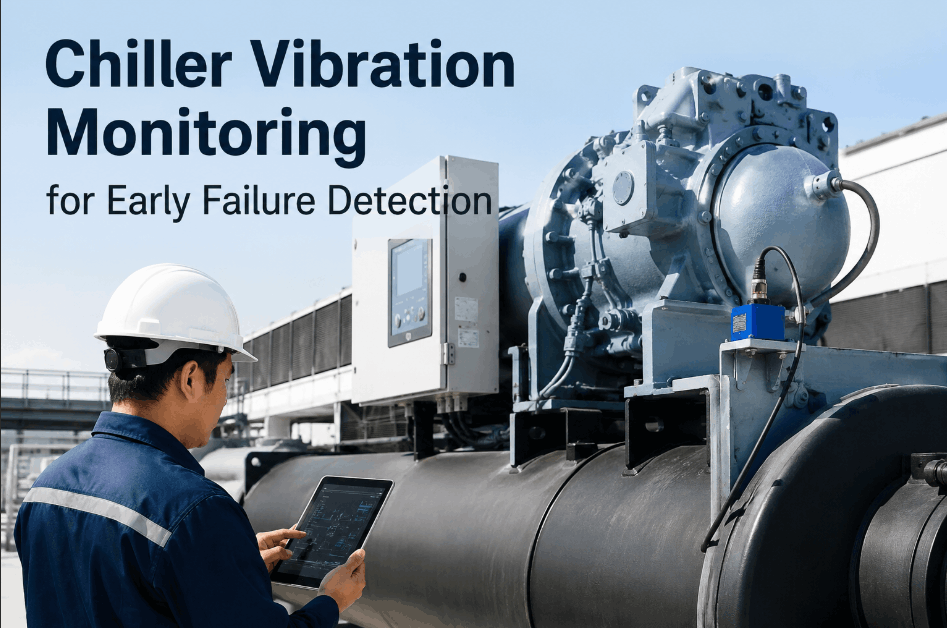
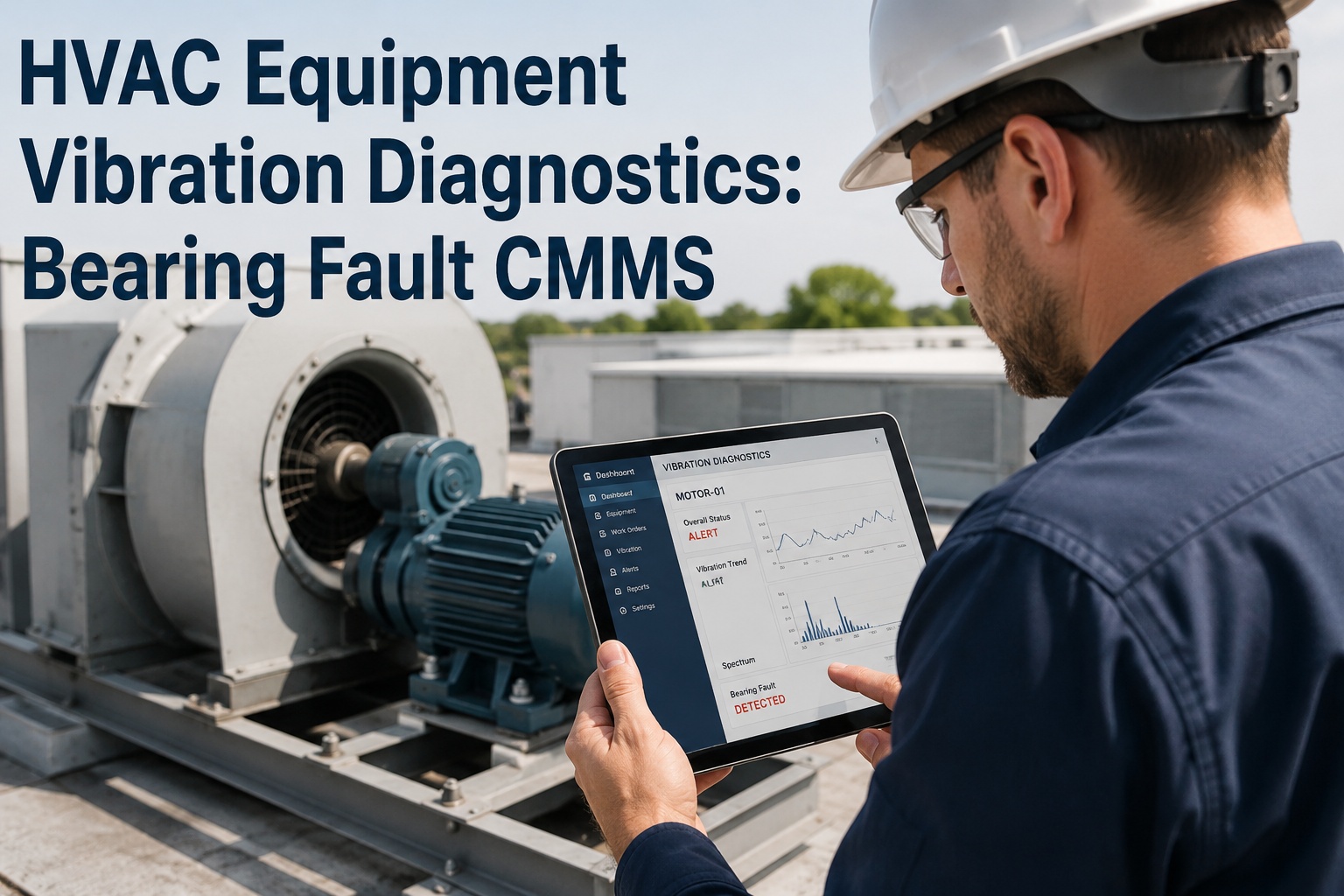
Chiller vibration monitoring is one of the most cost-effective early warning systems available to facility and plant engineers — a shift in vibration signature at a compressor bearing can signal weeks of advance notice before a catastrophic failure that halts cooling and triggers emergency replacement costs. Facilities using Sign Up Free with Oxmaint structure their chiller maintenance programs around condition monitoring data, linking vibration alerts directly to work orders so nothing falls through the gap between sensor and technician. Bearing wear, compressor imbalance, refrigerant-induced stress, and motor misalignment each produce distinct vibration patterns — recognizing them before failure escalates separates reactive shops from reliability-driven operations. Book a Demo to see how Oxmaint's predictive maintenance module integrates with chiller condition monitoring systems.
CHILLER · VIBRATION MONITORING · PREDICTIVE MAINTENANCE · EARLY FAILURE · 2026
Chiller Vibration Monitoring for Early Failure Detection
Catch bearing wear, compressor imbalance, and mechanical stress in chillers weeks before a small fault becomes a cooling plant shutdown — with structured vibration monitoring and CMMS-integrated work order response.
30–90Days of advance warning vibration monitoring provides before bearing failure in most chiller types
$180K+Typical cost of emergency chiller compressor replacement versus planned repair from early detection
85%Of chiller failures are detectable in advance with vibration and temperature condition monitoring
3–5×ROI on vibration monitoring programs at facilities with chillers over 200 tons capacity
Chiller Failure Modes That Vibration Monitoring Detects First
Every chiller failure mode has a vibration signature that precedes visible damage or performance degradation. The challenge is linking that signal to a work order before the fault progresses. Oxmaint's predictive maintenance module connects sensor thresholds to automated work orders — so a vibration alert at a compressor bearing creates an inspection task immediately, not after the next scheduled PM visit. Sign Up Free and configure vibration-triggered work orders for your chiller fleet.
Bearing Wear
Most Common — 40% of Chiller Failures
Bearing degradation produces increasing broadband noise floor and characteristic frequency spikes at bearing defect frequencies (BPFO, BPFI, BSF). Early detection allows planned replacement during scheduled shutdown.
Compressor Imbalance
Rotational 1× frequency dominance
Mass imbalance in centrifugal compressor impellers produces 1× running speed vibration that increases with RPM. Left unaddressed, it accelerates bearing wear and can cause impeller contact damage in tight-clearance designs.
Motor Misalignment
2× and axial vibration signature
Coupling misalignment between motor and compressor produces elevated 2× running speed and axial vibration. Detected early, realignment is a two-hour task. Ignored, it destroys motor and compressor bearings within weeks.
Refrigerant Slugging
Impulsive shock signature
Liquid refrigerant or oil carryover into the compressor produces random impulsive shock events in vibration data. This is a refrigerant circuit management issue that vibration monitoring catches before compressor valve damage occurs.
Loose Foundations / Mounts
Sub-synchronous and structural resonance
Chiller mounting pad deterioration or loose anchor bolts shift the resonance frequency of the assembly. Structural vibration that wasn't present at commissioning indicates foundation problems that amplify all other fault signatures.
Gear Mesh Faults (Gear-Driven Chillers)
Gear mesh frequency sidebands
In gear-driven centrifugal chillers, tooth wear or pitch errors produce sidebands around the gear mesh frequency. Tracking sideband amplitude trends gives 60–120 days of warning before tooth failure causes catastrophic compressor seizure.
Vibration Monitoring Implementation — 5-Stage Program
1
Baseline Measurement at Commissioning
Capture vibration signatures at all chiller measurement points (compressor drive end/non-drive end, motor bearings, gear box if applicable) at full load and part load. These baselines define normal — every future measurement is compared to them.
2
Define Measurement Points and ISO Alert Levels
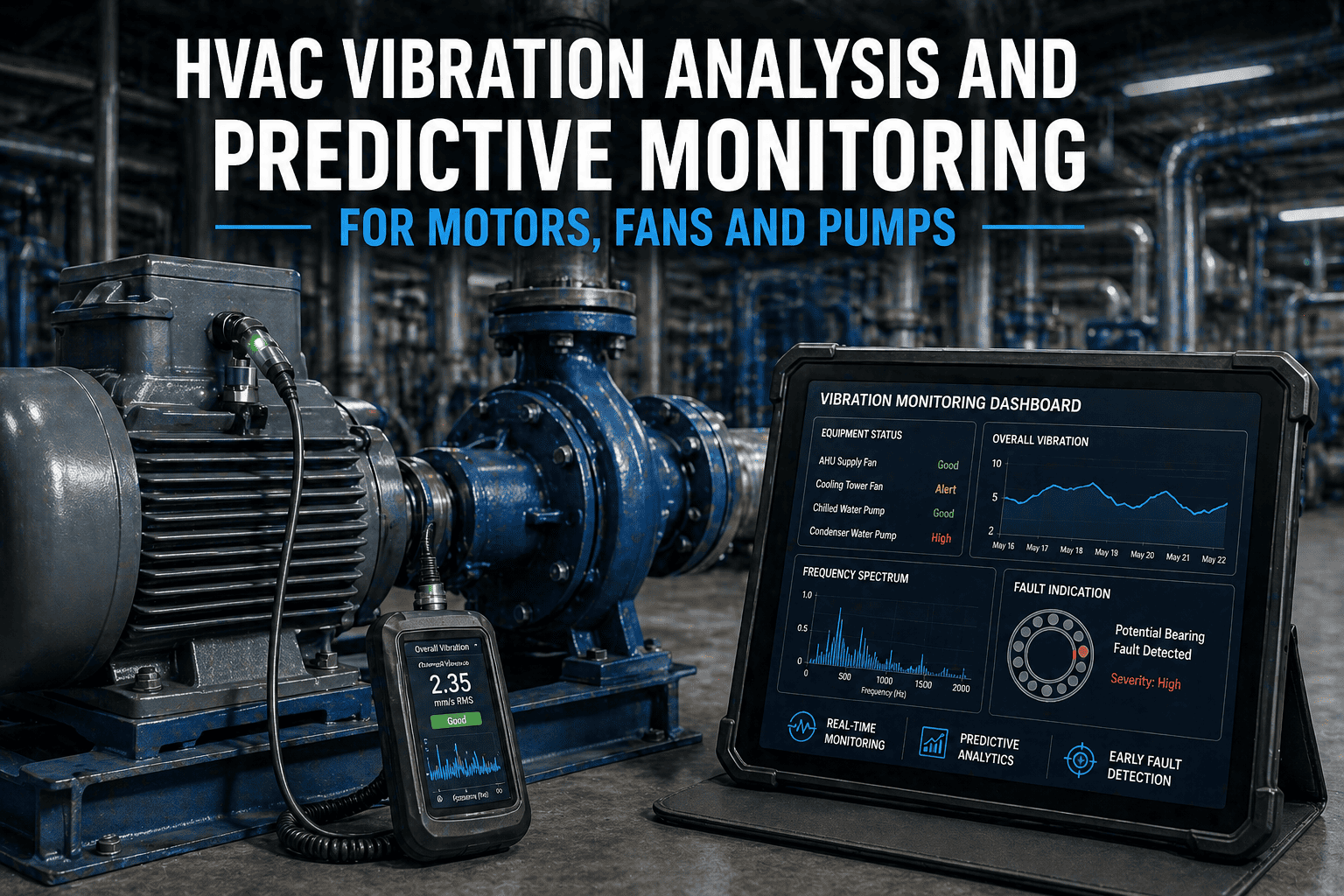
ISO 10816-3 defines vibration severity zones (A–D) for industrial machinery. Set CMMS alert thresholds at Zone B/C boundary for early warning and Zone C/D for immediate action — automatically generating work orders at each threshold crossing.
3
Scheduled Route-Based or Continuous Monitoring
For chillers over 200 tons, continuous online monitoring with wireless sensors provides real-time fault detection. For smaller chillers, monthly route-based measurements with a portable analyzer provide adequate detection interval for most failure modes.
4
CMMS Integration — Alert to Work Order
Connect vibration monitoring system alerts to Oxmaint so threshold crossings automatically generate inspection work orders, assign them to the responsible technician, and log all measurements against the chiller asset record for trend analysis.
5
Trend Analysis and Failure Mode Diagnosis
Trending overall vibration levels and frequency spectrum peaks over time separates developing faults from stable operation. Oxmaint's asset history stores all measurement data against the chiller record, making trend analysis available to any team member.
Vibration Alert Thresholds — ISO 10816 Reference for Chillers
| Vibration Zone |
Overall Velocity (mm/s RMS) |
Condition Assessment |
Oxmaint Response |
| Zone A (New) | < 2.3 | Good — newly commissioned | No action — baseline reference |
| Zone B (Acceptable) | 2.3 – 4.5 | Normal operational wear | Continue scheduled monitoring |
| Zone C (Alert) | 4.5 – 7.1 | Developing fault — inspect | Auto-create inspection work order |
| Zone D (Critical) | > 7.1 | Immediate risk of damage | Priority work order — plan outage |
Turn Vibration Alerts into Planned Repairs — Not Emergency Calls
Oxmaint links chiller vibration threshold alerts to automatic work orders, asset history, and technician assignment — closing the gap between sensor signal and field response before faults escalate.
Frequently Asked Questions — Chiller Vibration Monitoring
How often should chiller vibration be measured?
Monthly route-based measurements are minimum best practice for chillers under 200 tons. Chillers over 200 tons serving critical facilities benefit from continuous online monitoring with real-time alerting.
What vibration measurement points are most important on a centrifugal chiller?
Drive-end and non-drive-end motor bearings, compressor drive-end bearing, and gearbox housing (if applicable) are the four highest-priority measurement points. Motor axial measurements are added when misalignment is suspected.
Can vibration monitoring replace scheduled chiller overhauls?
No — vibration monitoring supplements overhaul intervals by identifying components that need earlier intervention and those that can safely run longer. It optimizes overhaul scope, not eliminates it.
How does Oxmaint support chiller vibration monitoring programs?
Oxmaint stores all vibration measurement data against the chiller asset record, generates scheduled measurement tasks, and auto-creates work orders when alert thresholds are exceeded — linking condition data directly to maintenance response.
What is the typical lead time between vibration alert and bearing failure?
Rolling element bearing failures typically progress from Zone C alert to failure in 30–90 days depending on load and speed. This window is sufficient for planned replacement in most facility maintenance environments.
Catch Chiller Faults Early. Prevent Cooling Plant Shutdowns.
Oxmaint's predictive maintenance module connects vibration monitoring alerts to work orders, asset history, and technician scheduling — so chiller condition data drives planned repairs, not emergency responses.