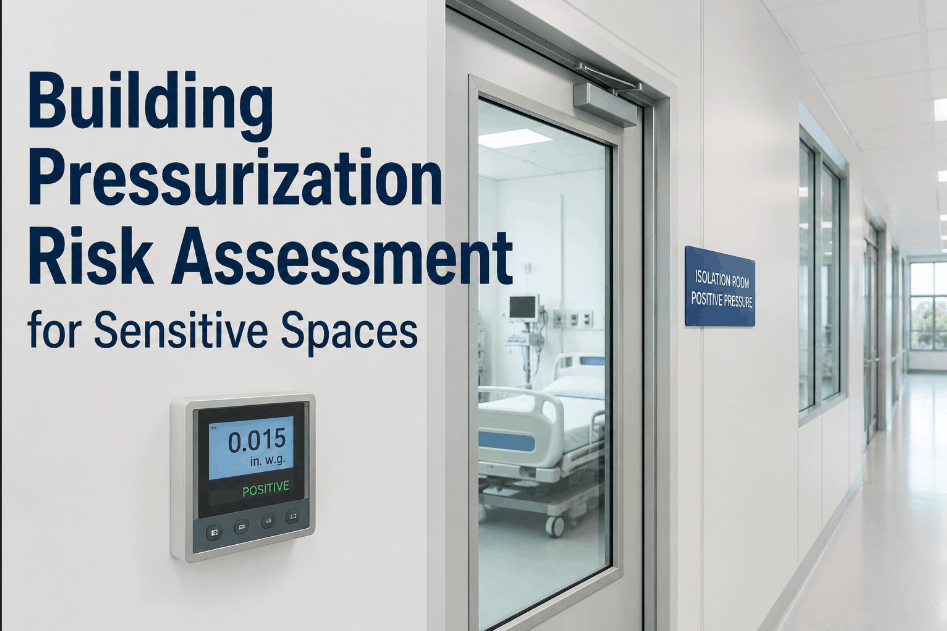
Building pressurization failures in hospitals, cleanrooms, laboratories, and isolation environments are not HVAC comfort problems — they are patient safety, contamination containment, and regulatory compliance failures. Facility teams using Sign Up Free on OxMaint can build structured pressurization risk assessments that link pressure monitoring data to HVAC asset records, schedule corrective maintenance before exceedances occur, and document compliance evidence for regulatory inspection. Treating building pressurization as a managed risk discipline — rather than a background HVAC function — is the standard that sensitive space operations require.
Why Building Pressurization Risk Demands Structured Assessment
Pressure differentials in sensitive spaces are maintained within narrow tolerances — often 0.01 to 0.05 inches of water column — that HVAC systems must sustain despite door cycling, supply air fluctuation, exhaust system variability, and building envelope leakage. Each of these variables degrades pressurization independently and in combination, and undetected exceedances in healthcare, pharmaceutical, or laboratory environments carry immediate operational and regulatory consequences. Book a Demo to see how OxMaint connects pressure monitoring records to HVAC maintenance schedules and work orders, enabling facilities to identify and address pressurization risk before it becomes an incident.
Six Pressurization Risk Factors That Require Structured Assessment
A complete pressurization risk assessment maps the variables that degrade differential pressure maintenance across the space, HVAC system, and building envelope. Sign Up Free to build pressurization risk records and corrective maintenance work orders in OxMaint linked to the specific spaces and equipment they protect.
Supply and Exhaust Air Imbalance
Pressurization depends on the calibrated relationship between supply air volume and exhaust or return air volume. Filter loading, damper wear, and fan performance degradation shift this balance over time, reducing positive or negative pressure differential without triggering alarms until the exceedance becomes persistent.
Building Envelope Leakage Paths
Gaps around penetrations, aging door seals, and structural cracks create uncontrolled leakage paths that bypass the designed pressure boundary. Periodic envelope integrity inspections linked to HVAC work orders in OxMaint ensure that physical building deficiencies are addressed alongside mechanical system maintenance.
Door-Cycle Pressure Recovery Time
Each door opening temporarily disrupts the pressure differential. HVAC systems properly designed for sensitive spaces recover quickly after door closure. Slow recovery — more than 30 to 60 seconds to return to setpoint — indicates supply air capacity degradation, damper response problems, or increased leakage that requires investigation.
Pressure Sensor Calibration Drift
Differential pressure sensors in critical spaces require periodic calibration verification. Sensor drift causes the BAS to report stable pressure conditions while actual pressure has shifted outside acceptable range. Annual sensor calibration tasks in OxMaint ensure monitoring accuracy is validated, not assumed.
Adjacent Space Pressure Cascade Effects
Pressure differentials in critical spaces depend on the pressure conditions of adjacent areas. Changes in neighboring zone HVAC operation — renovation work, system modifications, or equipment failures — can alter the pressure gradient across shared walls, undermining sensitive space pressure maintenance without touching its dedicated HVAC system.
HVAC Equipment Degradation — AHU, Dampers, Fans
Fan belt wear, damper actuator drift, coil fouling, and filter loading cumulatively reduce the air delivery capacity that maintains pressure differential. Scheduling preventive maintenance on all HVAC components serving sensitive spaces in OxMaint ensures equipment degradation is caught before it compromises pressure performance.
Pressurization Risk Profiles by Sensitive Space Type
Different sensitive space types operate under different pressurization requirements and carry distinct consequence profiles when pressure maintenance fails. Book a Demo to explore how OxMaint organizes space-specific HVAC maintenance records and links them to pressurization monitoring and compliance documentation requirements.
| Space Type | Pressure Requirement | Primary Risk Driver | Failure Consequence | OxMaint Mitigation |
|---|---|---|---|---|
| Hospital Isolation Rooms | Negative 0.01–0.03 in. w.c. | Door cycling, exhaust fan failure | Pathogen spread, infection risk | Monthly pressure verification WOs |
| Operating Suites | Positive 0.03–0.05 in. w.c. | Supply air imbalance, filter loading | Contamination ingress, surgical risk | Bi-weekly AHU and filter inspection |
| Pharmaceutical Cleanrooms | Positive cascade 0.02–0.05 in. w.c. | Envelope leakage, sensor drift | Batch contamination, regulatory hold | Sensor calibration + envelope inspection WOs |
| BSL-2 / BSL-3 Labs | Negative relative to corridor | Exhaust damper failure, cascade effects | Containment breach, safety incident | Exhaust damper PM + adjacent zone monitoring |
| Data Center / Server Rooms | Slight positive to exclude particulates | Supply fan degradation, door seal wear | Particulate contamination, equipment damage | Quarterly fan and seal inspection WOs |
Consequences of Unmanaged Pressurization Risk
Pressurization failures that go undetected or unaddressed in sensitive spaces generate consequences that extend well beyond HVAC system performance. Sign Up Free to build pressurization risk tracking and corrective work order workflows in OxMaint and protect your sensitive spaces from preventable exceedance events.
Frequently Asked Questions: Building Pressurization Risk Assessment for Sensitive Spaces
What is a building pressurization risk assessment?
A pressurization risk assessment documents the variables — HVAC system condition, envelope integrity, sensor calibration, and adjacent space interactions — that affect the ability of a sensitive space to maintain required pressure differentials reliably.
Which spaces require active pressurization management?
Hospital isolation rooms, operating suites, pharmaceutical cleanrooms, BSL laboratories, and sterile processing areas all require documented pressure differential maintenance with supporting HVAC maintenance and verification records.
How does OxMaint support pressurization risk management?
OxMaint links HVAC asset maintenance schedules to space-specific pressurization requirements, enables pressure verification work orders with documented completion records, and stores the corrective action history needed for regulatory inspection response.
How often should building pressurization be verified in critical spaces?
Operating suites and BSL labs typically require monthly or more frequent verification. Pharmaceutical cleanrooms and hospital isolation rooms require at minimum quarterly verification, with continuous BAS monitoring as the baseline between physical checks.
What HVAC components most frequently cause pressurization failures?
Exhaust fan performance degradation, supply air damper wear, filter loading beyond design differential, and pressure sensor calibration drift are the most common HVAC root causes of building pressurization exceedances in sensitive space environments.