A centrifugal chiller that sits idle for four months over winter accumulates refrigerant in the compressor oil sump — and the bearing that fails within the first 15 minutes of a poorly executed spring startup was destroyed not by mechanical fatigue but by the liquid refrigerant that slugged it because the oil temperature was 58°F instead of the 130°F minimum required before compressor start. The same chiller shut down without draining the water sides of the evaporator and condenser will present freeze-burst tubes when the mechanical room temperature drops below 35°F, producing a repair that costs 20 to 40 times what a correct shutdown checklist would have cost to execute. Chiller plant failures are not random — they are almost invariably the consequence of a defined procedural gap at startup, shutdown, or seasonal transition that the plant's maintenance programme either did not specify, did not verify, or did not document. ASHRAE Standard 180 establishes the minimum preventive maintenance requirements for HVAC systems in commercial buildings; EPA Section 608 requires records of refrigerant added to systems with 50 or more pounds of charge; and every OEM from Carrier to Trane to York has published startup and shutdown procedures that the warranty — and the chiller — require to be followed precisely. Book a 30-minute demo to see how Oxmaint's Preventive Maintenance platform schedules every chiller plant checklist item at the correct seasonal interval, requires technician sign-off with timestamped photo evidence, and generates the EPA-compliant refrigerant records that protect your licence and your asset — or start a free trial today.
Preventive Maintenance · Chiller Plant Operations · ASHRAE 180
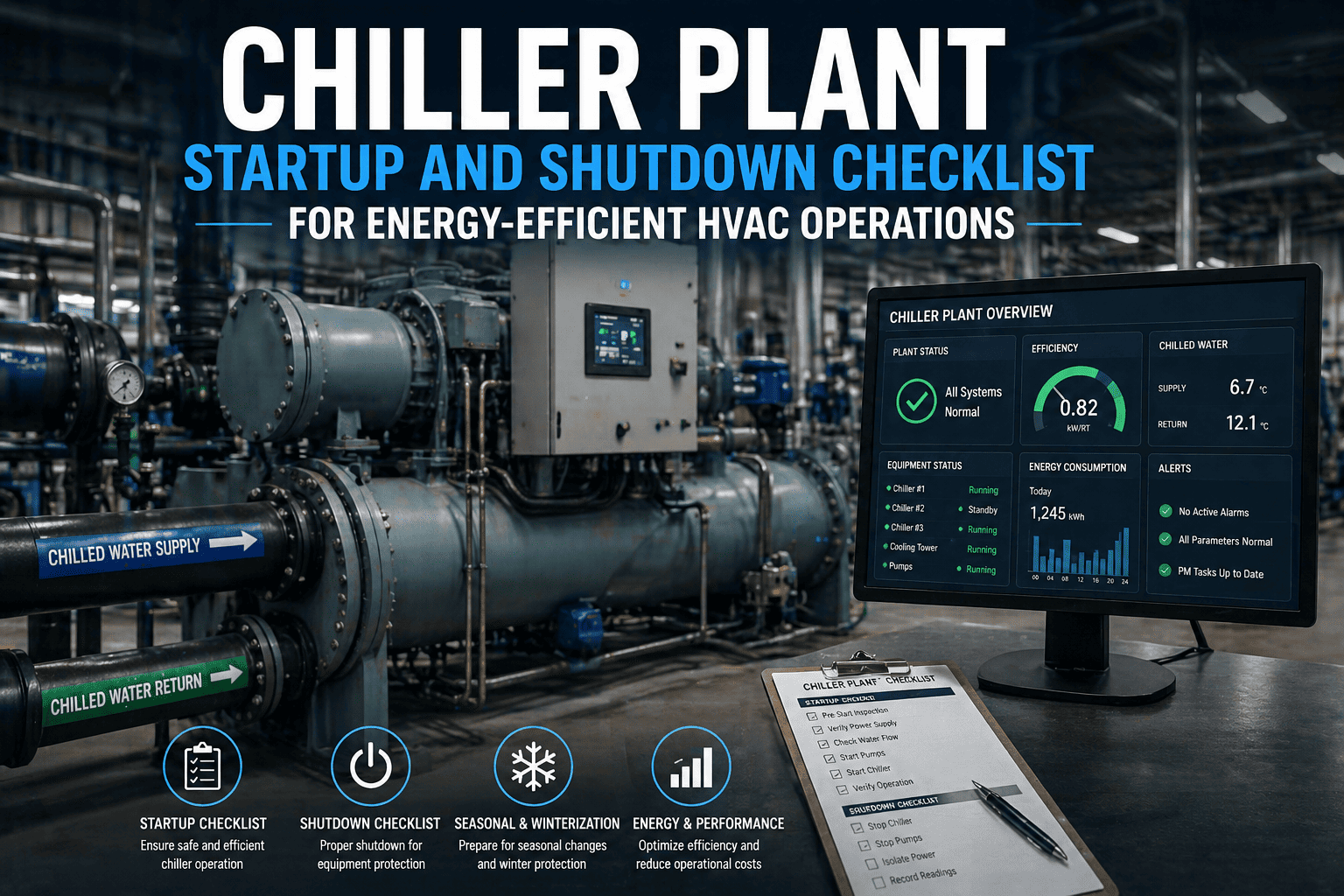
Chiller Plant Startup and Shutdown Checklist for Energy-Efficient HVAC Operations
Complete seasonal procedures for centrifugal and screw chiller plants — spring startup, summer optimisation, fall shutdown, and winterisation — with ASHRAE 180, EPA 608, and ASHRAE 90.1 compliance references built into every checklist item.
This Checklist Covers — 4 Operational Phases
Spring Startup
Pre-start verification before first cooling season run
In-Season PM
Weekly, monthly, and quarterly tasks during cooling season
Fall Shutdown
Controlled shutdown before cooling season end
Winterisation
Freeze protection and idle plant monitoring
Pre-Start Oil Temperature — The Most Costly Omission in Chiller Startup
Oil temperature must reach a minimum of 130°F (54°C) before compressor start on any centrifugal chiller. Refrigerant migrates into the oil sump during shutdown — starting the compressor with refrigerant-diluted oil causes bearing damage within minutes that is catastrophic and not covered by warranty when the startup record shows the pre-heat step was bypassed. Allow 8–12 hours of oil heater operation before startup after extended shutdown. This step is non-negotiable.
Spring Startup
In-Season PM
Fall Shutdown
Winterisation
SPRING STARTUP
Complete all items before first cooling season run — ASHRAE 180 Section 5 compliance
Pre-Start Verification (Day Before First Run)
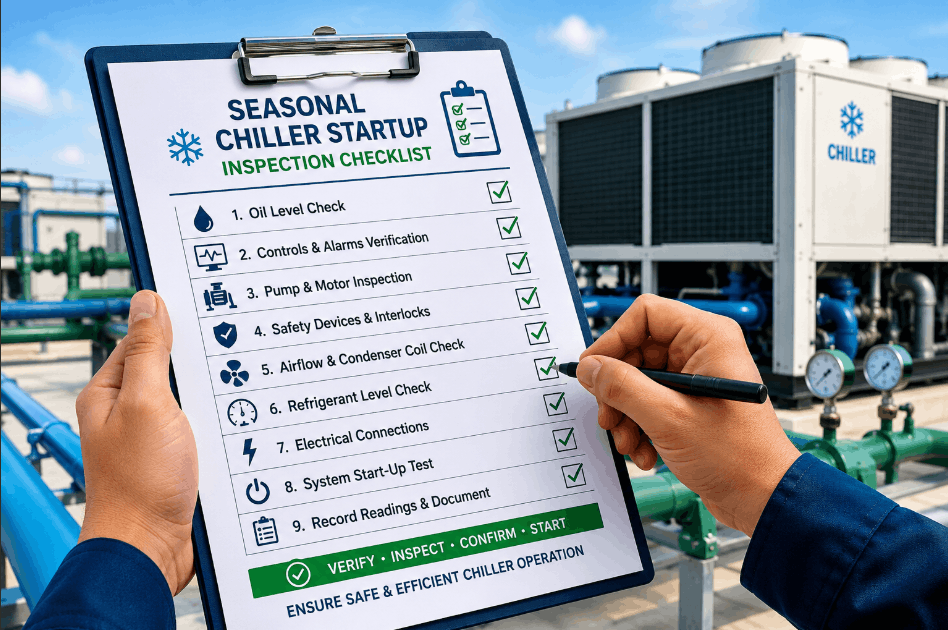
Verify oil sump temperature has reached minimum 130°F — confirm oil heater has been energised for 8–12 hours before startup attempt. Check oil level at sight glass; top up to OEM specification with manufacturer-approved lubricant. Do not start compressor until oil temperature is confirmed at gauge
Record: Oil temperature log with time and reading · Ref: OEM startup manual, Section on pre-lubrication · Role: Licensed chiller technician (EPA 608 Type II or III)
Confirm refrigerant charge is within OEM specification — record suction and discharge pressure readings against the refrigerant P-T chart for current ambient temperature. For centrifugal (low-pressure) chillers: R-123 suction pressure will be below atmospheric; verify purge unit is operational before start. Any refrigerant added must be logged per EPA Section 608 recordkeeping requirements
Record: Refrigerant log with quantity added (EPA 608 required for 50+ lb charge) · Role: EPA 608 certified technician
Inspect and test safety cutouts and interlocks — low oil pressure cutout, high discharge temperature cutout, flow switch on chilled water and condenser water circuits, low refrigerant temperature cutout, and starter overload protection. Each must be confirmed functional before the compressor is energised for the season
Record: Safety device test log with set point and trip value for each device · Role: Licensed HVAC technician
Inspect all condenser tubes and evaporator tubes for scale, fouling, and corrosion — use brush or inspection camera for accessible tube ends. Record tube cleanliness condition and schedule tube cleaning if fouling index exceeds 0.0005 hr·ft²·°F/BTU per ASHRAE 90.1 heat transfer requirements. Clean tubes reduce approach temperature and directly improve kW/ton efficiency
Record: Tube inspection form with fouling assessment · Role: Chiller service contractor
Verify chilled water and condenser water system integrity — check strainers, confirm expansion tank pressure, check glycol concentration if freeze protection system was installed, confirm all isolation valves are open, test all differential pressure switches on chilled water and condenser water loops
Record: Hydronic system pre-start checklist · Role: Mechanical technician
Test cooling tower: inspect fill media condition, clean basin of seasonal sediment, check drift eliminators, verify tower fan motor operation and belt condition, confirm makeup water valve and float operation, verify chemical treatment system is primed and operational before condenser water is circulated through the chiller
Record: Cooling tower pre-season inspection form · Role: Mechanical technician
First-Start Commissioning
Start chilled water pump and confirm flow and DP — then start condenser water pump and confirm flow. Both flow switches must prove flow to the chiller controller before compressor start sequence is permitted. Record initial pump amps and compare to nameplate — elevated amps indicate impeller wear or bearing drag
Record: Pump start log with amps and flow readings · Role: Mechanical technician
Start chiller and record first-run operating data: entering and leaving chilled water temperatures, entering and leaving condenser water temperatures, suction and discharge pressures (or refrigerant temperatures), oil pressure, compressor amps, and approach temperatures on both evaporator and condenser. Log against design operating conditions as the season baseline
Record: First-run performance data sheet — retain as seasonal baseline for trend analysis · Role: EPA 608 certified chiller technician
Oxmaint pre-builds spring startup, seasonal PM, fall shutdown, and winterisation checklists for your chiller plant — with technician sign-off required at every critical safety step and photo evidence mandatory before any item can be marked complete.
IN-SEASON PM
Weekly, monthly, and quarterly tasks during cooling season — ASHRAE 180 Table 2 intervals
Weekly
Log chiller operating data: CHWST/CHWRT, CWST/CWRT, suction and discharge pressure, oil pressure and temperature, compressor amps and kW. Compare against previous week and against season baseline. Rising approach temperature (CHWST above setpoint with adequate flow) or rising condenser approach indicates tube fouling developing
Record: Weekly operating log — retain full season for trend analysis · Role: Plant operator or technician
Inspect purge unit operation log for centrifugal chillers — purge frequency more than once per day indicates air infiltration leak that requires repair. Log purge runtime per ASHRAE Standard 147 recommendations. Excessive purge cycles cause refrigerant loss and non-condensable accumulation that degrades chiller efficiency and triggers EPA reporting obligations
Record: Purge unit log with daily runtime (EPA 608 compliance) · Role: Licensed chiller technician
Inspect cooling tower basin for biological growth, debris, and chemical treatment residue. Verify chemical treatment controller readings (conductivity, pH, inhibitor levels). Record and log cooling tower water chemistry — Legionella risk management requires a documented water treatment programme per ASHRAE 188 and local health authority requirements
Record: Cooling tower water treatment log with chemistry readings · Ref: ASHRAE 188 · Role: Water treatment contractor or trained operator
Monthly
Inspect chiller electrical connections, starter contacts, and control panel — check for discolouration, corrosion, or evidence of overheating. Verify demand limiter and ramp loading settings have not drifted from optimised settings. Confirm BMS interface is communicating correctly and setpoint reset strategies are active per ASHRAE Guideline 36 sequences
Record: Electrical inspection log · Role: Licensed electrician or controls technician
Conduct chiller plant IPLV performance check — calculate actual integrated part-load value by measuring power consumption against cooling output at part-load conditions. Compare against OEM IPLV rating. ASHRAE 90.1 minimum for water-cooled centrifugal is 0.38 kW/ton IPLV; plants running above 0.55 kW/ton at typical part-load conditions have an operational tuning opportunity
Record: Monthly IPLV calculation with kW and ton measurements · Ref: ASHRAE 90.1 Table 6.8.1 · Role: Energy or controls engineer
Quarterly
Oil analysis and vibration analysis on compressor bearings — submit oil sample to approved laboratory for acid number, water content, metal particle count, and viscosity. Compare bearing vibration signature against baseline; rising vibration amplitude at bearing natural frequency indicates developing wear that can be planned for repair, not responded to as emergency
Record: Oil analysis laboratory report + vibration trend data · Role: Predictive maintenance technician
Chiller refrigerant leak check — pressure test and electronic leak detection on all service valves, flanges, purge connections, and tube sheet areas. EPA Section 608 requires repair within 30 days if annual leak rate exceeds 15% for comfort cooling systems (50+ lb charge). Document leak check date and findings; any refrigerant added must be logged per EPA recordkeeping
Record: Leak check log + refrigerant addition record · Ref: EPA Section 608, 40 CFR Part 82 · Role: EPA 608 certified technician
FALL SHUTDOWN
Controlled seasonal shutdown — complete before ambient temperature risk of freeze
Controlled Shutdown Sequence
Unload compressor gradually and shut down in accordance with OEM shutdown sequence — do not trip chiller on a hard stop for seasonal shutdown. Allow the system to soft-stop with chilled water and condenser water pumps running through the shutdown sequence until oil pressure drops and compressor coast-down is complete. Document shutdown as planned maintenance in CMMS
Record: Shutdown sequence log with time stamps · Role: Licensed chiller technician
Record final season operating data and compare against spring startup baseline — document seasonal IPLV trend, any refrigerant additions during the season, tube fouling progression, oil analysis history, and any corrective actions taken. This end-of-season record is the input to the spring startup pre-start planning and drives the scope of off-season maintenance work
Record: End-of-season performance report · Role: Facility engineer or HVAC supervisor
Clean condenser and evaporator tubes while plant is offline — brush clean all accessible tubes and use chemical descale treatment if deposit analysis confirms carbonate or biological scale. Tube cleaning at shutdown (rather than spring startup) allows the end-of-season as-left condition to be documented and the cleaned baseline to be established before the plant returns to service
Record: Tube cleaning record with pre- and post-clean condition assessment · Role: Chiller service contractor
Inspect and service cooling tower for off-season — clean basin completely, inspect and replace fill media where biological growth cannot be fully cleaned, inspect drift eliminators, lubricate fan bearings, inspect belt condition and replace if within 20% of rated life, close basin isolation valve and drain if freeze risk exists at the site
Record: Cooling tower end-of-season service record · Role: Mechanical technician
Verify chiller oil heater is energised before electrical supply is secured — oil heater must remain energised throughout the off-season to prevent refrigerant migration into the oil sump. Confirm oil heater thermostat set point is maintained above 100°F and below 150°F. Tag chiller electrical isolator with "DO NOT DE-ENERGISE — OIL HEATER IN SERVICE" warning before leaving plant
Record: Oil heater commissioning confirmation with thermostat set point · Role: Electrical or HVAC technician
WINTERISATION
Freeze protection and idle plant monitoring — critical where mechanical room temperature may approach 35°F
Freeze Protection — Water-Side
Drain water sides of evaporator and condenser completely if mechanical room cannot be guaranteed above 35°F throughout winter — tube freeze burst is the most costly chiller winter failure and is entirely preventable. Open all drain plugs, blow down with dry nitrogen, confirm drainage complete by visual inspection at lowest point. For centrifugal chillers: keep water circulating if heat is maintained; drain only if shutdown is absolute
Record: Winterisation drainage confirmation with photo evidence · Role: Mechanical technician
If glycol freeze protection system is used instead of drainage — verify glycol concentration with refractometer and confirm protection rating is at least 10°F below the design winter minimum mechanical room temperature. Document concentration, protection rating, and inhibitor level. Top up as required
Record: Glycol concentration test record with refractometer reading and protection temperature · Role: HVAC technician
Install and verify low-temperature mechanical room alarm — set point at 40°F to provide advance warning before freeze risk. Connect alarm to building management system or external notification service. Document alarm test with verification that notification recipient received the alert. Monthly temperature check during winter to confirm alarm is active and mechanical room heating is maintaining design temperature
Record: Alarm test record + monthly temperature log · Role: Controls technician / Facilities manager
Chiller Plant KPIs — The Metrics That Prove Seasonal PM Is Working
| KPI |
Measurement Method |
Target |
Failure Signature |
| IPLV (Integrated Part-Load Value) | kW consumed / Tons cooling at part-load operating points | ≤ 0.38 kW/ton (ASHRAE 90.1 minimum, water-cooled) | Above 0.55 kW/ton = tube fouling, refrigerant undercharge, or condenser approach issue |
| Condenser approach temperature | Leaving CW temp minus refrigerant condensing temp | ≤ 3°F design approach | Above 5°F = condenser tube fouling; above 8°F = scale or biological deposit — clean required |
| Evaporator approach temperature | Refrigerant evaporating temp minus leaving CHW temp | ≤ 2°F design approach | Above 4°F = evaporator tube fouling or refrigerant charge issue |
| Purge unit runtime (centrifugal) | Hours per day of purge operation | ≤ 0.3 hr/day (indicates tight system) | Above 1 hr/day = significant air infiltration leak requiring immediate investigation |
| Annual refrigerant leak rate | Total refrigerant added (lbs) / Total charge (lbs) × 100 | ≤ 15% for comfort cooling (EPA 608 threshold) | Above 15% = EPA repair obligation within 30 days |
| Seasonal chiller availability | Hours available for service / Total hours in cooling season | ≥ 99% during cooling season | Below 97% = startup, shutdown, or in-season PM failures consuming availability |
"The seasonal startup and shutdown checklist is where chiller plant reliability is made or lost. In my experience auditing chilled water plants, the facilities that consistently achieve above 99% seasonal availability are the ones where the spring startup checklist has a hard gate on oil temperature — you cannot proceed until that number is confirmed at the oil temperature sensor, not estimated from ambient temperature or the number of hours the heater has been on. The facilities with recurring compressor bearing failures are almost always the ones where the startup process is compressed under schedule pressure: the cooling season starts, the plant has been idle four months, and the building engineer wants cold water running before noon. The bearing that was slugged with refrigerant-contaminated oil at 58°F does not fail immediately — it fails three weeks later under peak load conditions, in the hottest week of the year, taking the chiller offline when the building cannot afford it. Preventive maintenance software that makes it physically impossible to mark a spring startup complete without the oil temperature reading attached to the work order is not a bureaucratic exercise. It is the engineering control that prevents the most avoidable single-cause chiller failure in the industry."
Dr. Maria Santos, PE, CEM, LEED AP
Licensed Mechanical Engineer · Certified Energy Manager · LEED Accredited Professional · 21 years chiller plant commissioning, recommissioning, and performance optimisation · ASHRAE Distinguished Lecturer, Chiller Plant Efficiency and Reliability Track
Frequently Asked Questions
Why must chiller oil temperature reach 130°F before startup after a seasonal shutdown?
During shutdown, refrigerant migrates into the compressor oil sump because refrigerant has an affinity for oil at low temperatures. A sump full of refrigerant-diluted oil does not have the viscosity to support the compressor bearings during startup.
Starting the compressor before the oil heater has driven the refrigerant back into the circuit — confirmed by an oil temperature of at least 130°F — causes bearing damage within minutes that is catastrophic, irreversible, and unambiguously the result of a skipped startup procedure. Allow 8–12 hours of oil heater operation after an extended shutdown before attempting start.
Book a demo to see how Oxmaint enforces oil temperature sign-off before spring startup checklists can be completed.
What does EPA Section 608 require for chiller refrigerant record-keeping?
EPA Section 608 (40 CFR Part 82 Subpart F) requires that owners of appliances containing 50 or more pounds of refrigerant maintain records of the quantity of refrigerant added at each service event. For comfort cooling systems (including chillers), the annual leak rate triggering mandatory repair is 15%. Leaks must be repaired within 30 days of discovery. A follow-up leak verification test must be conducted within 10 days of passing the initial repair. Records must be retained for 3 years and be available for inspection. Oxmaint stores refrigerant addition records per chiller asset, calculates annual leak rate automatically, and alerts the facility manager when the 15% threshold is approached.
How often should chiller tubes be cleaned for energy efficiency?
ASHRAE 90.1 requires chilled water systems to maintain heat transfer performance — tube fouling above 0.0005 hr·ft²·°F/BTU degrades IPLV measurably. In practice, condenser tube cleaning is typically performed annually at seasonal shutdown, with additional mid-season cleaning if condenser approach temperature rises more than 2°F above the spring startup baseline measurement. Evaporator tubes foul more slowly in a closed loop but should be inspected annually. Every 1°F increase in condenser approach temperature increases chiller energy consumption by approximately 1.5–2%, making tube cleanliness one of the highest-ROI seasonal maintenance tasks in the chiller plant.
How does Oxmaint handle chiller seasonal PM scheduling?
Oxmaint creates separate PM work orders for each seasonal phase — spring startup, in-season weekly/monthly/quarterly, fall shutdown, and winterisation. Each checklist item requires technician sign-off with timestamped completion and mandatory photo evidence for critical safety items (oil temperature reading, tube inspection, refrigerant log). The system automatically generates the spring startup sequence 6 weeks before the cooling season start date and escalates any incomplete items to the facility manager.
Start a free trial to configure your first chiller plant seasonal PM calendar.
What is the risk of skipping winterisation on a water-cooled chiller plant?
The primary risk is tube freeze-burst in the evaporator and condenser — a single freeze event can crack multiple tubes simultaneously, requiring a full tube replacement campaign costing $15,000–$60,000 depending on chiller size and tube type. At 32°F, water expands by 9% volume — copper and cupronickel tubes are not designed for this stress. The secondary risk is bearing damage from a startup without the oil temperature pre-heat being confirmed, which is more likely in a plant that was not properly commissioned into off-season mode. Winterisation is not a precautionary formality — it is the maintenance event that determines whether the spring startup checklist begins with a functional chiller or a damaged one.
Every Chiller Startup, Shutdown, and Seasonal PM Task — Scheduled, Signed Off, and Documented Automatically
Oxmaint Preventive Maintenance schedules chiller plant seasonal checklists at the correct interval, requires technician completion with timestamped photo evidence at every safety-critical step, generates EPA 608-compliant refrigerant records automatically, and tracks IPLV performance trending to identify efficiency degradation before it becomes a capacity or reliability event.