A commercial chiller that receives structured preventive maintenance consistently achieves 30 or more years of service life — compared to 15-18 years for reactively maintained equipment. The difference is not the hardware. It is oil analysis catching refrigerant dilution before it destroys bearings, eddy current testing finding tube wall thinning before a leak forces an emergency shutdown, and kW/ton trending identifying fouling before it drives 15% energy cost increases. OxMaint's Preventive Maintenance module automates chiller PM scheduling, tracks oil and refrigerant analysis results, and generates performance trend alerts before efficiency losses become repair events. Book a 15-minute demo to see chiller PM management in OxMaint.
Chiller Preventive Maintenance: Complete Guide to Extending Equipment Life by 10+ Years
Compressor servicing, condenser tube cleaning, oil analysis, refrigerant management, and performance monitoring — with a CMMS-tracked PM programme that proves its value in lower energy costs and extended equipment life.
PM Requirements Differ Significantly by Chiller Type
Chiller PM Tasks — Frequency, Standard, and OxMaint Action
| PM Task | Frequency | Standard / Basis | OxMaint Action |
|---|---|---|---|
| Operating log review: pressures, temps, kW/ton | Daily | ASHRAE 180 / Manufacturer | BAS integration → auto-alert on deviation |
| Refrigerant sight glass inspection | Daily | Manufacturer SOP | Daily checklist WO — bubbles indicate low charge |
| Oil level and sight glass inspection | Monthly | Manufacturer / ASHRAE 180 | Monthly PM WO per chiller asset |
| Oil filter differential pressure check | Monthly | Manufacturer SOP | Monthly PM — replacement WO triggered at threshold |
| Condenser fan motor amp draw check | Monthly | NEC / ASHRAE 180 | Monthly PM WO — overamp triggers inspection |
| Control calibration verification | Monthly | ASHRAE 180 / JCI, Carrier SOP | Monthly calibration PM WO |
| Oil analysis (viscosity, TAN, metals, moisture) | Quarterly | ASHRAE 180 / manufacturer | Quarterly WO — results stored in OxMaint asset record |
| Refrigerant analysis (moisture, acidity) | Quarterly | ASHRAE 15 / manufacturer | Quarterly WO — out-of-spec triggers investigation WO |
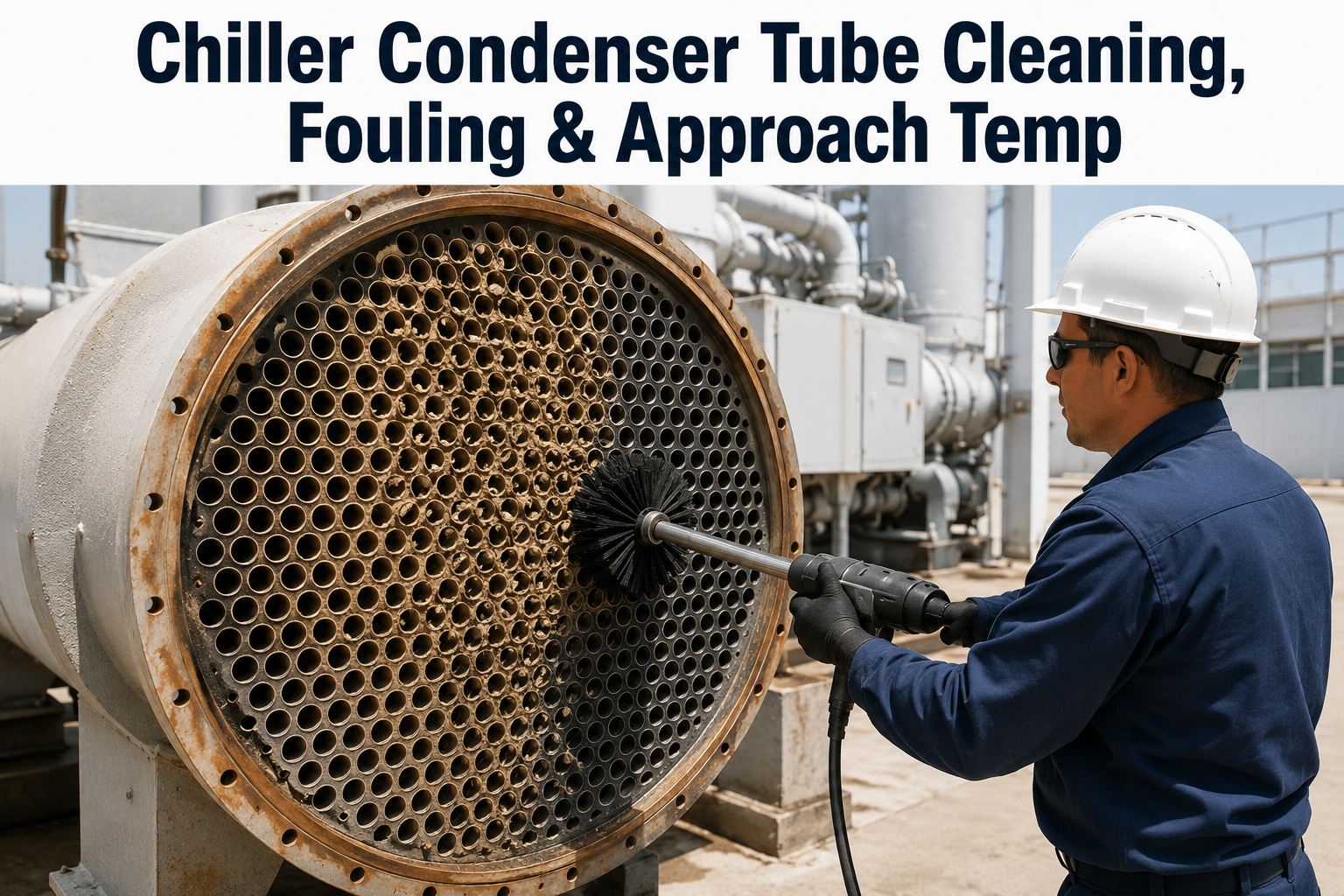
| Condenser tube brushing (water-cooled) | Quarterly | AHRI 550/590 / ASHRAE 180 | Quarterly PM WO — pre/post approach temp documented |
| Vibration analysis — compressor and motor | Quarterly | ISO 10816 Zone B | Quarterly WO — spectrum stored per bearing measurement point |
| Motor winding insulation (megger) test | Annual | IEEE 43 / NEMA MG1 | Annual WO — as-found megohm values stored to asset record |
| Eddy current tube test (evaporator and condenser) | Annual | ASME / AHRI manufacturer | Annual WO — tube wall thickness trend per tube number |
| Compressor oil change (centrifugal/screw) | Annual or on analysis | Manufacturer SOP | Annual WO or oil analysis result triggers replacement |
| Full mechanical inspection and report | Annual | ASHRAE 180 / manufacturer | Annual WO — full report PDF attached to chiller asset record |
Sign in to OxMaint to configure your complete chiller PM programme — all tasks auto-generated, tracked, and stored as auditable maintenance records.
Book a Demo — See Chiller PM Management in OxMaint in 15 Minutes.
Automated PM scheduling · Oil and refrigerant analysis tracking · kW/ton trending · Eddy current test records · Approach temperature alerts. All from one CMMS with no manual spreadsheet tracking.
Chiller Oil Analysis — Acceptance Limits and Action Thresholds
| Parameter | Normal Range | Caution — Investigate | Action Required | What It Indicates |
|---|---|---|---|---|
| Viscosity (cSt @ 40°C) | Within ±10% of new oil | ±10–20% deviation | More than ±20% — change oil | Refrigerant dilution, thermal degradation, wrong oil charge |
| Total Acid Number (TAN) | < 0.05 mg KOH/g | 0.05–0.10 mg KOH/g | > 0.10 mg KOH/g — change oil | Oxidation, moisture ingress, compressor overheating |
| Moisture content | < 25 ppm | 25–50 ppm | > 50 ppm — change oil, investigate source | Refrigerant system moisture — accelerates acid formation |
| Iron (Fe) particles | < 25 ppm | 25–50 ppm | > 50 ppm — inspect compressor internals | Bearing or shaft wear — imminent component failure risk |
| Copper (Cu) particles | < 15 ppm | 15–30 ppm | > 30 ppm — inspect bearings and bushings | Bearing cage wear, bronze bushing degradation |
| Refrigerant dilution | < 5% | 5–10% | > 10% — investigate refrigerant leak or charge | Oil film integrity compromised — bearing failure accelerated |
All limits per ASHRAE 180-2018 and major chiller manufacturer service manuals (Carrier, Trane, York, McQuay). OxMaint stores oil analysis results against the chiller asset and triggers investigation WOs on out-of-spec findings. Book a demo to see oil analysis tracking in OxMaint.
Key Performance Indicators — When to Act and When PM Has Succeeded
| KPI | Best-in-Class Target | Caution Zone | Action Required | Primary PM Driver |
|---|---|---|---|---|
| kW/ton at full load | ≤ 0.60 (centrifugal) | 0.60–0.75 | > 0.75 — investigate fouling, refrigerant, controls | Tube cleaning, refrigerant management, control calibration |
| Condenser approach temperature | ≤ 1°F rise per year | 1–3°F above baseline | > 3°F — condenser tube cleaning required | Quarterly condenser tube brushing |
| Evaporator approach temperature | ≤ 1°F above design | 1–2°F above design | > 2°F — evaporator tube inspection and cleaning | Annual eddy current test, water treatment |
| Compressor vibration (RMS) | ISO 10816 Zone A | Zone B — monitor monthly | Zone C or D — stop and inspect | Quarterly vibration analysis with spectrum storage |
| Motor insulation resistance | > 100 MΩ (IEEE 43) | 10–100 MΩ — investigate | < 10 MΩ — remove from service | Annual megger test before seasonal startup |
| Refrigerant charge (superheat) | 8–12°F superheat | < 5°F or > 15°F | Below 5°F — risk of liquid slugging | Quarterly refrigerant analysis and charge verification |
OxMaint tracks all six KPIs per chiller asset over time — trending deviations trigger predictive alerts before they require emergency action. Sign in to activate performance trending for your chiller fleet.
What Chiller Engineering and Maintenance Leaders Say
A chiller that is maintained with quarterly oil analysis, annual tube testing, and kW/ton trending does not just last longer — it costs less to operate every year it runs. Tube fouling that is caught and cleaned quarterly never accumulates enough to drive the 15% efficiency loss that unattended condensers reach by summer peak. Oil contamination caught at 8% refrigerant dilution never reaches the point where it destroys a compressor bearing. Preventive maintenance does not cost money. Deferred preventive maintenance does.
How OxMaint Manages Chiller Preventive Maintenance
Chiller PM Questions We Answer Every Week
How often should chiller oil be changed — on a schedule or based on analysis?
Based on quarterly oil analysis, not a fixed calendar. Chiller oil in good condition can serve 2–3 years before replacement is needed. Oil with refrigerant dilution above 10%, TAN above 0.10, or iron above 50 ppm should be changed immediately regardless of age. OxMaint records each quarterly analysis result and automatically generates a change WO when any parameter exceeds the action threshold. Sign in to configure oil analysis tracking in OxMaint.
What is the correct interval for condenser tube cleaning on a water-cooled chiller?
Quarterly brushing is the standard for most commercial water-cooled systems — more frequent in poor water quality environments, less frequent with excellent chemical treatment programmes. The performance indicator is condenser approach temperature: if it rises more than 1°F above baseline in a quarter, cleaning frequency should increase. OxMaint records approach temperature before and after each cleaning, creating a documented performance record. Book a demo to see approach temperature trending in OxMaint.
When is eddy current testing required for chiller tubes, and what does it detect?
Annual eddy current testing (ECT) is the standard for tubes in both evaporator and condenser bundles in water-cooled chillers — it detects wall thinning, pitting, cracking, and corrosion to within 10% of wall thickness. ECT identifies tubes approaching failure before they leak refrigerant into the water circuit (or vice versa), which causes a major contamination event and extended shutdown. OxMaint stores ECT results per tube number with year-on-year wall thickness comparison. Sign in to configure annual ECT work orders in OxMaint.
How does OxMaint connect chiller performance data from the BAS to maintenance work orders?
OxMaint integrates with BAS/BMS systems via OPC-UA and MQTT to receive live kW, tons of cooling, approach temperature, and refrigerant pressure readings. These feed into configured performance rules — when kW/ton exceeds 0.75 or condenser approach exceeds 3°F above baseline, OxMaint auto-generates a maintenance WO with the performance trend attached. The technician receives a WO with evidence of why the task is needed, not just a scheduled date. Book a demo to see BAS integration with OxMaint chiller performance alerts.
Book a Demo — See OxMaint Managing Your Chiller PM Programme in 15 Minutes.
Daily to annual PM scheduling · Oil and refrigerant analysis tracking · kW/ton and approach temperature performance alerts · Eddy current and vibration test records · BAS integration. Everything needed to extend chiller life by 10+ years — documented and auditable.