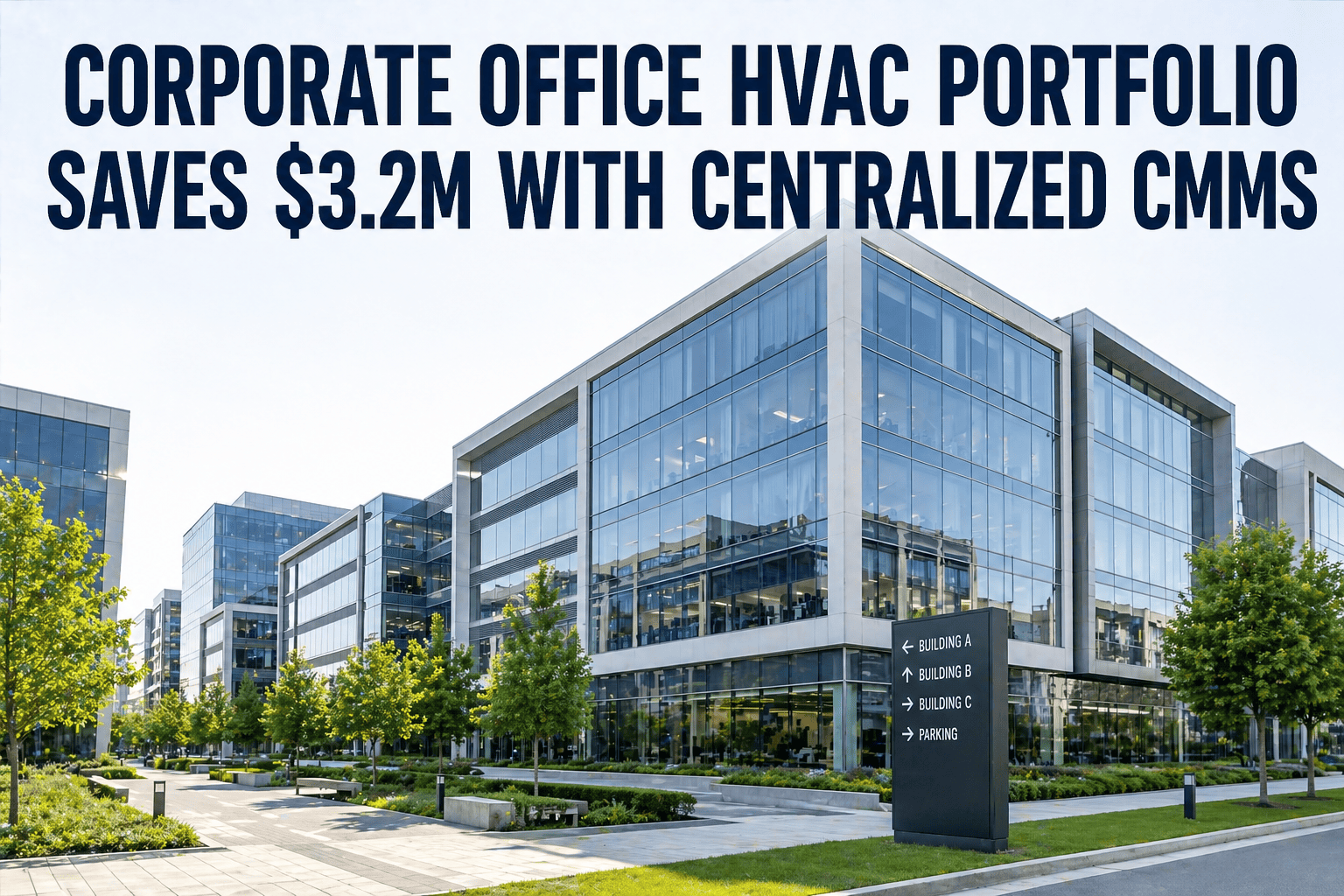
Commercial HVAC systems represent 39% of total building energy consumption — and in a multi-building corporate portfolio, that figure translates directly into millions in annual operating cost with no single point of visibility. A regional property portfolio of 80 commercial buildings reduced total HVAC vendor spend by 25% in 18 months after deploying centralized CMMS — without reducing maintenance scope or replacing a single vendor. OxMaint's multi-site dashboard gives corporate facility teams the same visibility, cross-portfolio analytics, and AI-optimized PM scheduling that drove these outcomes — deployed across your entire portfolio from day one.
Corporate Office HVAC Portfolio Saves $3.2M with Centralized CMMS
How a 42-building, 6.8M sq ft corporate portfolio eliminated reactive HVAC spend, standardized PM compliance, and generated $3.2M in verified savings across 24 months using OxMaint's multi-site dashboard and AI preventive maintenance optimization.
The Problem: 42 Buildings, Zero Unified Visibility
Before OxMaint, the facilities team managed HVAC maintenance across 42 corporate office buildings through a combination of per-building Excel trackers, email chains with 11 different contractors, and monthly PDF reports that arrived 3 weeks after the reporting period closed. Emergency repairs consumed 44% of the total HVAC budget — more than twice the industry benchmark of 20%. The team could not identify which buildings drove the most emergency spend, which assets were past economic useful life, or which contractors had the best first-call resolution rates.
Centralized Asset Registry and Baseline Establishment
OxMaint deployment began with a structured asset onboarding across all 42 buildings — creating a unified HVAC asset registry with nameplate data, installation date, last service date, and maintenance history for every unit. This baseline step is typically the most underestimated part of CMMS implementation and the most valuable: you cannot optimize what you cannot see.
AI PM Optimization and Contractor Performance Tracking
With baseline data established, OxMaint's AI PM engine analysed failure patterns by asset type, age, and seasonal load profile to generate optimised maintenance intervals — replacing the one-size-fits-all quarterly service contract with condition-driven schedules. Every contractor work order was matched against the digital asset record, enabling real-time invoice verification and first-call resolution tracking for the first time.
Maintenance intervals set by asset condition and failure history — not fixed calendar dates. Over-maintained assets reduced service frequency; high-risk units increased it. Net result: same technician hours, 31% fewer failures.
Each of the 11 contractors received a live scorecard tracking response time vs SLA, first-call resolution rate, and invoice accuracy. Three contractors were replaced at contract renewal based on scorecard data — saving $340K annually in callback costs.
Every invoice matched against a completed work order before payment approval. In the first 6 months, 14% of invoices contained line items outside the authorized work order scope — recovering $180K in overbillings that would previously have been paid without audit.
The 312 high-cost assets were reviewed against OxMaint's repair-vs-replace model. 47 units were recommended for replacement based on annual repair cost exceeding 50% of replacement value — producing $820K in deferred emergency costs over 18 months.
See OxMaint's multi-site HVAC dashboard live — configured for a portfolio of your size in under 30 minutes.
$3.2M in Verified Savings: The Full Breakdown
| Saving Category | Mechanism | Year 1 | Year 2 | Total |
|---|---|---|---|---|
| Emergency Call Reduction | 31% fewer emergency dispatches — PM compliance improvement | $580K | $640K | $1.22M |
| Energy Cost Reduction | 18% HVAC energy reduction — filter, coil, and refrigerant optimisation | $420K | $460K | $880K |
| Contractor Invoice Recovery | Out-of-scope billing caught by work order matching | $180K | $140K | $320K |
| Capital Deferral | 47 units replaced at optimal lifecycle point — avoided crisis replacements | $380K | $440K | $820K |
| Staff Efficiency | Centralised dashboard eliminated per-building reporting — 3 FTE-days per week | $80K | $80K | $160K |
| Total Verified Savings | $1.64M | $1.76M | $3.2M |
Where Corporate HVAC Portfolios Lose Money — and How CMMS Closes the Gap
What Corporate Facility Leaders Say
Before OxMaint, I had 42 buildings and 42 spreadsheets. I could tell you the total HVAC spend — I could not tell you which building was generating it, which contractor was causing it, or which asset was responsible. The multi-site dashboard gave us in one screen what took 4 staff members a week to compile manually. Within 6 months, we had identified cost patterns we had been blind to for 3 years.
VP Facilities Operations, 42-building Corporate Office Portfolio, US MidwestThe invoice verification feature alone paid for OxMaint in the first quarter. We discovered one contractor had been billing for filter replacements at a frequency double what the work orders authorized — across 12 buildings for 18 months. That one finding recovered $90K and changed how we audit every contractor invoice across the portfolio.
Director of Engineering, Real Estate Investment Trust, 28 commercial assetsThe repair-vs-replace analysis is the feature I use most in board presentations. Instead of requesting capital based on age and gut feel, I present a data-backed case showing annual repair spend as a percentage of replacement value for every unit flagged for replacement. Finance approved our entire HVAC capital budget for the first time in four years because the numbers were auditable, not estimated.
Chief Operating Officer — Facilities, Fortune 500 Corporate Real Estate PortfolioFrequently Asked Questions
See the Multi-Site Dashboard That Saved This Portfolio $3.2M
Book a 30-minute live demo and see OxMaint's multi-site HVAC dashboard configured for a portfolio your size — with real data, not slides. Most customers identify their first cost-saving opportunity during the demo itself.