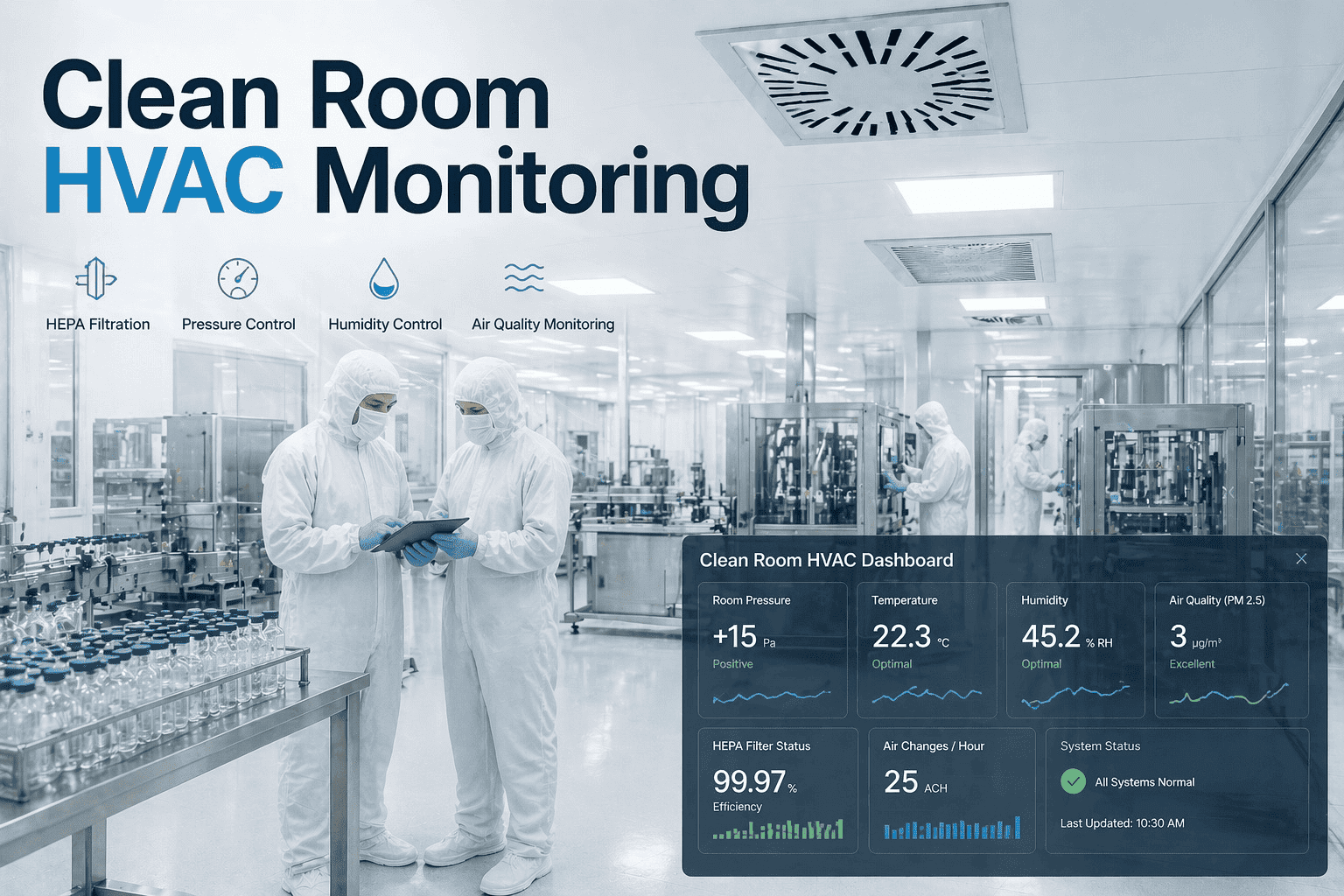
A single particle in the wrong place destroys a semiconductor wafer worth thousands. An undocumented pressure excursion triggers an FDA 483 observation and halts a pharmaceutical batch. Clean room HVAC systems are not comfort infrastructure — they are direct-impact quality systems where HVAC failure means product failure, regulatory action, or both. OxMaint's compliance tracking platform keeps clean room HVAC programmes continuously certified, audit-ready, and calibrated to the specific requirements of ISO 14644, EU GMP Annex 1, and FDA 21 CFR Part 211.
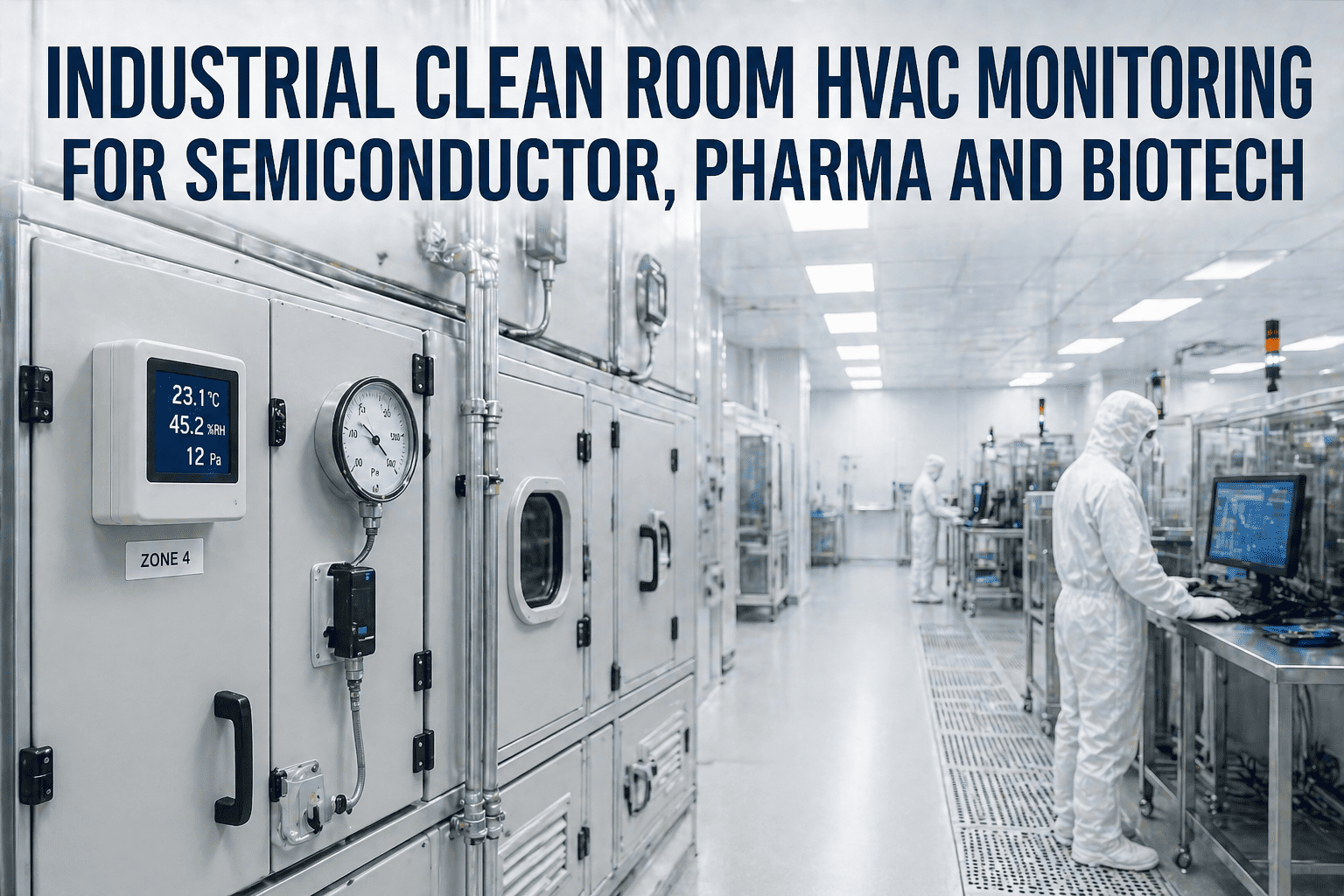
Industrial Clean Room HVAC Monitoring for Semiconductor, Pharma, and Biotech
Particle monitoring, pressure cascade control, temperature and humidity compliance, HEPA filter integrity, and ISO 14644 / EU GMP Annex 1 documentation — structured for the maintenance and compliance teams responsible for classified environments.
Clean Room HVAC Is Not a Building System — It Is a Product Quality Control
Under FDA 21 CFR Part 211 and EU GMP Annex 1, HVAC systems in pharmaceutical facilities are classified as direct-impact systems. Every calibration record, maintenance work order, and qualification document must be retained and producible on demand. In June 2024, the FDA issued a warning letter citing clean room HVAC deficiencies including inadequate environmental monitoring and filter integrity failures — triggering a production halt that cost the facility over $4M in lost batches and remediation costs.
Particle count above ISO class limit triggers batch quarantine, investigation, and potential product rejection. In semiconductor fabs, a single 100nm particle on a wafer during lithography causes die failure.
Loss of positive pressure differential in a pharmaceutical clean room allows unclassified air to enter — triggering a mandatory investigation under EU GMP Annex 1 regardless of whether visible contamination occurred.
ISO 14644 requires temperature 18–22°C and RH 30–60% in most classified environments. Deviations affect HEPA filter performance, electrostatic discharge risk in semiconductor fabs, and microbial growth potential in pharma.
A failed HEPA filter without a documented integrity test record is an automatic audit finding. ISO 14644-3 requires integrity testing after every filter replacement, pressure spike event, or upstream ductwork access — not only at periodic intervals.
What Must Be Continuously Monitored — and at What Frequency
| Parameter | Standard Requirement | Monitoring Frequency | Action Limit Trigger |
|---|---|---|---|
| Airborne Particle Count | ISO 14644-1 / EU GMP Annex 1 | Continuous in Grade A; periodic in B–D / ISO 5–8 | Exceedance of 95% UCL class limit |
| Differential Pressure (Cascade) | EU GMP Annex 1 / FDA 21 CFR 211 | Continuous — logged at minimum 1-minute intervals | Drop below minimum positive pressure differential |
| Temperature | ISO 14644 / EU GMP Annex 1 | Continuous with calibrated sensor; validated alarm limits | Outside 18–22°C validated range (or product-specific limit) |
| Relative Humidity | ISO 14644 / EU GMP Annex 1 | Continuous — especially critical in aseptic pharma | Outside 30–60% RH or product-validated range |
| Air Changes per Hour (ACH) | ISO 14644-3 | At qualification and after HVAC modification | Below minimum ACH for ISO class |
| HEPA Filter Integrity | ISO 14644-3 / EU GMP Annex 1 | After replacement, pressure event, or upstream access | Any penetration detected on DOP/PAO scan |
| Airflow Velocity and Pattern | ISO 14644-3 | At qualification; annually in critical areas | Deviation from validated unidirectional profile |
Structured HVAC Maintenance for Classified Environments
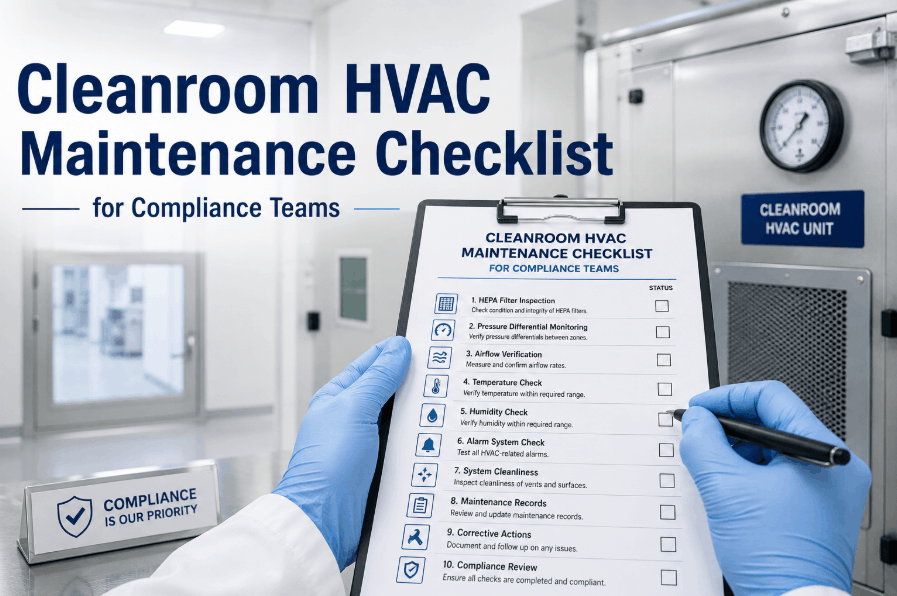
Clean room HVAC maintenance is not a standard commercial PM programme with stricter filters. Every task must be documented with technician identity, timestamp, calibration certificate references, and result sign-off. ISO 14644-5:2025 introduced a formal Operations Control Programme (OCP) requirement — clean room HVAC maintenance teams must now operate under documented procedures aligned to this standard.
Never face an FDA 483 or ISO audit with an incomplete maintenance record. OxMaint makes every clean room HVAC task timestamped, named, and audit-ready from day one.
How Requirements Differ Across Semiconductor, Pharma, and Biotech
What Clean Room Compliance Professionals Say
The single most common gap I find in pharmaceutical clean room HVAC programmes is the missing event-triggered HEPA integrity test. ISO 14644-3 is clear: the test is required after any filter replacement or upstream ductwork access — not just on an annual schedule. Facilities that use a CMMS with event-based work order triggers for integrity testing eliminate this gap entirely.
GMP Compliance Consultant, EU GMP Annex 1 Implementation Specialist, 18 years experienceIn semiconductor manufacturing, an HVAC maintenance record gap is not a compliance nuisance — it is a yield problem. When particle counts spike and we cannot correlate the event to a maintenance activity or HVAC alarm, the investigation runs open for weeks while the line stays up under risk. Complete, timestamped maintenance logs are the first tool the yield team reaches for when contamination trends appear.
Facilities Reliability Engineer, 300mm Semiconductor Fab, Southeast AsiaWe implemented OxMaint for our biotech manufacturing site and the first FDA inspection after deployment was the cleanest we had ever had on the HVAC documentation front. The inspector asked for three years of HEPA maintenance records and pressure differential logs — we pulled the complete, searchable history in under 4 minutes. The prior inspection took 2 days to compile the same documentation from paper files.
Head of Facilities and Engineering, Biotech Drug Substance Manufacturing Site, IrelandFrequently Asked Questions
Keep Your Clean Room HVAC Continuously Certified and Inspection-Ready
OxMaint's compliance tracking platform auto-schedules every ISO 14644 and EU GMP Annex 1 maintenance interval, triggers event-based integrity tests, and generates audit-ready documentation packages that reduce FDA and regulatory inspection preparation from days to minutes.