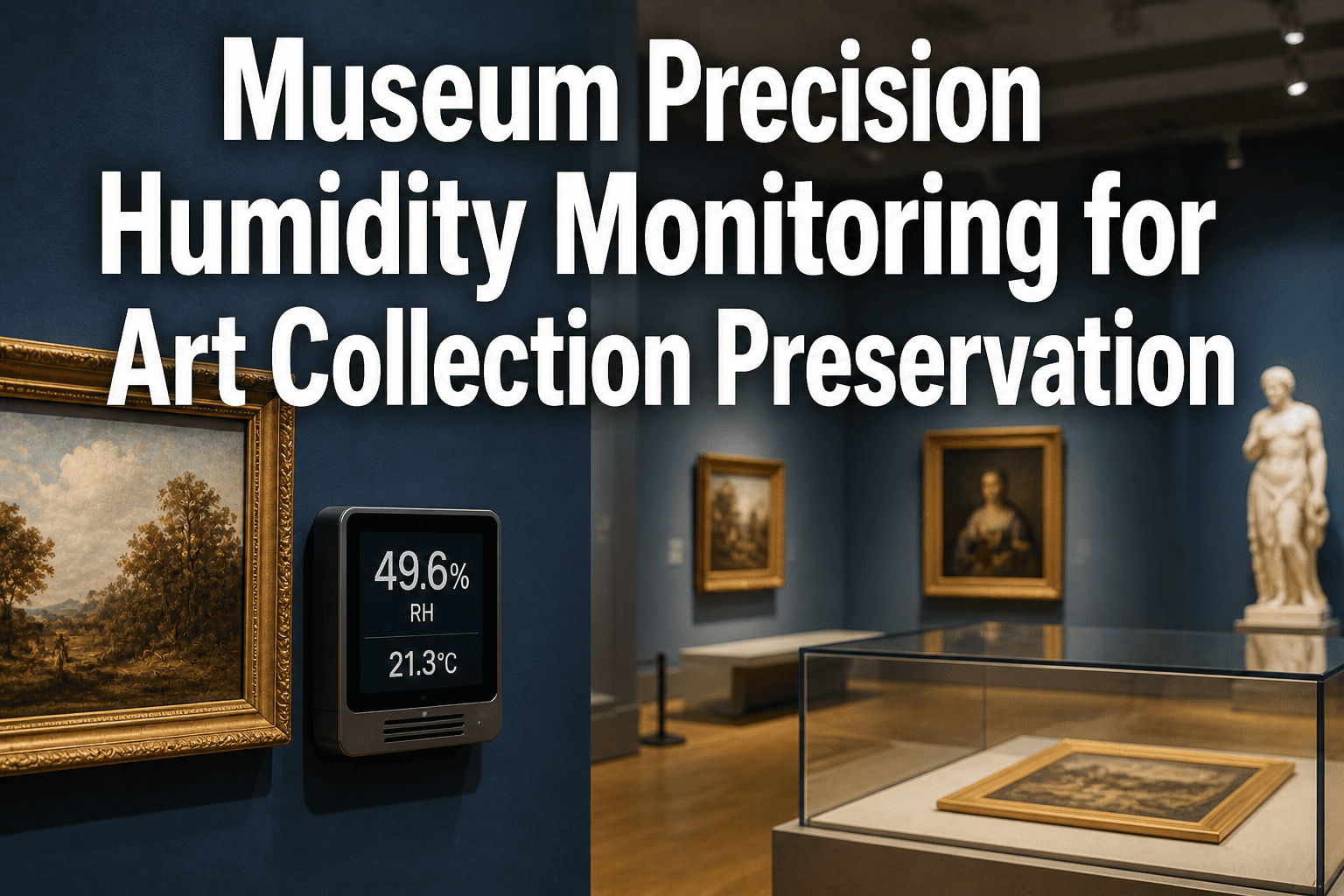
According to the global humidity control market is projected to reach $6.8 billion by 2030, driven by pharmaceutical, museum, archive, and indoor pool applications where precision moisture management is mission-critical. However, facility audit data indicates that 58% of humidity-sensitive environments experience at least one uncontrolled RH excursion annually — with museum collection damage (33%), pharmaceutical product stability issues (28%), and indoor pool structural corrosion (22%) representing the most common consequences. Unlike temperature control where deviations trigger immediate comfort complaints, humidity deviations often go undetected for days or weeks until visible mold, material degradation, or equipment failure occurs. OxMaint's Humidity Control Module provides continuous monitoring of relative humidity, dew point, desiccant wheel speed, reheat coil performance, and compressor runtime — generating predictive work orders when any parameter approaches critical thresholds. Book a demo to see how facility managers are reducing humidity-related failures by 55–74% within six months of deployment.
01
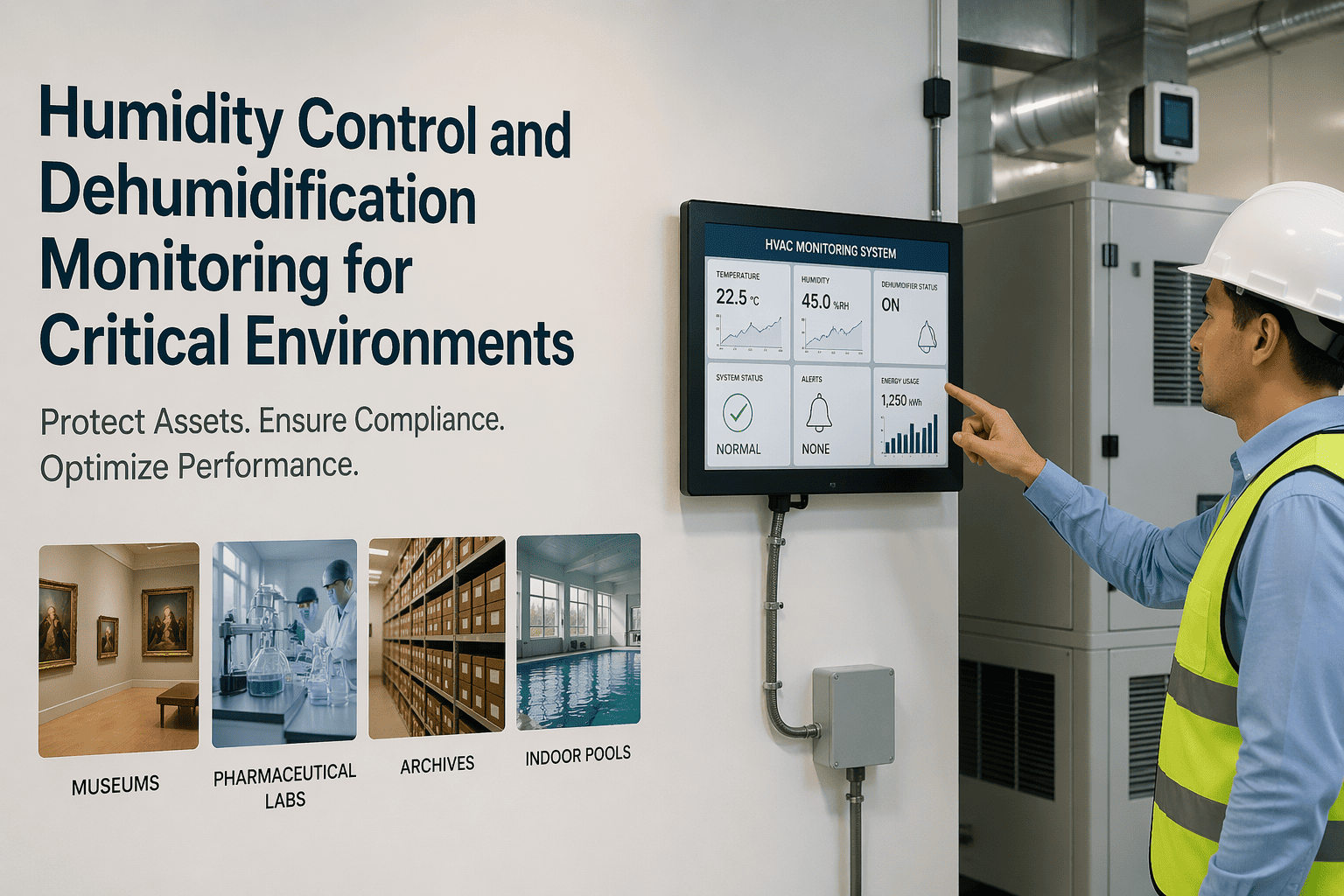
Humidity Control and Dehumidification Monitoring for Critical Environments
Precision RH monitoring · Desiccant tracking · Dew point alerts · CMMS integration · Predictive maintenance
58%Of humidity-sensitive environments experience uncontrolled RH excursions annually
55–74%Reduction in humidity-related failures with active monitoring
33%Museum collection damage attributed to uncontrolled humidity
Critical Environments at Risk
40–60%
Recommended RH range for most museums and archives
±5% stability required per ASHRAE
30–50%
Pharmaceutical manufacturing RH specification
Excessive moisture affects tablet stability
50–60%
Indoor pool RH target — to prevent condensation
Below dew point causes structural corrosion
Five Critical Environments Requiring Humidity Monitoring
01
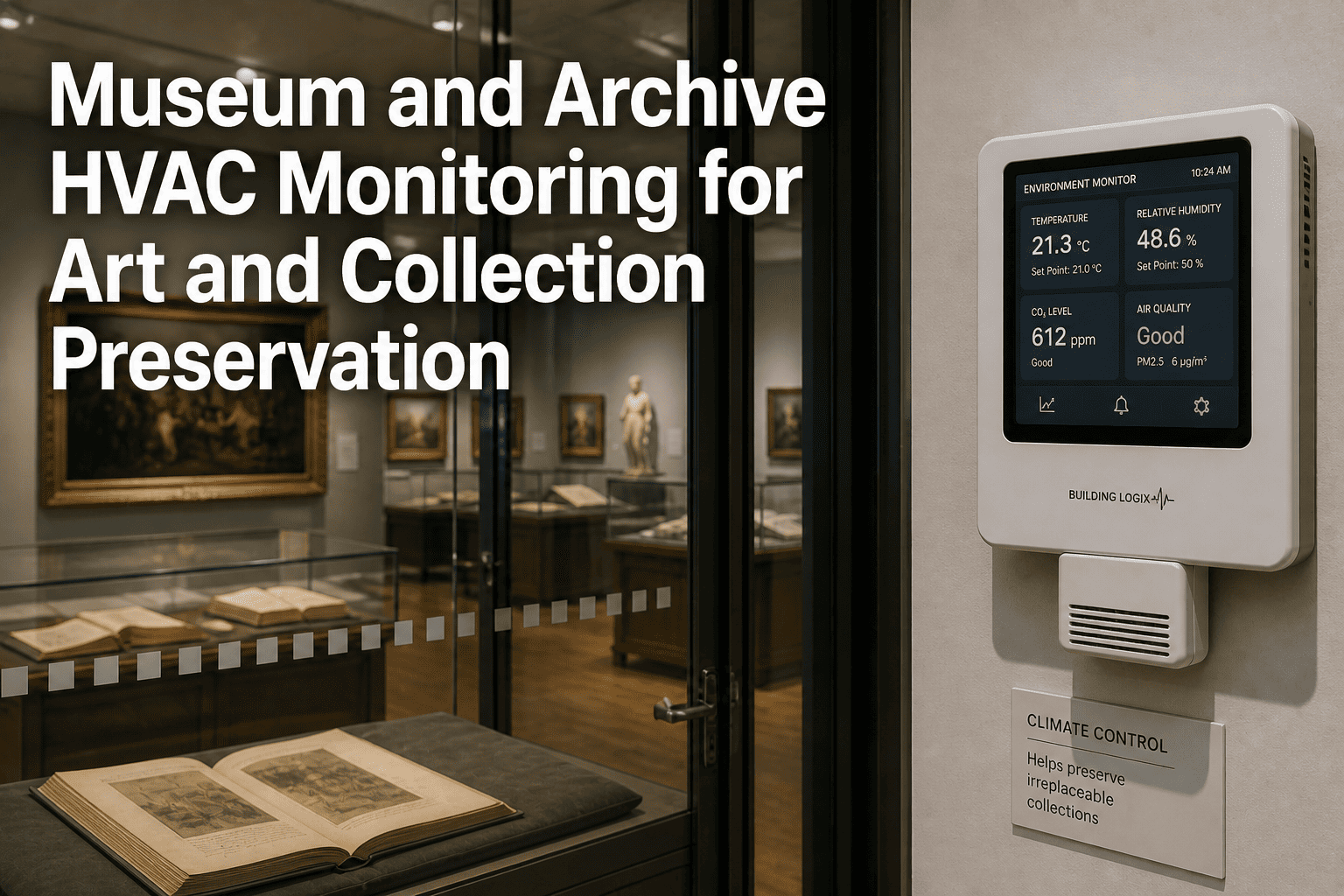
Museums, Galleries & Archives
Organic materials — paper, canvas, wood, leather, textiles — absorb and release moisture with RH changes, causing dimensional swelling, cracking, and biological growth. ASHRAE recommends 40–60% RH with ±5% stability for most collection types. A single 12-hour excursion above 65% RH can initiate mold growth on cellulose materials; below 35% RH causes embrittlement of leather and adhesives. Monitoring detects desiccant wheel degradation or HVAC control failures 2–4 weeks before visible collection damage.
02
Pharmaceutical & Biotech Labs
FDA GMP regulations require humidity control within validated ranges for manufacturing and storage — typically 30–50% RH depending on product. High RH promotes microbial growth and tablet degradation; low RH generates static electricity that can damage electronic components or alter powder flow properties. Continuous monitoring with documented alert/action limits is required for regulatory compliance. Deviation beyond action limits requires product impact assessment and potential batch rejection — averaging $18,000–$75,000 per event per product line.
03
Indoor Pools & Aquatic Centers
Indoor pools require dehumidification to maintain RH at 50–60% — low enough to prevent condensation on windows and structural steel, high enough to avoid excessive evaporation and occupant discomfort. Condensation on cold surfaces (windows, structural steel, ductwork) accelerates corrosion — leading to premature failure of building envelopes, HVAC equipment, and electrical systems. A single large indoor pool without active humidity monitoring can accumulate $50,000–$200,000 in undetected structural damage over 5–7 years before visible failure occurs.
04
Data Centers & Server Rooms
ASHRAE TC 9.9 recommends 45–55% RH for data centers. Low humidity (below 40%) increases electrostatic discharge risk — a single ESD event can damage servers or cause data corruption. High humidity (above 60%) promotes corrosion of connectors and circuit boards, plus condensation risk on cold aisle surfaces. Humidity monitoring with dew point tracking prevents both failure modes. Most data center UPS and cooling systems lack dedicated humidity trending — creating a gap that OxMaint fills with wireless RH and dew point sensors.
05
Food Processing & Cold Storage
Food processing facilities require humidity control to prevent condensation, microbial growth, and product quality degradation. Freezer and cooler environments experience frost accumulation and ice formation when humidity exceeds dew point — reducing cooling efficiency and requiring defrost cycles. Excessive humidity in dry storage areas (flour, grains, dried goods) causes caking, mold, and spoilage. Monitoring detects refrigeration system defrost failures and door seal degradation 2–5 weeks before visible frost or product quality issues appear.
Humidity Control Monitoring Checklist — Daily, Weekly & Monthly
01
Relative Humidity (RH) — Continuous Recording
Log RH at representative locations. Compare to specified range for environment type. Any excursion beyond action limit requires immediate investigation and documented corrective action per GMP or collection care policy.
Prevents mold & material damage
02
Dew Point Temperature — Daily Calculation
Dew point above surface temperature indicates condensation risk. Monitor cold surfaces (windows, chilled beams, ducts) with surface temp sensors. Dew point within 5°F of surface temperature triggers inspection.
Prevents condensation damage
03
Desiccant Wheel Speed & Regen Temperature
For desiccant dehumidifiers, log wheel RPM and regeneration heater temperature. Speed variation beyond ±10% of design triggers belt or drive inspection. Regen temp drop indicates heater or sensor failure.
Maintains dehumidification capacity
04
Chilled Water Valve Position & Coil Temperature
Monitor cooling coil leaving air temperature and valve position. Coil temperature below 35°F indicates freeze risk. Valve 100% open with RH above setpoint indicates undersized coil or refrigerant issue.
Optimizes dehumidification
05
Reheat Coil Performance
Dehumidification requires cooling below dew point then reheating to supply temperature. Log leaving air temperature before and after reheat. Reheat delta below design indicates valve or coil fouling.
Restores humidity control
06
Compressor Runtime & Short Cycling
For refrigeration-based dehumidifiers, log compressor cycles per hour and total runtime. Short cycling (more than 6 starts per hour) indicates control issues or oversized equipment — increases wear and energy.
Extends equipment life
Humidity Control Technology Comparison by Environment
| Humidity Control Technology | Ideal Applications | RH Range Achievable | Monitoring Priority | Failure Consequences |
|---|
| Desiccant Dehumidifier | Low dew point applications — museums, archives, cold storage | 10–40% RH (process air) | Wheel speed, regen temp, purge damper | Loss of low-RH capability — mold risk |
| Refrigeration Dehumidifier | Indoor pools, commercial buildings, warehouses | 40–60% RH typical | Compressor runtime, coil temp, defrost cycles | Short cycling, freeze-up, corrosion |
| Chilled Water Dehumidification | Large facilities — hospitals, labs, office towers | 45–55% RH | Chilled water temp, valve position, coil delta | Valve failure, coil fouling, freeze risk |
| Humidification System | Winter low-RH correction — labs, data centers, printing | 30–60% RH | Water quality, drain operation, steam generator | Scale buildup, drain failure, legionella risk |
| Split System with Reheat | Server rooms, telecom shelters, small labs | 40–55% RH | Compressor runtime, reheat delta | Humidity creep — condensation or ESD risk |
Source: OxMaint humidity control deployment data 2024–2025. Technology selection depends on application-specific RH requirements and load profile.
ROI Impact at a Glance — Humidity Control Monitoring
55–74%
Reduction in humidity-related equipment failures
OxMaint customer data
$18K–75K
Pharmaceutical batch rejection cost per RH excursion
Industry estimate
6–14 mo.
Payback period for monitoring hardware + software
Museum / archive / pharma facilities
"The most expensive humidity failures I've seen weren't caused by equipment breakdowns — they were caused by undetected performance drift that accumulated over months. A museum I consulted had maintained 45–55% RH in its paper collection storage for years, with weekly manual logging. The desiccant wheel bearings wore gradually, reducing wheel speed from 24 RPM to 18 RPM over 14 months. RH crept up to 65% during summer months, but because the logs were weekly and only recorded at midday (lowest RH point of the cycle), the average never triggered an alert. By the time a staff member noticed visible mold on several maps, the collection had been at damaging RH levels for three months. That's the difference between periodic logging and continuous monitoring — and between detection measured in weeks or months. OxMaint's ability to trend RH continuously, detect rate-of-change deviations, and generate work orders at configurable thresholds would have caught that wheel degradation at month three, not month fourteen."
— Margaret Chen, PE, CEM · Architectural Conservator & HVAC Specialist · 19 Years Museum and Archive Environmental Control · American Institute for Conservation Member
Stop discovering humidity excursions after damage occurs. Start monitoring RH, dew point, and dehumidifier performance continuously.
Frequently Asked Questions
What is the difference between relative humidity and dew point — and which should I monitor?
Relative humidity (RH) is the percentage of water vapor in air relative to saturation at a given temperature — it changes with temperature even if absolute moisture remains constant. Dew point is the temperature at which air becomes saturated and condensation forms — it is temperature-independent and directly indicates absolute moisture content. For most applications, monitor both: RH for material stability (museums, archives, pharma), dew point for condensation risk (cold storage, indoor pools, data centers). OxMaint calculates dew point automatically from RH and temperature sensors, triggering alerts when dew point approaches any monitored surface temperature within 5°F.
Sign in to configure dual RH + dew point alerts for your facility.How often should humidity sensors be calibrated in critical environments?
Calibration frequency depends on sensor type and application criticality. Capacitive RH sensors (most common) typically require annual calibration to maintain ±2% accuracy. Resistive sensors may require calibration every 6 months in dirty environments. For GMP-regulated pharmaceutical applications, calibration is typically required every 6–12 months per facility SOP. For museums and archives, annual recalibration is standard practice. OxMaint tracks calibration due dates per sensor, alerts the calibration team 30 days before due date, and stores calibration certificates in the asset record.
Book a demo to see sensor health monitoring.What is the optimal RH range for mixed collection types in a museum or archive?
There is no single optimal range for all collection materials — compromise ranges are used when multiple material types share a space. ASHRAE Chapter 24 recommends 40–60% RH with temperature between 60–75°F for most mixed collections. For paper-based collections (books, documents, prints), the narrower range of 45–55% RH is preferred to minimize hygroscopic expansion/contraction cycles. For mixed media (paintings on canvas, wood objects, textiles, photographs), ASHRAE suggests 45–55% RH with temperature stability of ±4°F. The critical requirement is stability — rapid RH fluctuations cause more damage than operating at the edges of the acceptable range.
Book a demo to set rate-of-change thresholds for your collection spaces.Can OxMaint integrate with existing humidity control equipment and sensors?
Yes. OxMaint's humidity monitoring module integrates with most common RH and temperature sensors from Vaisala, Rotronic, Honeywell, Siemens, Dwyer, and Sensirion — via analog (4–20mA), BACnet, Modbus, or wireless sensor networks. For desiccant dehumidifiers, OxMaint connects to OEM controllers from Munters, Bry-Air, Desiccant Technologies, and Airgel to pull wheel speed, regeneration temperature, and alarm status. For refrigeration-based dehumidifiers (DCA, Ultra-Aire, Santa Fe), OxMaint monitors compressor runtime and coil temperature via current transformers and temperature probes. For facilities without existing sensors, OxMaint's wireless RH/temperature sensor suite installs in minutes and transmits to a central gateway — no wiring required.
Start a free trial to map your existing humidity control equipment.
Ready to protect your critical environment from undetected humidity excursions?