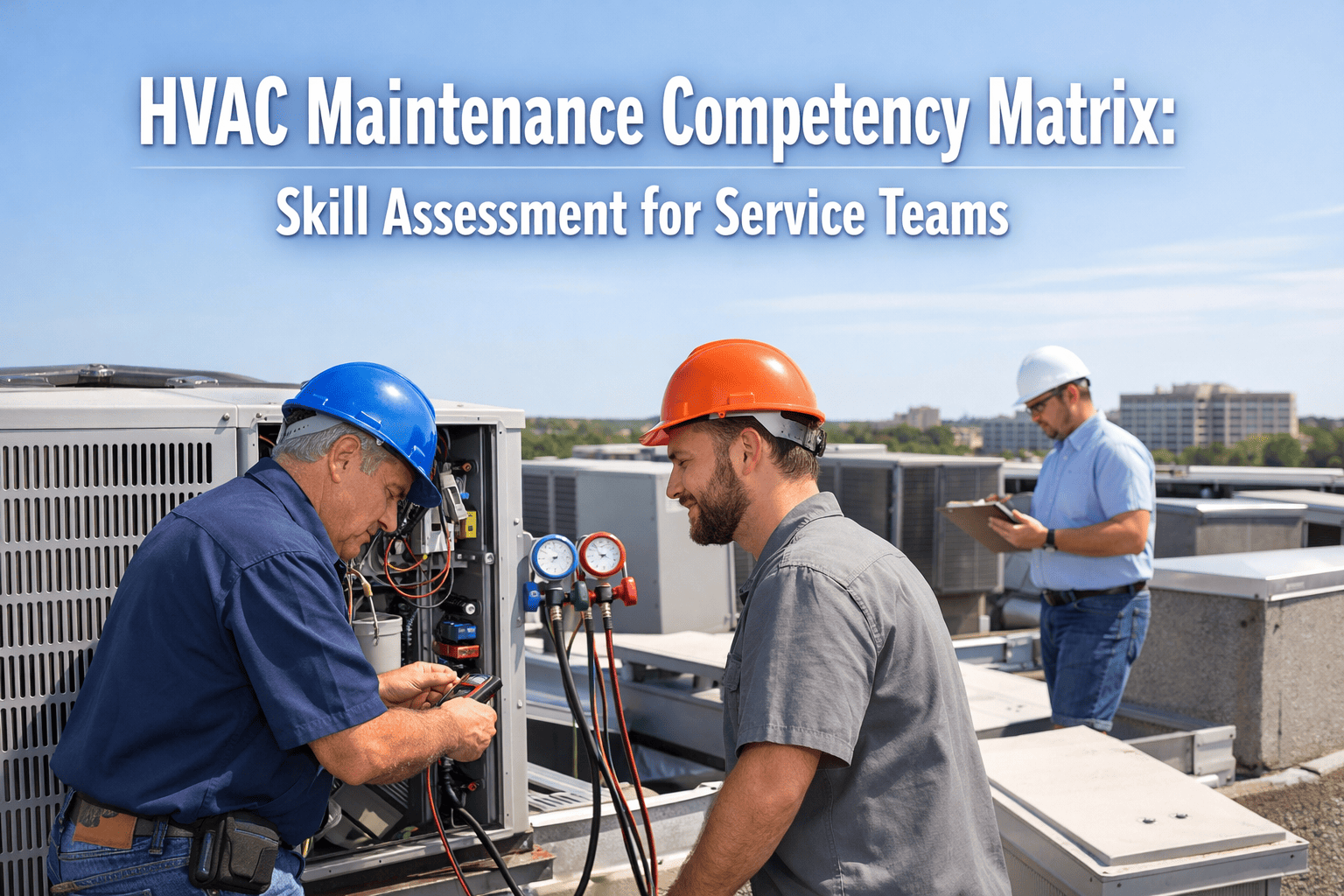
A technician who can diagnose a failed compressor but cannot read a wiring diagram is a liability on a commercial job site. A technician who understands refrigerant circuits but freezes in front of a customer complaint is costing your team service contract renewals. Most HVAC service teams promote based on tenure, not verified competency — and that gap shows up in callbacks, escalations, and failed inspections. A competency matrix fixes this by making every skill visible, measurable, and trackable. If you want to build one for your team today, sign up free on OxMaint or book a demo to see workforce planning in action.
HVAC Maintenance Competency Matrix
Skill assessment framework for service teams — mechanical, electrical, refrigeration, and customer service
4
Core skill domains every HVAC technician must be assessed across
67%
Of HVAC service callbacks trace back to an unaddressed technician skill gap
4x
Faster skill gap resolution when teams use a structured competency framework
38%
Higher technician retention at companies using defined progression paths
What Is a Competency Matrix and Why Does Your HVAC Team Need One?
A competency matrix is a grid that maps every technician against every skill your team needs — showing at a glance who can do what, at what level, and where the gaps are. For HVAC service teams, it replaces informal assumptions with documented evidence. It answers three questions that drive every workforce planning decision: who is qualified for this job, who needs training next, and who is ready for promotion. Sign up to start building your team's matrix inside OxMaint.
Three Problems a Competency Matrix Solves Immediately
The direct operational impact of moving from gut-feel to structured skill tracking
01
Wrong Technician, Wrong Job
Without a skills map, dispatchers assign by availability. The result: a level-2 tech sent to a chiller plant requiring level-4 refrigeration knowledge. The matrix ensures job requirements match technician qualifications before dispatch.
Impact: Eliminates skill-mismatch dispatches that cause site escalations and repeat visits
02
Invisible Skill Gaps
Teams often discover gaps during a failure — when a tech cannot complete a job. The matrix surfaces gaps proactively, allowing training to be scheduled before the gap becomes a missed SLA or a customer complaint.
Impact: Converts reactive training triggered by failure into proactive development on schedule
03
No Clear Career Path
Technicians who cannot see a progression path leave. The matrix defines exactly what skills are required at each level, giving every team member a visible roadmap from junior to master technician.
Impact: Supports 38% higher retention at teams with documented skill progression frameworks
The Four HVAC Skill Domains
Every HVAC technician role draws from four distinct skill domains. A competency matrix tracks all four — not just the mechanical tasks that are easiest to measure. Neglecting electrical, refrigeration, or customer service competency produces technicians who are technically capable in one area and dangerously underqualified in another.
Four Core Skill Domains for HVAC Team Assessment
Every skill in your competency matrix falls into one of these four categories
Domain A
Mechanical Skills
AHU and FCU maintenance and repair
Chiller plant operation and servicing
Cooling tower mechanical inspection
Pump and piping system maintenance
Duct inspection and balancing
Preventive maintenance task execution
Domain B
Electrical Skills
Wiring diagram interpretation
Control board diagnosis and replacement
VFD commissioning and parameter setting
Motor testing and fault diagnosis
BAS/BMS integration and point mapping
Electrical safety compliance procedures
Domain C
Refrigeration Skills
Refrigerant handling and EPA 608 compliance
System charging and superheat/subcooling
Leak detection and recovery procedures
Compressor diagnosis and replacement
Expansion valve and metering device service
Heat pump reversing valve diagnosis
Domain D
Customer Service Skills
Site arrival and professional presentation
Fault explanation to non-technical clients
Service report completion and handover
Complaint handling and de-escalation
Upsell and service agreement communication
Digital work order and photo documentation
Track Technician Skills Across All Four Domains in OxMaint
OxMaint's Training Management module lets you build a live competency matrix for your entire HVAC workforce — assign skill levels, schedule training, and see team readiness on one dashboard. No spreadsheets, no guesswork.
The Competency Level Framework: L1 to L4
A competency matrix is only as useful as the rating scale it uses. Vague labels like "basic" or "advanced" produce inconsistent assessments. A four-level framework with explicit behavioral definitions ensures every manager rates the same skill the same way — making the matrix data reliable enough to drive hiring, dispatch, and promotion decisions. Book a demo to see how OxMaint structures level assessments for HVAC teams.
HVAC Technician Competency Levels: L1 to L4 Definitions
Each level requires demonstrated evidence — not just years of experience
L1
Awareness
Has received instruction on this skill. Can identify the relevant equipment or concept. Cannot perform the task independently without direct supervision and guidance.
Observable signals
Shadows senior technician on task
Can name components but not diagnose
Requires step-by-step instruction
L2
Developing
Can perform the task with occasional guidance. Makes some errors that are caught before causing problems. Building consistency and reducing reliance on supervisor oversight.
Observable signals
Completes standard tasks with light supervision
Asks clarifying questions proactively
Documents work accurately with prompting
L3
Proficient
Performs the task independently with consistent quality. Can handle non-standard situations and adapt to site-specific conditions. Trusted to represent the company on this skill without supervision.
Observable signals
Works independently across common scenarios
Troubleshoots faults without escalation
Trains L1/L2 technicians on the skill
L4
Expert
Handles the most complex scenarios in this skill domain. Defines best practices, updates SOPs, and is the team's escalation point. Capable of developing training materials and assessing others.
Observable signals
Resolves escalations from L3 technicians
Authors or updates procedures for the skill
Formally assesses team members on this skill
The Full HVAC Competency Matrix Checklist
Use this matrix to assess every technician on your team across all four skill domains. Rate each skill using the L1-L4 framework. Where a technician scores L1 or L2 on a skill required for their role, that row becomes a training action item. Complete this assessment quarterly and track changes over time to measure development velocity. Sign up free on OxMaint to run this assessment digitally with automatic gap flagging and training assignment.
HVAC Maintenance Competency Assessment Matrix
Rate each technician L1 through L4 — gaps at required level become immediate training actions
| Skill |
Domain |
Min. Level by Role |
L1 Awareness |
L2 Developing |
L3 Proficient |
L4 Expert |
| Domain A — Mechanical Skills |
| AHU/FCU maintenance and repair |
Mechanical |
L2 (Junior) / L3 (Senior) |
Observe only |
Standard PM tasks |
Full repair scope |
Leads complex overhauls |
| Chiller plant operation |
Mechanical |
L3 (Senior) / L4 (Lead) |
Identify components |
Assisted startups |
Independent operation |
Optimizes performance |
| Cooling tower mechanical inspection |
Mechanical |
L2 (Junior) / L3 (Senior) |
Visual check with guide |
Standard inspection list |
Full inspection + report |
Trains and audits team |
| Pump and piping system maintenance |
Mechanical |
L2 (Junior) / L3 (Senior) |
Basic identification |
Routine maintenance |
Fault diagnosis + repair |
System commissioning |
| Duct inspection and air balancing |
Mechanical |
L2 (Junior) / L3 (Senior) |
Visual inspection only |
Basic TAB readings |
Full balance and report |
Designs balance strategy |
| Domain B — Electrical Skills |
| Wiring diagram interpretation |
Electrical |
L2 (Junior) / L3 (Senior) |
Simple circuits only |
Standard HVAC diagrams |
Complex multi-circuit |
Creates and validates |
| Control board diagnosis and replacement |
Electrical |
L2 (Junior) / L3 (Senior) |
Identify board location |
Replacement with guide |
Independent diagnosis |
Reverse-engineers faults |
| VFD commissioning and parameters |
Electrical |
L3 (Senior) / L4 (Lead) |
Name VFD components |
Basic parameter reading |
Full commissioning |
System integration lead |
| Motor testing and fault diagnosis |
Electrical |
L2 (Junior) / L3 (Senior) |
Identify fault indicators |
Run standard tests |
Full diagnosis + swap |
Root cause analysis |
| BAS/BMS integration and point mapping |
Electrical |
L3 (Senior) / L4 (Lead) |
Navigate BAS interface |
Read existing points |
Configure new points |
Designs integration |
| Domain C — Refrigeration Skills |
| Refrigerant handling and EPA 608 |
Refrigeration |
L2 (Junior) / L3 (Senior) |
Safety awareness only |
EPA 608 certified |
All refrigerant types |
Compliance lead |
| System charging — superheat/subcooling |
Refrigeration |
L2 (Junior) / L3 (Senior) |
Assisted observation |
Standard residential |
Commercial systems |
Complex multi-circuit |
| Leak detection and recovery |
Refrigeration |
L2 (Junior) / L3 (Senior) |
Use detection equipment |
Locate and document |
Full recovery + repair |
Develops team protocols |
| Compressor diagnosis and replacement |
Refrigeration |
L3 (Senior) / L4 (Lead) |
Identify failure signs |
Assisted swap |
Independent replacement |
Complex multi-circuit |
| Heat pump reversing valve diagnosis |
Refrigeration |
L2 (Junior) / L3 (Senior) |
Explain valve function |
Assisted diagnosis |
Independent diagnosis |
Trains team on process |
| Domain D — Customer Service Skills |
| Fault explanation to non-technical clients |
Customer |
L2 (Junior) / L3 (Senior) |
Uses technical language |
Basic plain-language |
Clear with any client |
Coaches team on style |
| Complaint handling and de-escalation |
Customer |
L2 (Junior) / L3 (Senior) |
Aware of process |
Follows script |
Adapts to situation |
Resolves escalations |
| Service report completion |
Customer |
L2 (Junior) / L3 (Senior) |
Partial completion |
Standard fields only |
Complete with photos |
Designs report templates |
| Digital work order documentation |
Customer |
L2 (Junior) / L3 (Senior) |
Guided entry only |
Basic fields complete |
Full CMMS proficiency |
Trains team on platform |
Swipe to view full matrix
Cells marked in orange during assessment indicate a gap between current level and minimum required level — these become immediate training action items in OxMaint
Run This Assessment Digitally — With Automatic Gap Detection
OxMaint's Training Management module lets you run this exact matrix for your full team, auto-flags skill gaps against role requirements, and assigns training tasks directly to technicians and managers — all from one dashboard.
Skills Gap Analysis: How to Read Your Matrix Results
Once you have rated every technician, the matrix reveals three types of actionable patterns. Each pattern requires a different response — training, redeployment, or hiring. Sign up free to run gap analysis automatically inside OxMaint.
Reading Your Matrix: Three Gap Patterns and What They Require
Not all gaps are equal — the type of gap determines the right response
Pattern 1: Individual Gap
One technician scores below the required level on a skill that the rest of the team holds. The gap is isolated, not systemic.
Signal in matrix: Single cell below threshold across a row
Recommended action
Pair with L3/L4 colleague for supervised practice. Assign targeted e-learning module. Re-assess in 30 days. No hiring required.
Pattern 2: Team Gap
Multiple technicians score below required level on the same skill — typically BAS integration, VFD commissioning, or a newer refrigerant type. A systemic training need, not an individual weakness.
Signal in matrix: Multiple cells below threshold in the same column
Recommended action
Schedule group training session with external instructor or manufacturer. Update SOP library. Consider hiring one L4 expert to anchor the domain and mentor the team.
Pattern 3: Role Mismatch
A technician in a senior role consistently scores L1/L2 across multiple required skills. The matrix reveals a promotion that outpaced demonstrated competency — a high-risk situation for the team and for clients.
Signal in matrix: Entire row below threshold for the technician's role
Recommended action
Conduct structured performance review using matrix data. Define 90-day development plan with specific level targets. Reassign complex jobs until targets are met. Document all actions.
Implementation: How to Roll Out the Matrix with Your Team
Four-Step Rollout: From Blank Matrix to Active Workforce Plan
A practical sequence that takes most HVAC service teams from zero to operating in under 30 days
Week 1
Define Roles and Required Levels
List every role in your team (junior technician, senior technician, lead technician, service manager). For each role, identify the minimum competency level required for every skill in the matrix. This becomes the threshold row that turns gaps red during assessment.
Week 2
Conduct Initial Assessments
Rate every technician against every skill using the L1-L4 framework. Use direct observation for mechanical and electrical tasks. Use scenario questions for customer service skills. Have assessments signed off by both the technician and their direct manager to ensure alignment and buy-in.
Week 3
Analyze Gaps and Build Training Plans
Review completed matrices for individual, team, and role-mismatch patterns. For every gap identified, assign a specific training action with a target completion date and a re-assessment date. Load training plans into OxMaint so technicians receive their development tasks directly in their workflow.
Ongoing — Quarterly
Re-Assess and Track Progress
Run the full matrix assessment every quarter. Compare current scores against the prior quarter to measure development velocity for each technician. Use improvement trends to identify fast-developing technicians ready for promotion and stagnant cases that need a different intervention. The matrix only drives outcomes if it is updated continuously.
Build Your Team's Competency Matrix in OxMaint Today
OxMaint's Workforce Planning tools let you define role requirements, run structured assessments, auto-flag gaps, assign training, and track development quarter over quarter. Everything in one place — no spreadsheets, no disconnected HR systems.
Frequently Asked Questions
How often should we run HVAC competency assessments?
Quarterly is the industry standard for active service teams. Annual assessments miss the development window — a technician who passed through a training program in February should be re-assessed in May, not the following January. For new hires, run a baseline assessment at 30 days, then again at 90 days. Use OxMaint to schedule assessments automatically so they never get skipped during busy service periods.
Who should conduct the skill assessments — managers or peers?
Primary assessment should be conducted by the technician's direct supervisor or a designated L4 expert in the relevant domain. For mechanical and electrical skills, direct observation of task performance is required — asking someone to self-report their level produces inflated scores. For customer service skills, evidence from completed service reports and client feedback forms provides objective supporting data. Manager sign-off on every rating ensures accountability and makes the data defensible in performance reviews.
How does a competency matrix connect to dispatch and job assignment?
When your CMMS holds competency level data for each technician, job assignments can be matched to skill requirements automatically. A chiller plant service call requiring L3 refrigeration competency will only surface technicians who hold that level. This eliminates the most common cause of site escalations — a skill-mismatched dispatch that results in an incomplete job, a callback, or a safety incident. OxMaint's workforce planning module connects technician competency records directly to work order assignment logic.
What is the difference between a competency matrix and a training record?
A training record documents that a technician attended a course or completed a certification. A competency matrix documents that a technician can actually perform the skill at a defined level — confirmed by direct observation, not just course completion. The two are related but not equivalent. A technician can complete an EPA 608 certification course and still be L1 on refrigerant leak detection if they have never performed the task on a live system. Use training records as inputs to the matrix, not substitutes for it.
Stop Guessing Who Is Qualified. Start Knowing.
OxMaint gives HVAC service managers a live competency dashboard for every technician — skill levels, training history, gap flags, and development progress all in one place. Build your team's matrix today and make every dispatch, promotion, and training decision with data behind it.