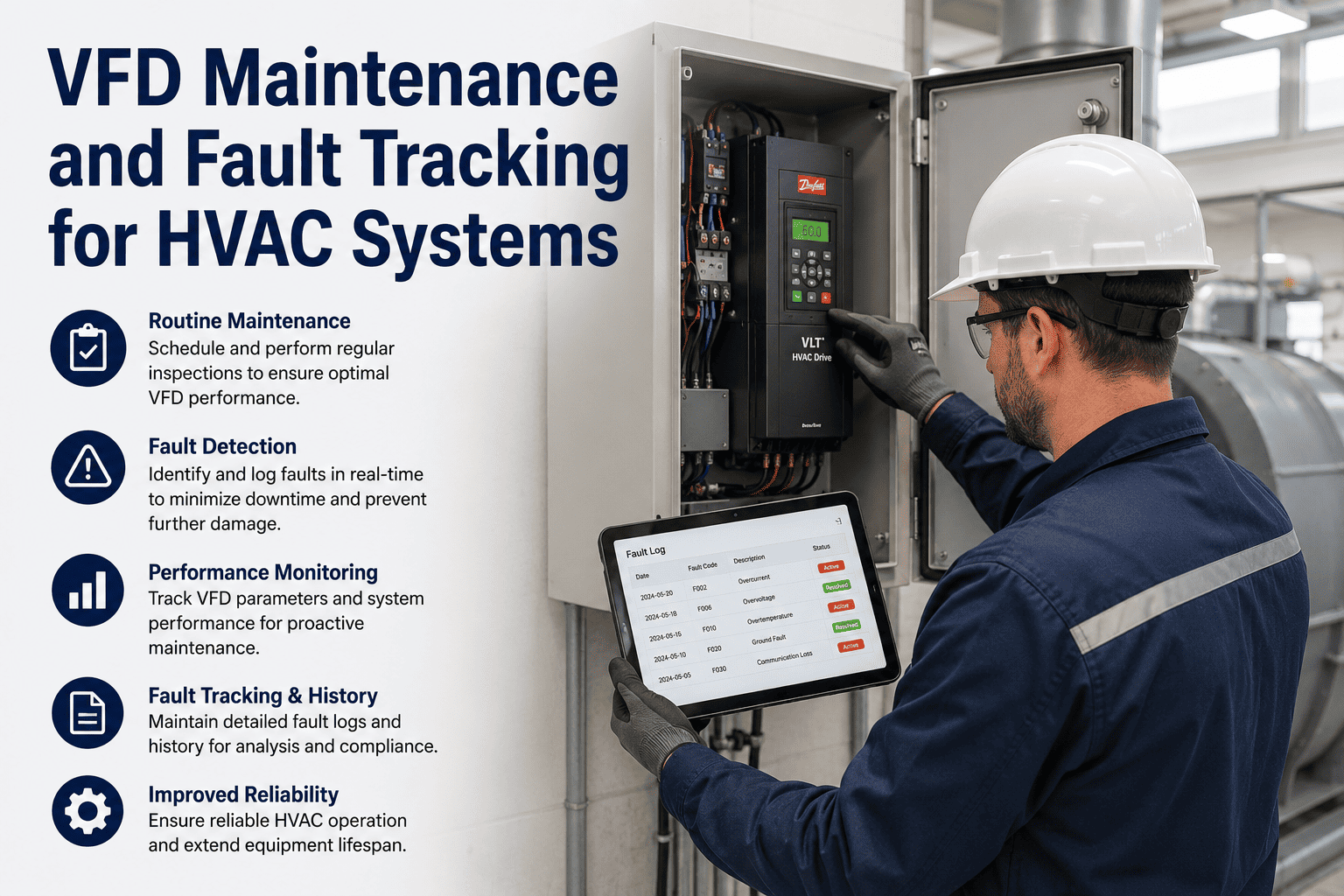
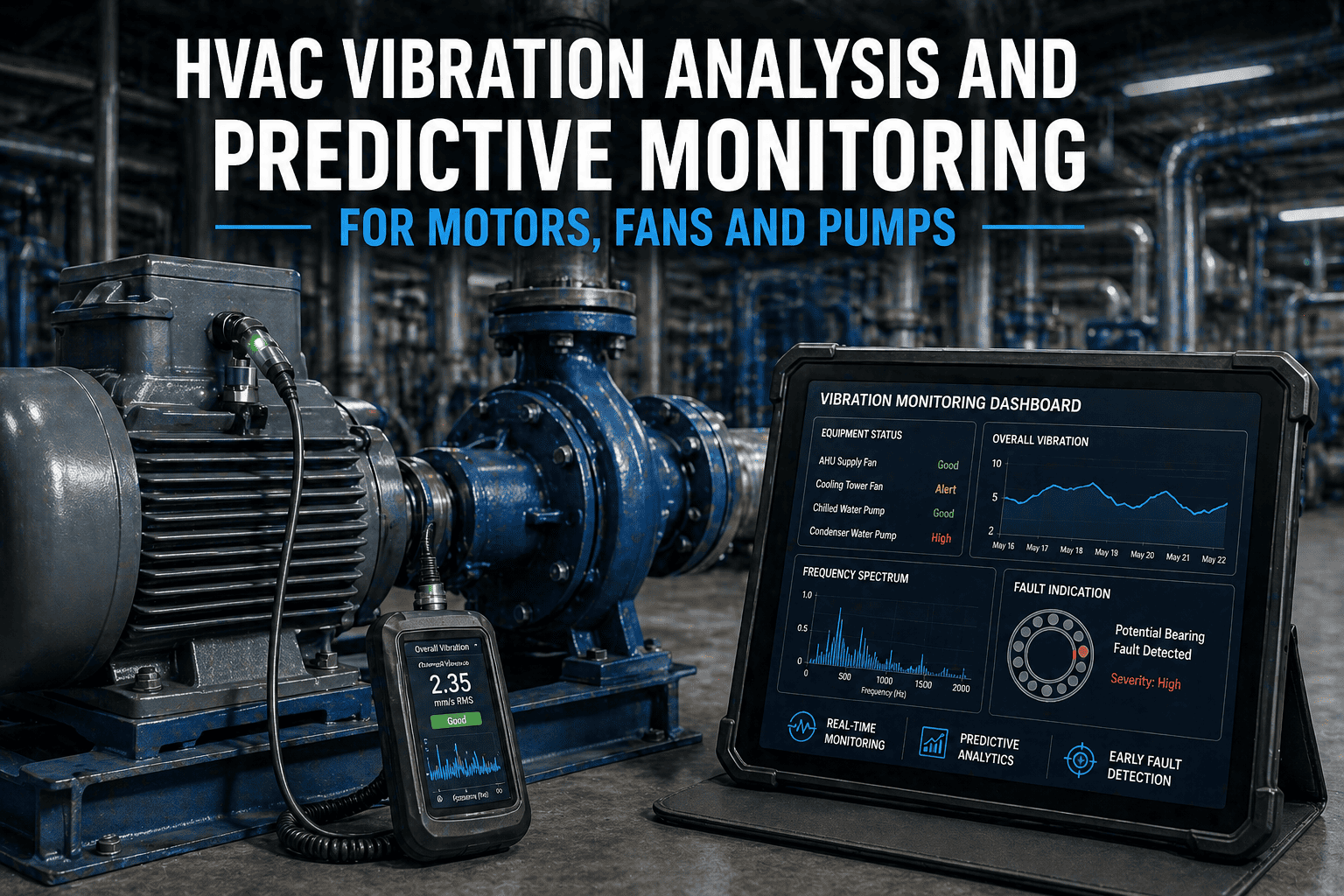
HVAC motors and drives are the mechanical backbone of every commercial building, hospital, data center, and industrial facility — yet they are among the most under-maintained assets on most PM schedules. Overheating accounts for nearly 55% of all motor failures, bearing problems contribute to almost half of documented breakdowns, and a systematic industry survey found that only 33% of VFDs in service have no problems at all. The other 67% are either actively failing or accumulating faults that a calendar-based inspection is almost certain to miss. This guide covers the three drive system types your facility is almost certainly running — VFDs, belt-drive systems, and direct-drive fans — with the specific maintenance tasks, testing intervals, and CMMS tracking methods that extend equipment life and prevent unplanned failures. Start a free OxMaint trial to build your motor and drive PM program with condition-triggered work orders from day one.
Technical Guide · HVAC · Motor & Drive Maintenance · 2025
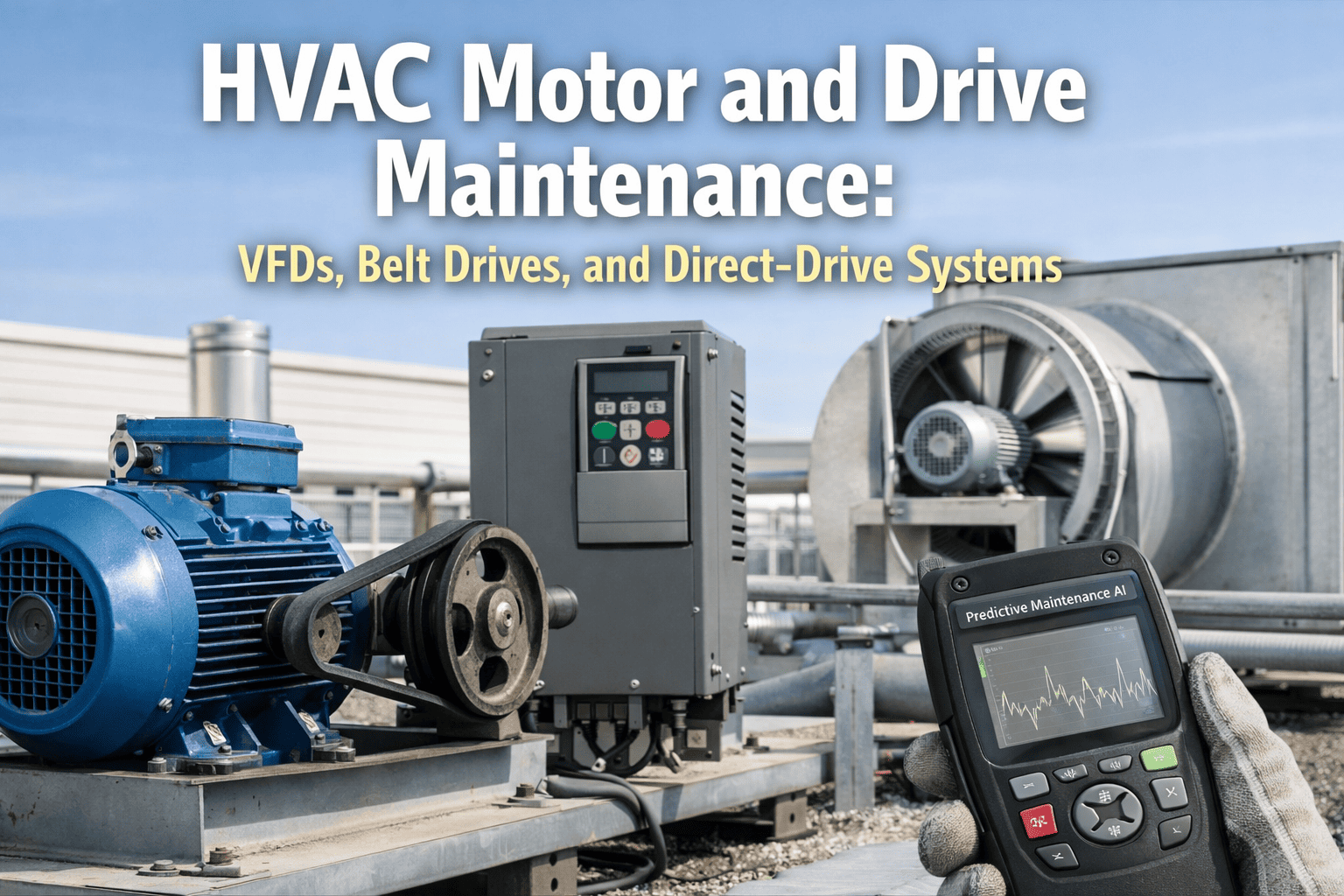
HVAC Motor and Drive Maintenance: VFDs, Belt Drives, and Direct-Drive Systems
55% of motor failures start with heat. 36% of bearing failures trace to lubrication. 67% of VFDs in service have undetected faults. This guide gives you the exact maintenance tasks, test intervals, and CMMS workflows to stop being part of those statistics.
55%
of motor failures caused by overheating and insulation degradation
36%
of bearing failures linked to lubrication problems — over or under
67%
of in-service VFDs have existing problems or are developing faults
7–10 yr
VFD service life under proper PM — cut to 3–5 years without it
Drive System Overview
Three Drive Architectures — Three Different Maintenance Profiles
Most HVAC facilities run a mix of all three drive types across their air handling, cooling tower, exhaust fan, and chiller equipment. Each architecture has a distinct failure mode pattern, a different set of diagnostic tools, and a different maintenance task frequency. Applying the wrong PM template to the wrong drive type is one of the most common sources of both over-maintenance waste and missed failure detection in HVAC operations.
01
Variable Frequency Drives (VFDs)
Electronic motor controllers that vary voltage and frequency to control motor speed. Dominant in AHUs, cooling towers, and pump applications. Primary failure modes are thermal — dirty heatsinks, failed cooling fans, loose bus connections, and capacitor degradation. Environmental contamination is the accelerating factor in most failures.
Thermal failures dominant
7–10 year service life
Bus caps: replace at 7 years
02
Belt-Drive Systems
V-belt or poly-V belt connecting motor to fan or blower via sheaves. The most maintenance-intensive drive type in HVAC — belt tension, sheave alignment, and bearing loads are all interdependent. Overtightening is the most common technician error and the leading cause of premature bearing failure in belt-driven equipment. Undertightening causes slip, energy waste, and belt wear.
Highest maintenance frequency
Alignment is critical
Check tension at 2 weeks after install
03
Direct-Drive Systems
Motor shaft connects directly to the fan impeller — no belts, no sheaves, no mechanical power loss in transmission. Lower maintenance volume than belt drives, but bearing and motor insulation failures become the primary risk vectors. VFDs paired with direct-drive fans introduce shaft current as a specific failure mechanism that requires insulated bearings or shaft grounding rings.
Lowest mechanical maintenance
Bearing and insulation focus
VFD shaft current risk
Failure Mode Data
What Actually Kills HVAC Motors and Drives
Understanding failure distribution is the foundation of any effective predictive maintenance program. Resources spent maintaining low-risk failure modes are resources not spent preventing high-probability failures. This table maps the documented failure cause distribution across HVAC motor and drive systems — so your PM task priorities align with actual risk.
| Failure Cause |
Affected Components |
Failure Share |
Detection Method |
PM Interval |
| Overheating / Insulation Degradation |
Motor windings, VFD power board |
~55% |
Insulation resistance test, thermal imaging |
Quarterly IR test; annual thermal |
| Bearing Failure |
Motor bearings, fan bearings |
~46% |
Vibration analysis, temperature trending |
Monthly vibration check |
| Lubrication Problems |
Bearings (all drive types) |
~36% of bearing failures |
Vibration spike, temperature rise |
Per manufacturer schedule |
| Shaft Misalignment |
Bearings, couplings, belt drives |
No. 1 bearing cause |
Laser alignment tool, vibration |
At install; after any maintenance |
| VFD Shaft Current (EDM) |
Direct-drive motor bearings |
Growing with VFD adoption |
Fluting inspection, insulated bearing test |
Annual bearing inspection |
| Contamination (dust, moisture) |
VFD heatsinks, motor housings |
Environmental factor |
Visual inspection, thermal imaging |
Monthly cleaning; quarterly inspection |
| Loose Electrical Connections |
VFD bus bars, motor terminals |
Common in vibrating environments |
Thermal imaging, torque check |
Annual torque verification |
Data compiled from IEEE motor failure studies, Danfoss VFD service data, and industry bearing failure analysis. Even small misalignment — as little as 0.002 inches — can cut bearing service life in half.
VFD Maintenance
Variable Frequency Drive PM — Task by Task
VFD failures develop slowly and invisibly. A drive running with clogged heatsinks, a failing cooling fan, or degrading bus capacitors will show normal output parameters right up until it fails. The maintenance tasks below address the three core requirements for VFD longevity: keep it clean, keep it dry, and keep connections tight — with specific actions mapped to each maintenance window.
Weekly
Visual and Thermal Check
Verify VFD display shows no active fault codes
Check enclosure door seals for gaps or compression failure
Confirm cooling fan is audibly running at full speed
Check ambient temperature around enclosure — must stay within rated limits
Monthly
Cleaning and Air Filter Service
Clean or replace air intake filters on NEMA 1 enclosures
Compressed air clean heatsink fins — dust buildup is the primary thermal failure driver
Inspect cooling fan blades for dust accumulation and blade condition
Check control board for visible contamination or moisture tracks
Quarterly
Electrical Verification
Verify input voltage balance across all three phases — imbalance accelerates component wear
Check output current balance to motor — asymmetry indicates winding or connection problems
Review fault log history in VFD memory — recurring faults indicate developing failure
Verify parameter settings match commissioning documentation — settings drift after resets
Annual
Full Inspection and Component Life Check
Torque verify all bus bar connections, terminal blocks, and ground lugs — vibration loosens connections over time
Replace cooling fans at 3–5 years — fan failure is the most common VFD thermal event
Schedule bus capacitor replacement at 7 years regardless of appearance
Thermal image under load — hotspots on bus bars or power devices indicate impending failure
Belt Drive Maintenance
Belt-Drive Systems: Tension, Alignment, and the Most Common Technician Error
Belt tension is the most misunderstood parameter in HVAC drive maintenance. Overtightening — not undertightening — is the dominant field error, and it directly causes premature bearing failure by creating excessive radial loads on motor and fan shaft bearings. A correctly tensioned new V-belt should deflect approximately 3/16 inch per foot of center distance between motor and blower shafts. The belt will stretch during its first 2 weeks of operation and tension should be re-verified at that interval.
Overtightened Belt — Failure Pattern
Excessive radial load on motor and fan bearings
Shaft deflection and misalignment under load
Over-amperage in motor — overheating accelerated
Premature bearing race fatigue and cracking
Reduced belt service life from internal stress
Undertightened Belt — Failure Pattern
Belt slip on sheave — power transmission loss
Energy waste from reduced mechanical efficiency
Belt heat from friction — rubber degradation accelerated
Squealing and vibration under variable load
Reduced airflow delivery — system performance degradation
Correct Tension — Service Life Outcome
3/16" deflection per foot of center distance (new belt)
Re-check at 2 weeks — belts stretch 70–80% of total stretch in first month
Laser sheave alignment to eliminate angular and offset misalignment
Even wear across belt width — belt life 3–5+ years achievable
Normal bearing loads — bearing service life at design specification
| Task |
Tool Required |
Interval |
Pass / Fail Criterion |
| Belt Tension Measurement |
Belt frequency meter or deflection gauge |
At install, 2 weeks, then quarterly |
3/16" deflection per foot of span |
| Sheave / Pulley Alignment |
Laser alignment tool or straight edge |
At install, after any bearing change |
Zero angular and offset misalignment |
| Belt Condition Inspection |
Visual — check for cracking, glazing, fraying |
Monthly |
No cracking, even surface wear |
| Sheave Wear Inspection |
Sheave wear gauge |
Annually |
No grooving deeper than 1/32" |
| Motor Bearing Temperature |
Infrared thermometer |
Monthly during operation |
Within 40°F of ambient baseline |
| Bearing Lubrication |
Per manufacturer specification |
Per manufacturer schedule — not calendar |
Correct grease type, no overpack |
Stop Running Belt Drive PM on a Calendar. Start Running It on Condition.
OxMaint lets you set vibration, temperature, and runtime triggers on belt-drive assets so work orders generate when the equipment tells you it needs attention — not when a calendar says it is due. One prevented bearing failure typically covers months of platform cost.
Direct Drive and Motor Testing
Insulation Resistance Testing and Bearing Health in Direct-Drive Systems
Direct-drive fans eliminate the mechanical complexity of belt systems but concentrate maintenance requirements onto two specific asset types: motor windings and bearings. For VFD-driven direct-drive fans, a third failure mechanism becomes relevant — shaft current induced by the VFD's pulse-width modulation, which causes electrochemical pitting of bearing races (a pattern called fluting). Understanding and testing for all three is essential for direct-drive motor longevity.
IR
Insulation Resistance Testing
IEEE Standard 43 sets the minimum acceptable insulation resistance at 1 megohm plus 1 megohm per kilovolt of operating voltage. For a 460V HVAC motor, the minimum threshold is 1.46 megohms. Any reading below this value indicates insulation degradation that is almost certain to progress to failure. A motor running 10°C above its rated temperature loses half its insulation life — making thermal management and IR trending two sides of the same maintenance discipline.
Test Tool: Megohmmeter (500V DC for motors up to 600V)
Interval: Quarterly trending; annual pass/fail
Minimum Value: 1 MΩ + 1 MΩ/kV (IEEE Std 43)
VB
Vibration Analysis for Bearing Health
Vibration trending is the earliest available signal for bearing deterioration — detectable weeks before a bearing reaches a temperature or noise threshold visible to operators. Even 0.002 inches of shaft misalignment doubles the bearing load and cuts service life in half. Trending vibration readings over time — not comparing to a static threshold — reveals the rate of deterioration and allows planned replacement before failure. Vibration data logged in CMMS creates the trend record that makes this possible.
Test Tool: Handheld vibration analyzer or accelerometer
Interval: Monthly trending on critical assets
Watch For: Rising trend — not just threshold breach
SC
Shaft Current Protection (VFD-Driven Motors)
VFD switching creates common-mode voltages that discharge through motor bearings as shaft current, creating microscopic pits in bearing races — a failure pattern called fluting that produces a distinctive washboard surface finish and characteristic electrical noise. Prevention requires insulated bearings on the non-drive end, shaft grounding rings, proper VFD grounding, and shielded motor cables with correct termination. Once fluting is detected, bearing replacement is the only remedy. Testing includes insulation resistance on the installed bearing and visual inspection for the characteristic race pattern during planned bearing changes.
Prevention: Shaft grounding ring or insulated NDE bearing
Detection: Inspect races during planned bearing change
Watch For: Washboard pattern on bearing race surface
CMMS Integration
How CMMS Tracking Turns Motor Data Into Documented Savings
Motor and drive maintenance generates data — vibration readings, IR test values, belt tension measurements, bearing temperatures, VFD fault logs — that is nearly worthless unless it is trended over time and linked to specific assets. Without a CMMS, this data lives in paper inspection forms, technician notes, and memory. With OxMaint, it becomes a trending record that makes deterioration visible weeks before failure and builds the evidence base for every planned replacement decision.
01
Asset-Linked IR and Vibration Trending
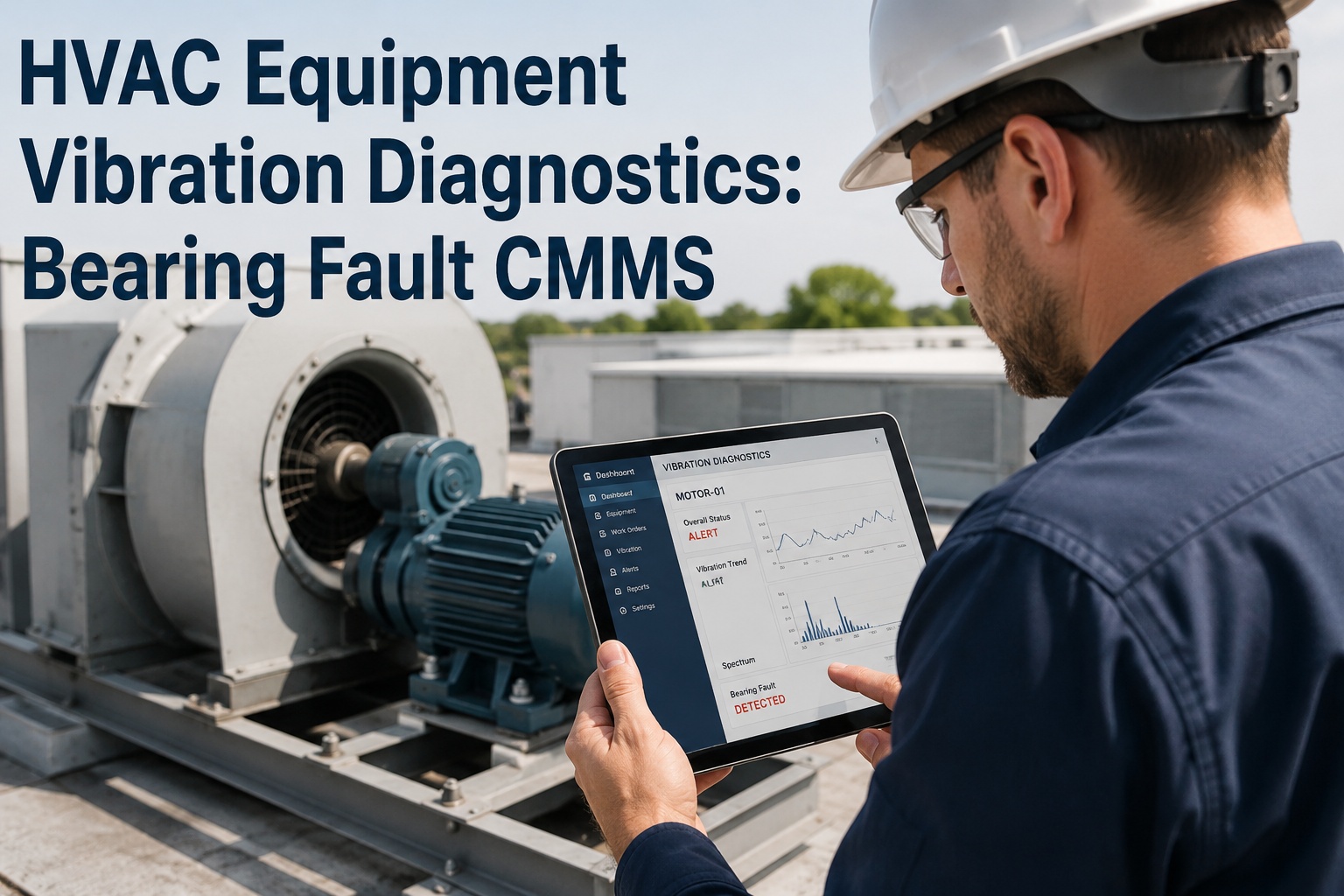
Every insulation resistance reading and vibration measurement entered against a specific motor asset in OxMaint becomes part of that asset's history. Trend charts show deterioration rate — not just current value — so the maintenance team can schedule bearing or winding replacement before the asset fails rather than after.
02
Condition-Triggered Work Orders
Set threshold triggers on vibration, motor temperature, or VFD fault count. When a reading crosses the trigger point, OxMaint auto-generates a work order with the asset, the measured value, the recommended action, and the technician assignment — before anyone has to notice the reading in a report.
03
Replacement Life Tracking
VFD cooling fans at 3–5 years. Bus capacitors at 7 years. Bearing regreasing at manufacturer intervals. OxMaint tracks installed dates, service life counters, and replacement history so these time-based tasks generate automatically without relying on anyone's memory or a spreadsheet that may be months out of date.
04
Cost Avoidance Documentation
Every condition-triggered intervention that prevents a motor or VFD failure carries a documentable cost avoidance figure. OxMaint accumulates these figures into quarterly savings reports — so the PM program's value is reported in dollars, not just in work orders completed.
Expert Perspective
What Facility Engineers Say About Motor and Drive Maintenance
★★★★★
We had a cooling tower VFD fail every 18 months on average. After we started logging fault history and temperature readings in OxMaint, we caught a pattern — the cooling fan in the enclosure was degrading around month 14 every cycle. We now replace it at month 12. No failures since. The data was always there. We just were not keeping it anywhere it could be used.
PK
Pradeep K.
Facility Engineering Manager, Commercial Real Estate Portfolio, India
★★★★★
We found a motor with an IR reading trending from 180 megohms down to 22 megohms over three quarterly tests — right on track to hit the IEEE 43 minimum within 6 months. We replaced the winding during a planned shutdown. That motor drives a critical AHU serving a server room. An unplanned failure there would have cost us far more than the rewind. Trending made the decision obvious.
SL
Sarah L.
Chief Engineer, Data Center Facility Operations, USA
★★★★☆
Belt drive maintenance used to be pure guesswork on our AHU fleet. Technicians were tightening belts by feel and we had constant bearing replacements on the motor side. Once we started tracking tension measurements and bearing temperature trends together in the CMMS, the connection between over-tensioning and bearing failures became clear. We retrained the team, tightened the PM standard, and bearing replacements dropped by more than half within a year.
MN
Michael N.
HVAC Maintenance Supervisor, Hospital Network, Australia
HVAC Motor & Drive Maintenance · OxMaint CMMS · Free to Start
Your HVAC Motors Are Trending Toward Failure Right Now. The Question Is Whether You Know It.
OxMaint gives your team asset-linked IR trending, vibration history, condition-triggered work orders, and component life tracking — so every motor and drive failure that can be prevented is prevented, and every prevention is documented as a saved cost. Deploy on your critical AHUs, cooling towers, and fan systems in days.
Frequently Asked Questions
HVAC Motor and Drive Maintenance — Common Questions
How often should insulation resistance testing be done on HVAC motors?
IEEE Standard 43 recommends insulation resistance testing as part of any structured motor maintenance program. For trending purposes, quarterly measurements give you the rate of deterioration, not just the current value. A motor dropping from 200 megohms to 100 megohms in one quarter is a very different situation from a motor stable at 50 megohms for two years. Annual tests alone miss the trend — and the trend is what predicts failure before it occurs. Always record temperature and humidity at each test since both affect resistance readings and make comparisons unreliable without normalization.
Track all IR readings per motor asset in OxMaint and let the trend chart tell you when to act.
What is the correct belt tension method for HVAC belt-drive systems?
The most reliable tension measurement methods for HVAC V-belts are a belt frequency meter or a calibrated deflection gauge. The target for a new V-belt is approximately 3/16 inch of deflection per foot of center distance between the motor and blower shafts — always verify this against the specific belt manufacturer's specification for your belt cross-section. Critically, belts stretch 70–80% of their total stretch in the first month of operation, so tension must be re-checked at the 2-week mark after any new belt installation. Overtightening is the most common field error and the leading cause of premature motor bearing failure in belt-driven HVAC equipment. Logging each tension measurement against the specific asset in OxMaint creates the historical record needed to identify systematic over- or under-tensioning across a facility's AHU fleet.
Book a demo to see how OxMaint tracks belt drive PM tasks per asset.
When should VFD cooling fans and bus capacitors be replaced?
VFD cooling fans are mechanical components with finite service lives and are the most common cause of thermal-related VFD failures. Most manufacturers recommend replacement at 3 to 5 years regardless of apparent condition — a fan that appears to be spinning may be running at reduced airflow due to blade wear or bearing degradation and creating hidden thermal stress on the power electronics. Bus capacitors should be replaced at 7 years as a programmatic decision, not a reactive one. Capacitor degradation is not visible during operation and produces no warning before failure. Maintaining installed dates and replacement histories in OxMaint allows these time-based replacement tasks to generate automatically as the equipment ages.
Set component life counters in OxMaint to generate replacement work orders automatically at the correct service intervals.
What is VFD shaft current and how does it damage direct-drive motor bearings?
When a VFD controls a direct-drive motor, the drive's pulse-width modulation creates common-mode voltages that can discharge through the motor shaft and bearings to ground — a phenomenon called shaft current or electrical discharge machining (EDM). These discharges create microscopic pits in the bearing races over time, eventually producing a washboard-pattern surface failure called fluting, along with characteristic electrical noise during operation. Prevention requires one of three approaches: a shaft grounding ring (such as an AEGIS ring) that provides a low-resistance path to ground bypassing the bearings, insulated bearings on the non-drive end of the motor, or both for higher-risk applications. Shielded VFD cables with correct grounding also reduce the common-mode voltage that drives the current. Annual visual inspection of bearing races during planned bearing changes is the detection method for facilities not yet using shaft grounding protection.
Book a demo to see how OxMaint structures direct-drive motor PM tasks including shaft current protection checks.
How does a CMMS improve HVAC motor and drive maintenance outcomes?
The core value of CMMS in motor and drive maintenance is converting one-time measurements into trends. A single vibration reading or IR test value tells you the current state of an asset. Readings trended over 4 to 8 quarters tell you the rate of deterioration and allow you to calculate when the asset will reach a failure threshold. Without asset-linked historical records, every reading is evaluated in isolation and deterioration goes undetected until it produces a symptom visible to operators. OxMaint stores every measurement against the specific motor or drive asset, displays trend charts, generates condition-triggered work orders when readings cross programmed thresholds, tracks component replacement life, and documents cost avoidance for every prevented failure. The result is a PM program that finds failures early rather than responding to them after the fact.
Start a free OxMaint trial and create your first motor asset with vibration and IR trending in under 10 minutes.