Your technician just installed a 40/5 MFD dual-run capacitor on a rooftop unit at a commercial property. He pulled it from the van, swapped out the failed part, closed the panel, and moved on to the next call. He didn't log the part. He didn't update the van inventory. He didn't record the manufacturer, the lot number, or the date code. He intended to log it when he got back to the shop — but by then he'd completed three more calls, and the capacitor is a blur mixed in with a contactor, two filters, and a refrigerant charge he also didn't log. By Friday, the van inventory in the system says 6 capacitors. The van has 2. The warehouse doesn't know the van needs restocking. And when the property manager calls in three months about a warranty on that capacitor, nobody can tell them who manufactured it, when it was installed, or even confirm it was a 40/5 and not a 45/5, because there's no record beyond a work order note that says "replaced cap." Barcode and QR code scanning eliminates every one of these failures in a single gesture. The technician pulls the part from the van bin, scans the barcode with his phone, and in under two seconds the system has recorded which part was used, deducted it from van inventory, linked it to the work order and customer asset, captured the manufacturer and date code, started the warranty clock, and flagged the van for restocking if the part dropped below par level. Two seconds. No typing. No forgetting. No end-of-day guesswork. The scan replaces a documentation process that technicians skip 40–60% of the time with one that takes less time than reaching for a pen.
1D Barcode
Part number + manufacturer ID
+
QR Code
Full part record + warranty + specs
=
Complete Record
2-second scan replaces 5 minutes of manual data entry
2 sec
Average time to scan a part barcode — capturing part number, manufacturer, lot, and linking to work order automatically
97.3%
Inventory accuracy achievable with scan-at-use discipline vs. 61% accuracy with manual end-of-day logging
84%
Reduction in parts documentation errors — wrong part numbers, missing lot codes, unrecorded warranty information
$32K
Annual savings per 15-van fleet from eliminated stockouts, accurate warranty tracking, and reduced admin time
Barcode vs. QR Code: What Each Does and When to Use Which
Both barcodes and QR codes serve the same fundamental purpose — converting a physical scan into a digital record. But they carry different amounts of information, work in different conditions, and serve different functions in HVAC parts management. Most operations use both, applied strategically based on the part type and the information requirements.
Damage toleranceHigh — up to 30% damage and still readable
Label sizeCompact — square format fits small parts
Best forCustom labels, small parts, equipment tags, van bins
Use when: You need more data, smaller label, or damage resilience in harsh field conditions
HVAC operations that sign up for barcode-integrated parts management get both 1D and QR scanning built into the mobile app — scan any manufacturer barcode or your own custom QR labels from the same interface, linked directly to inventory and work orders.
The Scan Workflow: What Happens in Those 2 Seconds
When a technician scans a part barcode or QR code, the system doesn't just record a number — it triggers a cascade of automated actions that would take 5–8 minutes of manual data entry to replicate, assuming the technician remembered to do it at all. Every scan creates seven data connections simultaneously.
Single Scan — Seven Automated Actions
Technician Scans Part
1
Van Inventory Updated
Part quantity decremented from this van's stock count. If below par level, replenishment request auto-generated.
2
Work Order Linked
Part usage attached to the active work order — accurate billing, cost tracking, and customer-specific parts history.
3
Customer Asset Updated
Part linked to the specific equipment unit — building the maintenance history for this asset with exact part details.
4
Warranty Clock Started
Installation date recorded with manufacturer, model, lot number. Warranty expiration calculated and tracked automatically.
5
Warehouse Demand Signal
Aggregate van consumption feeds warehouse reorder calculations — when fleet demand draws down central stock, purchase orders trigger.
6
Technician Usage Logged
Part consumption tied to technician — building individual usage profiles for van stock optimization by tech, territory, and season.
7
Cost Captured for Invoice
Part cost automatically added to the service invoice — correct markup applied, no manual price lookup required.
One Scan. Seven Updates. Zero Manual Entry.
OXmaint's mobile app scans any 1D barcode or QR code — instantly updating van inventory, work orders, customer assets, warranty records, warehouse demand, technician profiles, and service invoices. Every part tracked from bin to installation in 2 seconds.
Label Strategy: Where to Put Codes and What to Encode
Scanning only works if there's something to scan. A label strategy defines where barcodes and QR codes are placed — on van bin locations, on individual parts, on equipment assets — and what information each code encodes. The right strategy makes scanning faster than not scanning, which is the threshold that determines whether technicians actually do it.
Label Placement Strategy — HVAC Parts & Equipment
Van Bin Labels
QR Code
Encodes: Bin location ID, assigned part number, par level, reorder threshold
Use: Scan the bin to log a part pick. System knows which part and which van — technician just confirms quantity.
Tip: Laminated labels on every bin. Scan the bin, not the part — faster and works even if the part's manufacturer label is missing.
Individual Part Labels
1D Barcode or QR Code
Encodes: SKU, manufacturer, model, lot/batch number, date code, specifications
Use: Scan the part itself for warranty tracking, serial-specific records, and manufacturer traceability.
Tip: Use the manufacturer's existing barcode when available. Add custom QR labels only for parts without scannable codes or for serialized items.
Equipment Asset Tags
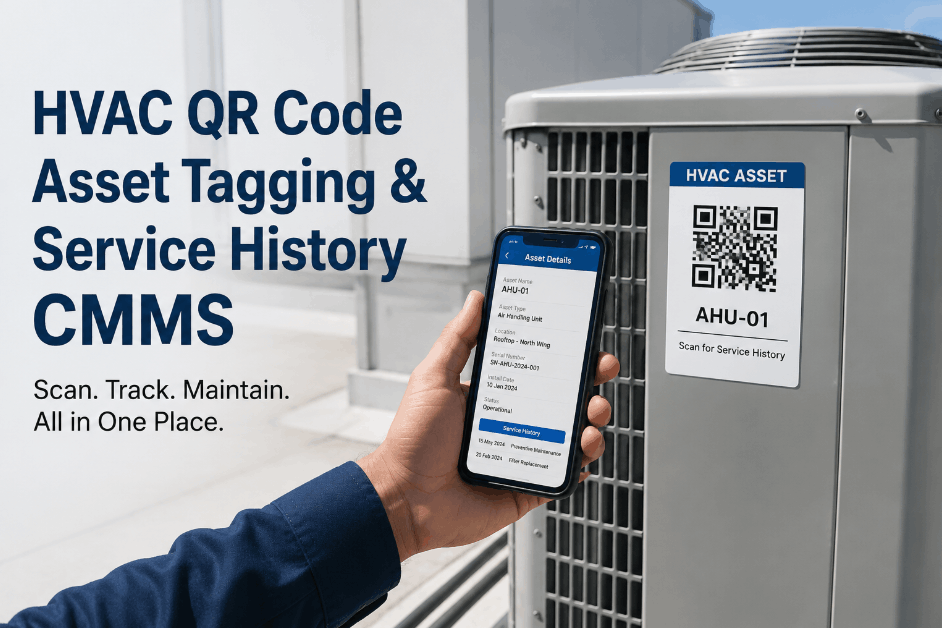
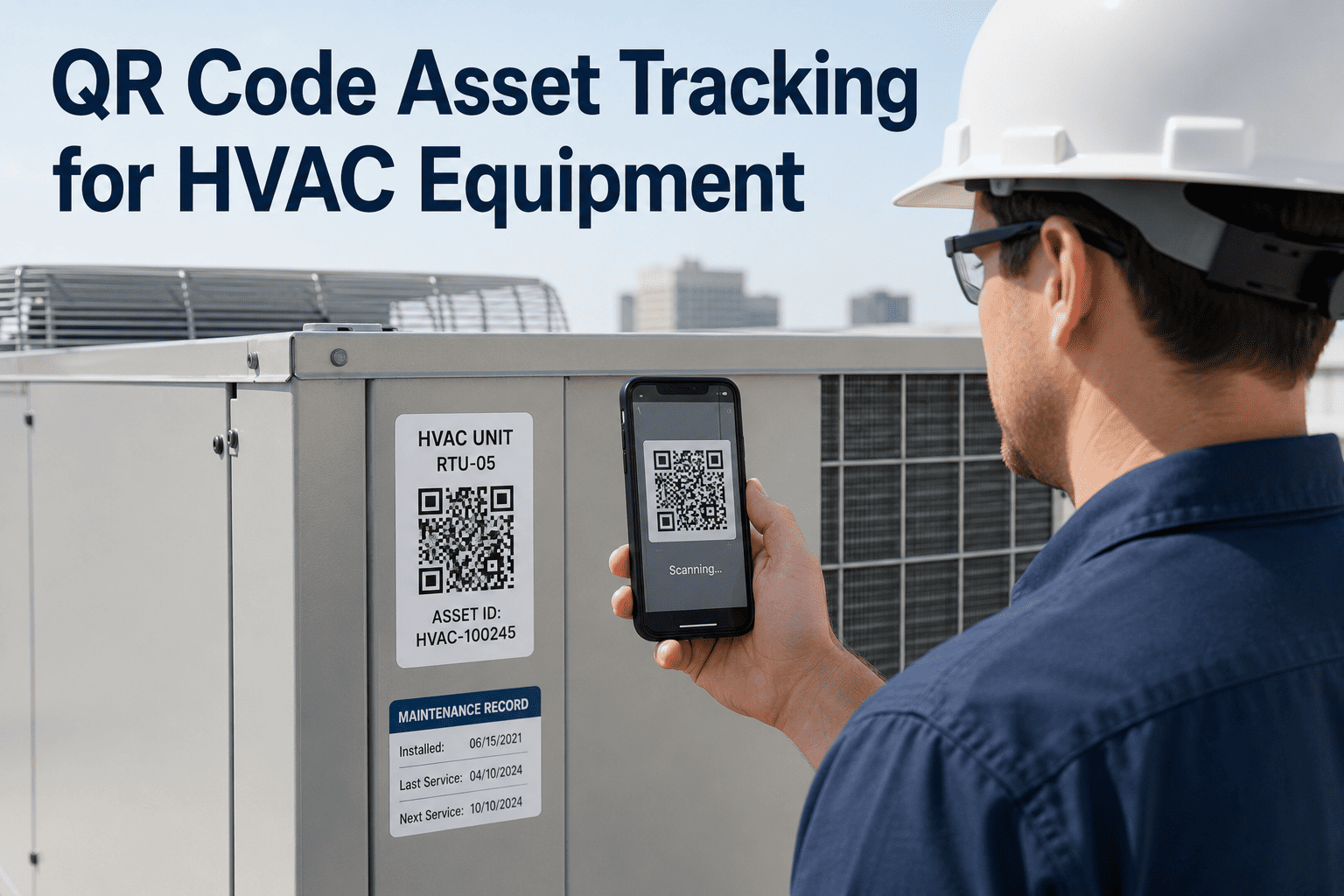
QR Code (weatherproof)
Encodes: Asset ID, equipment model, install date, service history link, refrigerant type/charge
Use: Technician scans equipment tag on arrival — pulls complete service history, PM schedules, and parts list for this specific unit.
Tip: UV-resistant, adhesive-backed metal or polyester labels. Mount on the access panel frame — visible, protected, and permanent.
Warehouse Shelf Labels
QR Code + Readable Text
Encodes: Bin address (Aisle-Rack-Shelf), assigned SKU(s), min/max levels, reorder status
Use: Warehouse staff scans shelf bin during picking, receiving, or cycle counting — confirming the right part in the right location.
Tip: Include human-readable part number and location below the QR code. Backup for when the scanner isn't handy or the label is partially obscured.
Error Elimination: What Scanning Prevents
Manual parts documentation fails in predictable ways. Scanning eliminates each failure mode systematically — not by asking technicians to be more careful, but by removing the opportunity for error entirely. Facilities evaluating scan-based systems can book a free demo to see how error rates drop after implementation.
Manual Entry Errors Eliminated by Scanning
✗
Wrong part number entered
Occurs 12–18% of manual entries
→
✓
Barcode scan captures exact manufacturer part number — zero transcription errors
✗
Part usage not logged at all
Occurs 40–60% of field installs
→
✓
Scan-to-close workflow requires part scan before work order completion — logging is mandatory, not optional
✗
Part assigned to wrong equipment
Occurs 8–15% when entering manually
→
✓
Equipment QR tag scanned on arrival links all parts used to the correct asset automatically
✗
Warranty info missing or wrong
Occurs 70%+ of manual records
→
✓
QR code encodes manufacturer warranty terms. Install date captured at scan. Expiration calculated automatically.
✗
Inventory count becomes inaccurate
Drift starts within 1 week of physical count
→
✓
Every scan adjusts inventory in real time — counts stay accurate continuously, not just on count day
Mobile Scanning: The Technician's Experience
Adoption depends on ease of use. If scanning takes longer than not scanning, technicians won't do it. The mobile scanning interface is designed so that scanning a part is faster than the old method of writing it down — and dramatically faster than the even older method of trying to remember it later. Operations optimizing their mobile workflow should sign up to test the mobile scanning experience.
Mobile Scan Interface — What the Technician Sees
1
Open Active Work Order
Technician taps the current job from the dispatch queue. Work order details, equipment info, and previous service history are already loaded.
Already open from dispatch
2
Tap "Add Part" → Camera Opens
Single tap opens the camera in scan mode. Point at any barcode or QR code — auto-detects format and decodes instantly. No mode switching needed.
1 tap
3
Scan Part or Bin Label
Camera reads the code. Part details populate: name, number, manufacturer, specs. If scanning a bin label, the assigned part auto-fills. Technician confirms quantity (default: 1).
1–2 seconds
4
Confirm → All 7 Actions Fire
One tap confirms. Van inventory, work order, asset record, warranty, warehouse signal, usage log, and invoice line item all update simultaneously. Done.
1 tap — total process under 5 seconds
Warranty Recovery: The Hidden Revenue Stream
Every HVAC service company has money sitting in expired warranty claims they never filed because they couldn't prove when a part was installed, which part was installed, or on which unit. Scan-based documentation creates an automatic warranty registry that tracks every warrantable part, alerts when warranty coverage is active, and provides the documentation manufacturers require for claim processing.
Warranty Recovery Impact — Before and After Scanning
Before: Manual Records
Only 20–30% of installed parts have complete warranty records
Warranty claims rejected for missing install dates or part numbers
Technicians replace parts without checking if existing part is under warranty
No alerts when warranty is about to expire — coverage lapses unnoticed
Average warranty recovery rate: 12% of eligible claims
After: Scan-Based Records
100% of scanned parts have complete warranty records from install moment
Claims include scan timestamp, part number, serial, technician, and asset ID
System alerts technician if existing part is under warranty before replacement
Automated alerts 30/60/90 days before warranty expiration on every part
Average warranty recovery rate: 68% of eligible claims
Expert Perspective: Make Scanning Easier Than Not Scanning
I've rolled out barcode scanning systems at over 40 HVAC service companies, and the success or failure of every single implementation came down to one thing: is scanning easier than not scanning? If a technician has to open a separate app, search for the right screen, wait for it to load, aim the camera, wait for processing, and then manually confirm three fields — they're not going to do it. If they tap one button, point the phone at a bin label, hear a beep, and they're done — they'll do it every time. The technology isn't the hard part. Getting technicians to use it consistently is the hard part. And the way you solve that is by making the scan workflow take fewer seconds and fewer taps than the alternative. The other critical factor is labeling. If even 10% of your van bins don't have scannable labels, technicians will develop the habit of manual entry "because the label was missing" — and then they'll use that excuse even when labels are present. Label every bin, every shelf, every equipment asset. One hundred percent coverage, zero exceptions. Then scanning becomes muscle memory instead of a choice.
Label First, Then Launch
Print and install QR labels on every van bin, every warehouse shelf, and every customer equipment asset before launching the scanning workflow. Incomplete labeling is the number one adoption killer.
Require Scan to Close Work Order
If scanning is optional, it's ignored. Make part scanning a required step before a work order can be marked complete. This single policy change drives adoption from 30% to 95% in the first month.
Celebrate Accuracy, Not Speed
Track and display van inventory accuracy by technician — weekly. Recognize the techs with 98%+ accuracy. Peer visibility drives behavior change faster than any training or policy memo.
Scan It. Track It. Never Lose a Part Record Again.
OXmaint's mobile app scans 1D barcodes and QR codes — updating van inventory, work orders, customer assets, warranty records, and invoices in a single gesture. Every part tracked from warehouse shelf to customer installation in 2 seconds. No typing. No forgetting. No errors.
What is barcode and QR code scanning for HVAC parts?
Barcode and QR code scanning for HVAC parts is a mobile-based documentation system that allows technicians to record part usage, update inventory, and create complete service records by scanning a code on the part or the van bin with a smartphone camera. When a technician scans a barcode (1D linear code containing part number and manufacturer identifier) or QR code (2D matrix code containing extended data like specifications, warranty terms, and install instructions), the system automatically identifies the part, links it to the active work order and customer equipment, deducts it from van inventory, starts warranty tracking, captures the technician and timestamp, and adds the part cost to the service invoice. This replaces manual data entry — which technicians skip 40–60% of the time — with a 2-second scan that creates seven simultaneous data connections. The result is accurate inventory, complete service records, automated warranty tracking, and parts traceability from warehouse to installation that would be impossible to achieve with manual documentation methods.
What is the difference between a barcode and a QR code for HVAC parts?
A 1D barcode (such as UPC or Code 128) stores 20–25 characters of data — typically a part number and manufacturer code — in a series of vertical lines that require a horizontal scanning path. Most HVAC parts arrive from manufacturers with a barcode already printed on the packaging. A QR code (Quick Response code) is a 2D matrix that stores up to 4,296 characters — enough for part number, specifications, warranty terms, installation instructions, and a link to the full part record in the CMMS. QR codes are square, can be printed much smaller than barcodes for equivalent data, and tolerate up to 30% physical damage while remaining readable. In HVAC operations, the optimal approach is to use manufacturer-printed barcodes where they already exist (no additional labeling needed) and add custom QR codes to van bins, warehouse shelves, and equipment asset tags where more data or damage resistance is needed. The scanning app reads both formats automatically — the technician simply points the camera and the system identifies the code type.
How does scanning improve HVAC parts inventory accuracy?
Scanning improves inventory accuracy from the typical 55–65% achieved with manual end-of-day logging to 95–98% with scan-at-use discipline. The improvement comes from three factors. First, the scan captures part usage at the exact moment of consumption — not at the end of the day when the technician tries to remember what was used on which job. Second, the scan is accurate by definition — it reads the actual code on the actual part, eliminating the transcription errors that occur in 12–18% of manual entries (wrong part numbers, transposed digits, approximate descriptions). Third, the scan is enforceable — by requiring a part scan before a work order can be closed, the system eliminates the 40–60% of installations where technicians skip documentation entirely. The cumulative effect is that van inventory counts match physical stock at all times, replenishment triggers fire when they should, and warehouse reorder calculations are based on actual consumption data rather than estimates.
Do technicians need special hardware to scan barcodes and QR codes?
No special hardware is required for most HVAC operations. Modern smartphones — both iOS and Android — have cameras fully capable of scanning 1D barcodes and QR codes at the distances and speeds needed in field service. The CMMS mobile app uses the phone's built-in camera with software-based decoding that reads codes in under a second, even in varied lighting conditions. For warehouse environments where scanning volume is higher and speed is more critical, some operations invest in dedicated Bluetooth barcode scanners ($150–$300) that pair with a phone or tablet and provide faster scanning with audible confirmation. Rugged cases with built-in scan windows are also available for field use in harsh conditions. However, for the typical HVAC technician scanning 5–15 parts per day, the smartphone camera in the standard CMMS mobile app provides excellent performance without any additional equipment investment.
How does barcode scanning integrate with CMMS and van inventory?
Barcode scanning integrates with the CMMS at every touchpoint in the parts lifecycle. When a part is received at the warehouse, it's scanned into inventory with quantity, bin location, and supplier information. When parts are picked for van replenishment, they're scanned out of warehouse stock and into the specific van's inventory — each van maintains its own stock profile in the system. When a technician uses a part on a service call, the scan simultaneously deducts from the van's inventory, links to the work order, updates the customer's asset record, starts warranty tracking, and adds the cost to the invoice. When the van's stock drops below par level, the system generates a replenishment request that appears on the warehouse pick list. This creates a continuous, scan-verified chain of custody from vendor delivery through warehouse storage, van loading, and field installation — with every transaction timestamped, every count accurate, and every part traceable to the specific technician, work order, and customer asset where it was installed.