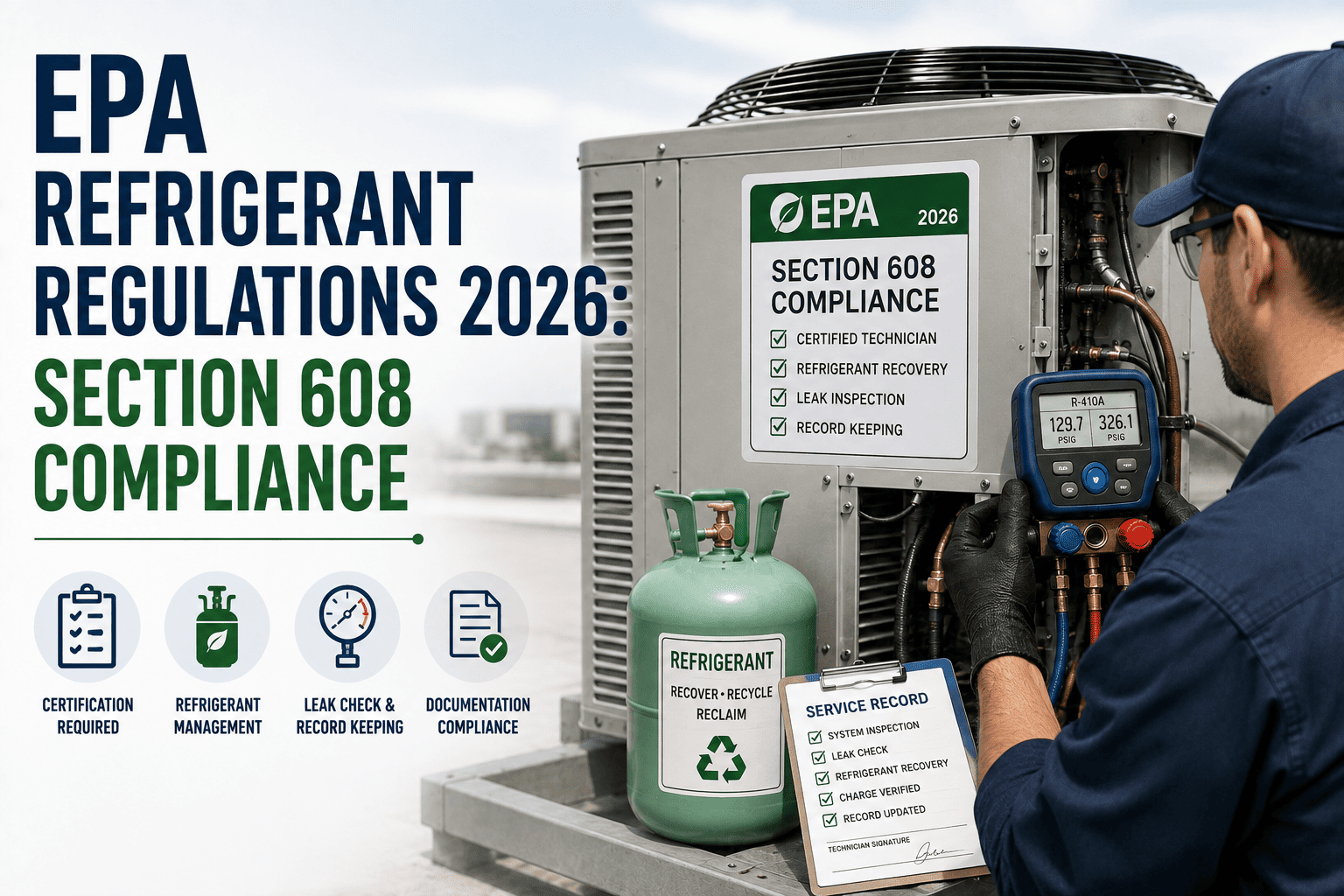
The global HVAC refrigerant landscape is shifting faster than most facility teams realize. In the United States, the AIM Act's Technology Transitions Rule began restricting manufacture and installation of high-GWP HFC systems on January 1, 2025. The HFC Leak Repair and Management Rule takes effect January 1, 2026, imposing mandatory leak detection requirements on all systems with 15+ pounds of HFC charge. The EU F-Gas Regulation is phasing down HFC quotas by 95% by 2050. And the Kigali Amendment to the Montreal Protocol has locked 150+ countries into binding HFC reduction schedules. Facility managers who wait for deadlines to arrive before acting face equipment stranding, compliance penalties, and refrigerant supply disruptions. Sign up for Oxmaint to track refrigerant compliance deadlines, leak inspection schedules, and equipment transition timelines automatically.
HVAC Refrigerant Regulations: AIM Act, EU F-Gas, and Global Phase-Down Compliance Guide
Navigate the US AIM Act Technology Transitions and HFC Management Rules, EU F-Gas Regulation, Kigali Amendment, and regional standards — with CMMS-driven compliance tracking for every deadline.
What Facility Managers Need to Know Right Now
Refrigerant regulations affect three areas simultaneously: what refrigerant new equipment can use, how existing equipment must be managed for leaks, and when high-GWP systems must be retired or retrofitted. The compliance landscape is layered — federal, state, and international rules overlap, and deadlines vary by equipment type, charge size, and sector. Missing a deadline does not just mean a fine — it can mean stranded equipment that cannot be legally recharged after its next leak event. Book a demo to see how Oxmaint tracks every regulatory deadline specific to your equipment inventory.
Three Regulatory Frameworks You Must Track
AIM Act (2020)
The American Innovation and Manufacturing Act authorizes EPA to phase down HFC production and consumption by 85% by 2036, restrict use of high-GWP refrigerants in new systems by sector, and mandate leak management for existing equipment.
EU F-Gas Regulation (Revised 2024)
The revised EU F-Gas Regulation accelerates HFC phase-down to a 95% reduction in HFC quotas by 2050, bans HFCs with GWP over 750 in new single split AC systems from January 2025, and tightens leak inspection and reporting requirements. Sign up for Oxmaint to track EU F-Gas deadlines alongside AIM Act requirements.
Kigali Amendment to the Montreal Protocol
Ratified by 150+ countries, the Kigali Amendment establishes binding HFC reduction schedules differentiated by national development status. Developed countries must reduce HFCs by 85% by 2036. Developing countries (Group 1) begin their freeze in 2024 with 80% reduction by 2045. Developing countries (Group 2) freeze in 2028 with 85% reduction by 2047.
Track Every Refrigerant Deadline Automatically
Oxmaint maps compliance deadlines to your specific equipment inventory — by refrigerant type, charge size, sector, and jurisdiction.
GWP Limits by Sector — Quick Reference
| Sector / Subsector | GWP Limit | Compliance Date | Jurisdiction |
|---|---|---|---|
| Residential AC and Heat Pumps | 700 | Jan 1, 2025 (mfg); Jan 1, 2026 (install) | US AIM Act |
| VRF Systems | 700 | Jan 1, 2026 (mfg); Jan 1, 2027 (install) | US AIM Act |
| Self-Contained Commercial Refrigeration | 150 | Jan 1, 2025 | US AIM Act |
| Remote Condensing Units (under 200 lb) | 300 (proposed: 1,400 until 2032) | Jan 1, 2026 | US AIM Act |
| Supermarket Systems | 150–300 (proposed: 1,400 until 2032) | Jan 1, 2027 | US AIM Act |
| Cold Storage Warehouses | 150–300 (proposed: 700 until 2032) | Jan 1, 2026 | US AIM Act |
| Single Split AC (under 3 kg) | 750 (2025); 150 (2027) | Jan 1, 2025 / 2027 | EU F-Gas |
| Multi-Split / VRF (under 12 kg) | 150 | Jan 1, 2032 | EU F-Gas |
What Your Facility Team Should Do Now
Inventory Every Refrigerant-Containing System
Document refrigerant type, charge size, GWP value, installation date, and sector classification for every unit. Systems with 15+ lb HFC charge are subject to the January 2026 leak management rule. Sign up for Oxmaint to build your refrigerant asset registry.
Map Equipment to Compliance Deadlines
Match each system against its sector-specific GWP limit and compliance date. Identify which units can continue operating with existing refrigerant, which need retrofit, and which face end-of-life replacement.
Establish Leak Inspection Schedules
The HFC Management Rule requires annual inspections for covered systems starting January 2026. Systems over 1,500 lb charge must have automatic leak detection installed. Build inspection schedules into your CMMS now.
Plan Equipment Transition Timelines
Budget for A2L-compatible equipment replacements. Coordinate with contractors on updated safety standards (UL 60335-2-40) for mildly flammable refrigerants. Book a demo to see refrigerant transition planning in Oxmaint.
Oxmaint Compliance Tracking for Refrigerant Management
Refrigerant Asset Registry
Every unit tracked by refrigerant type, GWP, charge size, sector classification, and applicable regulatory deadline — with automated compliance status alerts.
Leak Inspection Scheduling
Automated annual inspection schedules for all covered systems with technician assignment, completion tracking, and leak rate calculation against regulatory thresholds.
Reporting and Documentation
Generate EPA-required annual reports from CMMS data. Maintain audit-ready leak records, service histories, and refrigerant purchase/reclamation logs. Start your free trial.
Stay Ahead of Every Refrigerant Regulation
Your CMMS should know which units are approaching compliance deadlines before you do.
Frequently Asked Questions
Do Not Wait for the Next Deadline to Act
The HFC Management Rule is already in effect. Build your refrigerant compliance infrastructure today — before the next inspection cycle.