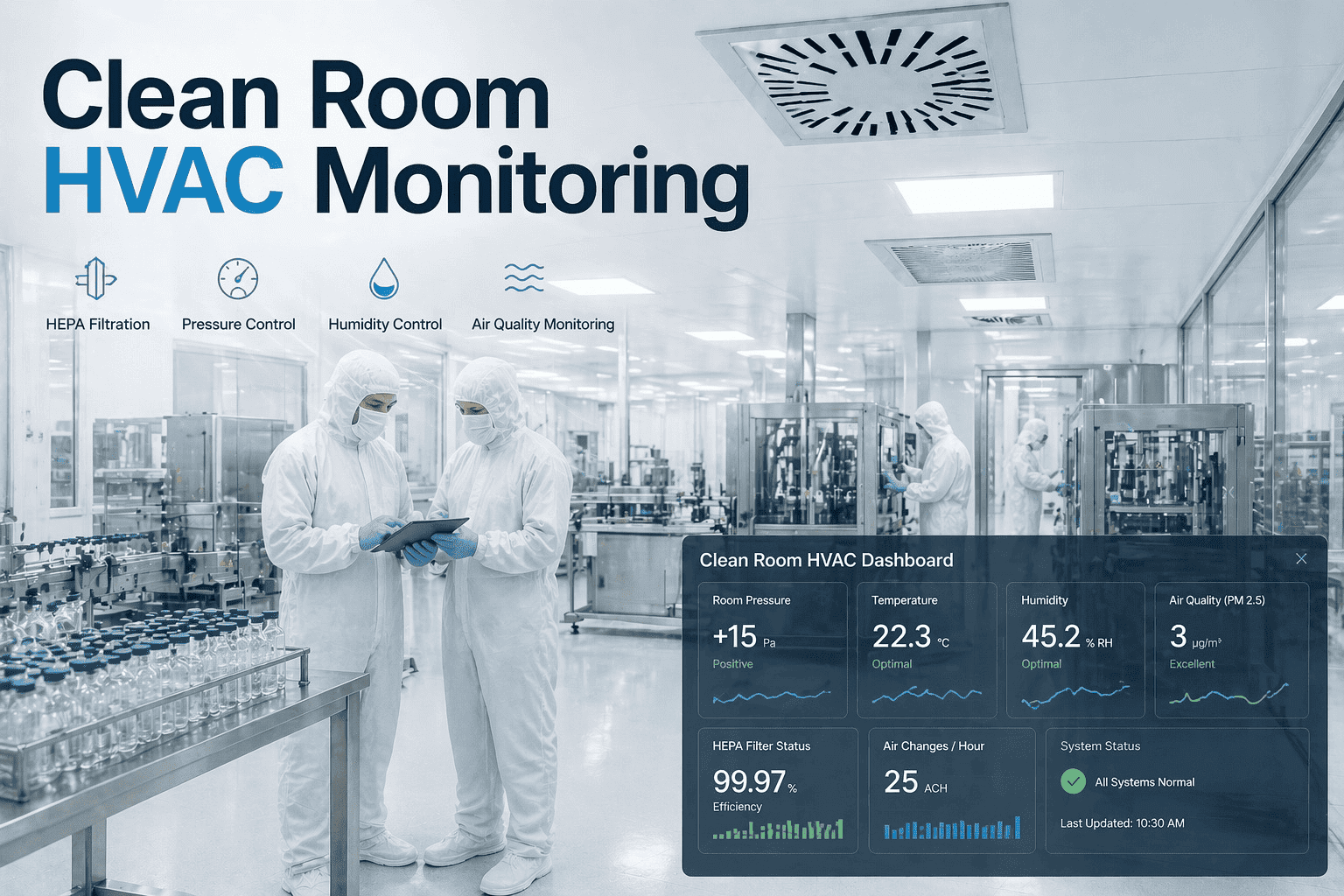
A pharmaceutical cleanroom HVAC system is not building infrastructure — it is validated manufacturing equipment regulated under 21 CFR Part 211, subject to qualification protocols, and required to maintain ISO classification at all times during production. When HVAC parameters drift outside defined limits, the consequence is not a maintenance work order — it is an FDA Form 483 observation, a potential batch rejection, and a contamination investigation that can halt production for weeks at a cost of $2–$8 million per event. A mid-sized oral solid dosage facility managing ISO 7 and ISO 8 cleanrooms across six production suites had maintained near-perfect HVAC performance for years — but was doing so through heroic individual effort, paper logs, and institutional memory rather than a system. After deploying Oxmaint's compliance tracking module, the facility maintained clean room HVAC certification for 4 consecutive years without a single documentation deviation, overdue qualification, or pressure cascade exceedance.
Case Study — Pharmaceutical Manufacturing
Pharmaceutical Facility Maintains Clean Room HVAC Certification for 4 Consecutive Years with Oxmaint
4 Years
Continuous certification — no gaps, no deviations
100%
HEPA integrity tests completed on schedule
Zero
FDA Form 483 HVAC observations across 3 inspections
0
Overdue qualifications in 48 months
The Regulatory Context
What Clean Room HVAC Certification Actually Requires
ISO 14644-1 classifies cleanrooms from ISO 5 to ISO 8 based on airborne particle counts per cubic metre. HVAC systems — specifically HEPA filtration, air change rates, and pressure differentials between zones — are the primary mechanical controls that maintain each classification. Any HVAC deviation is a potential classification exceedance. Grade A and B cleanrooms require annual requalification; Grade C and D every 2–3 years. And under both FDA 21 CFR Part 211 and EU GMP Annex 1, the most frequently cited HVAC finding in inspections is not equipment failure — it is undocumented maintenance.
01
HEPA Integrity Testing
Semi-annual DOP/PAO aerosol challenge on all HEPA filter banks. A single bypass path introduces unfiltered air into the classified zone — an immediately reportable GMP deviation. Filter lot number, test instrument calibration reference, and technician ID must all be documented.
Frequency: Semi-annual (Grade A/B) · Annual (Grade C)
02
Pressure Differential Monitoring
Continuous monitoring of differential pressure between cleanroom zones with alert and action limits defined in the Validation Master Plan. Pressure cascade collapse — even temporary — constitutes a classification risk requiring formal deviation and CAPA investigation.
Frequency: Continuous monitoring + daily log verification
03
Air Change Rate Verification
Air velocity and volume measurements confirming the facility delivers the required air changes per hour for each ISO class. ISO 7 requires a minimum 15–20 ACPH under operational conditions; ISO 8 requires 10–15 ACPH. Measurement must be performed with calibrated instruments traceable to reference standards.
Frequency: At qualification, after HVAC modifications, and at requalification
04
Temperature & Humidity Control
Environmental parameters maintained within defined limits (typically ±2°C and ±5% RH from setpoint). Calibrated sensors with documented calibration certificates, alert limits triggering immediate investigation, and action limits requiring product impact assessment and formal deviation.
Frequency: Continuous real-time monitoring with daily review
The Challenge
What Near-Misses Looked Like Before Oxmaint
Paper-Based HVAC Compliance
HEPA test due dates tracked in a spreadsheet — overdue status discovered only at monthly quality meeting
Pressure exceedances logged in paper diary — deviation not formally opened until the following day
Calibration certificates for pressure gauges filed in physical binder — unavailable for FDA inspection on demand
Qualification records scattered across facility management, QA, and engineering — no single source of truth
Technician who performed HEPA testing left company — institutional knowledge about filter numbering system lost
Oxmaint Compliance Tracking
Qualification calendar with automated alerts 30, 14, and 7 days before each test is due — zero overdue status
Pressure exceedance triggers automatic deviation work order with room, parameter, and timestamp — immediate response
All calibration certificates linked to instrument asset records — pulled in under 30 seconds during FDA walk-through
Single qualification dashboard covering all suites, all parameters — QA and engineering share one system
Complete documented asset history per HEPA bank, AHU, and sensor — survives every staff change
Compliance Tracking — Pharmaceutical HVAC
Maintain Clean Room Certification Without the Documentation Risk
Oxmaint's compliance tracking gives your QA and facilities teams a shared qualification calendar, auto-generated deviation work orders, and audit-ready records for every HEPA test, pressure check, and calibration event — linked to the instrument, technician, and SOP version in effect at execution.
Qualification Schedule
Clean Room HVAC Compliance Calendar — What Oxmaint Manages
| HVAC Compliance Task |
ISO Grade |
Required Frequency |
Documentation Required |
Regulatory Reference |
| HEPA Integrity Test (DOP/PAO) |
Grade A/B (ISO 5/7) |
Semi-annual |
Filter ID, instrument cal. cert., technician ID, results |
ISO 14644-3 / EU GMP Annex 1 |
| HEPA Integrity Test |
Grade C/D (ISO 7/8) |
Annual |
Filter ID, instrument cal. cert., technician ID, results |
ISO 14644-3 / 21 CFR Part 211 |
| Pressure Differential Monitoring |
All grades |
Continuous + daily log |
Alert/action limit exceedances → formal deviation |
EU GMP Annex 1 §4.8 |
| Air Change Rate Measurement |
All grades |
At qualification / after changes |
Calibrated instrument trace, measured ACPH by zone |
ISO 14644-3 / FDA cGMP |
| Temperature & RH Calibration |
All grades |
Annual minimum |
NIST-traceable calibration certificate, sensor ID |
ISO 14644-1 / 21 CFR Part 211.68 |
| Particle Count (requalification) |
Grade A/B |
Annual |
At-rest and operational counts, statistical analysis |
ISO 14644-1:2025 |
| AHU Filter Change (pre-filters) |
All grades |
Quarterly / by differential pressure |
Filter lot number, date, technician signature |
Facility SOP / Validation Master Plan |
| Damper & Valve Functional Test |
All grades |
Annual |
Before/after differential readings, calibration reference |
Validation Master Plan |
Expert Review
"
The FDA Form 483 observations I see most frequently in pharmaceutical facilities are not about equipment failures — they are about documentation failures. A HEPA filter that tested clean but has no instrument calibration certificate attached to the test record. A pressure exceedance that was corrected within 10 minutes but was never formally opened as a deviation. A requalification that was completed on time but the technician who signed it was not listed as trained on the SOP version in effect that day. These are all deviations that Oxmaint prevents structurally, not by adding administrative burden but by making the correct documentation path the only path. After four years of zero documentation observations across this facility's FDA inspections, the data speaks for itself — the system works because it makes compliance the path of least resistance.
Dr. Elena Marchetti
GMP Compliance Consultant — Former FDA Investigator / EU QP / 22 Years in Pharmaceutical Facility Qualification and Validation
Questions
Pharmaceutical HVAC Compliance — Frequently Asked Questions
How does Oxmaint support 21 CFR Part 211 HVAC compliance specifically?
Oxmaint's compliance tracking enforces SOP-linked work order completion with mandatory documentation fields — technician qualification, instrument calibration status, lot numbers, and result entry cannot be skipped. Calibration expiry dates for all pressure gauges, particle counters, and temperature sensors are tracked with automated pre-expiry alerts. Qualification status per cleanroom zone is maintained in real time, and audit-ready reports per suite or building are generated on demand — exactly the evidence package an FDA inspector expects to see during a 483-avoidance walk-through.
Start a free trial to configure your facility's qualification calendar.
How often must pharmaceutical cleanroom HVAC systems be requalified?
Under ISO 14644-1:2025 and EU GMP Annex 1, Grade A and Grade B cleanrooms require annual requalification including full HEPA integrity testing, particle counts, pressure differential verification, and air change rate measurement. Grade C and D cleanrooms require requalification every 2–3 years. Requalification must also be triggered after any significant HVAC modification, construction adjacent to the classified area, or repeated monitoring deviations — regardless of the calendar schedule. Facilities should embed these triggers into their change management procedure, with Oxmaint generating automatic requalification work orders when any triggering event is documented.
Book a demo to see how Oxmaint manages change-triggered requalification workflows.
What are the most common FDA HVAC observations in pharmaceutical facilities?
The most frequently cited GMP HVAC findings are: filter changes recorded without lot numbers or technician signature; HEPA integrity test records without the calibration certificate for the test instrument; pressure exceedances corrected in real time but never formally opened as deviations; overdue requalification discovered during inspection rather than before; and qualification records scattered between QA, engineering, and facility management with no single accessible source. All of these are structural documentation failures that a properly configured CMMS eliminates by making complete documentation mandatory before work order closure.
Oxmaint makes every required documentation field mandatory — incomplete records cannot be closed.
Can Oxmaint handle both QA qualification records and engineering maintenance records in a single platform?
Yes — Oxmaint is configured so that QA-owned qualification tasks (HEPA integrity testing, requalification, environmental monitoring review) and engineering-owned maintenance tasks (AHU filter changes, belt inspections, damper calibration) share the same asset record and compliance calendar. Both teams work from one system, eliminating the duplicate records, reconciliation effort, and gaps that occur when QA tracks qualification separately from the CMMS maintaining the maintenance history. This unified view is what FDA inspectors and EU QPs expect when they request the complete HVAC asset history during an inspection.
Book a demo to see the QA + engineering unified workflow in Oxmaint.
Built for Pharmaceutical Compliance
Four Consecutive Years of Clean Room HVAC Certification. No Documentation Deviations. No Overdue Qualifications.
Oxmaint gives pharmaceutical facilities the compliance tracking infrastructure to maintain cleanroom certification as a system — not as an act of individual memory. Qualification calendars, deviation auto-generation, audit-ready records, and unified QA + engineering workflows. Built for the documentation rigor that FDA and EU GMP inspections require.