The HVAC industry in 2026 is at an inflection point. The companies still operating on run-to-failure or calendar-based maintenance are watching their best customers leave for competitors who can predict failures before they happen, dispatch technicians before comfort is lost, and prove equipment health with real-time data instead of guesswork. Predictive maintenance powered by IoT sensors and robotics isn't experimental anymore — it's the standard that commercial building owners, property managers, and facility directors now expect from their HVAC partners. The technology has matured, the costs have dropped, and the ROI is undeniable: 25-40% reduction in unplanned breakdowns, 15-30% lower maintenance costs, and 10-20% extension of equipment lifespan.
For HVAC service companies managing hundreds or thousands of units through Oxmaint's maintenance platform, predictive technology transforms the business model from reactive firefighting to proactive asset management. IoT sensors provide continuous equipment health data. Machine learning algorithms detect degradation patterns weeks before failure. Robotic inspection and cleaning systems deliver consistent, documented maintenance. And the CMMS ties it all together — turning sensor alerts into dispatched work orders, tracking repair outcomes, and generating the performance reports that justify premium service agreement pricing. This guide covers the technologies, the implementation strategy, and the economics of predictive HVAC maintenance in 2026.
The Predictive Maintenance Technology Stack
A complete predictive HVAC maintenance system has four layers. Each builds on the one below it, and the full stack delivers dramatically better outcomes than any single technology alone:
Automated Action
CMMS integration auto-generates work orders from predictions. Dispatches the right technician with the right parts before the failure occurs. Tracks outcome to improve future predictions. This is where Oxmaint closes the loop — turning data into dispatched, completed, verified maintenance.
Analytics & Prediction
Machine learning models analyse sensor data patterns to detect anomalies and predict failures 2-8 weeks before they occur. Models learn from each unit's unique operating signature — what's normal for a 15-year rooftop unit in Phoenix is very different from a 3-year unit in Seattle.
Connectivity & Data Platform
Cellular, Wi-Fi, or LoRaWAN connectivity transmits sensor data to the cloud platform. Data normalisation, storage, and API integration with your CMMS. Typical data volume: 500-2,000 data points per unit per day.
IoT Sensors & Edge Devices
Physical sensors installed on HVAC equipment measuring vibration, temperature, pressure, current, humidity, and refrigerant parameters. Battery-powered wireless sensors with 3-5 year battery life. Installation time: 15-30 minutes per unit.
IoT Sensors: What to Monitor and Why
Not every sensor delivers equal value. Here are the highest-ROI sensor deployments for HVAC predictive maintenance in 2026, ranked by failure-detection effectiveness:
Compressor Current & Vibration
Current signature analysis detects bearing wear, valve degradation, and refrigerant issues 3-6 weeks before failure. Vibration sensors catch mechanical degradation. Combined, they predict 70-85% of compressor failures — the most expensive HVAC repair.
Supply/Return Air Temperature
Continuous delta-T monitoring detects degrading heat transfer from dirty coils, low refrigerant charge, or airflow restrictions. A shrinking delta-T trend over weeks indicates declining system performance before comfort complaints arise.
Refrigerant Pressure (Suction/Discharge)
Wireless pressure transducers on suction and discharge lines detect charge loss, restriction, and compressor valve issues. Superheat and subcooling calculated in real time without a technician connecting gauges.
Electrical Power Monitoring
Whole-unit power consumption trending detects efficiency degradation, phase imbalance, and contactor/capacitor issues. A unit drawing 15% more power than baseline with the same load indicates developing problems across multiple components.
Condensate & Humidity Sensors
Detect drain line blockages before overflow causes water damage. Humidity trending in the supply air indicates evaporator coil issues or drainage problems. Critical for commercial buildings where water damage claims average $10,000-$50,000.
Filter Differential Pressure
Measures pressure drop across the air filter in real time. Replaces calendar-based filter changes with condition-based changes — some filters last 2 months in clean environments, others need monthly replacement in dusty conditions. Prevents both premature replacement waste and overdue changes.
Robotics in HVAC Maintenance: 2026 Applications
Robotic systems are moving beyond novelty into practical, revenue-generating HVAC applications. Here are the three robotic technologies delivering real ROI for service companies today:
Robotic Coil Cleaning
Autonomous robots that traverse coil faces delivering consistent, controlled cleaning. Restore 85-98% of original airflow vs. 60-75% from manual cleaning. Clean 12-20 units per tech per day vs. 4-6 manual. Investment: $15,000-$45,000 per system. Payback: 2-6 months.
Duct Inspection Robots
Camera-equipped crawlers that navigate ductwork documenting interior condition, debris accumulation, insulation damage, and biological growth. Replace destructive access panel cutting with non-invasive video inspection. Generate customer-facing reports with timestamped footage.
Automated Refrigerant Leak Detection
Continuous refrigerant monitoring systems with IoT-connected sensors that detect leaks as small as 0.5 oz/year. Critical for EPA compliance under AIM Act regulations tightening HFC management requirements. Automated alerts replace quarterly manual leak checks.
Implementation Roadmap: From Zero to Predictive in 12 Months
You don't need to deploy every technology at once. The most successful HVAC companies follow a phased approach that proves ROI at each stage before expanding:
Foundation
Expansion
Optimization
The Future of HVAC Maintenance Isn't Reactive. It's Predictive. Start Building It Today.
Oxmaint connects IoT sensor data, robotic maintenance workflows, and predictive analytics into a single platform — turning your service company into a technology-powered asset management partner.
Frequently Asked Questions
How much does it cost to add IoT predictive maintenance to our service?
Total cost depends on scale and sensor depth. For a basic deployment (temperature + current on 50 units): $5,000-$15,000 hardware, $200-$500/month platform fee, ROI positive within 3-4 months from prevented failures. For a comprehensive deployment (full sensor suite on 200+ units plus robotic cleaning): $40,000-$100,000 Year 1 investment, generating $150,000-$500,000 in additional revenue from premium service tiers and prevented callbacks. The key insight: sensor costs are dropping 15-20% per year while the value of predictive data is increasing as ML models improve with more data.
Do we need to be a large company to benefit from predictive maintenance?
No. A 5-technician company can start with sensors on their top 20-30 commercial accounts and see meaningful results within one season. The technology scales down effectively: install sensors on your highest-value maintenance agreement customers first, use the predictive alerts to prevent failures that would have been expensive callbacks, and use the data to justify premium pricing on renewals. Many small HVAC companies report that predictive monitoring on just 20-30 units generates enough prevented failures to pay for the entire sensor investment in the first cooling season.
How accurate are predictive failure alerts?
Accuracy depends on the failure type and data maturity. Compressor failures (current + vibration sensors): 70-85% detection rate with 2-6 week lead time after 3-6 months of baseline data. Refrigerant charge loss (pressure sensors): 85-95% detection with 1-4 week lead time. Airflow degradation (temperature + filter DP): 90%+ detection but with shorter lead time (days to weeks). False positive rates typically run 5-15% in the first year, dropping to 2-8% as the ML models learn each unit's specific operating patterns. The key is that even imperfect prediction is dramatically better than no prediction: catching 75% of failures before they happen eliminates the majority of emergency calls.
How do we price predictive maintenance services to customers?
Three proven pricing models: Premium tier add-on — add $50-$150/month per unit on top of standard PM agreement for continuous monitoring + predictive alerts + priority response. Works well for high-value commercial accounts. Equipment-as-a-service — bundle monitoring into a comprehensive monthly fee covering all maintenance, parts, and labour. Highest margin but requires strong data on unit-level maintenance costs. Monitoring-only subscription — $15-$40/month per unit for sensor data and alerts only, customer still pays for service calls. Lowest barrier to entry, good for building the monitored base before upselling full service. Most companies start with the premium tier add-on and migrate toward equipment-as-a-service as their data matures.
What happens to sensor data when it integrates with Oxmaint?
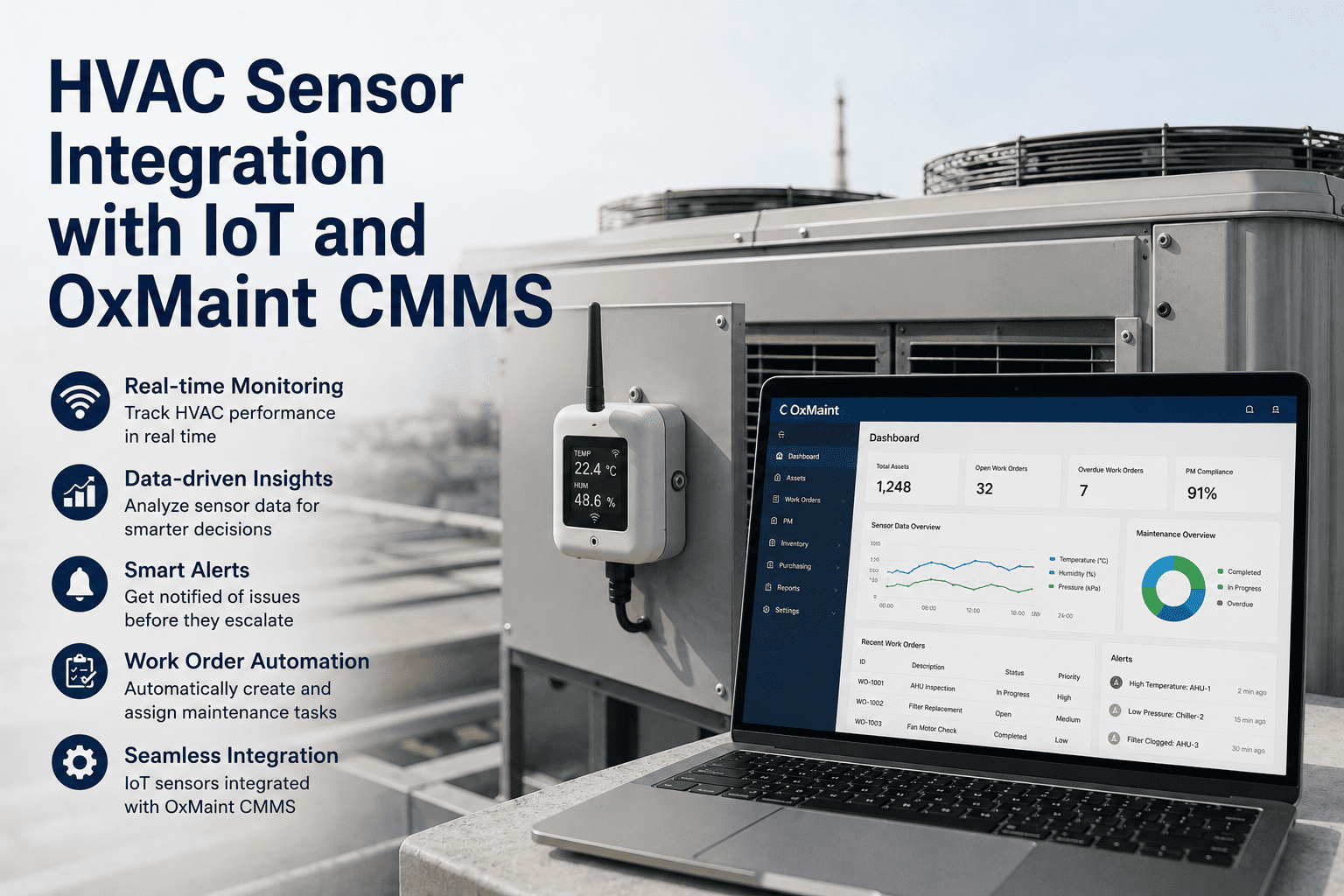
Oxmaint receives sensor data via API integration with the IoT platform and processes it through configurable rules: when compressor current exceeds 110% of baseline for 48+ hours, generate a Priority 2 work order for "compressor performance investigation" assigned to the account's primary technician with the sensor data attached. The technician arrives with diagnostic context already in hand. After the repair, the outcome is logged against the alert — building a feedback loop that improves prediction accuracy over time. All sensor data is stored in the equipment history, creating a rich performance record that supports warranty claims, replacement timing decisions, and customer reporting.