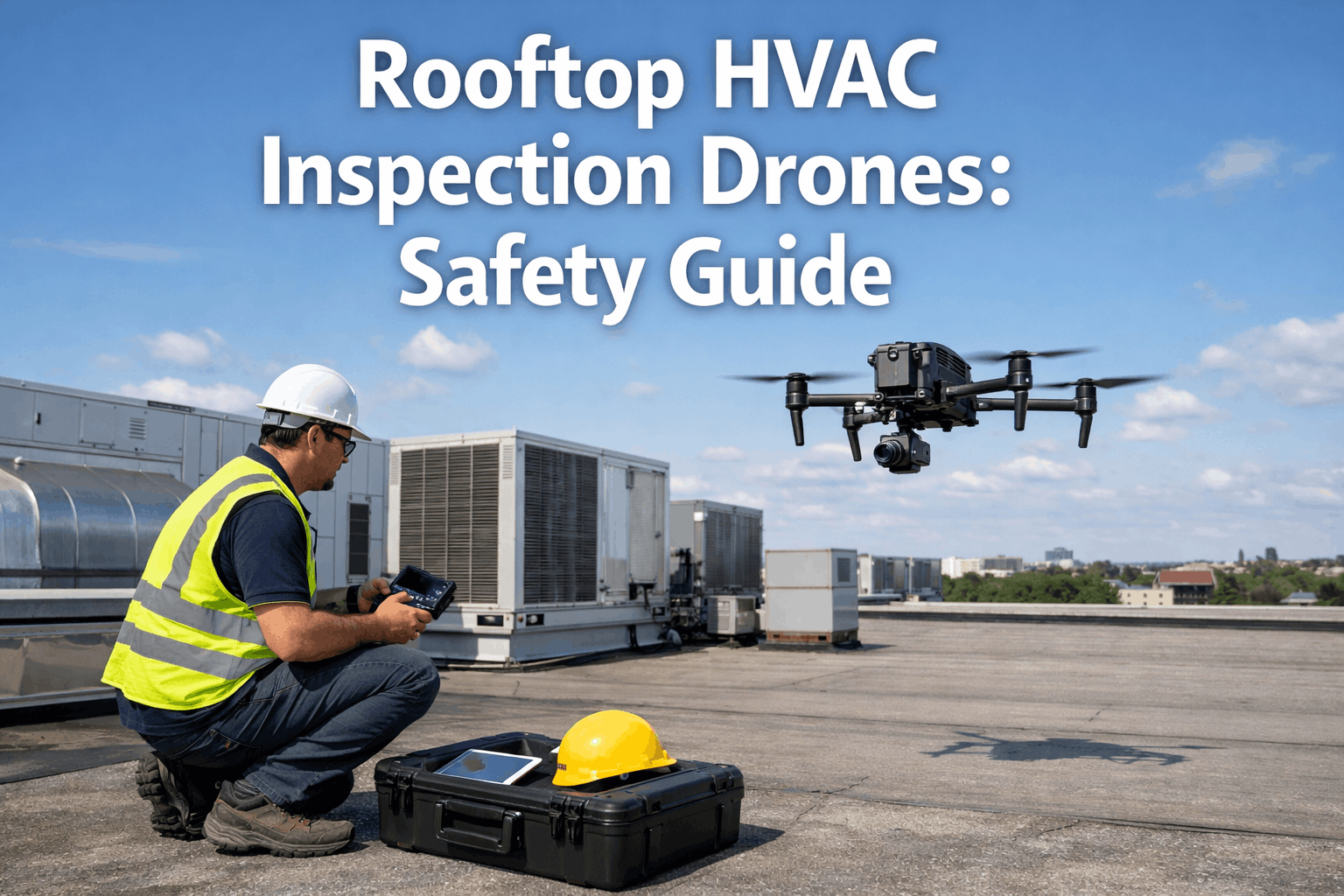
Rooftop HVAC inspections are one of the most underestimated safety risks in the commercial service industry. Every year, HVAC technicians suffer falls from ladders, roofs, and elevated platforms that account for 15-20% of all industry injuries — with rooftop-related incidents carrying an average workers' compensation cost of $45,000-$120,000 per claim. Add heat stress during summer roof inspections (surface temperatures reach 65-80°C on dark membrane roofs), slip hazards on wet or icy surfaces, and the risk of stepping through deteriorated roofing material, and the case for reducing human rooftop exposure becomes overwhelming.
Drone-based HVAC inspection eliminates the majority of these risks while delivering superior data quality. A trained drone pilot standing safely at ground level can inspect 20-40 rooftop units in the time it takes a technician to ladder up, walk across a roof, and visually inspect 4-6 units. Thermal imaging captures condenser coil condition, refrigerant issues, and electrical anomalies invisible to the naked eye. High-resolution photography documents equipment condition for customer reporting. And when drone findings flow into Oxmaint's HVAC maintenance platform, every observation becomes a tracked work order — from "Unit 7 condenser fan not spinning" to "Building B east unit showing abnormal discharge temperature" — dispatched to the right technician with photos, location, and priority before they ever climb to the roof.
The Rooftop Safety Problem
Before discussing drone solutions, it's important to understand the full scope of risks that rooftop HVAC inspections create for technicians and the companies that employ them:
Falls From Height
Ladder access, roof edge proximity, skylights, and unguarded openings. OSHA requires fall protection above 6 feet, but compliance in rooftop HVAC is inconsistent. Parapet height varies from zero to 42 inches across buildings.
Heat Stress
Dark membrane roofs in direct sun create extreme heat conditions. Technicians carrying tools and wearing PPE are at elevated risk of heat exhaustion, heat stroke, and impaired judgment leading to secondary incidents.
Structural Hazards
Aging roof membranes, concealed skylights, equipment curb deterioration, and soft spots from water damage. Technicians stepping through weakened roofing material is more common than most companies acknowledge.
Electrical Exposure
High-voltage disconnects, exposed wiring on aging units, and proximity to electrical service entrances. Wet conditions during rain or early morning dew amplify electrical contact risk during visual inspections.
Time & Productivity Loss
Ladder setup, roof traverse, visual inspection, note-taking, photography, and descent. For a 20-unit property, a technician spends 6-10 hours on the roof for what a drone can accomplish in 45-90 minutes from the ground.
Liability & Insurance
Workers' comp premiums, OSHA citations ($15,876 per serious violation), litigation costs, experience modification rate (EMR) increases that compound for years. One serious fall can increase insurance costs by $50K-$200K annually for 3+ years.
What Drones Can & Cannot Inspect
Setting clear expectations is critical for a successful drone inspection programme. Drones are exceptionally effective at certain inspections and not appropriate for others:
Survey 40 Units From the Ground. Send Technicians Only Where They're Needed.
Oxmaint converts drone inspection findings into dispatched work orders with photos, unit ID, GPS location, and priority — so your technicians arrive on the roof knowing exactly which units need work and what to bring.
Drone Hardware & Sensor Guide for HVAC Inspection
DJI Matrice 350 RTK + H20T Payload
The current industry standard for commercial HVAC drone inspection. Combines 4K visual zoom (23x optical), radiometric thermal (640x512), wide-angle, and laser rangefinder in a single gimbal payload. 55-minute flight time covers 30-50 rooftop units per battery. RTK positioning provides ±1cm GPS accuracy for repeat inspections.
DJI Mavic 3 Enterprise Thermal
Compact and portable with integrated thermal + visual cameras. Lower thermal resolution (256x192) suitable for basic condenser assessment and fan verification. 45-minute flight time. Best for smaller HVAC companies starting drone programmes with lower capital investment.
Autel EVO Max 4T
Quad-sensor payload: wide, zoom, thermal (640x512), and laser rangefinder. Advanced obstacle avoidance for rooftop environments with antennas and vent pipes. 42-minute flight time. Competitive thermal resolution with strong image stabilisation.
Skydio X10
AI-powered autonomous flight with industry-leading obstacle avoidance. Capable of navigating between rooftop units autonomously. Interior mechanical room inspection capability (GPS-denied indoor flight). Best for companies wanting maximum automation.
FAA Regulations & Safety Compliance
Operating drones commercially for HVAC inspection requires compliance with FAA Part 107 regulations. Here's the complete compliance checklist:
Drone-to-CMMS Workflow: Finding to Work Order
The value of drone inspection multiplies when findings flow directly into your maintenance management system:
Fly & Capture
Pilot flies systematic route over all rooftop units. Each unit gets: thermal image (full condenser face), visual image (overall condition), close-up of any anomalies. GPS coordinates auto-tagged to every image. 20-40 units captured in 45-90 minutes.
Review & Classify
Pilot or office team reviews imagery. Each finding classified: unit ID, finding type (coil condition, fan issue, physical damage, electrical, drainage), severity (routine/priority/emergency), and recommended action. Takes 15-30 minutes for a 20-unit property.
Work Order Generation
Classified findings uploaded to Oxmaint. Each finding creates a work order with: thermal/visual images attached, unit location on roof map, priority level, recommended repair, and estimated parts. Dispatched to assigned technician's mobile device.
Targeted Roof Access
Technician climbs to roof knowing exactly which units need service and what tools/parts to bring. No wasted trips. No walking every unit. Repair documented in Oxmaint with before/after photos. Next drone inspection verifies repair effectiveness — closing the loop.
ROI: The Business Case for HVAC Inspection Drones
Fewer Ladder Climbs. Faster Inspections. Smarter Dispatching. Better Documentation.
Oxmaint turns drone imagery into dispatched work orders with unit photos, GPS locations, priority ratings, and recommended repairs — before your technician ever touches a ladder.
Frequently Asked Questions
Do we need a licensed drone pilot on staff?
You need at least one person with an FAA Part 107 Remote Pilot Certificate. The exam covers airspace rules, weather, and safety procedures — most HVAC technicians pass after 10-20 hours of self-study using free online resources (Sporty's, 3DR, FAA Pilot Institute). Pass rate is approximately 92%. Cost: $175 exam fee. Alternatively, many HVAC companies train 2-3 technicians as certified pilots for scheduling flexibility. Some companies initially contract a licensed drone service provider ($200-$500 per site visit) while deciding whether to invest in an in-house programme.
Can drones fly in wind and rain?
Commercial drones (DJI Matrice 350, Autel EVO Max) operate in sustained winds up to 28-33 mph and light rain (IP45-IP55 rated). In practice, HVAC drone inspections work well in most conditions except heavy rain, snow, fog (obscures camera), or winds exceeding 25 mph (image quality degrades). Most HVAC service areas have 85-90% flyable days per year. Early morning flights often have the calmest winds and best thermal contrast (cool ambient makes hot anomalies more visible). Schedule drone surveys for morning hours when possible.
How do we handle buildings near airports?
Many commercial buildings are in controlled airspace near airports. The LAANC (Low Altitude Authorization and Notification Capability) system provides instant or near-instant airspace authorization directly through the drone's flight app. Most HVAC inspections require flying below 100-200 feet AGL, which LAANC can approve in under 60 seconds for most zones. For buildings in the strictest zones (within 1-2 miles of airport runways), authorization may take 24-48 hours via FAADroneZone. In zero-authorization zones, drone inspection is not permitted — but these represent less than 5% of commercial building locations.
Can we sell drone inspections as a service to customers?
Absolutely, and this is a significant revenue opportunity. Pricing models: Per-survey fee ($150-$500 per property depending on unit count), included in premium service agreements (quarterly drone surveys as a differentiator), or pre-season assessment (spring/fall drone survey bundled with seasonal PM). Customers value the thermal imaging documentation showing condenser condition, the professional PDF reports with annotated photos, and the reduced disruption compared to full-day roof inspections. Many HVAC companies report drone surveys are their highest-margin service offering at 70-85% margin, and they serve as a powerful lead generator for repair and replacement sales.
What about customer privacy and tenant concerns?
Legitimate concern. Best practices: notify building management 48+ hours before drone operations, provide a brief explaining the inspection purpose and flight path (rooftop only, cameras pointed down at HVAC equipment not windows), carry your Part 107 certificate and insurance certificate on-site, fly during business hours (avoids appearing suspicious), keep the drone above the roofline at all times. Most property managers welcome drone inspection once they understand it means fewer people on their roof (reducing liability for the building owner) and better documentation of equipment condition. Some tenants may have specific security requirements — government facilities, data centres — that restrict drone operations; confirm with the customer before the visit.
Ground-Level Safety. Rooftop-Level Data. Fully Integrated Maintenance Workflows.
Oxmaint connects drone survey findings to technician dispatching, repair tracking, and customer reporting — turning aerial imagery into completed, documented maintenance.