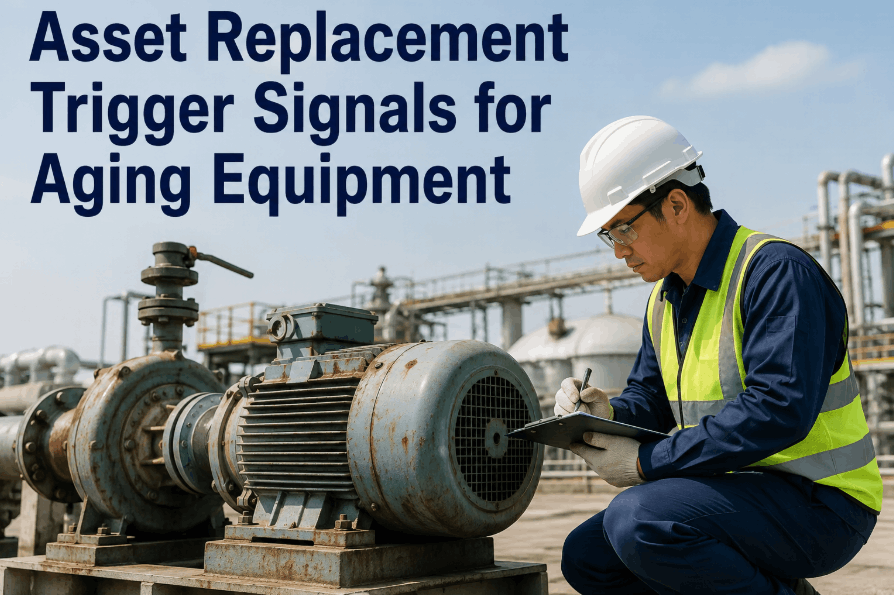
Aging equipment rarely fails without warning — but most maintenance teams miss the signals until a catastrophic breakdown forces an unplanned capital decision. Asset replacement planning requires recognizing wear trends, escalating fault patterns, and lifecycle cost inflection points before aging machinery becomes an emergency budget surprise. Oxmaint gives reliability engineers a Sign Up Free platform to track asset condition trends, log fault recurrence, and build data-driven replacement roadmaps directly inside a connected CMMS — so capital planning teams can act on evidence, not guesswork. Whether you manage a single production line or a multi-site asset portfolio, catching replacement trigger signals early prevents both emergency downtime and unplanned capital expenditure. Book a Demo to see how leading manufacturers use Oxmaint to manage end-of-life asset decisions with full lifecycle visibility.
ASSET LIFECYCLE · REPLACEMENT PLANNING · CMMS
Track Replacement Triggers for Every Asset in Oxmaint
Monitor wear trends, fault recurrence, and lifecycle cost thresholds — and build capital replacement roadmaps backed by real asset data.
Why Replacement Decisions for Aging Equipment Go Wrong
Most facilities lack a structured framework to evaluate when repair costs outweigh replacement investment. Decisions get made reactively — after a catastrophic failure — or based on age alone rather than actual condition data. Sign Up Free to capture fault history, maintenance cost per asset, and condition trend data inside Oxmaint, so replacement decisions are driven by asset performance evidence rather than instinct.
COMMON FAILURE MODES IN ASSET REPLACEMENT PLANNING
01
Reactive Replacement Decisions
Teams wait for catastrophic failure before initiating replacement — maximizing downtime impact and eliminating any lead time for capital budget approval.
02
Age-Based Rules Without Condition Data
Calendar-based replacement schedules ignore actual asset condition — replacing healthy equipment too early and running degraded assets past their useful life.
03
No Fault Recurrence Tracking
Without linked work order history, teams cannot identify which assets are generating repeat faults — the clearest signal that replacement has become more cost-effective than repair.
04
Lifecycle Cost Blind Spots
Cumulative repair spend is rarely compared against replacement cost — leaving the R/P ratio (Repair-to-Purchase) uncalculated and capital justification weak.
05
Criticality Not Factored Into Timing
Replacement sequencing ignores asset criticality — resulting in capital spend on non-critical equipment while high-criticality machines continue degrading.
06
No Forward-Looking Asset Roadmap
Maintenance teams operate without a multi-year capital replacement roadmap — making annual budget submissions reactive and poorly defended to finance leadership.
Key Replacement Trigger Signals Every Maintenance Team Must Monitor
Replacement trigger signals fall across four domains: condition trend, fault pattern, financial threshold, and operational risk. Tracking all four simultaneously inside your CMMS gives reliability teams the evidence needed to build a defensible replacement case. Book a Demo to see how Oxmaint's asset records capture the data streams that feed accurate replacement timing decisions.
ASSET REPLACEMENT TRIGGER SIGNAL FRAMEWORK
Wear Trend
Accelerating component wear rate on inspection
Condition inspection scores over time in CMMS
Declining score trend over 3+ consecutive inspections
Fault Recurrence
Same failure mode repeating within short intervals
Work order fault code frequency analysis
3+ identical fault codes within 12-month window
Lifecycle Cost
Cumulative repair cost approaching asset replacement value
Total MRO spend per asset vs. current replacement cost
R/P ratio exceeds 40–60% of replacement value
Downtime Impact
MTBF declining, MTTR increasing on same asset
Work order completion time and frequency tracking
MTBF drop of 30%+ from prior 12-month baseline
Parts Availability
Critical spare parts becoming obsolete or unavailable
Storeroom + vendor lead time tracking in CMMS
OEM parts discontinued or lead time exceeds 90 days
Criticality Risk
Asset failure consequence ranking increasing
Criticality assessment updated in asset register
Tier-1 or Tier-2 criticality with degraded condition score
The R/P Ratio: Calculating When Repair Becomes More Expensive Than Replacement
The Repair-to-Purchase (R/P) ratio is the most actionable financial metric for replacement timing. When cumulative maintenance spend on a single asset approaches its current replacement cost, continued repair becomes economically indefensible. Sign Up Free to track per-asset maintenance cost in Oxmaint and automatically surface assets approaching the R/P replacement threshold.
Building a Multi-Year Asset Replacement Roadmap in Oxmaint
A capital replacement roadmap transforms reactive emergency spend into a planned, defensible multi-year investment schedule. When asset condition data, fault history, and lifecycle cost are maintained inside Oxmaint, generating a prioritized replacement roadmap becomes a reporting function rather than a manual exercise. Book a Demo to see how Oxmaint's asset register supports replacement prioritization and capital planning outputs.
REPLACEMENT ROADMAP DEVELOPMENT STEPS
01
Assign Criticality to Every Asset
Classify assets by production impact, safety consequence, and replacement lead time. Criticality determines replacement urgency weighting in the roadmap scoring model.
02
Record Condition Inspection Scores
Log scheduled condition inspection results in Oxmaint against each asset record. Declining trend lines trigger replacement review flags before functional failure occurs.
03
Track Cumulative Maintenance Cost per Asset
Link all work order parts and labor costs to the parent asset. Oxmaint aggregates total spend per asset automatically — enabling R/P ratio calculation at any time.
04
Flag Fault Recurrence Patterns
Use Oxmaint's work order history to identify assets with repeating fault codes. Assets with 3+ identical failures in 12 months are automatically candidates for replacement review.
05
Rank Assets by Replacement Priority Score
Apply the composite priority scoring model to all assets showing trigger signals. Rank the replacement list by criticality-weighted score to guide capital budget sequencing.
06
Generate Annual Capital Plan Submission
Export Oxmaint asset reports with condition data, fault history, and lifecycle cost — providing finance and operations leadership with evidence-backed capital replacement requests.
How Oxmaint Supports End-of-Life Asset Detection and Capital Planning
Asset replacement planning is only as strong as the data feeding it. Oxmaint connects work orders, inspection records, parts consumption, and asset registers into a single maintenance intelligence platform — giving reliability teams every signal they need to identify end-of-life equipment before unplanned failure forces the decision. Book a Demo to see Oxmaint's full asset lifecycle management capabilities in a live manufacturing environment.
HOW OXMAINT POWERS ASSET REPLACEMENT DECISIONS
01
Asset Register with Condition History
Every asset record in Oxmaint captures full inspection history, condition scores, and degradation trend lines — providing the condition data foundation for replacement timing decisions.
02
Work Order Fault Code Analysis
Oxmaint links all work orders to parent assets by fault code — enabling automatic identification of assets with repeating failure modes that signal end-of-life degradation.
03
Per-Asset Maintenance Cost Reporting
Track cumulative labor, parts, and contractor costs per asset over any date range. Compare total spend against replacement value to calculate the R/P ratio on demand.
04
MTBF and MTTR Trend Tracking
Monitor mean time between failures and mean time to repair trends per asset. Declining MTBF and rising MTTR are the strongest reliability signals for approaching end-of-life.
05
Criticality Classification in Asset Register
Assign production criticality, safety criticality, and lead time classifications to each asset — ensuring replacement roadmap prioritization reflects operational risk, not just age.
06
Capital Planning Export and Reporting
Generate asset condition and lifecycle cost reports from Oxmaint for capital budget submissions — giving finance teams the data evidence needed to approve replacement investments.
Asset Replacement KPIs to Track in Your CMMS
Measuring replacement decision quality over time ensures your capital planning process improves with each budget cycle. These KPIs transform asset replacement from an art into a measurable, improvable management discipline. Sign Up Free to access Oxmaint's live asset performance dashboards and build your replacement planning KPI baseline from day one.
ASSET REPLACEMENT PERFORMANCE METRICS
R/P Ratio per Asset
Cumulative Repair Cost / Current Replacement Value
Replacement Flag: > 0.5
Primary financial trigger for initiating a capital replacement evaluation. Assets above 0.5 should be reviewed; above 0.7 should be on the active replacement roadmap.
MTBF Trend Slope
Current 12-Month MTBF / Prior 12-Month MTBF
Alert: Ratio < 0.7
A declining MTBF ratio signals accelerating degradation. Assets with MTBF declining by 30%+ year-over-year are approaching the reliability floor for continued operation.
Fault Recurrence Rate
Repeat Fault Occurrences / Total Work Orders (Asset, 12 mo.)
Review Threshold: > 25%
High fault recurrence on a single asset indicates repairs are no longer resolving the underlying degradation — a strong indicator that replacement will outperform continued repair.
Condition Score Trend
Latest Inspection Score vs. 12-Month Average Score
Flag: Score < 60% of baseline
Tracks physical asset condition degradation over time. Assets scoring below 60% of their original baseline condition are strong replacement candidates regardless of age.
Capital Plan Accuracy
Assets Replaced on Schedule / Total Planned Replacements × 100
Target: > 80%
Measures how well the replacement roadmap predicts actual capital events. Low accuracy signals either poor trigger signal quality or insufficient lead time in the planning process.
Emergency Replacement Rate
Unplanned Replacements / Total Replacements × 100
Target: < 10%
The percentage of replacements forced by catastrophic failure rather than planned capital events. High rates indicate the trigger signal system is not detecting degradation early enough.
REPLACEMENT PLANNING · ASSET LIFECYCLE · MANUFACTURING CMMS
Build Your Asset Replacement Roadmap Inside Oxmaint
Condition history, fault recurrence tracking, per-asset cost reporting, and capital planning exports — go live in days and stop making reactive replacement decisions.
Frequently Asked Questions
Q1 What are the main triggers for replacing aging equipment?
Key triggers include a high R/P ratio (cumulative repair cost above 50% of replacement value), declining MTBF, recurring fault patterns, falling condition inspection scores, and obsolete spare parts availability.
Q2 How does Oxmaint help with asset replacement planning?
Oxmaint tracks condition history, fault recurrence, and cumulative maintenance cost per asset — giving maintenance managers the data to calculate R/P ratios and build defensible capital replacement roadmaps.
Q3 What is the R/P ratio and why does it matter?
The Repair-to-Purchase ratio compares cumulative repair spend to replacement cost. When it exceeds 0.5, replacement typically delivers better financial ROI than continued maintenance investment.
Q4 How early should replacement planning begin for critical assets?
For Tier-1 critical assets, replacement planning should begin 18–24 months before anticipated end-of-life to allow adequate procurement lead time and capital budget cycle alignment.
Q5 Can Oxmaint export data for capital budget submissions?
Yes. Oxmaint generates per-asset condition, fault history, and lifecycle cost reports that can be exported to support capital expenditure requests and annual budget planning submissions.
Q6 How does criticality affect replacement timing decisions?
Higher-criticality assets should be replaced earlier in their degradation curve to minimize production risk. Criticality weighting ensures the replacement roadmap prioritizes operational impact over simple age or cost ranking.
END-OF-LIFE DETECTION · CAPITAL PLANNING · ASSET RELIABILITY
Start Tracking Asset Replacement Triggers in Oxmaint Today
Condition trend monitoring, fault recurrence analysis, R/P ratio tracking, and capital roadmap reporting — built for manufacturing maintenance teams managing aging equipment portfolios.