Audit findings that stay open past their agreed closure date are not just a compliance programme failure — they are a documented record of a plant's inability to execute its own corrective action commitments. Every day an audit finding remains open without linked evidence, an assigned owner, and a verified deadline, the risk profile of the site increases: re-audit likelihood grows, regulatory scrutiny intensifies, and the gap between what was promised and what was delivered widens. At an average of $18,400 per major re-audit event, the cost of managing findings reactively dwarfs the cost of a structured closure programme. Sign Up Free to build your audit evidence closure tracker in OxMaint — linking every finding to its proof, owner, and deadline in a single compliance dashboard.
Compliance · Article · Plant Operations
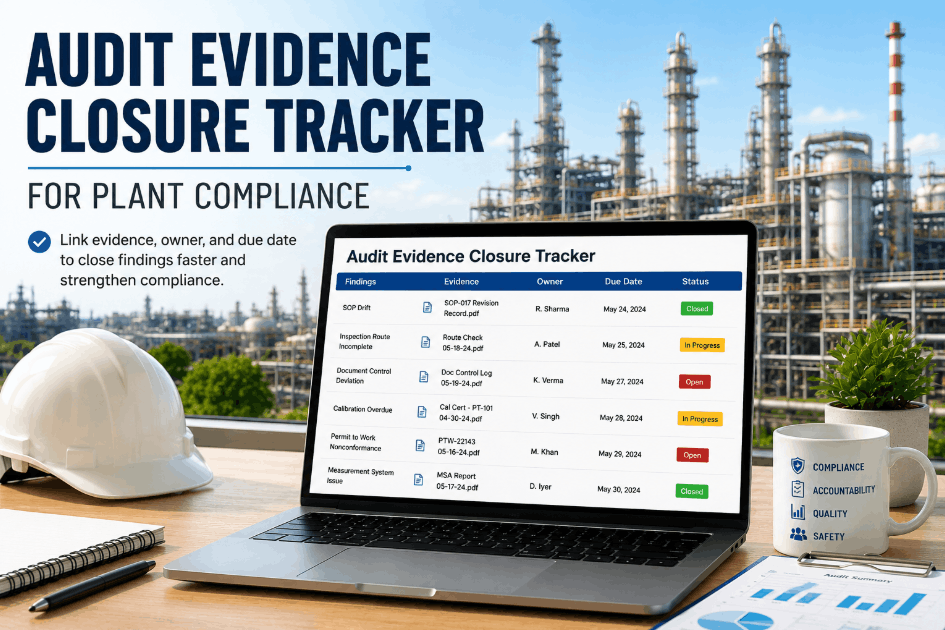
Audit Evidence Closure Tracker for Plant Compliance
Finding registers, evidence linking, owner assignment, deadline tracking, and CMMS-integrated closure workflows — structured compliance management for plant teams managing regulatory audits, internal inspections, and corrective action programmes.
$18,400Average cost of a regulatory re-audit triggered by open findings past agreed closure dates
54%Of audit findings remain open beyond the agreed closure date due to missing evidence or unclear ownership
−66%Reduction in overdue findings when CMMS tracks owner, evidence, and deadline per finding
4.1×Faster evidence assembly for re-audit when findings and proof are linked in a single CMMS record
Audit Finding Closure Components — What Every Record Needs
A finding closure record is not closed when corrective action has been taken — it is closed when documented evidence demonstrating that corrective action has been verified and linked to the finding record, the responsible owner has signed off, and the closure deadline has been met. Most plant compliance programmes fail the evidence linking step: the action was taken, but the proof — the updated procedure, the re-trained sign-off sheet, the new inspection record — is not attached to the finding, leaving the closure unverifiable. Book a Demo to see how OxMaint enforces evidence linking as a mandatory closure requirement for every audit finding in your programme.
Step 1
Finding Registration
Finding logged in CMMS with finding type, source audit, severity classification, and regulatory reference. Finding ID generated for traceability across all subsequent records.
Foundation
Step 2
Owner Assignment
Named responsible owner assigned per finding. Acceptance notification sent. Escalation path configured if no acceptance within 48 hours of assignment.
Accountability
Step 3
Corrective Action Plan
Root cause documented. Corrective action steps defined. Interim controls logged if immediate risk requires containment before full closure.
Planning
Step 4
Evidence Attachment
Closure evidence attached to finding record — updated procedure, re-training record, inspection result, or engineering change. CMMS blocks closure without evidence attachment.
Critical Gate
Step 5
Deadline Tracking
Agreed closure date tracked in CMMS. Escalation alerts fire at 7 days and 3 days before deadline. Overdue findings automatically escalated to compliance manager.
Time Control
Step 6
Verification Sign-Off
Independent verification that evidence is sufficient and action is sustained. Sign-off locks the finding record. Closed findings included in next audit preparation export.
Closure
The Finding Backlog Cascade — How Open Findings Compound into Re-Audit Risk
Audit findings left unmanaged do not stay static — they compound. A finding without an owner becomes a finding without a deadline. A finding without a deadline becomes an overdue item in the next audit review. An overdue item from a previous audit raises a systemic programme question: if corrective actions are not being closed, how confident is the auditing body in the plant's compliance management capability? Understanding this cascade is why compliance managers need a real-time finding tracker, not a quarterly spreadsheet review. Sign Up Free to replace your finding spreadsheet with OxMaint's live compliance dashboard — showing every open finding, its owner, its evidence status, and its days to deadline in one view.
Audit Finding Backlog Cascade — 5 Stages from Open Finding to Re-Audit
Stage 1
Finding Logged, No Owner Assigned
Finding registered but not assigned to a named owner. No corrective action planned. Deadline not set.
$0
Cost if assigned immediately
↓
Stage 2
Deadline Passes Without Evidence
Agreed closure date passes with no evidence attached. Finding moves to overdue status. No escalation triggered.
↓
Stage 3
Finding Carried into Next Audit Period
Overdue finding appears on the next scheduled audit review. Auditor notes repeat open status. Programme capability questioned.
$1,200
Audit preparation escalation
↓
Stage 4
Systemic Programme Finding Raised
Multiple overdue findings generate a systemic finding on the compliance management programme itself. Root cause analysis of the compliance programme required.
$4,600
Programme review cost
↓
Stage 5
Regulatory Re-Audit Triggered
Regulatory body schedules unannounced or early follow-up audit. All open findings under scrutiny. Corrective action programme under formal review. Certification at risk.
$18,400+
Re-audit + remediation
Compliance Programme Maturity Score — How Is Your Plant Managing Finding Closure?
The gap between a high-maturity and a low-maturity compliance programme is most visible in finding closure performance — not in whether findings are generated, but in how quickly and how completely they are closed with verified evidence. The scoring framework below gives compliance managers a structured self-assessment tool for evaluating their current finding closure programme and prioritising the most impactful improvements. Book a Demo to walk through your current finding management workflow and identify where OxMaint's closure tracker eliminates the manual gaps that let findings age past their deadlines.
Audit Evidence Closure Programme Maturity Score
Score 5 = full closure control · Score 1 = active re-audit risk · Assess per site or per audit programme
5
Fully Controlled — Evidence-Linked Closure
Every finding has a named owner, a documented corrective action, attached evidence, and a verified sign-off before the agreed deadline. Zero overdue findings in current programme.
Action: Maintain closure rate. Review evidence quality quarterly. No programme gaps at current maturity.
4
Mostly Controlled — Evidence Gaps
Most findings closed on time. Some closures recorded without supporting evidence attachment. Verbal sign-offs not consistently transcribed to the finding record.
Action: Enforce evidence attachment as mandatory closure requirement. Back-fill evidence on closures from last 90 days. Close verbal sign-off gap within 30 days.
3
Partially Managed — Deadline Drift
Findings logged and assigned but closure deadlines routinely extended. Evidence attached inconsistently. Some findings open from the previous audit period with no escalation triggered.
Action: Implement automated deadline escalation. Prioritise findings from previous audit period for closure within 30 days. Add evidence attachment gate to closure workflow.
2
Reactive — Multiple Overdue Findings
Finding register exists but is not actively managed. Overdue findings accumulate without escalation. Evidence is assembled retrospectively when the next audit is announced, not maintained continuously.
Action: Immediate audit of all open findings. Assign owners within 48 hours. Implement CMMS closure workflow before next audit window.
1
No Programme — Active Re-Audit Risk
No live finding register. Closure is tracked manually by one individual. Evidence is unlinked. Audit preparation requires emergency documentation sprint. Re-audit risk is active.
Action: Emergency finding audit. Build CMMS finding register immediately. Engage compliance manager and site leadership before next regulatory contact.
Technology Integration: CMMS Finding Register, Evidence Management, and Deadline Automation
A live audit evidence closure tracker requires four connected capabilities that a spreadsheet cannot provide: real-time visibility into every open finding across the site, mandatory evidence attachment that blocks premature closure, automated deadline escalation that fires before the overdue condition is reached, and an audit-ready export that assembles the complete finding record in minutes rather than days. OxMaint's compliance module delivers all four — with finding classification, owner assignment, evidence linking, and deadline tracking built into the same CMMS workflow used for maintenance work orders and inspection schedules. Sign Up Free to move your finding management programme from a spreadsheet managed by one person into a CMMS-driven compliance tracker visible to every relevant stakeholder on site.
Live Finding Register
100%
Finding visibility across all audit sources in one dashboard
All findings from regulatory audits, internal inspections, and management reviews in a single register. Real-time status per finding: open, in progress, evidence pending, closed.
Evidence Gate
−66%
Reduction in evidence-missing closures with mandatory attachment enforcement
CMMS blocks finding closure until evidence is attached, owner has accepted, and verification sign-off is complete. No finding can be closed on intent — only on documented proof.
Deadline Automation
4.1×
Faster evidence assembly vs manual spreadsheet tracking
Escalation alerts fire at 7 days and 3 days before each finding's agreed closure date. Overdue findings auto-escalate to compliance manager and site lead without manual review.
Audit Export
14 min
Average time to produce complete finding closure pack for re-audit
Single-click export per audit, per regulatory body, or per site. Finding record, corrective action, evidence attachment, and sign-off history in one package ready for auditor review.
"
We were carrying 23 open findings from the previous year's audit into our next review because nobody owned the closure tracking. We implemented OxMaint's compliance tracker, assigned owners to every finding, and enforced evidence attachment before closure. We went into the next audit with four open findings — all within their agreed window — and had our full evidence pack ready in a day and a half.
Compliance Manager — Chemical processing plant, multi-site operations, North West England
Root Causes of Finding Closure Failures
Finding closure failures in plant compliance programmes cluster into six root cause categories that are consistent across industries and audit types. The bar chart below shows the distribution based on compliance audit programme analysis across process, manufacturing, and utilities sectors. Book a Demo to map your programme against these root cause categories and build the specific workflow controls that address your highest-frequency failure points.
Audit Finding Closure Failure — Root Cause Distribution (%)
No named owner assigned to finding
76%
Evidence not linked to closure record
69%
No automated deadline escalation
63%
Finding register not actively reviewed
54%
Root cause analysis not documented
42%
No independent verification at closure
35%
Close Every Finding — With Proof, an Owner, and a Deadline — Before the Auditor Returns.
OxMaint tracks every audit finding from registration to verified closure — evidence gated, deadline automated, and audit-ready at any time.
Frequently Asked Questions
What is an audit evidence closure tracker and why do plant compliance teams need one?
A live record system linking every audit finding to its corrective action, responsible owner, closure evidence, and agreed deadline — providing real-time visibility into finding status and ensuring no finding reaches the next audit unresolved.
Sign Up Free to build yours in OxMaint.
What evidence is required to close an audit finding?
Evidence must demonstrate that the corrective action was implemented and is sustained — typically an updated procedure, a re-training record, an inspection result, or an engineering change record. The evidence must be linked directly to the finding record, not stored separately.
How does a CMMS help manage audit finding closure across a plant?
A CMMS assigns findings to named owners, tracks deadlines with automated escalation, blocks closure without evidence attachment, and exports complete finding records for audit review — replacing manual spreadsheet tracking and the risk of overdue findings going unnoticed.
What is the difference between finding closure and finding verification?
Closure is the submission of corrective action evidence by the responsible owner. Verification is the independent review that confirms the evidence is sufficient and the corrective action is sustained. Both steps are required for an auditable closure record.
Can OxMaint manage findings from multiple audit types — regulatory, internal, and management review?
Yes — OxMaint registers findings from all audit sources in a single dashboard, with finding type, source, severity, and regulatory reference tracked per record. Audit exports can be filtered by source, period, or finding status.
Book a Demo to see the full workflow.
Build Your Audit Closure Tracker — Evidence, Owner, Deadline. Every Finding. Every Time.
OxMaint automates finding management for plant compliance teams — CMMS-integrated, evidence-gated, and free to start.