SOP drift is the maintenance industry's most underestimated compliance failure mode — not because the standard operating procedure is wrong, but because the way the procedure is actually being executed has quietly diverged from what the document says. Unlike equipment failure, SOP drift produces no alarm, no error code, and no immediate consequence. It accumulates through informal shortcuts, undocumented workarounds, and training gaps — until a quality non-conformance, a safety incident, or a regulatory audit reveals that the documented process and the actual process are no longer the same thing. Sign Up Free to build your SOP drift detection programme in OxMaint — linking inspection checklists, work order sign-offs, and deviation records to each procedure across your manufacturing facility.
Manufacturing · Article · Supervisory Compliance
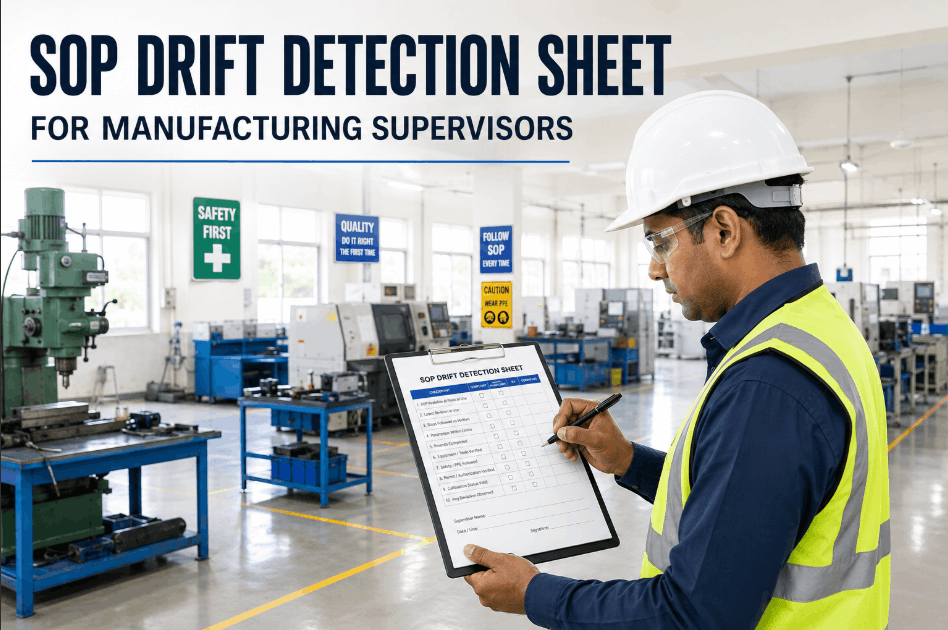
SOP Drift Detection Sheet for Manufacturing Supervisors
Process observation, deviation logging, trend analysis, and CMMS-linked corrective action — structured drift detection frameworks for manufacturing supervisors protecting standard work, quality records, and regulatory readiness.
$9,600Average cost of a quality non-conformance traced to undocumented SOP deviation in manufacturing
71%Of process deviations originate from informal workarounds that were never reviewed or documented
−64%Reduction in SOP-related NCRs when structured drift detection is linked to the CMMS inspection schedule
5×Higher likelihood of repeat deviation when the first occurrence is not captured in a formal deviation record
SOP Drift Detection Sheet — Six Observation Points for Manufacturing Supervisors
An SOP drift detection sheet is a structured observation tool that a supervisor uses at defined intervals to compare actual task execution against the documented procedure — step by step, parameter by parameter. The six observation points below represent the highest-frequency drift patterns in manufacturing environments: the places where informal workarounds take root, where sequence shortcuts are most likely to occur, and where parameter drift typically begins before it becomes a systematic deviation. Book a Demo to see how OxMaint builds drift detection observations into the CMMS inspection schedule — triggering supervisor checks at configurable intervals per procedure per line.
Point 1
Step Sequence Compliance
Observe whether all procedure steps are executed in the documented sequence. Note any skipped, combined, or reordered steps. Record as deviation if sequence diverges.
High Frequency Drift
Point 2
Parameter Verification
Confirm that process parameters — temperatures, pressures, torque values, mixing times — are checked against the documented spec, not estimated or skipped under production pressure.
High Frequency Drift
Point 3
Sign-Off Discipline
Verify that sign-off steps in the SOP are being completed in real time, not batch-signed at the end of a shift. Retrospective sign-offs are a leading indicator of drift and audit risk.
Audit Risk
Point 4
PPE and Safety Control Adherence
Confirm that safety controls specified in the SOP — PPE, isolation steps, permit requirements — are consistently applied. Non-adherence is typically the earliest visible drift signal.
Safety Critical
Point 5
Material and Specification Use
Verify that specified materials, fluids, consumables, and parts are being used — not substituted informally. Material drift without documentation is a quality and traceability risk.
Quality Risk
Point 6
Equipment and Tool Compliance
Confirm that specified tools and equipment are being used at the correct settings. Calibrated tool substitutions or setting workarounds create measurement and quality risk not visible in the product.
Measurement Risk
The SOP Drift Cascade — How Small Deviations Become Routine Behaviour
SOP drift follows a predictable escalation path. A single shortcut, tolerated on one shift, becomes a team norm within two weeks. A team norm, undocumented and un-challenged, becomes the de facto procedure within two months. A de facto procedure, when it diverges from the documented standard, is discovered by an auditor — not by a supervisor — because no structured detection mechanism existed between the document and the execution. The cascade below shows how each stage of undocumented drift compounds the risk and cost of eventual correction. Sign Up Free to build the detection mechanism that intercepts the cascade at Stage 1 — before a single shortcut becomes a systemic deviation.
SOP Drift Escalation Cascade — 5 Stages from First Shortcut to Regulatory Finding
Stage 1
Informal Shortcut — First Occurrence
Operator skips or modifies a step informally. No supervisor observation. No deviation record. Outcome appears normal.
$0
Cost if detected and corrected here
↓
Stage 2
Shortcut Becomes Team Practice
Other operators observe and adopt the shortcut. It is now team-wide but still undocumented. Supervisor briefings reference the shortcut informally.
$280
Re-training if caught here
↓
Stage 3
De Facto Procedure Diverges from Document
Documented SOP and actual execution are now measurably different. New operators are trained to the de facto procedure, not the document.
$920
Procedure re-validation cost
↓
Stage 4
Quality Non-Conformance or Process Incident
Deviation produces a measurable output: product defect, safety near-miss, or process incident. Root cause investigation begins. SOP drift identified.
$4,200
NCR investigation + rework
↓
Stage 5
Regulatory Audit Finding — Systemic Drift
Auditor observes execution diverges from documented SOP. Systemic finding raised. Corrective action plan required. All product produced during drift period potentially in scope for review.
$9,600+
Systemic finding + remediation
SOP Drift Risk Score — Assess Your Manufacturing Lines
Different production lines, different shifts, and different procedure types carry different drift risk profiles. A line that has been running without a structured supervisor observation programme for more than 90 days carries a fundamentally higher drift risk than a line where deviations are logged, reviewed, and linked to corrective actions in the CMMS. The scoring framework below provides manufacturing supervisors with a rapid assessment tool to prioritise which lines and which procedures need structured observation attention first. Book a Demo to configure OxMaint's drift detection inspection schedule for your highest-risk lines and procedures.
SOP Drift Risk Score — Manufacturing Line Assessment
Score 5 = well-controlled · Score 1 = active drift risk · Assess per line, per shift, or per procedure class
5
Fully Controlled — Active Observation Programme
Structured supervisor observations scheduled and completed at defined intervals. All deviations logged in CMMS and linked to corrective action. SOP version control current. Zero open drift findings.
Action: Maintain observation schedule. Review deviation trend monthly. No programme gaps at current maturity.
4
Mostly Controlled — Observation Gaps
Observations performed but not fully documented. Some deviations captured verbally, not in CMMS. Corrective actions assigned informally without deadline tracking.
Action: Formalise observation record in CMMS. Enforce deviation logging at point of observation. Close informal corrective action gap within 30 days.
3
Intermittent — No Structured Programme
Supervisor walks the line but without a structured observation tool. Deviations noted mentally, not logged. No deviation trend data available. SOP versions may be out of date on some procedures.
Action: Implement drift detection sheet per highest-risk procedure. Begin structured observation programme within 2 weeks. Update SOP version control immediately.
2
Reactive — Deviations Not Logged
Deviations are only recorded when they produce a visible output defect or incident. No proactive observation. De facto procedures may already differ significantly from documented SOPs on multiple lines.
Action: Immediate observation audit of highest-risk lines. Log all identified deviations. Initiate corrective action programme before next scheduled audit.
1
No Detection — Active Systemic Risk
No drift detection programme exists. SOPs are available but actual execution has not been compared to document for more than 6 months. Systemic deviation across multiple lines is likely.
Action: Emergency observation programme. Compare actual execution to documented SOP on all critical lines within 10 days. Engage quality team for independent verification.
Technology Integration: CMMS Observation Scheduling, Deviation Records, and Trend Analysis
A drift detection sheet that lives on a clipboard in the supervisor's office catches the deviations that happen to coincide with a supervisor walk — which is not a detection programme, it is a sampling accident. Effective SOP drift detection requires the observation schedule to be owned by the CMMS, the deviation record to be created in the same system as the work order and inspection record, and the trend analysis to surface repeated deviations across shifts, lines, and procedure versions automatically. OxMaint connects all three: observation work orders generated per procedure at configured intervals, deviation records linked to the asset and the procedure version, and trend reports surfacing drift patterns before they reach the auditor. Sign Up Free to move your drift detection programme from a clipboard to a CMMS-driven observation schedule that runs whether or not any one supervisor is on shift.
Observation Scheduling
100%
Observation coverage when CMMS-scheduled vs supervisor-initiated
Drift detection work orders auto-generated per procedure, per line, at configured observation intervals. Observation cannot be skipped without a CMMS record — coverage is complete and auditable.
Deviation Records
−64%
Reduction in SOP-related NCRs with structured deviation logging
Each observation generates a structured deviation record linked to the procedure version, the line, and the shift. Deviation triggers corrective action work order automatically at Tier 2+ severity.
Trend Analysis
5×
Earlier detection of systemic drift vs reactive incident-based discovery
Repeat deviations on the same observation point across multiple shifts surface automatically in OxMaint's compliance dashboard — identifying systemic drift weeks before it produces a quality failure.
SOP Version Control
98%
Procedure currency compliance when CMMS-managed vs manual distribution
Current SOP version linked to every observation work order. Outdated versions flagged automatically when a new revision is issued. Operators and supervisors always observe against the current documented standard.
"
We had a quality audit finding that traced back to a step sequence change that had been running for four months on the night shift. Nobody had flagged it because there was no formal observation tool — supervisors walked the line but didn't have a structured sheet. We implemented OxMaint's observation scheduling and drift detection records. In the next 90 days we caught 14 deviations before they became findings. The next audit passed with zero SOP drift findings for the first time in three years.
Manufacturing Quality Supervisor — Consumer goods production facility, 6 production lines, East Midlands
SOP Drift Root Cause Distribution in Manufacturing
SOP drift in manufacturing facilities originates from a consistent set of root causes that are visible in observation data before they produce quality or compliance failures. The bar chart below shows the distribution across manufacturing quality programme analysis covering process, assembly, and packaging operations. Book a Demo to map your facility's highest-risk observation points against this distribution and configure OxMaint's detection schedule to target the most frequent drift origins first.
SOP Drift Root Cause Distribution — Manufacturing Operations (%)
Informal workaround under production pressure
71%
SOP not updated after process change
64%
Training to de facto rather than documented procedure
58%
No structured supervisor observation programme
52%
Retrospective sign-off practice
44%
Deviation not logged at first occurrence
37%
Detect SOP Drift Before It Becomes a Finding — Structured Observation, CMMS-Scheduled.
OxMaint schedules drift detection observations per procedure, per line — deviation-logged, corrective action-linked, and free to start.
Frequently Asked Questions
What is SOP drift and how does it affect manufacturing quality?
SOP drift is the gradual divergence between a documented standard operating procedure and the way the procedure is actually being executed on the floor. It typically begins as an informal shortcut and compounds into a systemic deviation that produces quality non-conformances, audit findings, and safety risk without any visible trigger.
Sign Up Free to build your drift detection programme in OxMaint.
What is a drift detection sheet and how should manufacturing supervisors use it?
A structured observation checklist that a supervisor uses to compare actual task execution against the documented procedure — noting sequence, parameters, sign-off discipline, and material use. Observations are conducted at defined intervals and logged in the CMMS as a formal inspection record, not a verbal note.
How often should SOP drift observations be scheduled in a manufacturing facility?
For high-risk and safety-critical procedures: every 30 days. For standard production procedures: every 60–90 days. For low-risk or rarely-executed procedures: every 180 days or after each execution event. Intervals should be reviewed after any quality incident linked to SOP deviation.
How does a CMMS help supervisors detect and document SOP drift?
A CMMS generates observation work orders at configured intervals, provides a structured checklist per procedure, records deviations at point of observation, triggers corrective action work orders automatically, and surfaces repeat deviation trends across shifts — replacing informal walk-and-talk oversight with a documented programme.
What is the difference between an SOP deviation and SOP drift?
A deviation is a single, documented departure from a procedure. Drift is the pattern of repeated, undocumented departures that accumulate until the actual process and the documented process are structurally different. Drift is harder to detect and more costly to correct.
Book a Demo to see how OxMaint's observation programme distinguishes and addresses both.
Protect Your Standard Work — Observation-Scheduled, Deviation-Logged, Corrective Action-Linked.
OxMaint builds SOP drift detection into your CMMS inspection programme — automated, auditable, and free to start.