Nonconformance escalation failures in manufacturing operations rarely stem from a lack of quality awareness. They build through undefined severity thresholds, manual routing bottlenecks, and inconsistent response timelines that leave critical findings sitting unacknowledged while production continues on a defective process. One mid-size assembly operation with a 9-person quality team found its average nonconformance resolution time climbing past 72 hours — with no structured mechanism to route high-severity findings to the right responder, no escalation trigger when response windows were missed, and no unified record that connected the original finding to its corrective action closure. If your team is absorbing the same nonconformance backlog pressure, Sign Up Free to see how Oxmaint structures severity-based escalation from day one — or Book a Demo with a quality operations specialist.
Nonconformance Management · Severity Routing · CAPA Tracking
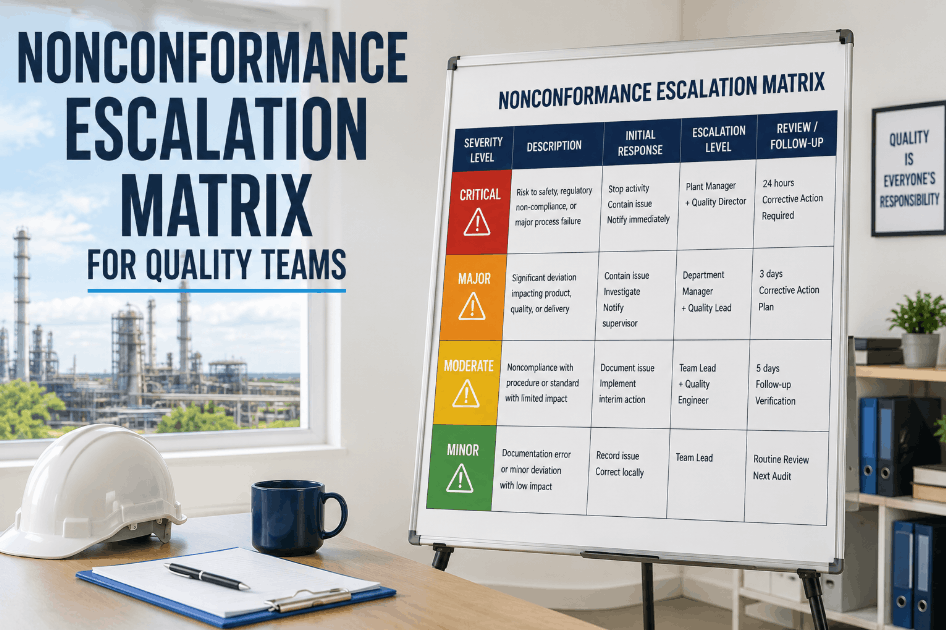
Connect Nonconformance Severity to the Right Escalation Path
Severity-based routing, automated escalation triggers, corrective action tracking, and audit-ready closure records — Oxmaint helps quality teams respond faster and with less confusion at every severity level.
Plant Profile
The Operation: One Quality Team, Three Severity Levels, No Routing Logic
Site Profile
IndustryDiscrete assembly — mixed product lines with QMS requirements
Lines4 assembly lines, 80+ active inspection points
Team9 quality technicians, 2 quality engineers, 1 QA manager
ComplianceISO 9001, customer-specific PPAP and CAPA requirements
Prior systemEmail-based NCR routing, paper forms, shared spreadsheet log
Oxmaint featuresNonconformance Tracking · Severity Classification · Escalation Workflows · CAPA Management · Audit Trail
Baseline Pressure Points
72hrs
Average nonconformance resolution time, with no escalation trigger for overdue findings
48%
Of NCRs misrouted or delayed due to manual severity classification at point of entry
34%
Of corrective actions closed without linked evidence confirming root cause was addressed
Root Cause Analysis
Why Nonconformances Were Stacking Up — And Why the Team Couldn't Clear Them Faster
A structured review of 90 days of NCR logs, email chains, and corrective action records identified four systemic gaps compounding response delays and closure failures faster than any staffing change could resolve. The quality team did not need more people. It needed structured severity logic at point of entry, automated routing to the right responder, and a single system that tracked each nonconformance from detection through evidence-backed closure. Sign Up Free to map your own NCR escalation bottlenecks — or Book a Demo to see how Oxmaint's quality workflow engine applies to your operation.
39%
No Severity Classification at NCR Entry
Every nonconformance entered the same flat queue regardless of production impact, safety implication, or customer exposure risk. Critical findings waited alongside minor deviations with no weighting applied at the point of detection.
28%
Manual Routing Through Email and Spreadsheet
NCRs were forwarded manually via email to the appropriate responder. Routing errors, missed notifications, and inbox prioritization meant high-severity findings were regularly delayed or assigned to the wrong person.
19%
No Escalation Trigger for Overdue Responses
When an NCR exceeded its target response window, no automated alert was generated. QA managers had no real-time visibility into which findings were aging without action until end-of-day log reviews.
14%
CAPA Closure Without Evidence Verification
Corrective actions were marked closed in the spreadsheet without a structured mechanism to confirm that root cause had been addressed and recurrence risk was documented. Audit findings consistently cited incomplete CAPA closure records.
The Solution
How Oxmaint Replaced Manual NCR Routing with Severity-Driven Escalation
The facility deployed Oxmaint without adding headcount or restructuring its quality team. The platform replaced the email-and-spreadsheet NCR workflow with a structured digital system that applied severity classification at the moment of detection, routed each finding to the correct responder automatically, and tracked open nonconformances with escalation triggers when response windows were missed. CAPA records were linked directly to their originating NCR — requiring evidence of root cause resolution before closure was accepted. Book a Demo to see how severity routing is configured for your quality workflow — or Sign Up Free to explore the platform directly.
01
Severity Classification Applied at Point of NCR Entry
Every nonconformance is classified by severity — critical, major, or minor — at the moment it is raised. The classification drives automatic queue prioritization, response time targets, and routing logic. Critical findings surface immediately to the QA manager dashboard without requiring manual escalation.
02
Automated Routing to the Correct Responder
Severity classification triggers automatic assignment to the appropriate quality team member or engineering function. Email routing and manual handoff are eliminated. Every responder logs into a dashboard showing only the findings assigned to them, with target response windows visible.
03
Escalation Alerts When Response Windows Are Missed
Open NCRs display age in real time on the QA manager dashboard. When a finding exceeds its severity-based response window without action, an automated escalation alert is generated — enabling supervisors to intervene before findings age into customer or audit exposure.
04
Evidence-Linked CAPA Closure
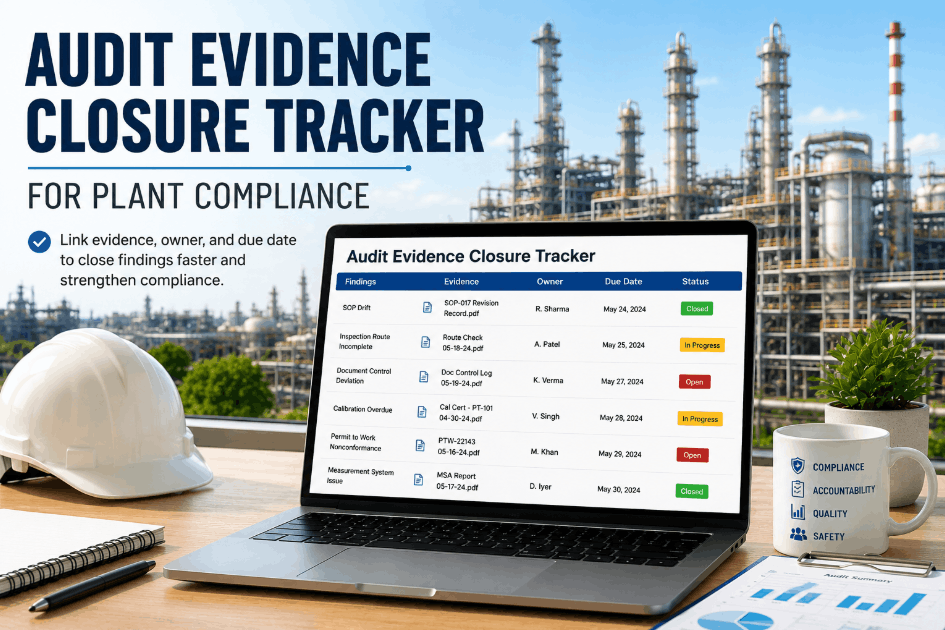
Each corrective action is linked directly to its originating nonconformance. Closure requires attached evidence — photos, measurement records, or process update confirmation — before the CAPA is accepted as complete. QA managers access a full NCR-to-CAPA audit trail without searching across email threads or spreadsheet versions.
Results at 90 Days
What the Numbers Looked Like Three Months After Deployment
61%
Reduction in average nonconformance resolution time — from 72 hrs to 28 hrs
74%
Drop in NCRs misrouted or delayed by manual severity classification
57%
Fewer overdue nonconformances after escalation triggers were activated
100%
CAPA closure documentation rate — evidence required before closure accepted
+38%
First-time CAPA acceptance rate — root cause documentation improved significantly
4.1×
Faster audit evidence retrieval — digital NCR trail replaced spreadsheet search
| Metric |
Before Oxmaint |
90 Days After |
Change |
| Avg NCR resolution time |
72 hrs |
28 hrs |
-61% |
| NCRs misrouted / delayed |
48% |
13% |
-74% |
| Overdue open NCRs (monthly) |
31 |
13 |
-57% |
| CAPA closure with evidence |
66% |
100% |
Full compliance |
| First-time CAPA acceptance |
54% |
75% |
+38% |
| Audit evidence retrieval time |
3.9 hrs avg |
0.9 hrs avg |
-77% |
Key Business Impact
What Structured Nonconformance Escalation Actually Delivers for Quality Teams
"The nonconformance escalation problems I see most consistently in quality operations aren't about finding the issue — they're about what happens in the 90 minutes after it's found. When severity classification is manual and routing depends on someone forwarding an email to the right inbox, you've already introduced delay and decision variability at the worst possible moment. A critical finding sitting in a flat queue next to a cosmetic deviation isn't a workflow failure — it's a system design failure. When severity classification is applied at point of entry and routing happens automatically, the quality team stops spending energy on triage and starts spending it on resolution. That shift — from reactive confusion to structured response — is where the real nonconformance reduction happens, and it doesn't require headcount, it requires sequencing logic."
Daniel Okafor, Quality Systems Advisor
19 years manufacturing quality management · Former quality director, precision components manufacturer · Specialist in NCR systems, CAPA design, and audit readiness programs
NCR Routing · Escalation Automation · CAPA Closure
Replace Email-Based NCR Routing with Severity-Driven Escalation
Severity classification at entry, automatic routing, escalation alerts for overdue findings, and evidence-linked CAPA closure — Oxmaint gives quality teams the structure to respond faster and close cleaner at every nonconformance level.
FAQs
Frequently Asked Questions
How does Oxmaint handle severity-based routing for nonconformances?
Severity is classified at the point of NCR entry — critical, major, or minor — and automatically routes the finding to the correct responder with a defined response window. No manual email routing or triage queue required.
Can Oxmaint trigger escalation alerts when nonconformances are not actioned in time?
Yes. When an open NCR exceeds its severity-based response window without action, an automated escalation alert is sent to the QA manager — enabling intervention before the finding ages into audit or customer exposure.
Does Oxmaint support CAPA management linked to nonconformance records?
Yes. Each CAPA is linked directly to its originating NCR, with evidence attachment required before closure is accepted. The full NCR-to-CAPA trail is available in a searchable audit log.
How quickly can a quality team see results after deploying Oxmaint's NCR workflows?
Most teams see measurable reductions in routing delays and resolution time within 30 days. Full CAPA compliance and audit trail improvements typically stabilise within 60–90 days of structured use.
Is Oxmaint suitable for operations with customer-specific PPAP or CAPA requirements?
Yes. Oxmaint's NCR and CAPA workflows are configurable to match customer-specific response time requirements, evidence standards, and closure criteria — supporting PPAP documentation and audit readiness for ISO 9001 and similar standards.
Every NCR Closed Faster Is Quality Risk You Eliminate
Give Your Quality Team the Escalation Structure to Resolve NCRs Without Confusion
Oxmaint brings severity-based NCR routing, automated escalation alerts, CAPA tracking, and evidence-backed closure to quality teams — with no additional headcount required.