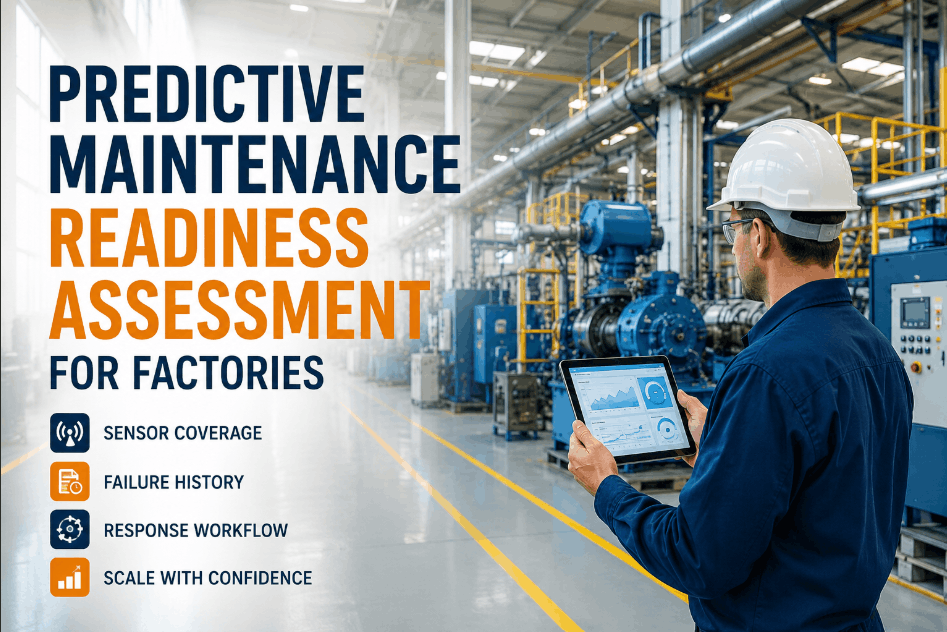
Predictive maintenance readiness assessment for factories is the structured evaluation process that determines whether your facility has the sensor coverage, failure history depth, and response workflow maturity needed to scale condition-based monitoring into a reliable production protection system. Without a readiness assessment, factories invest in predictive maintenance technology only to discover that sparse failure data, poor signal quality, or slow repair cycles prevent the system from delivering fault pattern detection and detection latency reduction at the pace the investment demands. Sign Up Free to see how OxMaint helps factories evaluate predictive maintenance readiness and build the data foundation that turns condition monitoring signals into timely maintenance action. Factories that complete a readiness assessment before scaling predictive maintenance programs report 30–40% faster time-to-value and significantly higher fault detection accuracy than those that deploy technology without assessing foundational readiness first.
Assess Your Predictive Maintenance Readiness with OxMaint
Sensor coverage analysis. Failure history depth review. Response workflow evaluation. Condition monitoring integration. OxMaint gives factories the readiness tools to scale predictive maintenance with confidence.
Why Predictive Maintenance Programs Fail Without Readiness Assessment
Most predictive maintenance failures are not technology failures — they are readiness failures. When factories deploy sensors and analytics without evaluating the quality of their failure history, the coverage of their condition monitoring network, and the responsiveness of their repair workflow, the investment produces alerts that cannot be acted on and data that cannot be interpreted. Book a Demo to see how OxMaint's asset and failure data platform supports predictive maintenance readiness evaluation for your facility.
Insufficient Failure History Depth
Predictive models require sufficient historical failure data to identify fault patterns. Factories with fewer than 12–18 months of structured failure records per asset class cannot train reliable detection models.
Sensor Coverage Gaps on Critical Assets
Condition monitoring deployments that cover only high-visibility assets leave critical production equipment unmonitored — creating blind spots where failure recurrence goes undetected until catastrophic breakdown occurs.
Slow Response Workflow Neutralizes Early Detection
Predictive alerts that cannot generate, approve, and schedule work orders within the detection-to-failure window provide no operational advantage — detection latency must be matched by repair cycle speed.
Poor Signal Quality from Existing Sensors
Vibration and temperature sensors installed on poorly maintained mounts or with incorrect sampling rates produce signal noise that generates false positives — eroding technician trust in the system before it matures.
No Mean Time Between Failure Baseline
Without a documented MTBF baseline per asset class, factories cannot measure whether predictive maintenance is extending mean time between failures — making program value impossible to demonstrate to leadership.
Root Cause Analysis Not Linked to Prediction Model
When root cause analysis findings are not fed back into condition monitoring thresholds, the predictive system cannot learn from confirmed failures — preventing the model accuracy improvement that builds long-term program value.
Predictive Maintenance Readiness Assessment — 6 Evaluation Dimensions
A complete readiness assessment evaluates six dimensions — from failure data quality through response workflow speed — before predictive maintenance technology is scaled. Sign Up Free to use OxMaint's data analytics and condition monitoring modules as your readiness evaluation platform.
| Readiness Dimension |
What It Evaluates |
OxMaint Capability |
Readiness Indicator |
| Failure History Depth |
Months of structured failure records per asset class |
Work Order Failure Code Analytics |
12+ months per critical asset class |
| Sensor Coverage Mapping |
Percentage of critical assets with active condition monitoring |
Asset Register + PLC Integration |
90%+ critical asset coverage |
| Signal Quality Assessment |
Noise levels, sampling rates, mount integrity per sensor |
Condition Monitoring Dashboard |
False positive rate below 15% |
| MTBF Baseline Availability |
Documented mean time between failures per asset class |
Reliability Analytics Module |
MTBF baseline defined for all critical assets |
| Response Workflow Speed |
Time from alert detection to work order activation and job start |
Work Order Workflow Engine |
Alert-to-action under 4 hours for critical alerts |
| Root Cause Feedback Loop |
RCA findings feeding back to condition monitoring thresholds |
Failure Analysis + Threshold Config |
All confirmed failures generate threshold review |
How OxMaint Supports Predictive Maintenance Readiness in Factories
01
Failure History and Fault Pattern Analytics
OxMaint accumulates structured failure records per asset — with failure codes, component-level detail, and repair outcomes — building the history depth that predictive models require. Fault pattern analysis across the asset fleet identifies which equipment classes have sufficient failure history to support reliable condition-based alerting.
Book a Demo to evaluate your failure history depth in OxMaint.
02
Condition Monitoring Integration and Signal Management
OxMaint integrates with vibration analyzers, thermal sensors, and PLC condition monitoring outputs — displaying trend data per asset alongside work order history. Signal quality issues are visible in the platform before they produce false positive alerts that erode technician trust in the predictive program.
03
Alert-to-Work Order Response Workflow
OxMaint connects condition monitoring alerts directly to automated work order creation — with priority routing, technician assignment, and parts availability checking built into the response workflow. This closes the detection-to-action gap that determines whether predictive maintenance actually prevents failures in a factory environment.
Sign Up Free to configure predictive alert response workflows for your facility.
04
MTBF Trending and Health Scoring
OxMaint's reliability analytics module tracks MTBF trends per asset over time — providing the baseline measurement that allows maintenance teams to quantify predictive maintenance program impact on failure frequency reduction and inspection cadence optimization.
Predictive Maintenance Readiness Results in Factory Operations
The following examples show how factories used OxMaint's failure analytics and condition monitoring platform to evaluate readiness, close coverage gaps, and scale predictive maintenance programs with measurable outcomes.
Heavy Manufacturing
Fault Pattern Detection Accuracy Improved to 87%
ChallengeCondition monitoring alerts generating 40% false positives — technicians ignoring alerts within 3 months of deployment
AppliedOxMaint failure history review revealed insufficient fault records; 6-month data accumulation phase before threshold configuration
ResultFalse positive rate reduced to 11%; fault detection accuracy reached 87% after history depth reached 18 months
Steel Processing
Response Time from Alert to Job Start: 6.5hr to 1.8hr
ChallengePredictive alerts generated but no automated work order pathway — alerts emailed to supervisors who manually created jobs
AppliedOxMaint alert-to-work order automation with priority routing and on-call technician notification
ResultDetection latency reduced from 6.5 hours to 1.8 hours; 3 bearing failures prevented in first quarter
Automotive Stamping
MTBF Extended 34% on Critical Press Lines
ChallengeNo MTBF baseline documented — unable to demonstrate predictive maintenance ROI to capital committee
AppliedOxMaint MTBF baseline established per press line; 12-month post-program comparison analysis
ResultMTBF extended 34% on critical press lines; ROI case approved for sensor expansion to secondary lines
Pharmaceutical Packaging
Inspection Cadence Optimized by Condition Data
ChallengeTime-based inspection schedules generating excessive technician hours on healthy equipment
AppliedOxMaint health scoring replaced fixed inspection intervals with condition-triggered review thresholds
ResultInspection labor reduced 28%; no increase in unplanned failures during 12-month transition period
Step-by-Step: Conducting a Predictive Maintenance Readiness Assessment
Step 1
Audit Failure History Depth Per Asset Class
Review structured failure records in OxMaint for each critical asset class — counting months of failure code history, average failures per period, and root cause documentation completeness. Asset classes with fewer than 12 months of structured history need data accumulation before predictive model configuration.
Book a Demo to run a failure history audit for your facility.
↓
Step 2
Map Sensor Coverage Against Critical Asset Register
Compare your active condition monitoring sensor list against your criticality-ranked asset register in OxMaint. Identify coverage gaps where critical assets have no vibration, temperature, or other condition signal — these are the highest-priority gaps for predictive maintenance expansion.
↓
Step 3
Evaluate Signal Quality and False Positive Rate
Review existing sensor outputs in OxMaint's condition monitoring dashboard — flagging sensors with high noise levels, incorrect sampling rates, or mounting issues that produce false positive alerts. Signal quality remediation before program expansion prevents the technician trust erosion that kills predictive maintenance adoption.
Sign Up Free to activate condition monitoring dashboards for your facility.
↓
Step 4
Measure Alert-to-Action Response Time
Time the current workflow from condition monitoring alert generation to work order creation, technician assignment, and job start. Any detection-to-action cycle exceeding 4 hours for critical assets means the response workflow must be redesigned before predictive monitoring adds operational value.
↓
Step 5
Establish MTBF Baselines and Scale Program
Document MTBF baselines per critical asset class in OxMaint before expanding your predictive maintenance program. These baselines enable the before/after comparison analysis that demonstrates program ROI and secures leadership support for further sensor investment.
Sign Up Free to establish MTBF baselines across your production asset fleet.
Key KPIs for Predictive Maintenance Readiness and Program Performance
These metrics allow factory maintenance leaders to evaluate both readiness before program launch and performance after scaling — providing the measurement framework that justifies continued predictive maintenance investment. Book a Demo to see how OxMaint tracks predictive maintenance KPIs across your production fleet.
Failure History Depth (Months)
Average months of structured failure records per critical asset class. Readiness threshold: 12 months minimum for stable fault pattern identification across production equipment.
Sensor Coverage Rate
Percentage of criticality-ranked assets with active condition monitoring coverage. Target 90%+ for production-critical equipment before scaling predictive analytics investment.
Detection Latency
Time from condition signal threshold crossing to maintenance team awareness and work order activation. The primary indicator of whether the response workflow can capture the value that condition monitoring provides.
False Positive Alert Rate
Percentage of condition monitoring alerts that do not correspond to a confirmed developing fault. Rates above 20% signal quality issues that must be resolved before technician adoption is achievable.
MTBF Trend (Post-Program)
Change in mean time between failures per asset class after predictive maintenance program activation. The primary outcome metric for demonstrating program effectiveness to factory leadership and finance teams.
Failure Recurrence Rate
Percentage of assets experiencing repeat failures within 90 days of repair. High recurrence rates indicate root cause feedback loops are not linking inspection findings back to condition monitoring thresholds.
Evaluate Your Predictive Maintenance Readiness with OxMaint
Failure history analytics. Sensor coverage mapping. Alert response workflow automation. MTBF trending. OxMaint gives factories the foundation for predictive maintenance programs that deliver measurable results.
Frequently Asked Questions
What is a predictive maintenance readiness assessment for factories?
It is a structured evaluation of sensor coverage, failure history depth, signal quality, response workflow speed, and MTBF baseline availability — determining whether a factory's data and operational infrastructure can support reliable condition-based maintenance at scale.
How much failure history is needed before deploying predictive maintenance?
Most factories need a minimum of 12–18 months of structured failure records per critical asset class before fault pattern models produce reliable detection accuracy above 80%.
What is detection latency and why does it matter?
Detection latency is the time between a condition alert and the start of corrective maintenance. If this exceeds the detection-to-failure window, predictive monitoring provides no advantage over reactive repair.
How does OxMaint support predictive maintenance readiness?
OxMaint accumulates structured failure history, integrates condition monitoring signals, automates alert-to-work order workflows, and tracks MTBF trends — providing the data and response infrastructure predictive programs require.
What KPIs indicate predictive maintenance program effectiveness?
Core KPIs include MTBF trend improvement, false positive alert rate, detection latency, sensor coverage rate, failure recurrence rate, and failure history depth — all trackable in OxMaint's analytics module.
What causes high false positive rates in predictive maintenance?
Most false positives originate from poor sensor mounting, incorrect sampling rates, or insufficient failure history to set accurate detection thresholds — each requiring different remediation approaches before program scaling.
Give Your Factory the Predictive Maintenance Foundation It Needs
OxMaint delivers failure history analytics, sensor integration, alert response automation, and reliability trending — purpose-built for factories scaling predictive maintenance from readiness assessment to full program deployment.