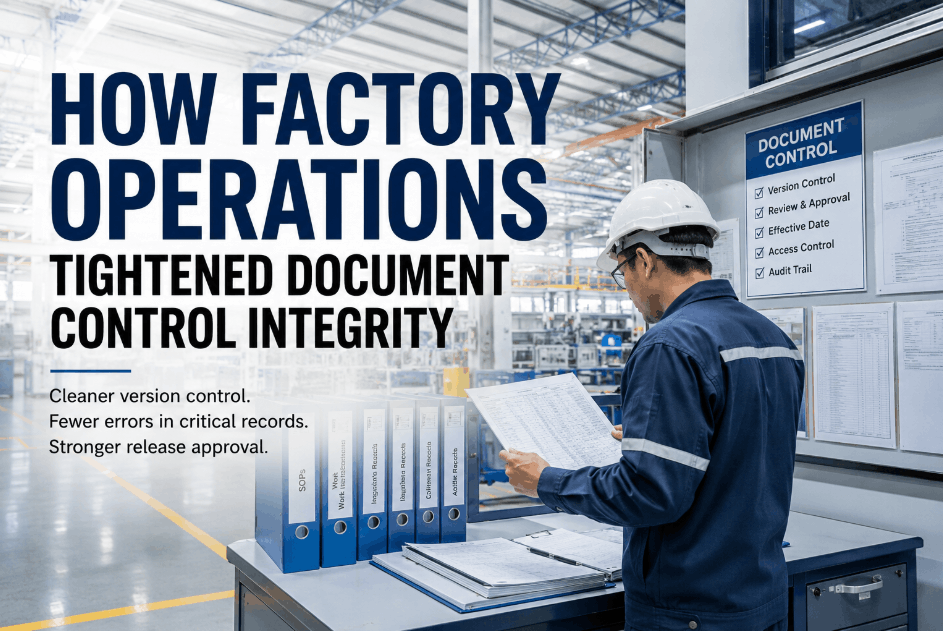
Document control integrity is one of those operational gaps that accumulates quietly — until a regulatory audit, a nonconformance event, or a failed quality review makes it suddenly visible. A mid-size factory running three production lines found itself with a persistent documentation problem: critical records existed, but version control was inconsistent, release approvals were informal, and no one could confirm that technicians in the field were referencing the current procedure. The document system existed. The records were populated. But there was no enforced revision cycle, no digital approval chain, and no connection between document release status and the people executing work against those records. If your plant is managing critical documents with disconnected version control and informal release processes, Sign Up Free to see how Oxmaint structures document control from draft to field-verified closure — or Book a Demo with an operations specialist.
Document Integrity · Version Control · Release Approval
Connect Document Control to the People Executing Work Against It
Revision cycle enforcement, digital approval chains, SOP drift detection, and audit-ready record completeness — OxMaint helps factory operations keep critical documents accurate, current, and verifiably in use.
Plant Profile
The Operation: Three Production Lines, a Fragmented Document System, and No Approval Enforcement
Plant Overview
IndustryDiscrete manufacturing — three active production lines, regulated quality environment
Document Volume180+ active document records including SOPs, inspection procedures, and calibration records
Team22 operations and maintenance staff, 1 quality coordinator, 2 supervisors
Prior SystemShared drive storage, manual version labels, informal email-based approval routing
Oxmaint FeaturesDocument Control · Version Management · Release Approval Workflow · Audit Trail · SOP Compliance Tracking · Nonconformance Linkage · Calibration Traceability
Baseline Pressure Points
44%
Of quality audit findings traced back to staff operating against superseded or unapproved document versions
2.8×
Time required to locate and verify current approved document versions versus target during compliance review
31%
Of critical SOPs had no traceable release approval record — release history was informal or undocumented
Root Cause Analysis
Why Document Control Kept Failing — And Why Version Errors Kept Reaching the Floor
A structured review of 90 days of nonconformance records and audit findings identified four structural gaps driving document integrity failures. The plant was not short on documentation — procedures, work instructions, and calibration records all existed. The problem was structural: no enforced revision cycle, no digital approval chain, no mechanism to retire superseded versions, and no connection between document release status and field execution. Sign Up Free to identify your own document control gaps — or Book a Demo to see how Oxmaint applies version control structure to your document catalog.
40%
No Enforced Revision Cycle — Document Updates Were Informal
Document revisions were initiated by email or verbal instruction with no system-tracked review cycle. Updated versions coexisted with outdated ones in shared storage, and staff had no reliable way to identify which version was current and approved for use.
28%
Release Approvals Not Captured as Traceable Records
Approval routing was handled through email threads that were not linked to the document record. When auditors requested release history, the approval chain was either absent, incomplete, or required manual reconstruction from inbox searches.
20%
Superseded Documents Not Retired From Active Use
Old document versions remained accessible in shared drives after revisions were issued. Staff on the floor frequently pulled the most recently accessed version rather than the most recently approved — creating SOP drift and nonconformance risk without anyone recognizing it as a control failure.
12%
No Connection Between Documents and Work Execution
Work orders and inspection records referenced documents by name, not by version. There was no mechanism to confirm that the procedure followed during a job matched the document version in effect at the time — leaving calibration traceability and permit-to-work records without verifiable document linkage.
The Solution
How Oxmaint Tightened Document Control Integrity Across All Three Production Lines
The factory deployed Oxmaint without restructuring its quality team or migrating to a new document format. The platform replaced shared drive storage with a controlled document environment that enforced revision cycles, routed release approvals through a traceable digital workflow, and automatically retired superseded versions when new releases were approved. Work orders and inspection records were linked to specific document versions — ensuring field execution was always tied to the approved procedure in effect at the time. Nonconformance records were connected to the document review cycle, creating a closed loop between quality findings and procedure updates. Book a Demo to see how the platform brings version control discipline to your document management environment.
01
Enforced Revision Cycles With System-Tracked Review Status
Each document was assigned a revision interval calibrated to its criticality class. Revision triggers were system-generated and tracked — ensuring that procedure reviews happened on schedule and that review status was visible to quality coordinators without manual follow-up.
02
Digital Approval Workflow With Traceable Release Records
Release approvals were routed through a structured digital workflow that captured approver identity, timestamp, and review comments against the document record. Every released document carried a complete, auditor-accessible approval chain — eliminating the need to reconstruct release history from email archives.
03
Automatic Supersession and Version Retirement
When a new document version was released and approved, prior versions were automatically marked superseded and removed from active use queues. Staff accessing documents through Oxmaint always reached the current approved version — eliminating the SOP drift that resulted from shared drive version coexistence.
04
Work Order and Inspection Linkage to Specific Document Versions
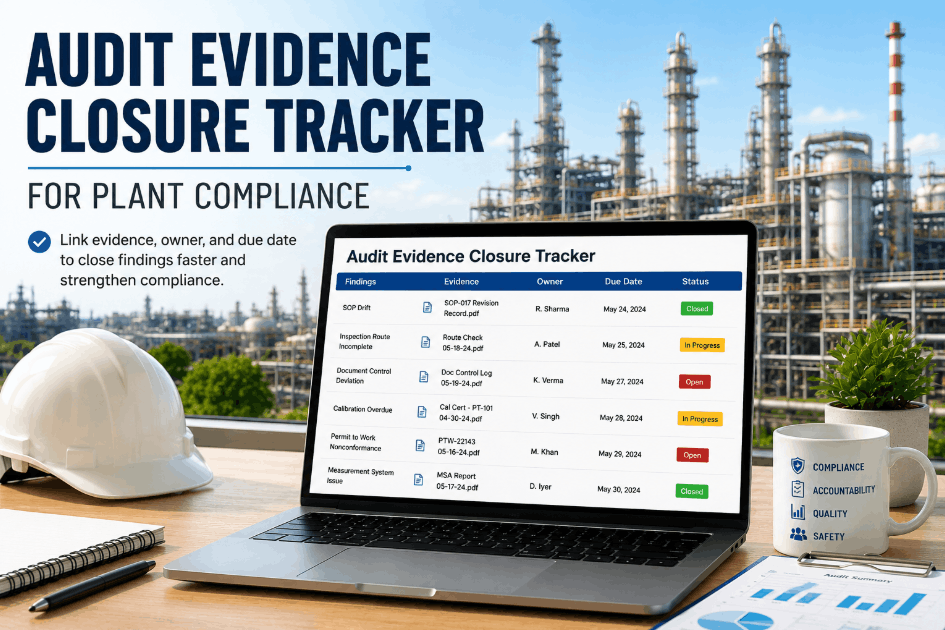
Work orders, inspection records, and permit-to-work entries were linked to the document version in effect at the time of execution. Calibration records carried traceable document references — giving auditors a verifiable connection between field activity and the approved procedure that governed it.
Results at 90 Days
What Document Integrity Numbers Looked Like Three Months After Deployment
79%
Drop in audit findings linked to superseded or unapproved document versions — from 44% to 9%
94%
Reduction in SOPs accessible to field staff without a traceable release approval record
71%
Faster document version verification during compliance review — from 2.8× to 0.9× target time
+48%
Increase in work orders linked to specific approved document versions at execution
100%
Release approval documentation compliance — up from ~69% under manual routing system
3.9×
ROI on platform cost within 90 days from reduced nonconformance rework and audit preparation
| Metric |
Before Oxmaint |
90 Days After |
Change |
| Audit findings from document version errors |
44% of findings |
9% of findings |
-79% |
| SOPs without traceable release approval |
31% of catalog |
2% of catalog |
-94% |
| Document version verification time |
2.8× target |
0.9× target |
-71% |
| Work orders with document version linkage |
21% |
69% |
+48% |
| Release approval documentation rate |
~69% (manual) |
100% (digital) |
Full compliance |
| Audit preparation time (document review) |
22 hrs avg |
7 hrs avg |
-68% |
Key Business Impact
What Closing Document Control Gaps Means for Quality-Regulated Factory Operations
"The factories I've seen with the most persistent document control problems almost always have the same pattern: the documentation exists, but the system around it is entirely manual. No one is enforcing revision schedules, approvals live in email threads, and the shared drive has six versions of the same procedure with no clear indication of which one is current. The consequence isn't just audit exposure — it's SOP drift that shows up as nonconformance events and quality escapes that take weeks to trace back to their root cause. The fix is not more documentation. It's a system that makes the approved version the only accessible version, that captures the approval chain as a record, and that connects what people are working against to what was actually in effect when they did the work. That's when document control starts functioning as an actual control, not just a filing exercise."
Danielle Wirth, Quality Systems and Document Control Advisor
16 years discrete manufacturing quality programs · Former quality systems manager, multi-line production facilities · Specialist in document control architecture, SOP compliance, and regulatory audit preparation
Version Integrity · Approval Traceability · Regulatory Readiness
Replace Informal Document Routing With Controlled Version Management
Revision cycle enforcement, digital approval workflows, automatic version supersession, and work-execution document linkage — OxMaint gives factory operations the document control structure that holds up under audit.
FAQs
Frequently Asked Questions
How does Oxmaint improve document control integrity for factory operations?
Oxmaint enforces revision cycles, routes approvals through a traceable digital workflow, and automatically retires superseded versions. Staff always access the current approved document — version errors reaching the floor are eliminated by design.
Can Oxmaint capture release approval records with a full audit trail?
Yes. Every document release captures approver identity, timestamp, and review comments as a permanent record linked to the document. Auditors can access the complete approval chain without manual reconstruction from email archives.
Does Oxmaint link work orders and inspections to specific document versions?
Yes. Work orders, inspection records, and permit-to-work entries are linked to the document version in effect at execution time — providing calibration traceability and defensible audit evidence for every work record.
How does Oxmaint handle SOP drift and nonconformance linkage?
Nonconformance records can be linked to the document review cycle in Oxmaint. Quality findings trigger document review flags — creating a closed loop between field incidents and procedure updates that prevents drift from compounding.
How quickly does document control compliance improve after deploying Oxmaint?
Most plants achieve full release approval documentation compliance within the first document revision cycle. Version error reduction in the field is typically measurable within 30 days of deployment.
Every Approved Version in Use Is a Nonconformance Prevented
Give Your Factory the Document Control Structure It Needs
Oxmaint brings enforced revision cycles, traceable approval workflows, automatic version management, and work-execution document linkage to factory operations — with no additional quality headcount required.