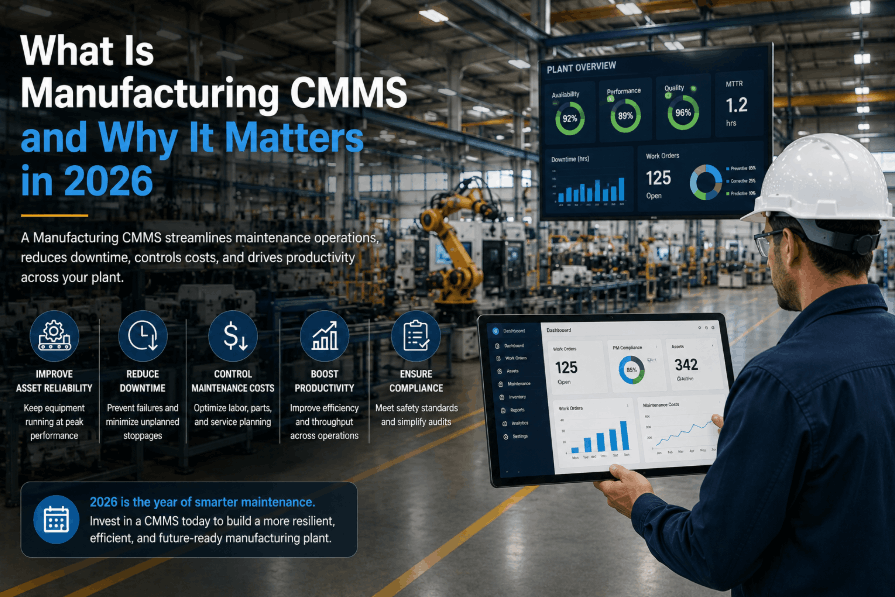
A Computerized Maintenance Management System — CMMS — is the operational backbone of a modern manufacturing plant's maintenance program. It centralizes every asset record, work order, PM schedule, spare parts inventory, and downtime event into one connected platform, replacing spreadsheets, whiteboards, and paper-based systems that hide critical information from decision-makers. In 2026, manufacturing CMMS has evolved far beyond basic work order tracking: today's platforms integrate IoT sensor data, deliver AI-powered failure predictions, automate PM scheduling, and provide real-time OEE visibility across multi-site operations. Sign Up Free to see how OxMaint's manufacturing CMMS connects your assets, technicians, and maintenance data into one actionable platform. Plants without a CMMS — or using outdated, disconnected systems — face a compounding disadvantage: reactive maintenance costs 3–5 times more than planned maintenance, PM compliance is untrackable without system support, and equipment failure patterns remain invisible until they cause production crises. Book a Demo to see why leading manufacturers credit their CMMS as the single highest-ROI technology investment in their maintenance transformation. The question in 2026 is no longer whether a manufacturing plant needs a CMMS — it's whether their current system is sophisticated enough to support predictive maintenance, mobile-first technician workflows, and data-driven reliability improvement. Sign Up Free to evaluate OxMaint's capabilities against your plant's current maintenance maturity level.
Manufacturing CMMS Platform
The CMMS Built for How Manufacturing Plants Actually Operate
OxMaint delivers end-to-end manufacturing CMMS — asset management, preventive maintenance, predictive analytics, mobile work orders, and downtime tracking — in one platform your entire team will actually use.
What Is a Manufacturing CMMS? Core Capabilities Explained
Six Functions That Define a Production-Grade CMMS Platform in 2026
Asset Registry and Hierarchy
A
A manufacturing CMMS maintains a complete digital record of every plant asset — equipment specifications, OEM documentation, failure history, warranty status, and maintenance costs. Asset hierarchies connect machines to production lines to facilities, enabling plant managers to understand exactly which assets drive the most downtime and cost.
Preventive Maintenance Scheduling
B
PM schedules in a CMMS are automated and condition-aware — triggered by calendar intervals, meter readings, operating hours, or sensor thresholds. Technicians receive task lists with step-by-step procedures, required parts, and estimated duration. PM completion rates above 90% are achievable with CMMS-managed scheduling versus 60–70% without system support.
Work Order Management
C
Every maintenance task — reactive, preventive, or predictive — flows through CMMS work orders. Assignments are made based on technician skill and availability, parts are reserved automatically, and completion data (actual time, root cause, resolution notes) is captured for future analysis. Work order data is the primary source of maintenance intelligence over time.
Spare Parts and Inventory Management
D
CMMS tracks spare parts inventory in real time — linking parts to assets, triggering reorder alerts at minimum stock levels, and capturing parts consumed per work order. Plants using CMMS for parts management reduce stockouts by 60–80% and eliminate excessive safety stock that ties up working capital on parts that never fail.
Downtime Tracking and Root Cause Analysis
E
Manufacturing CMMS captures every downtime event with timestamp, duration, affected asset, root cause category, and corrective action. This data powers MTBF and MTTR calculations, identifies recurring failure modes, and enables proactive investment in prevention. Plants without structured downtime tracking have no basis for improvement prioritization.
Predictive Maintenance and IoT Integration
F
In 2026, leading manufacturing CMMS platforms ingest sensor data from vibration monitors, thermal cameras, oil analysis systems, and IoT gateways — automatically creating work orders when equipment condition crosses alert thresholds. Predictive maintenance via CMMS reduces unplanned failures by 70–80% on monitored assets.
3–5×
higher cost of reactive maintenance versus planned maintenance managed through a CMMS
25–35%
reduction in unplanned downtime within 12 months of structured CMMS implementation
10–25%
improvement in OEE for plants transitioning from reactive to CMMS-managed preventive maintenance
Why Manufacturing CMMS Matters in 2026: Six Business Realities
The Competitive and Operational Case for CMMS Investment This Year
1
Maintenance Costs Are a Controllable P&L Line
Maintenance spend in manufacturing represents 15–40% of total production cost at most facilities. Without a CMMS, this spend is invisible, unoptimized, and reactive. With a CMMS, every maintenance dollar is tracked against assets, outcomes are measured, and investment is directed to the highest-return interventions — turning maintenance from a cost center into a competitive advantage.
Book a Demo to see OxMaint's maintenance cost analytics.
2
Labor Shortages Demand Technician Efficiency
The skilled trades shortage is reshaping manufacturing maintenance in 2026. Plants cannot hire their way to better reliability — they need to make existing technicians more effective. CMMS eliminates wasted time searching for asset information, chasing parts, and deciphering incomplete work histories, delivering 20–30% productivity gains from the same workforce headcount.
3
Customer Delivery Commitments Require Production Reliability
Just-in-time supply chains have zero tolerance for unplanned downtime. A single 8-hour equipment failure can miss a customer shipment, trigger contractual penalties, and damage long-term relationships. CMMS-managed preventive maintenance reduces the frequency and severity of unplanned failures, protecting on-time delivery performance as a measurable business outcome.
4
Compliance and Audit Requirements Are Intensifying
ISO 9001, FDA GMP, OSHA PSM, and customer audit requirements increasingly mandate documented maintenance records, calibration logs, and inspection histories. A CMMS provides audit-ready documentation automatically — every PM completion, corrective action, and inspection result is timestamped and traceable. Compliance through manual recordkeeping is no longer scalable.
Sign Up Free to explore OxMaint's compliance documentation features.
5
AI and Predictive Maintenance Are Now Accessible
In 2026, predictive maintenance capabilities that once required enterprise-scale investment are embedded in cloud CMMS platforms at accessible price points. Machine learning failure prediction, anomaly detection from sensor data, and AI-recommended maintenance actions are now standard CMMS features — not expensive add-ons requiring data science teams.
6
Data-Driven Maintenance Is Now a Baseline Expectation
Plant managers, operations directors, and CFOs now expect maintenance KPIs — MTBF, MTTR, PM compliance rate, downtime cost — to be available on demand, not compiled in quarterly spreadsheets. CMMS delivers real-time maintenance dashboards that align maintenance performance with business objectives and enable proactive resource decisions.
Book a Demo to see OxMaint's executive maintenance dashboards live.
Manufacturing CMMS Implementation Checklist: Getting Started Right
What a Successful CMMS Deployment Requires in 2026
- Asset registry built with criticality classifications
- PM task lists written per asset type and OEM specs
- Technician roles and permissions defined
- Spare parts inventory catalogued with reorder points
- PM schedules loaded and activated in system
- Work order approval workflows configured
- Downtime reason codes defined and standardized
- Mobile access deployed for all floor technicians
- MTBF and MTTR baselines established by asset
- PM compliance rate dashboard configured
- Downtime cost reporting linked to production data
- Weekly maintenance review cadence established
- IoT sensor integrations connected for critical assets
- Predictive maintenance alerts calibrated and tested
- ERP integration active for procurement and cost
- Recurring failure analysis running monthly
CMMS ROI in Manufacturing: What Plants Measure and What They Achieve
Quantifying the Return on Manufacturing CMMS Investment
Unplanned Downtime Reduction
Downtime hours eliminated × production value per hour × gross margin
Example: 120 downtime hours saved annually × $4,000/hr production value = $480,000 recovered
Maintenance Labor Efficiency
Productivity gain per technician × number of technicians × fully-loaded hourly rate
Example: 20% efficiency gain × 8 technicians × $55/hr × 2,000 hrs = $176,000 annual value
Parts and Inventory Optimization
Inventory reduction (excess parts eliminated) + emergency shipping costs avoided
Example: $40,000 excess inventory released + $18,000 rush shipping avoided = $58,000 recovered
Total First-Year CMMS ROI
Total savings ÷ CMMS annual subscription cost = ROI multiple
Example: $714,000 total savings ÷ $15,000 annual CMMS cost = 47× first-year ROI
CMMS for Manufacturing in 2026
Your Plant's Maintenance Transformation Starts With the Right CMMS
OxMaint gives manufacturing plants the complete CMMS foundation — asset management, PM automation, predictive maintenance, and real-time analytics — to reduce downtime, control costs, and build a reliable production operation.
Frequently Asked Questions: Manufacturing CMMS in 2026
What is a manufacturing CMMS and what does it do?
A manufacturing CMMS is a software platform that manages all maintenance operations — assets, work orders, PM schedules, spare parts, downtime events, and compliance records — in one connected system. It replaces disconnected spreadsheets and paper-based systems with real-time data that drives proactive, cost-effective maintenance decisions.
How is CMMS different from ERP maintenance modules?
CMMS is purpose-built for maintenance operations — with mobile-first technician interfaces, PM scheduling logic, condition monitoring integration, and downtime analytics. ERP maintenance modules are designed for financial tracking, not operational execution. Most plants use both: CMMS for operations, ERP for procurement and accounting integration.
How long does it take to implement a manufacturing CMMS?
Cloud CMMS platforms like OxMaint deploy in 1–4 weeks for most manufacturing plants. Core configuration includes asset setup, PM schedule loading, and user onboarding. Advanced integrations (IoT sensors, ERP connections) add 2–6 weeks depending on complexity. Sign Up Free to start your deployment today.
What makes OxMaint different from other manufacturing CMMS options?
OxMaint is built specifically for manufacturing operations — with AI-powered failure prediction, IoT-ready condition monitoring, mobile-first technician workflows, and real-time downtime analytics. It combines ease of use with production-grade functionality, delivering value within the first week of deployment without requiring dedicated IT resources.
What CMMS KPIs should manufacturing plants track?
Core CMMS KPIs include: MTBF (mean time between failures), MTTR (mean time to repair), PM compliance rate, planned vs unplanned maintenance ratio, downtime cost per asset, and parts stockout frequency. Book a Demo to see how OxMaint calculates and presents all these KPIs automatically.
Is a CMMS worth the investment for smaller manufacturing plants?
Yes. Even 20–50 person manufacturing plants benefit significantly from CMMS — eliminating reactive maintenance, capturing asset history, and reducing emergency repair costs. Modern cloud CMMS platforms start at accessible price points and deliver ROI within the first quarter through reduced downtime and eliminated emergency parts orders.
Start Your CMMS Journey Today
Manufacturing Reliability Begins With Better Maintenance Data.
OxMaint's manufacturing CMMS is the fastest path from reactive maintenance chaos to planned, measurable, continuously improving asset reliability in 2026.

.png)

.png)
.png)

